From Genesis to Revelation: The One Story – The Golden Thread that Explains Everything – Part 26
By Andre Eksteen
The day after the miracle of the bread, the air lay heavy over Galilee. People were still talking about the fish and the loaves, but in the spirit something had shifted. The Light had begun to move, and the powers of the air had drawn together. For when the Son of God broke the bread, He broke the yoke of lack and fear — and the enemy had to respond.
He now walks through towns and fields, and wherever He goes, unrest stirs in the unseen realm. The Pharisees send spies, the Sadducees whisper, and the Romans watch from a distance. They see a young man in sandals, but the invisible realm sees the Creator walking again in His creation. The Son of the woman, the Light made flesh, is reclaiming ground that has been lost since Eden.
The sick come in crowds. People bring them on beds, in their arms, on donkeys. They believe He heals — and He does. But more is happening. He touches a blind man, and the spirit of darkness flees. He touches a deaf man, and the spirit of muteness screams and comes out. He commands a man who has lain paralysed for years and says: “Stand up.” The body obeys, and so does the spirit that held him captive. For every sickness has a root, and that root does not lie in the flesh, but in the spirit.
The Bible says: “He healed them all.” (Matthew 8:16) But note what is added: “and He cast out the spirits with a word.” Healing and deliverance were never separated. He heals because He conquers; He delivers because He reigns. And that is exactly why the world hated Him — because when He addresses sickness, He also exposes the power behind it.
The spirits of the air had long ruled over people through fear, sickness, and guilt. They made people believe that suffering always comes from God, that misery is punishment, that the Lord is far away. But now there stands a Man who addresses them with authority — not as a priest, not as a prophet, but as the One who created them. He simply says: “Go,” and they go.
And yet, centuries later, the church now preaches the very same lie He destroyed back then. They say that everything — even pain, cancer, famine, and death — comes from God’s hand. They make Him the scapegoat for everything Satan does. They say: “The Lord gave and the Lord took away,” without understanding that these were the words of a man in confusion, not a revelation of God’s heart. They have forgotten that Jesus Himself said who the source of suffering is: “The thief comes only to steal, to kill, and to destroy; I have come that they may have life, and have it abundantly.” (John 10:10)
Sickness, disaster, hardship, and destruction do not come from God. They are the work of the one who rose up against Him, the ancient serpent who has tried to keep his grip on humanity since Eden. Jesus came to break exactly that. He addressed every sickness, every pain, every demonic bondage to show: this is not My Father’s work — this is My enemy’s.
And when He had shown this, He gave the same authority to His followers. “And He called to Him His twelve disciples and gave them authority over unclean spirits, to cast them out, and to heal every disease and every sickness.” (Matthew 10:1) He did not come only to overcome darkness — He came to share His victory. The authority with which He commanded, He gave to ordinary people. Not priests, not kings, not academics — fishermen, tax collectors, women, young men, and even children.
“I give you authority,” He says, “to trample on snakes and scorpions, and over all the power of the enemy; and nothing shall by any means harm you.” (Luke 10:19) This is not a symbolic verse — it is a military order. He transferred heaven’s authority over hell to people who believe. And He added: “Heal the sick, cleanse the lepers, raise the dead, cast out demons; freely you have received, freely give.” (Matthew 10:8)
He did not merely lift the yoke of fear, guilt, and sickness — He destroyed it. He realigned humanity with the original purpose of creation: that flesh should once again become a temple of the Spirit. That is why He said: “Whoever believes in Me will do the works that I do, and greater than these.” (John 14:12) The church has always tried to soften this as metaphor, because it cannot explain why it no longer sees it happening.
The truth is simple: the power did not disappear; faith did. Jesus never took back His authority — the church dropped it when she became satisfied with theory instead of obedience. Today people discuss the things they were supposed to do. They organise seminars about the Spirit, but have no Spirit. They write books about healing, but no longer pray for the sick. They hold conferences on spiritual warfare, but flee from conflict. They call it wisdom, but it is unbelief dressed up nicely.
The modern church has created a gospel that is safe for the devil. A gospel without power, without fire, without authority. They say: “God sometimes sends sickness to keep us humble,” but the Word says He healed all who were oppressed by the devil. (Acts 10:38) They say: “Maybe it is not His will to heal,” but Jesus never told anyone: “Stay sick, it is for your spiritual growth.” They say: “God uses pain to teach,” but He uses the Spirit, not sickness.
It is time for people to stop attributing Satan’s work to God. Every time a believer says, “God sent this,” he places the enemy’s crown on the head of his Father. It is blasphemy, even when done in the name of theology. The cross did not only bear sin, but sickness as well. “Surely He has borne our griefs and carried our sorrows.” (Isaiah 53:4) And yet millions live as if this is only poetry, not truth.
The church has forgotten who she is meant to be. She is supposed to be an army that drives out sickness, commands demons, and sets souls free. But she has become an audience that sits, listens, and forgets. Jesus did not start a theological institution — He established a kingdom. He did not recruit disciples to give lectures — He raised soldiers to destroy the works of the enemy.
And yet, if someone today does the same things He did, the church calls him a heretic. They say: “It is dangerous to preach like this.” They say: “You think you are like Jesus.” No — He Himself said I must be like Him. He Himself said I must do what He did. That is not arrogance; it is obedience.
But obedience has long been replaced by excuses. The modern believer reads about power, but believes in weakness. He reads about victory, but lives in fear. He reads about the Light, but calls darkness “part of God’s plan”. And so the church has exchanged her sword for a candle — strong enough to give light inside a building, but not strong enough to wage war in the world.
He did not come to show what people cannot do — He came to show what people should do when they are filled with the Spirit. He broke the curse, restored authority, and said: “I give you the keys of the kingdom of heaven; whatever you bind on earth will be bound in heaven, and whatever you loose on earth will be loosed in heaven.” (Matthew 16:19)
This is the true gospel — not a message of suffering, but of victory. Not a call to passivity, but to power. Not a religious tradition, but a spiritual war against everything that steals, kills, and destroys.
And this is the war we are living in now. The cross has won it, but the Body of Christ must carry it out. Heaven is not waiting for God to speak again — He has already spoken. He is waiting for His people to believe again, to command again, to live again as people who know: the darkness has already been broken.
And then came the storm.
He says to His disciples: “Let us go over to the other side.” They get into the boat, tired but obedient. The sea is calm at first, but then the wind rises — first a breeze, then a wall of water. The waves crash, the boat fills, and the men cry out. They are fishermen, not afraid of water, but this storm is different. It does not come from the north or the south — it comes from the depths. A living rage. This is not weather; it is resistance.
For remember: the Hebrew world understood — the sea is not just water. The sea is the place of the abyss, the dwelling of Leviathan, the symbol of chaos and of the powers that oppose God. When Jesus said, “Let us go over,” He did not mean only to the other side of the lake — He was entering the enemy’s territory. And the storm was their response.
He sleeps. The flesh rests, but the Spirit watches. The disciples cry out: “Lord, do You not care that we are perishing?” He stands up, looks into the darkness, and simply says: “Be silent. Be still.” And immediately it becomes calm. Not only the wind — but the spirit behind it. The water becomes smooth like glass, and the silence is unnatural. It is the silence of authority. The silence of a power that has just been subdued.
The disciples whisper: “Who is this man, that even the wind and the sea obey Him?” They do not yet know, but the spiritual realm knows. The storm was not just weather — it was an attack. And the silence afterwards was not merely calm — it was victory.
When He arrives on the other side, a man in chains is waiting — the demoniac of Gadara. Matthew says there were two; Mark focuses on one. The detail does not matter; the war remains the same. This man lives among tombs, cuts himself, screams at night, and no one could bind him. It is a picture of humanity under demonic authority: wounded, bound, trapped in self-destruction.
When Jesus comes near, the man runs and falls before Him. This is not worship — it is recognition. The spirits in him know who this is. They cry out: “What have we to do with You, Jesus, Son of the Most High God? Have You come to torment us before the time?” Note this: they know there is a time, and that their time is running out. They beg not to be sent out of the region — for even spirits have territories. Jesus asks: “What is your name?” And the answer comes: “Legion, for we are many.”
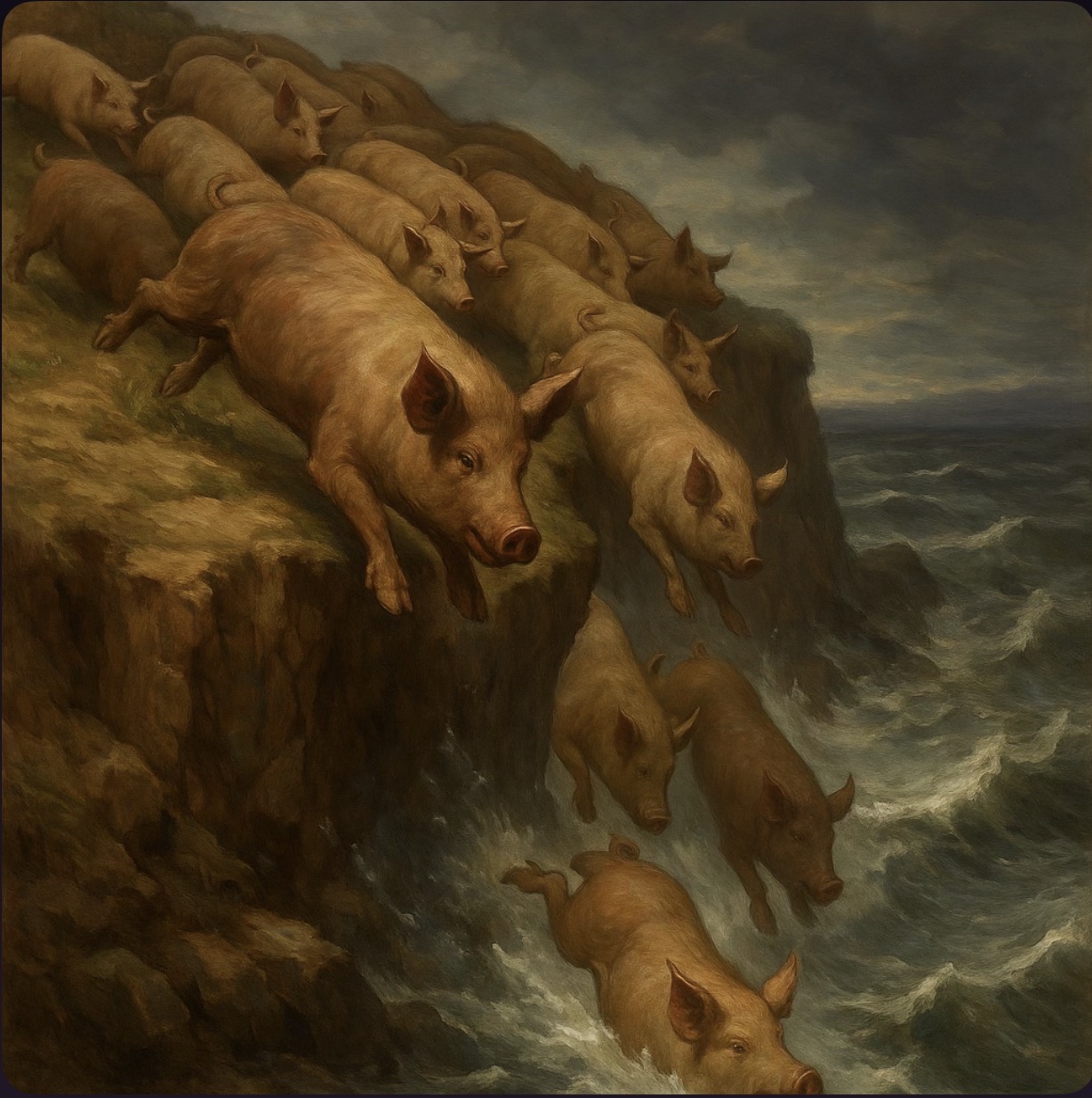
It is the language of Rome, the language of war. A legion was six thousand soldiers — a regiment of death. This man carries the power of an entire curse. The people of Gadara could not control him; the religion of that time could not free him; but Jesus speaks one sentence, and the entire power breaks. He commands, and they go. Not into the air — into pigs. And when the pigs rush into the sea, the world laughs, but heaven knows: the old gods have fallen back into the abyss from which they came.
This happened just after the miracle of the bread and fish — first the storm on the sea, then the spirits on the land. These events are not weeks apart; they are one movement of war. First the powers of the deep tried to stop Him on the water, and when He triumphed there, they were already waiting for Him on the other side. The same spirits that made the wind roar now spoke through people. And when He commanded them, they left — first out of the man, then out of the land. The storm on the sea and the pigs in the sea were one story: the powers of chaos attacked Him in both realms, and in both they were defeated.
That is why the people were afraid. They asked Him to leave. Not because He had done evil, but because they could not handle the power within Him. The town could tolerate one man in chains, but not one Saviour in light.
And see how the pattern remains through the centuries. People are comfortable with sin, but not with holiness. They tolerate darkness, but not Light. They call it religion, but it is fear in disguise. Even today people say: “We believe,” but when the Light begins to move, they ask Him to leave — out of their schools, their homes, their countries, even their churches.
Jesus gets back into the boat and crosses over. The storm is over, but the war is not. For every place He goes, the powers awaken. He heals the woman with the issue of blood — twelve years trapped in a sickness that destroyed her not only physically, but spiritually. When she touches His garment, He says: “I felt power go out from Me.” This is not metaphorical; it is real. The Light touches flesh, and darkness retreats.
When He arrives at Jairus’s house, the girl lies dead. The people laugh when He says: “She is sleeping.” But He takes her hand and says: “Talitha cumi” — Little girl, arise. The Light speaks to the spirit, and the spirit obeys. Even death, the final weapon of the enemy, cannot remain in the presence of this voice.
It is the same voice that in the beginning said: “Let there be light.” It is that Light now speaking through flesh. Genesis is repeated — but this time not in creation, but in restoration. The earth, the sea, humanity, even death itself — everything begins to respond to the voice that once created it.
And yet I see it in the comments: “Just preach the gospel! Leave the Old Testament out!” Which gospel do you mean? The comfortable lie? The gospel without war, without judgement, without truth? Here we are now in the gospel — in the Word made flesh Himself — and I already know they will shout even louder. Because the truth that began in Genesis runs straight through into the gospel, and the Light that spoke in the beginning is the same Light that has now become flesh to complete it. The Bible is not two stories; it is one war — from creation to restoration, from Light against darkness.
But the world does not understand. They see only the wonders He performs. They see bread, healing, the dead rising. They do not hear the war. They do not understand that every miracle is a command in the spirit, every touch a reclaiming of ground that long belonged to the devil.
Even His own disciples do not fully understand. They believe, but they doubt. They see His power, but they do not yet know who He truly is. And He knows this. That is why one day He asks: “Who do people say that I am?” They answer: “Elijah… Jeremiah… one of the prophets.” And He asks: “But you — who do you say that I am?” And Peter answers: “You are the Christ, the Son of the living God.” And Jesus says: “Flesh and blood have not revealed this to you, but My Father who is in heaven.”
Notice the pattern: revelation always comes from above, not from human reasoning. This is the heart of the war — to see by the Spirit, not by the flesh. For flesh sees a carpenter; spirit sees the Son of God.
And here the true battle begins. For now someone has seen the truth. And the moment truth is revealed, the enemy moves. He will try to twist it, soften it, destroy it. For Satan’s greatest fear is not miracles — it is revelation.
Jesus says: “On this rock I will build My church, and the gates of hell shall not prevail against it.” Note this — He does not say hell will not attack; He says it will not win. The war continues, but the outcome is fixed.
In the days that follow, the powers begin to conspire. The Pharisees, the Herodians, even the Romans — people who hate one another now find common cause in resisting the Light. For wherever the Light moves, every other light is tested. The false prophets, the dead religion, the self-righteous priesthood — all begin to tremble. The temple itself feels it. The sacrificial animals grow restless, the priests lose sleep, for heaven has begun to speak on earth again.
And so the next phase of the war arrives. People begin to choose sides. The Light has come into the world, and the darkness cannot overcome it — but it still tries. It will bring storms, send sickness, use people, even tempt His own disciples. For the powers of the air know: every step this Man takes brings them closer to their end.
But Jesus keeps walking. Not as a king with soldiers, but as a Creator reclaiming His creation. He commands, and the wind obeys. He speaks, and the dead hear. He touches, and the unclean become clean. Every step is a victory, every word a command, every breath a reminder to the serpent that his head will soon be crushed.
And the earth feels it. For the Creator is walking again in His garden — not in silence, but in authority. The voice that once brought light has now begun to speak among people. And the powers of the air, the depths of the sea, sickness in flesh, pride in hearts — everything knows: their days are numbered. The war that began in Eden has now been released onto the dust of the earth, and the Son of God Himself walks at the front.