
From Genesis to Revelation: The One Story – The Golden Thread that Explains Everything – Part 25
By Andre Eksteen
The sun rises over the mountains of Galilee. People stream in from everywhere — from Capernaum, Bethesda, Nazareth, and even from Judea. They come because they have heard about the young man who heals the sick and drives out demons. Some come out of curiosity, others out of desperation, and some simply because they hope to see something. The world has always been more interested in wonders than in truth.
Jesus goes up a mountain and sits down. It is not a pulpit; it is stone and dust. But when He opens His mouth, something moves through the air. The powers of the air know: what is about to be spoken will shake the foundations of their kingdom. For the first time since Moses, the Law will again come from a mountain — not written on stone, but in words that will burn into human hearts.
He says: “Blessed are the poor in spirit, for theirs is the kingdom of heaven.” (Matthew 5:3) It sounds gentle, but it is a declaration of war against pride. He says: “Blessed are those who mourn, for they shall be comforted” — and with that He wages war against the spirit of apathy. “Blessed are the meek,” and the world laughs, because meekness has never looked like victory in human eyes. But He shows that the weapons of the Kingdom look different. The world fights with steel; He fights with purity.
He continues: “You are the salt of the earth… you are the light of the world.” This is not comfort — it is commission. He calls ordinary people to carry the role of priests, and the priests of that time hate Him for it. Because when ordinary people become Light, they lose their power.
And today it is the same. People still hate Him for these words. They want what He offers — healing, protection, peace, prosperity — but being disciples? No, that is too costly. “That’s the pastor’s job,” they say. “I’d rather warm a church bench than proclaim the Word.” They forget that He never said: “Let only the priests be light.” He said: “You.” Every believer, every person who receives the Light, becomes a carrier of it. But the modern believer wants to be saved without obedience, blessed without sacrifice, and served without ever working. That is why the church has grown weak — because salt that is no longer salty is worthless.
And the air shifts. Because the kingdom of darkness is threatened by a man who not only performs miracles, but teaches people to become light-bearers themselves. He did not come to be admired, but to transform people.
He speaks about anger, lust, forgiveness, truth. He says things that even today’s church still tries to soften. “If your right eye causes you to stumble, tear it out.” “If someone forces you to walk one mile, walk two.” “You have heard: an eye for an eye; but I say to you: do not resist an evil person.” These are words human nature hates. He is not speaking about peace between people; He is speaking about war against the flesh itself.
The Pharisees watch from below. They see a man without status who seems to twist their law. But they do not understand: He is not twisting it; He is restoring it. He brings it back to the original voice of the Creator. “You have heard,” He says, “but I say to you.” He speaks as the One who gave the Law. And the spirits working through their structures know exactly who is speaking.
After that day, people begin to follow Him everywhere. Hundreds, later thousands. Not only twelve — a great crowd who hear His words and hope for bread, healing, and deliverance. They call Him “Rabbi” and “Lord,” but they do not understand Him. They see His power, but not His purpose.
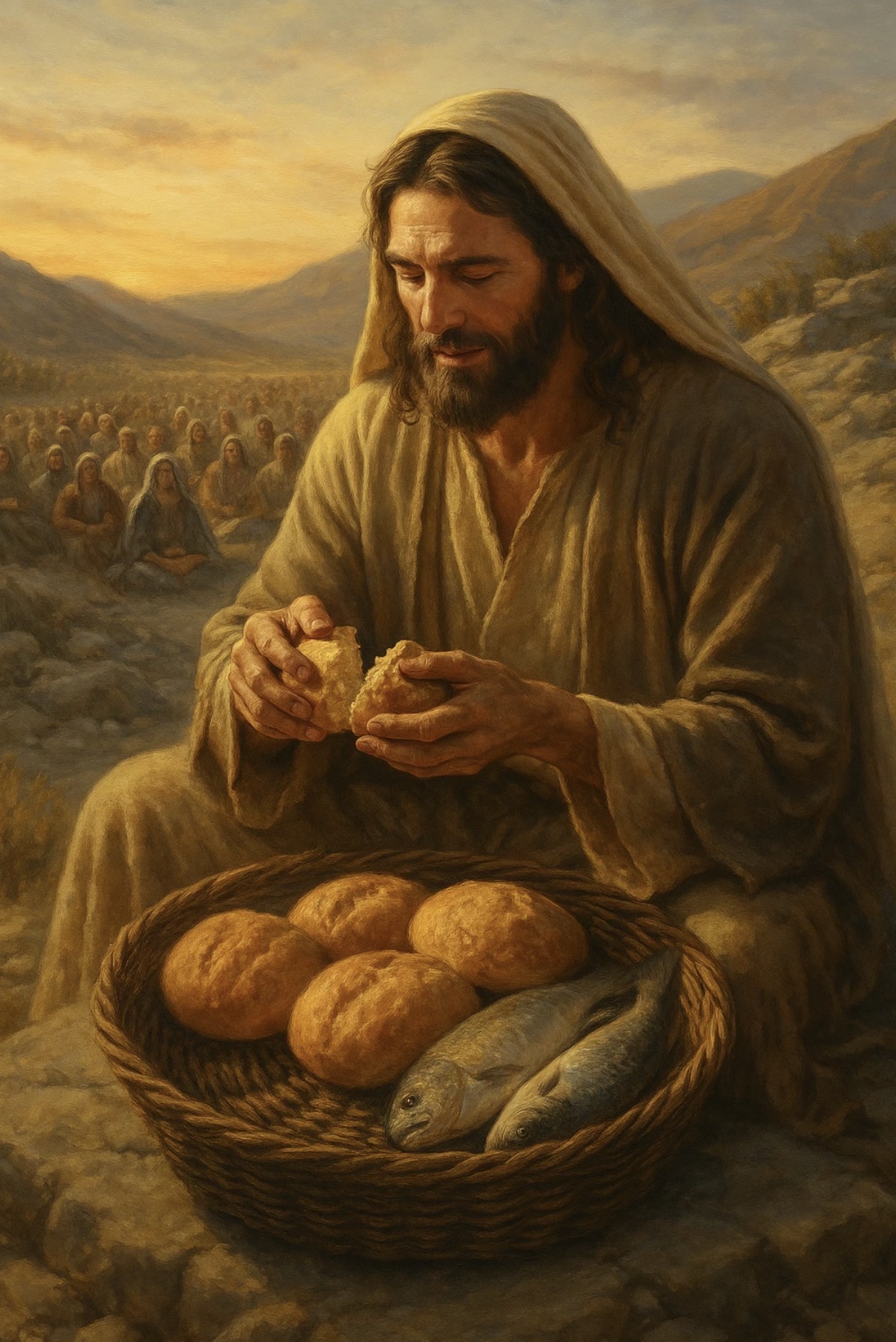
On the day Jesus fed the crowd on the mountain with five loaves and two fish, far more happened than people could see with their eyes. It was not just food — it was war. Heaven broke into the earth again that day.
The five loaves carried something much deeper. Five was not accidental. It is the number of the Torah — the five books of Moses with which God laid the foundation of His covenant with humanity. Genesis, Exodus, Leviticus, Numbers, Deuteronomy — the Law, the order, the voice of God set down in writing. The people honoured those books, but they forgot that the Law itself does not give life. It is only bread in a basket until the Son breaks it.
Now the One greater than Moses stands on the mountain, holding that same number five in His hands, and He breaks it. Not to destroy it, but to fulfil it. The breaking of the bread is the breaking of the old yoke of the Law — the liberation from human religion built only on ritual. Where Moses brought the Law down from above on stone tablets, Christ now brings it from within — living, through flesh, through blood, through His own hands. This is the moment where grace and truth meet. The Law, which brought death to those who could not carry it, is now transformed by Him into bread that gives life.
But it is also war. Because five does not only represent the Law; it represents spiritual battle — five smooth stones against the giants of old, five parts of the armour with which the believer stands. Five is the sign of victory through suffering. And here, before the eyes of demons and men, Jesus shows that He has come to defeat the powers of lack and fear through obedience, not violence.
The two fish again connect the two realms — heaven and earth, spiritual and physical, flesh and spirit. They symbolise testimony — two, the number that confirms that something is established. “By the mouth of two or three witnesses every matter shall be established,” says Scripture. And here the two fish stand as witnesses: that the King of heaven and earth has now appeared in flesh, that the two realms are beginning to become one.
What happened in the spirit, the people never saw. They simply sat, ate, and their stomachs were filled. They did not see how the devil lost ground in that moment. The power that ruled over human lack, the spirit of famine and fear that had held people captive since Eden, began to waver that day. For the Son showed that provision does not come from men or kings, but from His own hand. Heaven fed the earth without temple, without sacrifice, without priest. It was an open challenge to the powers that keep people in spiritual poverty.
But the crowd did not understand it. They saw the sign, but not the truth. They saw bread, but not Light. They saw their bellies filled, not their souls freed. They wanted to make Him king — an earthly king who fills stomachs, not a heavenly King who cleanses spirits. They wanted the miracle without the cross, the blessing without repentance, the abundance without obedience.
And so they begin to fall away. For when He later said: “I am the bread of life,” most of them left Him. They wanted Him for what He gives, not for who He is. They did not see the war — that the bread He breaks declares war on every spirit that keeps people satisfied with lies.
Even today the world does not understand this. The five loaves and two fish were the first manifestation of the coming war between the Kingdom of Light and the powers of lack. Five — the Law now overcome by grace. Two — the testimony that heaven and earth are reconnected through the Word made flesh. And there, on that mountain, the war against spiritual famine began.
He says: “If anyone would come after Me, let him deny himself, take up his cross, and follow Me.” (Matthew 16:24) The words cut through them like a knife. Everyone wants the power, but no one wants the cross. They wanted the king who gives bread, not the Lamb who gives blood.
And it is exactly the same today. Enduring faith is rare, because carrying a cross is out of fashion. People want His blessing, His peace, His protection, His healing — but not His path. They call themselves Christians, but how many of them actually work daily to proclaim His Word? How many live in such a way that the world sees the Light through them? They wear gold crosses, but not crosses of obedience. They sing about the cross, but avoid it in their lives.
For most, faith is a piece of identity, not a calling. They call Him Lord, but follow the world. They shout “Amen” in church, but remain silent outside the doors. And yet they think their silence is wisdom — while in heaven it sounds like betrayal. For the enemy does not fear the one who merely believes; he fears the one who obeys. Remember, the demons also believe.
John later writes: “From that time many of His disciples turned back and no longer walked with Him.” (John 6:66) Notice the number — 666. Not accidental. The spirit of rebellion that will one day be revealed through the Antichrist had already begun there: people who hear the Truth, but turn away because it is too costly.
He had many disciples — not only twelve. There were women, men, young people, old people — all who heard the voice. But when He began to teach that the Light does not only heal, but judges; that the Word does not only comfort, but divides — they walked away. People love the Christ who breaks bread, but not the Christ who breaks flesh.
That is why He says: “Whoever eats My flesh and drinks My blood has eternal life.” (John 6:54) This is not cannibalism; it is the language of war. He is saying: you must take My life into yourself, receive My Spirit, share in My sacrifice — otherwise you remain flesh. And flesh has no place in a kingdom of Spirit.
But the people could not accept it. They said: “This is a hard saying; who can listen to it?” (John 6:60) And He does not soften it. He says: “It is the Spirit who gives life; the flesh profits nothing.” (John 6:63) He explains nothing further. Because truth does not need to be explained to those who have no ears.
Then He looks at the twelve who remain. He asks: “Do you also want to go away?” And Peter answers: “Lord, to whom shall we go? You have the words of eternal life.” (John 6:68) That is the difference between disciples and followers. One stays for the miracles; the other stays for the Word.
And here lies the heart of the war. Darkness has never been afraid of miracles — only of truth. Miracles can be imitated; truth cannot. The magicians of Egypt could imitate Moses’ signs, but when the dust turned into lice, they could go no further. There the imitators stop, because truth has boundaries the lie cannot cross.
That is why Jesus does not attack the world only with power, but with revelation. He brings light so that people can choose — and the choice itself is war. For every time a person hears the truth and refuses it, that evil spirit within them grows stronger.
Many say: “I believe.” But faith without obedience is only a mask. The spirits who fell from heaven also believe — they know Him better than humans do. But they do not bow. That is why faith without obedience means nothing. The devil himself stood in God’s presence; it did not save him.
Jesus says: “Not everyone who says to Me, ‘Lord, Lord,’ will enter the kingdom of heaven, but the one who does the will of My Father.” (Matthew 7:21) This was not a warning to unbelievers, but to believers. To people who know His name, see His miracles, fill church benches, yet still live in rebellion.
He said: “Many will say to Me on that day: Lord, Lord, did we not prophesy in Your name, cast out demons, and do many mighty works?” And He will answer: “I never knew you; depart from Me, you who practise lawlessness.” (Matthew 7:22–23) The most terrifying words ever spoken — not to the world, but to the church.
The war of Light against darkness is not outside of us — it runs through every heart. The church wants to see the enemy outside, but ignores the one within. Jesus did not come to the temple to admire it; He came to cleanse it. That is what the Spirit still does today. He does not come for applause — He comes for purification.
Many say: “I accepted Jesus.” But the real question is: has He accepted you? For He does not accept flesh; He inhabits it only after it dies. Darkness is not afraid of a church with lights and music — it fears the person who is dead to self and filled with the Spirit.
The world still seeks bread, comfort, and a God who blesses its plans. But the Light of the world does not offer comfort; He offers war — a war for your soul.
And that is why, when He came down from the mountain, the spirits already knew their time was short. The seed of the woman had begun to walk, and every step shook a throne.
In the next part we will see how this war expands — how He confronts the sick, the possessed, and even the storms. For the power of the Light did not come only to save people, but to restore the whole of creation.


