Darwin Day Is Not About Science — It Is About Removing God
By Andre Eksteen
Every year, Darwin Day is celebrated on the 14’th of February with speeches, articles, documentaries, classroom events, and an almost liturgical reverence. We are told it is about curiosity, discovery, bravery, and intellectual progress. We are told it is harmless. We are told it is simply about following the evidence wherever it leads. A neutral acknowledgement of science doing what science does.
But that is not what Darwin Day is really about, and it never has been.
Darwin Day is not a neutral scientific commemoration. It is a worldview statement. It is the public celebration of a story that removes God from creation, removes purpose from life, and removes accountability from humanity. It is the ritual affirmation of a narrative that allows modern man to look at the universe and say, “I did not come from God, I do not belong to God, and I do not answer to God.”
And that is why it matters far more than most people realise.
If Darwin Day were genuinely about honouring scientific inquiry, there would be no controversy at all. Christianity has never been afraid of science. In fact, Christianity gave birth to modern science. The very idea that nature is orderly, intelligible, consistent, and worthy of study comes from the biblical understanding of a rational Creator who upholds His creation by design. The founders of modern science did not expect chaos; they expected structure because they believed in a Lawgiver behind the laws.
The problem, then, has never been science.
The problem is the story Darwinism tells.
Darwin Day does not celebrate microscopes, fossils, or careful observation. It celebrates a narrative. A narrative that claims life created itself, that order arose from chaos, that information wrote itself, that consciousness emerged from chemistry, and that meaning is nothing more than a human coping mechanism layered on top of a meaningless universe.
This is where the line between true science and false science must be drawn clearly, because the modern world deliberately blurs it. True science is what has historically been called experimental science or operational science. It deals with things that can be observed, measured, tested, repeated, and falsified in the present. You take something physical, you test it under controlled conditions, you repeat the experiment, and others can reproduce your results. Chemistry, physics, engineering, and medicine all operate in this realm. If a claim cannot be tested, measured, or repeated, it is not scientific fact. It is, at best, a hypothesis.
Darwinism does not belong to this category.
Darwinism falls under what is properly called historical science or origins science. This is a fundamentally different kind of inquiry. Historical science attempts to reconstruct unobservable past events using present data, assumptions, and inference. It cannot be tested. It cannot be repeated. It cannot be observed. It cannot be falsified in any meaningful experimental sense. At its core, it is reconstruction, not demonstration.
And this is where the deception lies.
In experimental science, conclusions follow evidence. In historical science, conclusions are often decided first, and the evidence is then interpreted to fit them. A fossil does not tell you how it formed, how long it took, or what evolutionary steps led to it. Those stories are supplied by the worldview of the interpreter. The fossil is real. The narrative attached to it is not observable. It is assumed.
Darwinism is built almost entirely on this second category. It does not say, “We tested this and proved it.” It says, “We believe that if enough time passed, and if enough small changes accumulated, and if natural selection acted in this way, then this could have happened.” That is not experimental science. That is speculative inference. It is storytelling dressed in scientific language.
This is why Darwinism constantly relies on phrases such as millions of years, it is believed, it is thought, scientists suggest, and this may have evolved. These are not the words of proof. They are the language of assumption. They reveal a model that cannot be tested and therefore must be believed.
Darwin himself acknowledged this limitation. His theory required vast amounts of time and innumerable transitional forms that were never observed. Time became the substitute for evidence. Once time is treated as infinite, speculation becomes untouchable. Anything can be claimed, and nothing can be disproved.
That is not how real science works.
In true science, if a mechanism cannot be demonstrated, it is rejected. In Darwinism, if a mechanism cannot be demonstrated, more time is added. This is how the theory survives. It is not strengthened by proof, but insulated by assumption.
Darwinism is therefore not rejected by the scientific method. It avoids the scientific method altogether. It operates in a category where belief replaces verification. This is precisely why it functions comfortably as a worldview but poorly as a demonstrable science.
True science asks, “Can this be tested?” Darwinism asks, “Can this be imagined?”
And imagining a process is not the same as proving it.
There is another question that Darwin Day never allows to be asked, because it exposes the delusion at the heart of the story.
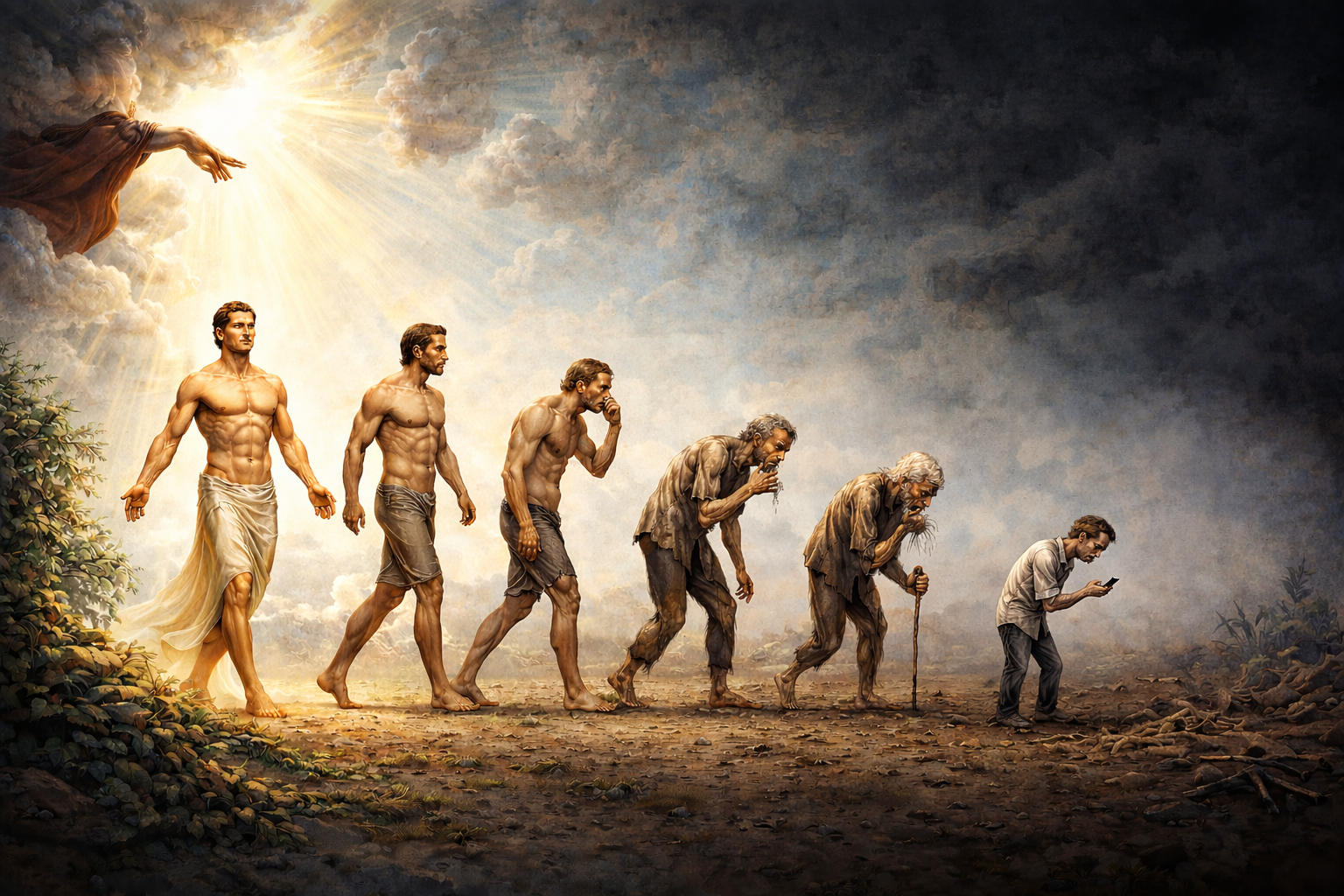
If evolution were true, if it were an upward, improving process driven by natural selection, then why can science not improve human life through evolution itself?
Not technology. Not medicine. Not prosthetics, drugs, or machines.
Evolution through breeding.
After more than a century and a half of Darwinism being treated as settled fact, humans should be biologically better than they were before. Stronger. Healthier. Longer-lived. More resilient. That is what evolution is supposed to produce.
But the opposite is true.
According to Scripture, early humanity lived for centuries. Adam lived 930 years. Seth lived 912. Methuselah lived 969. Even after the Flood, human lifespans initially remained far longer than anything we see today. But Scripture is clear that after the Flood, God imposed a deliberate and immediate limitation. He declared that man’s days would be one hundred and twenty years. This was not gradual evolution. It was divine intervention.
That cutoff was not arbitrary. It served a specific purpose. Before the Flood, the corruption of human flesh through the mingling of fallen beings and human women had produced the Nephilim — hybrids that grew to unnatural size, strength, and longevity. Their extended lifespans allowed them to mature into full giants, terrorising the earth and corrupting all flesh. By limiting human lifespan after the Flood, God ensured that no half-breed Nephilim could ever again reach the size, power, or dominance they had before the judgment.
This is why we see a sharp decline in lifespan immediately after the Flood, not a slow evolutionary slide. Generations lived progressively shorter lives until the ceiling settled where God set it — roughly seventy to eighty years, with one hundred and twenty as the absolute maximum. This was not nature selecting for weakness. It was God restraining corruption.
That is not evolution.
That is judgment with mercy.
And it directly contradicts the Darwinian claim that life naturally improves over time. Instead of upward biological progress, Scripture records a controlled reduction, imposed to prevent the return of pre-Flood abominations. Humanity did not climb out of primitiveness. It was cut down from something far greater to preserve what remained.
That is not delusion.
That is design.
That is not progress.
That is degeneration.
Modern science cannot evolve the human body to live longer. It cannot select for longer natural lifespans. It cannot breed longevity into humanity the way Darwinism claims nature once did. All it can do is slow decay through external intervention. Remove the technology and the body collapses back to weakness.
This is not evolution at work. This is maintenance of a failing system.
If Darwinism were true, natural selection should be refining the human genome toward greater biological strength. Instead, genetic disorders are increasing. Chronic disease is rising. Fertility is declining. Immune systems are weakening. Human bodies are not becoming more robust. They are becoming more fragile.
And science knows this.
The human genome is not improving. It is accumulating mutations. Natural selection does not create new information. It filters existing information while damage continues to accumulate. This is why geneticists speak of mutational load and genetic decay. These are not theological terms. They are scientific admissions.
Evolution does not explain why life is breaking down.
The biblical account does.
Scripture does not describe humanity climbing upward from primitive beginnings. It describes humanity falling from an original state of strength, longevity, and closeness to God into corruption, decay, and death. Death is not a creative force in Scripture. It is a curse. Entropy is not progress. It is the consequence of sin.
From that perspective, the decline in human lifespan is exactly what we should expect.
From Darwinism’s perspective, it is an unsolvable problem.
Evolution cannot explain why earlier humans lived longer. It cannot explain why death entered the world. It cannot explain why degeneration is universal. It cannot explain why everything trends toward decay unless constantly sustained by intelligence.
So the question is avoided.
Weakness is rebranded as adaptation. Decay is normalised. The past is rewritten so that decline is never acknowledged. The possibility that humanity once stood higher than it does now is dismissed outright.
That is not science.
That is narrative protection.
The irony is that Darwinism depends entirely on intelligence to function. Intelligent scientists design experiments. Intelligent engineers build machines. Intelligent doctors intervene in failing bodies. Intelligence is required at every level, yet the worldview insists intelligence itself is an accident.
Darwinism cannot improve human life through evolution because evolution does not improve. It filters. It discards. It degrades.
What we call progress today is not evolutionary at all. It is technological. And technology itself is evidence of design, purpose, and intelligence, the very things Darwinism denies.
So when Darwin Day celebrates progress, it is not celebrating what Darwinism has produced. It is celebrating what human ingenuity has achieved in spite of it.
And that leaves one final question that cannot be escaped.
If evolution were true, reality should look very different.
Instead, reality looks exactly like the Bible said it would.
Life moves toward decay, not improvement. Death reigns, not retreats. Everything requires constant intervention to avoid collapse.
That is not evolution.
That is entropy.
And entropy is not a creator.
It is a destroyer.
Calling that progress is not science.
It is delusion.
That is not science.
That is philosophy.
And it is a philosophy with very real consequences.
When Charles Darwin published On the Origin of Species, he did not merely propose a biological mechanism. He introduced an alternative creation story. And every culture, whether it admits it or not, lives by a creation story. How you believe everything began determines how you understand who you are, why you exist, what matters, and where everything is going.
Darwinism did not remain confined to biology for a single generation. It spilled rapidly into ethics, sociology, psychology, politics, economics, education, and law. Once people accepted that humans are the product of blind, unguided processes, everything else had to be reinterpreted. Human value became relative. Morality became adaptive. Truth became provisional. And power quietly replaced accountability.
This is not speculation. This is documented history.
Darwin Day is celebrated not because Darwin ‘proved’ God does not exist — he did not — but because his ideas provided a framework in which God was no longer necessary. And unnecessary gods are easily ignored. Once God becomes optional, He quickly becomes inconvenient. And once He is inconvenient, He is eventually removed altogether.
The modern world does not celebrate Darwin because he discovered something undeniable. It celebrates him because he provided an intellectual justification for independence from God. A way to tell the universe, “We did this ourselves.” A way to enjoy the fruits of Christian morality while quietly sawing through its roots. A way to justify and glorify human idolatry.
And that independence has not led to enlightenment. It has led to collapse.
From the moment life is explained as the result of chance and necessity, purpose becomes optional. If we are not created, we are not accountable. If there is no Designer, there is no design. If there is no design, there is no moral order — only preference, power, and survival.
This is why Darwin Day is never merely academic. It is cultural. It is ideological. It is moral. It is religious.
Darwinism is a belief system, and Darwin Day is its feast day.
The celebration of Darwin is the celebration of a universe without meaning, and that should disturb anyone who is still capable of thinking beyond slogans. It disturbs anyone whose brain has not “evolved” into a programmable single-core microchip.
What is almost never mentioned during Darwin Day celebrations is how thin the scientific foundation of Darwinism actually was at its birth, and how much of it rested not on evidence, but on assumption. Darwin worked without any understanding of genetics, DNA, molecular biology, irreducible complexity, or information theory. He proposed a mechanism that could not even be tested in his own lifetime, yet his ideas were elevated to near-sacred status within a generation.
Why?
Because they served a deeper need.
By the mid-nineteenth century, Europe was already drifting away from biblical authority. The Enlightenment had exalted human reason as the highest court of appeal. The Industrial Revolution had created unprecedented wealth and power. Scientific success in limited fields bred philosophical arrogance and human idolatry. The idea that man could explain everything without God was already in the air. Darwin did not create that desire — he gave it a structure.
And once that structure was in place, the flood followed.
Ideas have consequences. They always do.
When humans are taught that they are animals shaped by competition, society eventually reflects that belief. When survival becomes the ultimate value, compassion becomes conditional. When progress is defined biologically, weakness becomes expendable. When life is reduced to matter in motion, dignity becomes negotiable.
These ideas did not remain theoretical.
They justified eugenics.
They fuelled racial hierarchies.
They underpinned totalitarian ideologies.
They normalised the idea that some lives are worth more than others.
This was not a distortion of Darwinism. It was its logical extension.
Darwin himself was deeply uncomfortable with many of the implications of his theory. He wrestled with doubt, guilt, and fear throughout his life. He was troubled by what his ideas meant for morality, meaning, and human value. But later generations had no such hesitation. They embraced Darwinism enthusiastically, not because it led them to truth, but because it removed restraint.
Darwin Day celebrations almost never mention this history. They focus on curiosity while ignoring consequence. They praise courage while ignoring cost. They speak endlessly of science while carefully avoiding philosophy.
And that avoidance is intentional.
Because Darwinism is not merely a scientific hypothesis. It is a comprehensive worldview. It offers an account of origins, identity, morality, and destiny without reference to God. And every worldview demands allegiance.
Darwinism tells us we are accidents. That our thoughts are the by-products of chemical reactions. That love is hormonal. That morality evolved because it was useful for group survival. That meaning is something we invent to distract ourselves from the fact that the universe does not care.
This story is repeated so often that people stop asking whether it actually explains anything at all.
It does not explain consciousness.
It does not explain reason.
It does not explain moral obligation.
It does not explain why truth matters.
It does not explain why humans instinctively seek meaning, justice, and transcendence.
It simply asserts that everything is the result of time and chance, and then demands belief.
That is not science.
That is faith.
In fact, Darwinism functions exactly like a religion. It has a creation story. It has a prophet. It has sacred texts. It has priests in white lab coats. It has heresy laws. And it has feast days.
Darwin Day is one of them.
Questioning Darwinism is treated not as healthy scepticism, but as moral failure. Doubt is mocked. Dissent is pathologised. Alternative explanations are excluded not because they lack evidence, but because they violate the approved narrative.
If Darwinism were simply one hypothesis among many, it would welcome scrutiny. It does not. It demands conformity. And that tells you everything you need to know. I can predict right now that you will see many attacks on this article as people try to force me into conformity, but that will fail. A theory that claims I descend from apes has no authority to command a human who was given dominion by God.
What makes this even more revealing is that Darwinism relies on assumptions it cannot justify. It assumes the uniformity of nature. It assumes the reliability of human reason. It assumes that truth exists and can be discovered. None of these assumptions arise naturally from a materialistic worldview.
They make perfect sense in a created world.
They make no sense in an accidental one.
If our minds are the product of blind processes selected for survival rather than truth, then there is no reason to trust our conclusions — including Darwinism itself. The theory undermines the very rationality it depends on. It saws off the branch it sits on.
This contradiction is almost never acknowledged.
Instead, Darwin Day presentations portray evolution as the foundation of all knowledge, the lens through which everything must be interpreted. Any challenge is dismissed as ignorance or religious bias.
But bias cuts both ways.
The refusal to consider creation is not scientific neutrality. It is philosophical exclusion. It is the prior decision that God cannot be an explanation — not because the evidence demands it, but because the worldview forbids it.
That is not science following evidence. That is ideology policing boundaries — boundaries that need to be protected so that ignorance is not exposed.
And this is where the story becomes even more uncomfortable, especially for the modern Church.
In From Genesis to Revelation, we documented in detail how Darwinism did not merely challenge the Church from the outside. It was invited in from within. Not because it was proven true, but because it was socially powerful. Not because it aligned with Scripture, but because it aligned with the spirit of the age.
The Church did not abandon creation because the Bible was unclear. It abandoned creation because it was afraid.
Afraid of ridicule.
Afraid of being labelled anti-intellectual.
Afraid of losing cultural influence.
Afraid of losing students.
Afraid of losing donors.
Afraid of empty pews and shrinking coffers.
Darwinism was not accepted into the Church through conviction. It was smuggled in through compromise.
The language shifted subtly at first. Genesis became “poetry.” Adam became “symbolic.” The Fall became “mythological.” Death before sin was rebranded as “natural.” The Flood became “local.” Creation days became “ages.” And slowly, almost imperceptibly, the authority of Scripture was relocated from the text itself to the academy.
This was sold as intellectual maturity. In reality, it was surrender.
The Church told itself it was being wise. What it was really doing was negotiating with the world. It believed that if it gave ground on origins, it could keep its moral influence. That if it softened Scripture, it could stay relevant. That if it avoided offence, it could preserve attendance and funding.
And for a while, it worked.
The pews stayed full. The budgets grew. The Church gained respectability. It was invited into academic circles. It was allowed a voice — on the condition that it did not challenge the foundational story of modernity.
But compromise always demands more.
What the Church also failed to confront is the biblical evidence of structured activity, order, and exchange before Adam — what Scripture hints at as trade, governance, and organised function in the pre-Adamic world. Passages speaking of Lucifer describe him not merely as a fallen angel, but as one who moved among stones of fire, who was adorned, established, and entrusted with authority. The language used is not primitive or abstract. It points to administration, hierarchy, and activity within a functioning system. This was not chaos. It was not emptiness. It was civilisation before ruin.
Scripture does not give these details to satisfy curiosity, but neither does it hide them. They are there for those willing to read without fear. The Bible shows an earth that functioned before mankind, populated and governed under divine order, with responsibility, structure, and yes, exchange. That entire layer of biblical truth was ignored because it complicated the simplified story the Church preferred to tell.
I deal with this in depth in my book Genesis to Revelation, where the pre-Adamic world, the role of angels, the fall of Lucifer, and the resulting judgment on the earth are unpacked carefully from Scripture. What is mentioned here is only the surface. The deeper picture is there in the Word, but it requires honesty, patience, and the willingness to let Scripture speak for itself instead of forcing it into comfortable boxes.
This is precisely why, to the uninformed or the casual observer, it appears as though true science and the Bible are at war with one another. That illusion exists only because both sides have been misrepresented. On the one hand, you have a Church that abandoned careful reading of Scripture and replaced it with shallow assumptions, and on the other hand, a false science that elevates speculation to fact and protects its theories from scrutiny. The conflict is not between the Bible and real science. They have never been enemies. The real conflict is between truth and ignorance — between a Church that forgot how to study its own foundations and a scientific establishment that promotes belief without proof. Both have tried to force reality to submit to their ideas instead of submitting their ideas to hard evidence. Where Scripture is read honestly and science is practised properly, they do not clash. They align. The noise comes from those who refuse to do the work on either side.
The Church gained acceptance and lost its backbone.
This is why Darwinism inside the Church is far more dangerous than Darwinism outside it. When secularists celebrate Darwin Day, they are at least being consistent. When the Church does it — overtly or quietly — it is undermining its own foundation while pretending nothing has changed.
You cannot build theology on a story you no longer believe yourself.
And yet, this compromise is rarely acknowledged honestly. It is dressed up as nuance. As humility. As intellectual sophistication. But at its core, it is fear. Fear of man. Fear of exclusion. Fear of financial loss. Fear of the false god — the idol called self.
The Bible warned about this long ago.
The moment the Church decided that offending the world was worse than offending God, it chose survival over faithfulness. And Darwinism provided the perfect tool to make that choice seem reasonable.
What is almost never discussed on Darwin Day is the deeply personal side of this story — the man himself.
Charles Darwin is often portrayed as a confident atheist hero, bravely slaying the dragon of religion. That image is false. Darwin was not a militant unbeliever. He was a deeply conflicted man. He struggled with doubt, depression, guilt, and fear throughout his life. The death of his daughter Annie devastated him. His writings reveal a man haunted by the implications of his own ideas.
And then there is the testimony that modern Darwinists work tirelessly to suppress: Darwin’s death-bed confession.
In the final years of his life, Darwin was reportedly visited by Lady Hope, a Christian woman who cared for him and spoke with him extensively. According to her testimony, Darwin expressed deep regret over how his theory had been used, reaffirmed his belief in God, asked her to read Scripture to him, and spoke of Christ with reverence.
This account has been ridiculed, dismissed, and aggressively attacked. Not because it has been disproven, but because it is dangerous to the narrative. Remember I said earlier, if people cannot prove the theory with facts, they beat the meek into submission, just as they did with the Church.
If Darwin died doubting Darwinism, the mythology collapses.
If the prophet himself wavered, the religion looks fragile.
What is telling is not that sceptics question the account — that is fair — but the vehemence with which it is rejected. The fury. The mockery. The desperation to ensure that Darwin remains a symbol of unwavering unbelief.
Because Darwin the doubter is inconvenient.
Darwin the conflicted man does not serve the cause. Darwin the regretful human being does not inspire ideological certainty. The movement needs a saint, not a sinner.
Whether one accepts Lady Hope’s testimony or not, the reaction to it reveals something profound. Darwinism cannot tolerate ambiguity. It cannot afford humility. It must project confidence at all costs.
Because if doubt enters the narrative, people might start asking questions.
And Darwinism does not survive honest questions very well.
Darwin Day is celebrated because it reassures modern man that his rebellion against God is justified. That removing God is progress. That redefining humanity is enlightenment. That replacing creation with chance was courage.
And yet, the fruit of this belief is everywhere.
A culture that cannot define what a human being is — not even what sex a human is born as.
A society that debates which lives are valuable.
A generation drowning in anxiety, despair, and meaninglessness.
A world that insists injustice is wrong but cannot explain why.
These are not unfortunate side effects. They are logical consequences.
When you tell people they are cosmic accidents, do not be surprised when they live accordingly.
The biblical account of creation offers what Darwinism never can: coherence. It explains origin, purpose, morality, and destiny in a unified framework. Humans are created, not accidental. Valuable, not expendable. Accountable, not autonomous.
That framework makes sense of reality as we actually experience it.
Darwinism does not.
This is why Darwin Day celebrations often feel defensive. They are not joyful affirmations of discovery. They are ideological rallies. They reassure believers in the narrative that their faith is still reasonable.
Because deep down, the story does not satisfy.
If Darwinism were enough, people would not be so desperate for meaning. They would not constantly invent identities, causes, and crusades to fill the void. They would not oscillate between arrogance and despair.
A worldview that removes purpose creates a vacuum. And vacuums always demand to be filled.
That is why Darwinism so often pairs itself with activism. With moral outrage. With manufactured meaning. With endless crusades promising significance.
People know, instinctively, that life must mean something.
Darwinism cannot provide that meaning. So culture tries to manufacture it.
Darwin Day is celebrated as progress, but it represents regression — not intellectually, but spiritually and morally. It marks the moment humanity began telling itself it no longer needed God.
History has been judging that decision ever since.
This is not an argument against studying biology. It is an argument against elevating a scientific hypothesis into a secular gospel. It is an argument against the Church doing the same thing in a desperate attempt to gain acceptance. It is an argument against teaching children that they are accidents of nature with no purpose and no accountability. And it is an argument against building societies on a story that cannot sustain truth, morality, or hope.
Science flourishes when it acknowledges its limits and stays within what can be tested, measured, and verified. It collapses the moment it pretends to answer metaphysical questions it was never designed to address. And the Church collapses alongside it when it borrows those pretensions instead of standing on revealed truth. When science tries to explain meaning, purpose, and morality without God, it becomes a false religion. When the Church allows that false religion to reshape Scripture instead of correcting it, it ceases to be salt and light.
This failure becomes painfully visible when the Church starts shrinking the Word to make it acceptable. When Leviathan is reduced to a hippopotamus to avoid dealing with what the text actually says, the only truth left in that Church is smaller than the ears of that hippopotamus. Scripture is no longer permitted to define reality; reality is permitted to edit Scripture. The supernatural is explained away, the uncomfortable is domesticated, and the authority of God’s Word is neutralised. Both science and the Church fail for the same reason: they step outside their rightful boundaries and claim authority where they have none.
Darwinism pretends to do both.
Darwin Day is not about honouring a man. It is about affirming a narrative. A narrative that has shaped education, ethics, and culture for generations.
And it is failing.
The question is not whether Darwin Day will continue to be celebrated.
It will — and so will Satan.
The question is whether people will finally have the courage to ask what it really celebrates, and whether they are willing to live with the consequences of that celebration.
Because every story we tell about origins shapes the future we build.
And a story that removes God will always remove meaning shortly thereafter.
That is not progress.
That is collapse with better branding.