From Genesis to Revelation: The One Story – The Golden Thread that Explains Everything – Part 32
By Andre Eksteen
When Constantine declared Christianity the state religion in the fourth century, the Church sold her soul. What began as a movement of martyrs and prophets became an institution of power. The cross, once a symbol of self-denial, became a state emblem. The Roman Empire did not repent — it merely changed tactics. Instead of killing Christians, it decided to control them.
Before Constantine, the Church was pure. She had no temples, no titles, and no money. Believers met in homes and risked their lives for the truth. After Constantine, the Church began to build — not people, but buildings. She acquired priests, processes, ceremonies, and a new hierarchy based on power and status. She was no longer the Body of Christ — she was an organisation with an emperor as her head.
And what happened next was nothing new. It was a repetition of Solomon — the same spirit of pride that built temples for the princes of the air found its place again, this time in the name of Christ. This time, temples were not built for idols, but for the state, for the Church itself, and for man. The holy place once again became a marketplace. The Spirit of God was replaced by the spirit of pride. The humble wooden cross gave way to walls of gold, copper, and marble. The new temples no longer carried the presence of God — they displayed earthly wealth.
What should have stood as a testimony of faith became a monument to power. The Church began to boast instead of preach. She worshipped herself in her own mirrors of splendour and art. The holy fire of Pentecost was replaced by the cold gleam of gold. And where the Spirit of humility should have dwelt, pride took over.
The Spirit moved, but politics took control. What God intended as a living body became an institution. The Bible shifted from revelation to ritual. And so the great apostasy began — not through atheists or pagans, but through the Church itself.
To maintain control, the new leaders decided what people were allowed to believe. The Council of Nicaea (AD 325) began determining which books were “acceptable” and which were not. Books such as Enoch, Jubilees, Baruch, and even parts of Esdras were excluded — not because they were false, but because they spoke too clearly about the spiritual world. They warned too plainly about who the real enemy is — the princes of the air, the fallen spirits working behind earthly powers.
Once again, we see the history of Stephen repeated. In his time he was stoned because he wanted to teach and equip people through the history of these writings. He showed how each of them pointed forward to Christ and to the spiritual war we are in. Today the Church does exactly the same — she declares these books unbiblical so that people cannot or may not understand the history. What Stephen’s murderers did with stones, the modern Church does by rejecting anyone who dares to read or mention these books. She banishes the truth and calls it theological order, but in reality it is control.
The new Church did not want people to understand that they were living in a spiritual war, because fear makes people controllable. If you believe the devil is only a symbol, you will never fight him.
That is why prophecy was turned into figurative language. Revelation, Daniel, and Ezekiel were no longer taught literally. Where they spoke of real kingdoms, judgement, and the return of Christ, priests began to say, “It is only spiritual — it is symbolic.” They taught that the devil is a metaphor for human evil, hell a state of mind, and heaven a spiritual idea. In this way, the Church replaced the fear of judgement with a religion of comfort. Prophecies meant to wake people up were now used to lull them to sleep.
The next step was to soften the law. The Ten Commandments gave way to interpretation. Sin stopped being sin if you could simply pay for it. The idea of indulgences arose — you could buy off your sins with money. Forgiveness became a marketplace. What Jesus purchased with His blood, the Church sold for coins. Even the Sabbath was changed: the emperor moved the day of worship from the seventh day to the first to align it with the sun worshippers of Rome. This was not about honouring God — it was about unity with pagans.
In this way, pagan practices slowly entered the Church: the veneration of ancestors and saints, the use of incense, candles, images, and prayers to the dead. They called it “tradition”, but it was old idolatry with a Christian coat of paint.
And today we see the same pattern in another form. Many from the descendants of Japheth — those reached by the Spirit on the day of Pentecost — now physically declare themselves to be Jews. They read the Torah, keep the laws, and believe that through this they can draw closer to God. But Scripture clearly says: “For he is not a Jew, which is one outwardly; neither is that circumcision, which is outward in the flesh: but he is a Jew, which is one inwardly; and circumcision is that of the heart, in the spirit, and not in the letter.” (Romans 2:28–29)
Jesus Himself made the spiritual distinction clear: “I know the blasphemy of them which say they are Jews, and are not, but are the synagogue of Satan.” (Revelation 2:9)
In other words — if you do not come from the physical bloodline of Abraham, Isaac, and Jacob, you cannot physically be a Jew. And if you are born again through the blood of Christ, you do not need to be one either, because He has broken down the middle wall of separation. (Ephesians 2:14–16)
Yet many remain blinded by the spirit of jealousy. They try to adopt an identity that does not belong to them, and in doing so they reject the sacrifice of Christ. For whoever seeks to be justified by the law has fallen away from grace. They honour Moses but reject the One who is greater than Moses. They believe they are restoring the truth, but in reality they are returning to the yoke from which Jesus freed us.
By the fifth century, the Church began to rule alongside kings. The voice of God was replaced by the voice of the pope. And every time someone questioned this, he was killed as a heretic. Prophecy fell silent. The Holy Spirit was replaced by ceremony. People’s faith became dependent on the authority of the Church — not on the authority of Scripture.
For a thousand years the Word lay behind closed doors, written in Latin, inaccessible to ordinary people. And in that darkness, the princes of the air established their throne within the Church itself. The “holy” institution became an instrument of control. The real war — the spiritual war — was hidden beneath ritual and authority.
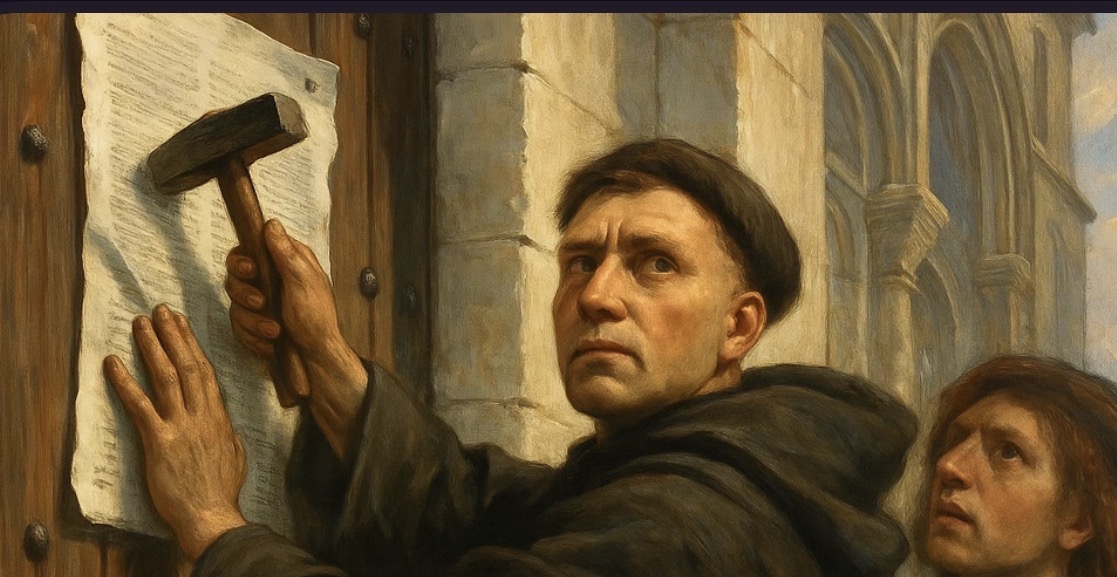
When the Reformation came, this began to change. Luther, Huss, Wycliffe, and others once again proclaimed that salvation comes through faith alone. They translated the Bible and opened the light. But even then division began. With every new group that broke the chains, new doctrines emerged. What was meant to be one body once again fractured into opinions and directions. History repeated itself — just as Israel, after every deliverance, sought a new idol, so the Church, after every reformation, began to follow a new doctrine.
From the Reformation onward, the Church began to tear apart: Lutherans, Reformed, Anglicans, Baptists, Methodists — and later thousands of denominations. The one Body broke into factions, each with its own teaching, ritual, and identity. The division Stephen addressed in his time simply took on a new name. He warned against the spirit of division caused by the princes of the air — those powers that incite nations and people to build their own doctrine, their own truth, and their own kingdom. And here we see exactly the same pattern repeated. After every reformation, the spirits of pride and doubt exerted their influence again. Every people, every nation, every church group began to establish its own teaching, as if the Holy Spirit were a liar who brings different truths.
Thus the Body of Christ, which was meant to be one, began to break under the pressure of unseen powers, protected by people through the removal of the history that exposes them. The unity of the Spirit was exchanged for the consensus of men. And the spirit that had Stephen stoned still lives — this time in people who think they are protecting the truth, but in reality are helping to tear it apart.
Why? Because people once again exchanged the Spirit for structures. They began to build churches instead of people. What started as liberation from false authority ended in new human authority. Today there are thousands of denominations, all with different teachings, all with their own “truth”. And yet all claim to follow the same Christ. This is the proof of spiritual war — the enemy could not destroy the Church, but he divided her and made the Holy Spirit out to be a liar.
Where prophecy was originally meant to warn, it is now used to entertain. The end times are, for many, nothing more than a debate topic or a film theme. And the law of God — the holiness that once set the Church apart — has now been almost entirely abolished. Churches openly say that sin is acceptable “if your heart is right”. They call rebellion “being authentic”. They say, “God understands.” Yes, He understands very well that the Church has excluded Him — He understands so well that He is going to pour out His wrath on the world. But He does not change.
The results are clear. The Church has lost her fear of God, and with it her authority. The devil no longer needs to possess people — they follow him willingly, in the name of love and tolerance. Preaching about the cross has been replaced with motivational talks. Prayer for holiness has been replaced with requests for prosperity. And the word “sin” is hardly used anymore, even from pulpits.
That is why the world now rules as it does. The restrainer — the true, Spirit-filled Church — is becoming smaller, while the world church is growing larger. The remnant cries out, but few listen. For what looks like religion is no longer from God.
And just as in Stephen’s time, those who proclaim the truth are once again “stoned” — not with rocks, but with words. The true Church today is the restrainer, the small handful who still stand for the truth and hold back the darkness. But the world, even the so-called Church, fears them and tries to silence them. They are slandered, pushed aside, removed from platforms, and mocked as extremists. Yet they remain standing — because the Spirit within them is stronger than the spirit in the world.
The spirits Jesus cast out in His day now walk freely in churches. They hold hands with preachers, sing in choirs, and speak in names that are no longer holy.
And yet, in the midst of this darkness, God still keeps His remnant. They are few, but firm. They understand that the Spirit still dwells in them and that they are the only reason the world has not yet collapsed into total chaos. They are the restrainer — the last wall against the flood of evil. When the rapture takes place, this wall will be removed, and then the world will see what it means when God’s Spirit is no longer present. The restrainer will be gone, and the powers of the air will have free rein. They will take over nations, control governments, and plunge people into total deception.
But the most shocking part is this: many of them will still be sitting in their church pews. They will still sing, still preach, still believe they are serving God — but the Spirit will no longer be there. The church buildings will be full, but the Light will be extinguished. The people left behind will realise that they were only part of a religion, not part of the Body of Christ.
For now, the remnant still stands. They carry the Golden Thread — the truth that began in Eden and has been preserved through the ages, through blood, fire, and persecution. But time is running out. The world has made its choice, and the Church has turned her back. When the trumpet sounds, there will be only two groups: those who are taken away, and those who remain behind in the darkness they themselves chose.