Modern Human Decay
By Andre Eksteen
As we progress further into the age of rapid technological advancements, humanity stands at the precipice of profound spiritual and ethical dilemmas. In ancient times, Lucifer and his army of rebellious angels sought to corrupt humanity by altering God’s creation through interbreeding, producing a hybrid race known as the Nephilim. Today, the spiritual battlefield has shifted from the physical realm of angelic offspring to the domain of scientific and technological innovation. Lucifer’s influence now manifests through humanity itself, as we embrace genetic manipulation, gender fluidity, and transhumanism—each a tool in the corruption of God’s pure human lineage.
The allure of forbidden knowledge and the desire to transcend our mortal limits drive these advancements. This is nothing new. In the Garden of Eden, Satan tempted Eve with the promise of godlike wisdom, and she fell prey to the allure of knowledge outside the boundaries set by God (Genesis 3:5). Today, that same temptation surfaces in humanity’s relentless pursuit of genetic control and self-augmentation. What began as a desire to understand creation has evolved into a mission to rewrite it, placing humanity on a collision course with divine judgment.
One of the clearest signs of humanity’s moral and spiritual decay is how casually God’s name is taken in vain in our daily lives. It has become so normalized that even many who claim to be Christians fail to recognize the gravity of this sin. God commanded in no uncertain terms, “You shall not take the name of the Lord your God in vain, for the Lord will not hold him guiltless who takes His name in vain” (Exodus 20:7). Yet, the very name of the Creator, the one who formed the heavens and the earth, is now reduced to a cuss word, a casual exclamation, or worse, a meaningless abbreviation: “OMG.”
This isn’t limited to those who openly reject God. Many who profess to be Christians flippantly misuse His name in their conversations, entertainment, and moments of frustration. This is not merely an innocent slip of the tongue. It is a profound indicator of a heart that does not reverence the Lord. Jesus Himself said, “For out of the abundance of the heart, the mouth speaks” (Matthew 12:34). If you can casually misuse God’s name, what does that reveal about your relationship with Him?
Those filled with the Holy Spirit cannot take part in this behavior without deep conviction. The Spirit of God leads His people into truth and holiness, stirring reverence for His name. Habitual misuse of God’s name without repentance is a dire warning. The Bible declares, “No one who is born of God practices sin” (1 John 3:9). Those who consistently desecrate the Lord’s name yet call themselves Christians are living in deception and are not truly saved.
In today’s society, the normalization and even celebration of sin reflect a moral decay that far exceeds the days of Sodom and Gomorrah. What God has called an abomination, humanity now calls progress. Homosexuality, fornication, adultery, gender confusion, pornography, abortion—the list goes on—are no longer just tolerated but celebrated, with entire movements built around their normalization.
Today, such actions are not only accepted but celebrated, and anyone who dares to speak against them is labeled hateful, bigoted, or intolerant—as I can attest myself, being shunned for taking a stand. Standing for God’s truth often comes at a cost, but it is a price we must be willing to pay.
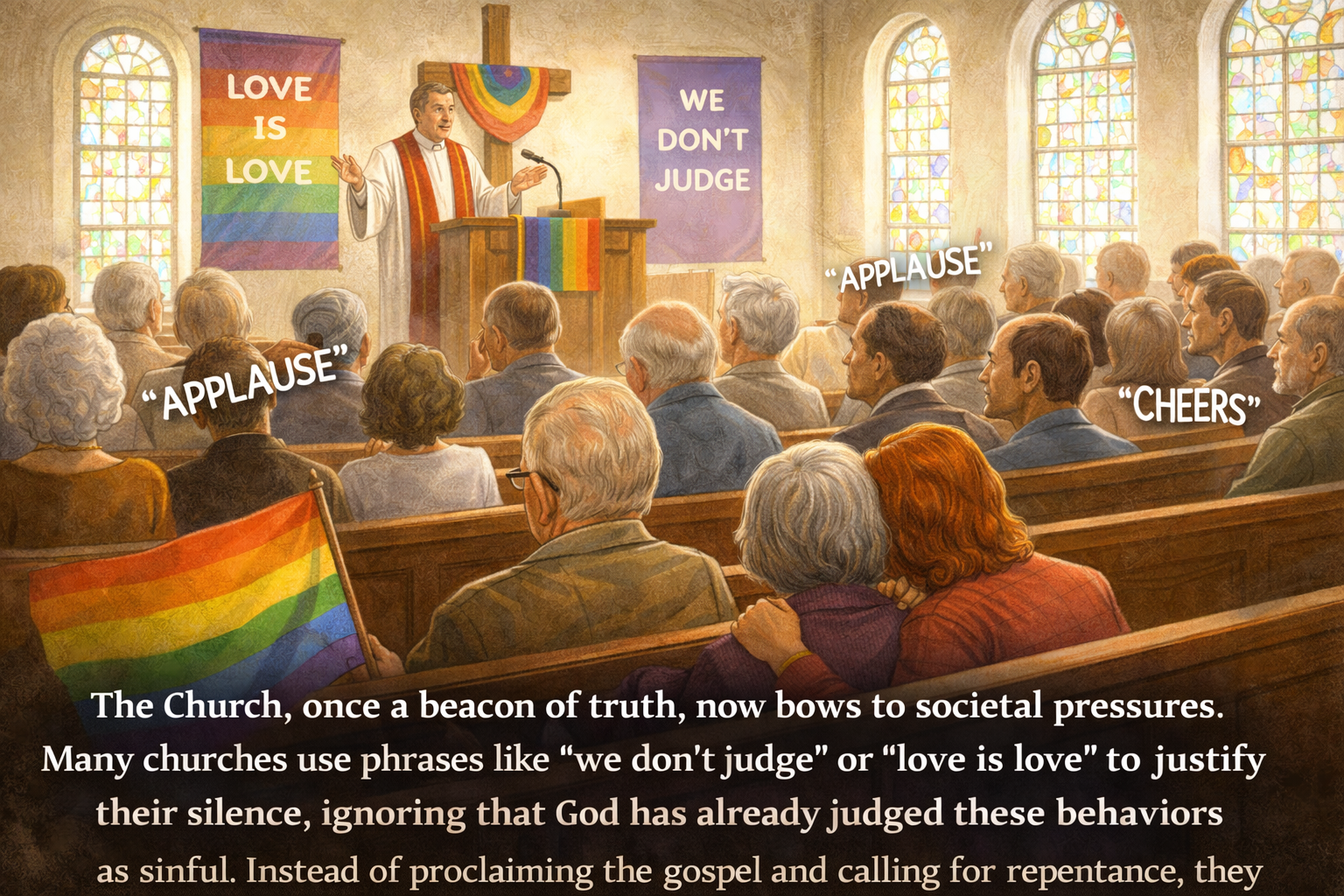
The Church, once a beacon of truth, now bows to societal pressures. Many churches use phrases like “we don’t judge” or “love is love” to justify their silence, ignoring that God has already judged these behaviors as sinful. Instead of proclaiming the gospel and calling for repentance, they choose comfort and popularity over obedience to God. By doing so, they fail in their mission as the salt and light of the world.
Do you fear man and the opinions of this world more than you fear God? Jesus said plainly, “Do not fear those who kill the body but cannot kill the soul. Rather fear Him who can destroy both soul and body in hell” (Matthew 10:28). If you prioritize avoiding persecution over standing firm in God’s truth, you risk losing your soul.
This isn’t about hate; it’s about truth. God’s Word does not change with cultural trends. Homosexuality, gender confusion, and all forms of sexual immorality are as much an abomination to God today as they were in the days of Sodom and Gomorrah. To condone sin is to stand in opposition to God. To remain silent is to participate in that rebellion.
The development of CRISPR gene-editing technology is widely heralded as one of the greatest scientific achievements of our time. While its promise appears noble, the risks and ethical concerns are equally profound. When Chinese scientist He Jiankui revealed in 2018 that he had used CRISPR to modify the DNA of twin girls, the world witnessed humanity crossing a threshold that had long been considered sacrosanct.
By editing the human genome, we move beyond healing into the realm of creation—a space meant solely for God. The Bible teaches the sanctity of life and God’s role as Creator. Just as the fallen angels introduced corruption into the human lineage, humanity now participates in a similar rebellion by rewriting the genetic code. In the hands of those eager for control, CRISPR technology becomes a modern forbidden fruit—a pathway to corruption and chaos.
Transhumanism—the belief that humanity can transcend its physical and mental limitations through technological augmentation—is the next frontier in Lucifer’s rebellion. This ideology envisions a future where humans merge with machines, gaining superhuman abilities, extended lifespans, and perhaps even digital immortality. Elon Musk’s Neuralink exemplifies this pursuit, promising to merge human consciousness with artificial intelligence.
Yet this vision of immortality is a counterfeit salvation, echoing Satan’s ancient lie in Eden: “You will be like God” (Genesis 3:5). Transhumanism offers an illusion of godlike power, but it leads humanity further from God’s truth.
Jesus warned, “As it was in the days of Noah, so it will be at the coming of the Son of Man” (Matthew 24:37). What were the days of Noah like? They were days marked by corruption, violence, and rebellion against God’s natural order. The Nephilim—the offspring of fallen angels and human women—polluted the Earth, leading to judgment through the flood.
Today, we see the same patterns of rebellion. Humanity once again attempts to transcend its limitations, merge with technology, and corrupt God’s creation. The parallels are undeniable, and so is the mocking spirit that accompanies it.
Peter wrote, “In the last days scoffers will come, scoffing and following their own evil desires. They will say, ‘Where is this ‘coming’ He promised?’” (2 Peter 3:3–4). This mocking spirit permeates modern culture. People ridicule the idea of judgment, dismiss prophecy, and deny the reality of the spiritual battle raging around them.
But as in the days of Noah, the mocking will cease when judgment arrives. Those who mocked Noah likely laughed as he built the ark, but their laughter turned to terror when the rain began to fall. So too will those who mock God today face the reality of His judgment.
The final deception is unfolding before our eyes. Genetic manipulation, transhumanism, and the normalization of sin are not mere cultural shifts—they are spiritual battles that require discernment and courage. Are you prepared to stand for God’s truth in a world that mocks Him? Will you bow to the pressures of this world, or will you stand firm in the faith, knowing that the victory is already won through Jesus Christ?
The time is now. Choose this day whom you will serve.