From Genesis to Revelation: The One Story – The Golden Thread that Explains Everything – Part 10
By Andre Eksteen
And now we come to the part that makes most people uncomfortable — the formation of nations, cultures, and even skin colours.
And so all the different groups moved away from Babel — north, south, east, and west — each to its own territory where they resettled. They did not wander aimlessly; they were guided by the heavenly princes whom God Himself had appointed over them when He “set the bounds of the people according to the number of the sons of God” (Deuteronomy 32:8).
Here the great division of mankind begins. Babel was not only a break in language — it was a break in spiritual authority. Every nation received its own heavenly prince, its own spiritual guardian, its own governing spirit. That is why the history of every nation is accompanied by its own set of gods and rituals. They did not invent new gods; they simply began worshipping the heavenly beings that had been appointed over them.
The world therefore began to move in two patterns: the nations under their heavenly princes — and the people who belonged directly to God.
“But the LORD’s portion is his people; Jacob is the lot of his inheritance.”
(Deuteronomy 32:9)
Although the blood trail of the pure Adamic line becomes fainter here, any skilled tracker can still follow it. Among all these pagan nations there were members of both bloodlines — that of Adam and that of Satan — as we have already seen at Babel and will prove again later. Yet there was only one group that remained a pure Adamic line. God chose that line as His people. They had no heavenly prince, because they had God Himself. This is important to understand here, especially when we later come to God’s strict stance against sexual corruption: He wanted to keep His people’s bloodline pure.
The Bible confirms that this separation was not only spiritual, but also physical and historical. What was divided in heaven soon became visible on earth.
Pay close attention: the events of Genesis 10 — the division of the descendants of Japheth, Ham, and Shem — began before Babel, but only became fully visible after Babel. Genesis 10 is the Table of Nations: a retrospective written by Moses to show where the nations eventually ended up after the confusion of languages. That is why you already read there (10:5) “each according to his language” — which implies that Genesis 11 (Babel) had already occurred when the list was compiled.
The chronology is simple:
- Genesis 10: genealogies and eventual distribution,
- Genesis 11:1–9: the Babel event,
- Genesis 11:10–32: focus on Shem’s line down to Abram.
In other words: God had already commanded, “Be fruitful and multiply and fill the earth” (Genesis 9:1), but at Babel mankind refused. Only when God confused the languages did they truly spread — and that determined the map of the nations.
Thus the three main lines found their places:
• Japheth moved north and west — the peoples of Europe and the islands of the sea.
• Ham moved south — Egypt (Mizraim), Canaan, Cush (Ethiopia), and Put (Libya).
• Shem settled east and north-east — Aram, Asshur, Elam, and Eber, from whom Abram would later be born.
But this spread determined more than geography — it determined blood.
From Ham’s line, through Canaan, the corrupt seed of Satan began to surface again, just as God had foretold through Noah:
“Cursed be Canaan; a servant of servants shall he be unto his brethren.”
(Genesis 9:25)
At the same time, Noah pronounced the blessing:
“Blessed be the LORD God of Shem.”
(Genesis 9:26)
There the division began — curse and blessing in two opposing bloodlines. Shem’s line would become the Golden Line — the path through which God would reveal Himself to the world.
Between them moves a third line — Japheth. His name (Yefet) means “expansion,” exactly as Noah prophesied over him:
“God shall enlarge Japheth, and he shall dwell in the tents of Shem.”
(Genesis 9:27)
Japheth’s descendants would spread widely — north and west — but under the spiritual shadow of Shem. Japheth carries the pure Adamic inheritance among the nations, but without the covenant that would later come through Abram. They preserve much of the physical and cultural heritage; Shem carries the covenant.
Meanwhile Ham’s line moves south — into Africa — and the old knowledge of Babel is revived in Egypt: gods, magic, and the worship of dead kings.
Thus the earth follows three paths:
Shem — the line of promise,
Japheth — the line of expansion,
Ham — the line of corruption.
But here something happens that the church does not want to preach and the world does not want to hear: people did not only divide into three main groups and then settle into smaller tribes — they also changed physically.
Natural selection — the same principle seen in animals — adapted human appearance to environment over centuries. Place a short-haired and a long-haired dog in Antarctica, and over generations only the long-haired line survives; even that line continues to change to survive better. Thus a breed develops that is uniquely adapted to that environment.
The same applies to humans:
• Northern groups developed lighter skin (vitamin D availability, low-UV environments), lighter hair and eyes adapted to snow and low light.
• Southern groups — especially from Ham’s line — developed darker skin (UV protection) and curly hair (heat dissipation).
• Intermediate regions (deserts, coasts, forests) produced their own variations. Thus we have the ethnic diversity we know today.
But do not fall back into the old error of the Sethite doctrine:
These physiological differences have nothing to do with bloodline.
This is biology, not theology.
Natural selection, not spiritual change.
What did happen to the bloodline is something else entirely: Satan’s seed — which spread from Ham — divided into subgroups that later became nations. They did not disappear; they differentiated. That is why we later see the Anakim, Rephaim, Emim, and Zamzummim — all giant peoples, all from the same corrupt line that confirms Noah’s curse over Canaan.
The pagan world therefore separated not only in language and culture, but also in blood. Nations within nations; peoples within peoples. Even the pure Adamic line eventually divided internally, while the original Nephilim line mixed with ordinary people — leaving the world only a shadow of the original creation.
That is why Genesis 6 says:
“All flesh had corrupted its way upon the earth.”
Those words do not only describe Noah’s days; they show what began again after Babel: a world full of people — but not all human.
And now, out of this divided humanity — the world after Babel — the first great civilisations begin to rise. Not by chance, but by blood.
Remember: knowledge travels with seed.
Ham’s line carries Babel’s architecture, mathematics, astronomy, and spiritual technology with them. Wherever they go, the same pattern takes root: temples, gods, ancestor worship, blood sacrifices.
The first great empire from Ham is Egypt (Mizraim) — Ham’s son (Genesis 10:6). That is why Egypt runs like a red thread through the Bible — it is not merely a country; it is a spirit: pride, magic, control.
Egypt builds the first organised priesthood that tries to manipulate heaven through knowledge rather than obedience. Stars are mapped, pyramids are erected according to astronomical patterns; the separation between heaven and earth is ritually “encoded.” It is the spirit of Babel, cast in stone.
Even the hieroglyphs say it: the signs were never merely a human language, but also a god-language — symbols as keys for contact. That is why the Book of the Dead is not a manual for dying, but for crossing — through gates God had closed.
But Egypt was not alone. In the east, Sumer rises on the plain of Shinar — where Babel stood. Their tablets name Anu, Enki, Enlil, Inanna — the same beings who later appear under new names in Egypt, Greece, Rome, and elsewhere.
Notice this: their kings are rarely just “men.” Dynasties call their rulers “sons of the gods” — semi-divine. Exactly the pattern of Genesis 6.
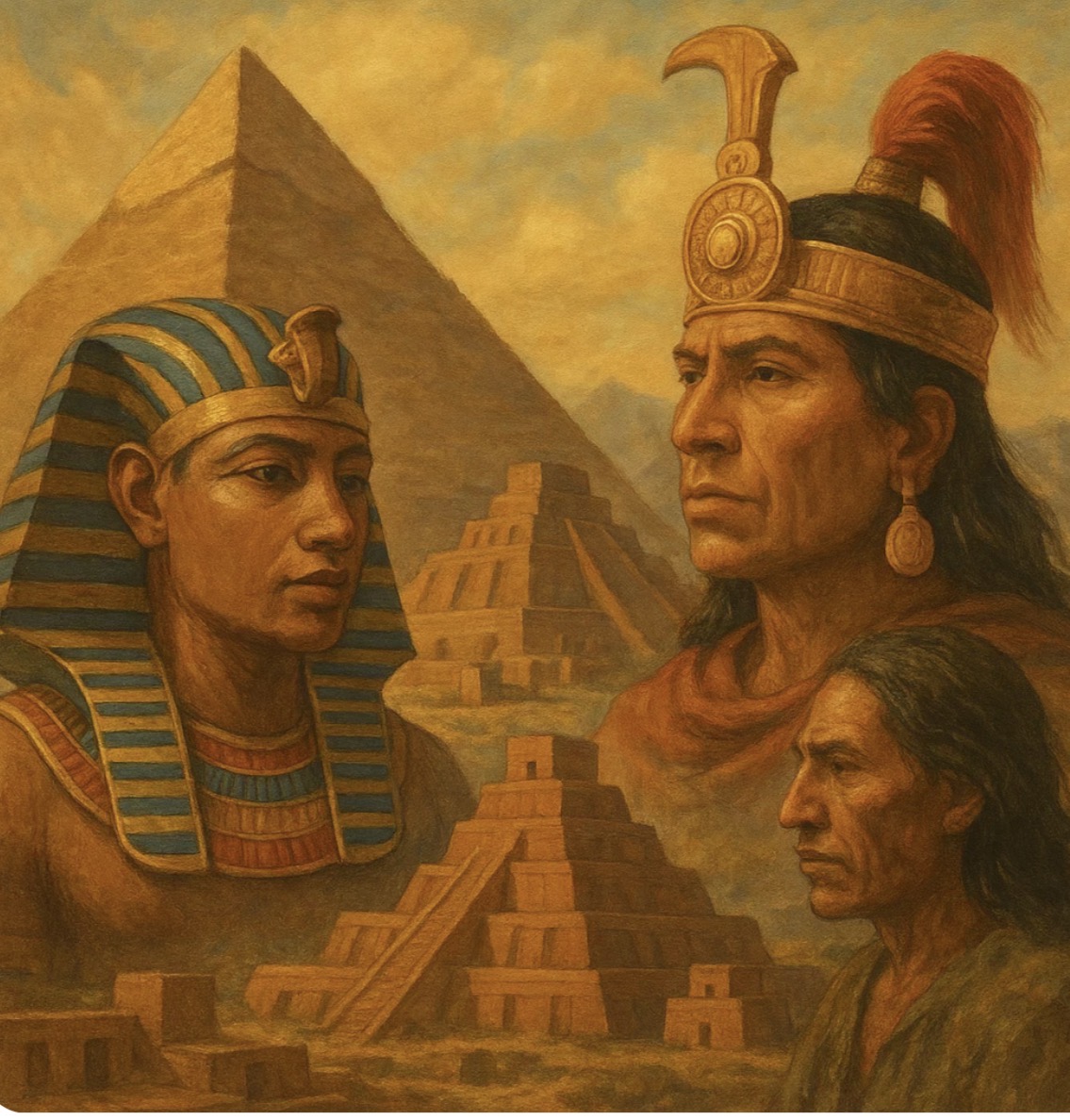
The Indus Valley develops at the same time: water systems, geometry, heavenly beings with animal faces. Across the world, the Maya and Inca build steps, towers, and altar sacrifices — the same archetype as Babel and Egypt.
This is not coincidence. These peoples did not visit one another — they share a common origin: Babel is the seed; the nations are the fruit.
What you see is Babel’s knowledge spread through Ham’s descendants. And every culture carries the same spiritual signature:
• a divine king,
• a temple tower,
• a star calendar,
• and blood sacrifices to the heavenly beings they call gods.
That is why Amos 9:7 says:
“Are ye not as children of the Ethiopians unto me, O children of Israel? saith the LORD. Have not I brought up Israel out of the land of Egypt? and the Philistines from Caphtor, and the Syrians from Kir?”
God shows: He knows the origin of every line. He says: “I know who your fathers were; I know what blood flows in you.”
The world fractures into civilisations after Babel, but every civilisation still carries the old Babel spirit.
The temple towers of Ur, the pyramids of Egypt, the ziggurats of Sumer, the sun pyramids of the Maya — they are all the same root, different branches.
Babel was never just a city — it was the seed of the world’s false religion.
Ham’s descendants were its carriers.
In Part 11 we will turn to Shem’s line — because from here on the Word follows their path, and the rest of the Old Testament must be understood through this lens. We will see how God begins to build His promise through Abraham, the man in whom the Golden Thread becomes visible again.
But we will also briefly look at Japheth’s descendants — the so-called “sleeping line” that moved quietly in the background for centuries. They were the carriers of the Adamic inheritance without the covenant, the silent keepers of order, knowledge, and language — a line that would only be activated much later in the Bible when the gospel goes out to the nations.