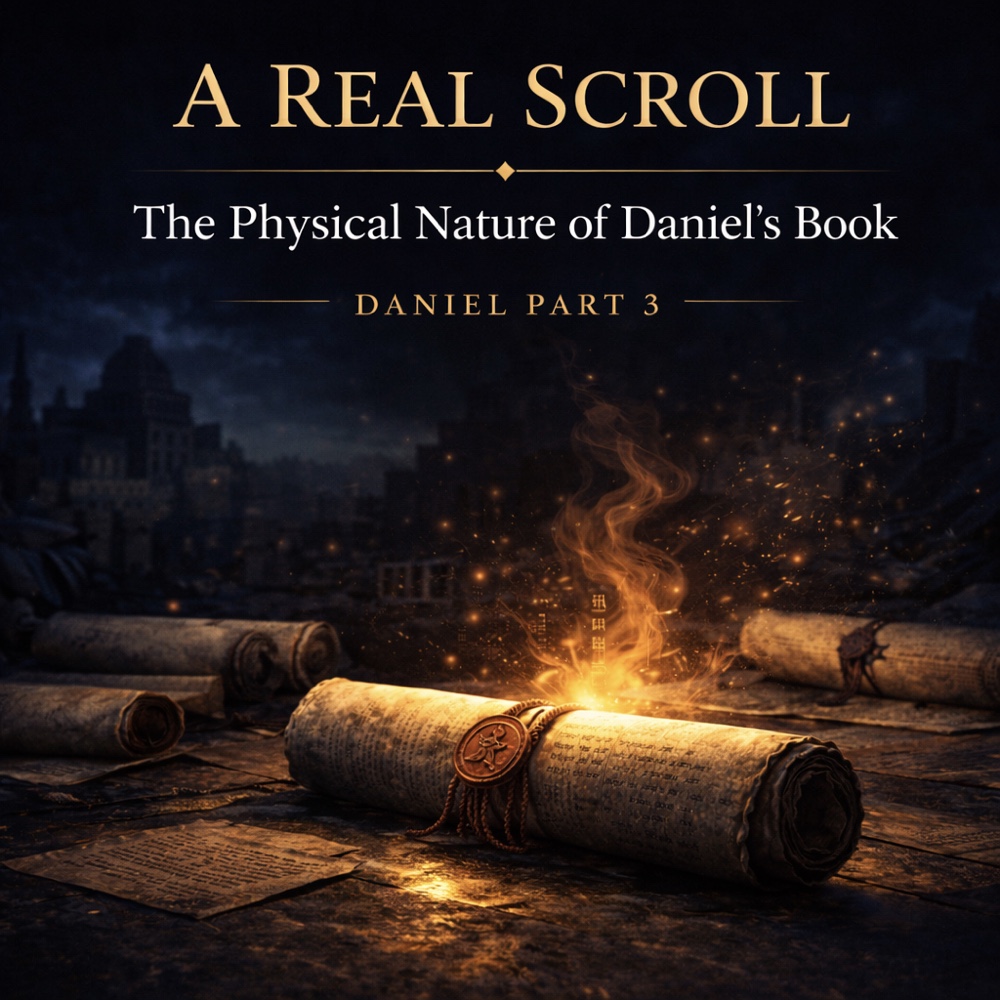
A Real Scroll: The Physical Nature of Daniel’s Book – Daniel Part 3
By Andre Eksteen
If you have followed carefully so far, you already see where most people go wrong.
They read “seal the book” and immediately jump to conclusions. Either they think the book was hidden somewhere — buried, lost, removed from history — or they assume that because we have the text today, everything must already be fully understood.
Both positions miss the point.
Because the text never says the book was lost. And it never says it was fully open either. It says it was sealed. And if you understand that properly, the next question becomes unavoidable.
What kind of book are we actually talking about?
Not in theory. Not in theology. In reality.
Because if Daniel was told to seal the book, then you are dealing with something real. Something written. Something that existed in the physical world. Not a metaphor. Not an idea floating around. A book.
And this is where modern thinking quietly shifts the ground without people noticing. When people talk about Scripture today, they often treat it like a concept instead of something that moved through real history. They speak about “the Bible” as if it just exists — complete, untouched, always accessible. But that is not how it worked.
Daniel did not write a bound Bible. He wrote on scrolls. Handwritten. Copied by hand. Carried from place to place. Preserved through effort, discipline, and in many cases, risk. That alone should change how you read this. Because now you are not dealing with abstract theology. You are dealing with something that could be held, copied, damaged, preserved, or lost.
So when God says “seal the book,” He is not speaking into a vacuum. He is speaking about something that physically exists. A written record.
Now let us ground this properly.
Daniel lived during the Babylonian exile. He was taken into a foreign empire, served under kings, and received visions that stretched far beyond his lifetime. When he wrote, he wrote into that world. That means his words entered history at a specific point. They did not appear centuries later out of nowhere. They began there. And from that moment, they had to be preserved.
Think about that. Every word Daniel wrote had to pass through generations. Copied. Handled. Stored. Moved. And yet here we are today, still reading those same words. That is not accidental. That is preservation. And preservation does not happen without intention.
Now here is where it becomes important for your thinking.
If the book existed physically and moved through history, then “sealing” cannot mean it disappeared. Because clearly it did not. So again we come back to the same conclusion. The sealing is not about the existence of the book. It is about the accessibility of its meaning.
Now let me take you one step deeper. Because this is where people begin to get uncomfortable.
If Daniel’s words were written, copied, and preserved, then people throughout history had access to them. They could read Daniel. They could study Daniel. They could teach Daniel. And still, the book remained sealed.
That should unsettle you. Because it tells you something very direct.
Access to Scripture does not guarantee understanding of Scripture.
You can hold the truth in your hands and still not see it. You can read it, quote it, even teach it — and still miss what God is actually saying. That is not a theory. That is exactly what Scripture itself shows. When Christ came, the people who knew the Scriptures best were the ones who rejected Him. They had the text. They had the prophecies. And yet when the fulfilment stood in front of them, they did not recognise it.
Why? Because something was still sealed. Not the words. The understanding.
Now bring that back to Daniel. If the book is real, if it is physical, if it moves through history and yet remains sealed — then you are dealing with something very precise. The words are fixed. The meaning is controlled. God does not change the text. He governs when it is understood. That is a completely different way of thinking than what most people are used to.
We assume that once something is written, it is open. God says otherwise.
Now let us deal with another assumption that quietly sits underneath most modern teaching.
People often speak as if Scripture was always treated the same way throughout history. That is not true. Different communities handled the text differently. Some preserved it carefully. Some copied it with discipline. Some studied it deeply. Others misunderstood it. And that matters. Because it means the journey of the text through history is not neutral. It is shaped by those who handle it.
Think about that in relation to Daniel. His words did not sit untouched. They moved. Through empires. Through cultures. Through generations. And at every step, someone had to decide how to handle them. Preserve them. Copy them. Ignore them. Or misunderstand them.
That tells you something important. The existence of the book is one thing. The handling of the book is another.
And that is where things begin to diverge. Because once human hands are involved, interpretation enters. And once interpretation enters, variation follows. Not in the text itself. But in how it is understood. And that brings us back again to the word “sealed.” Because if the book is moving through history but the understanding is not fully open, then you must accept something. People were reading Daniel through incomplete frameworks. They were trying to make sense of something that was not yet fully unlocked. And in doing that, they would naturally begin to fill in gaps. Make connections. Build ideas. Some of those would be close. Some would miss the mark. But all of them would be limited.
Now pause there. Because this is where the modern reader needs to be careful.
We often look back and assume that because something is ancient, it must be closer to the truth. But that is not always the case. Earlier does not automatically mean clearer. If the words were sealed until a certain time, then earlier generations were still working within that limitation. That should remove the idea that any one historical interpretation has final authority. Only the text does.
Now let me bring this back to something very simple.
Daniel wrote a real book. That book existed physically. It was copied and preserved. It moved through history. And yet, according to God’s own words, it remained sealed.
That combination should shape how you approach everything that follows. Because now you are not chasing a lost document. You are dealing with a preserved one. Not something hidden away forever. Something carried forward.
And that means the question is no longer, “did the book exist?” That has already been answered.
The question is — what happened to it as it moved through history? Who preserved it? How was it handled? And at what point does something shift from being sealed to being opened?
We are getting closer to that. But if you rush it now, you will miss the foundation. Because if you do not understand that Daniel was dealing with a real, physical book that moved through real history, you will start building conclusions on assumptions again. And once that happens, you are back where everyone else is.
Confident. But not aligned.
So before we move forward, hold onto this. The book was real. The words were preserved. The meaning was sealed. And that means the story of Daniel is not just about what was written. It is about what happened to those words after they were written.
That is where we go next.