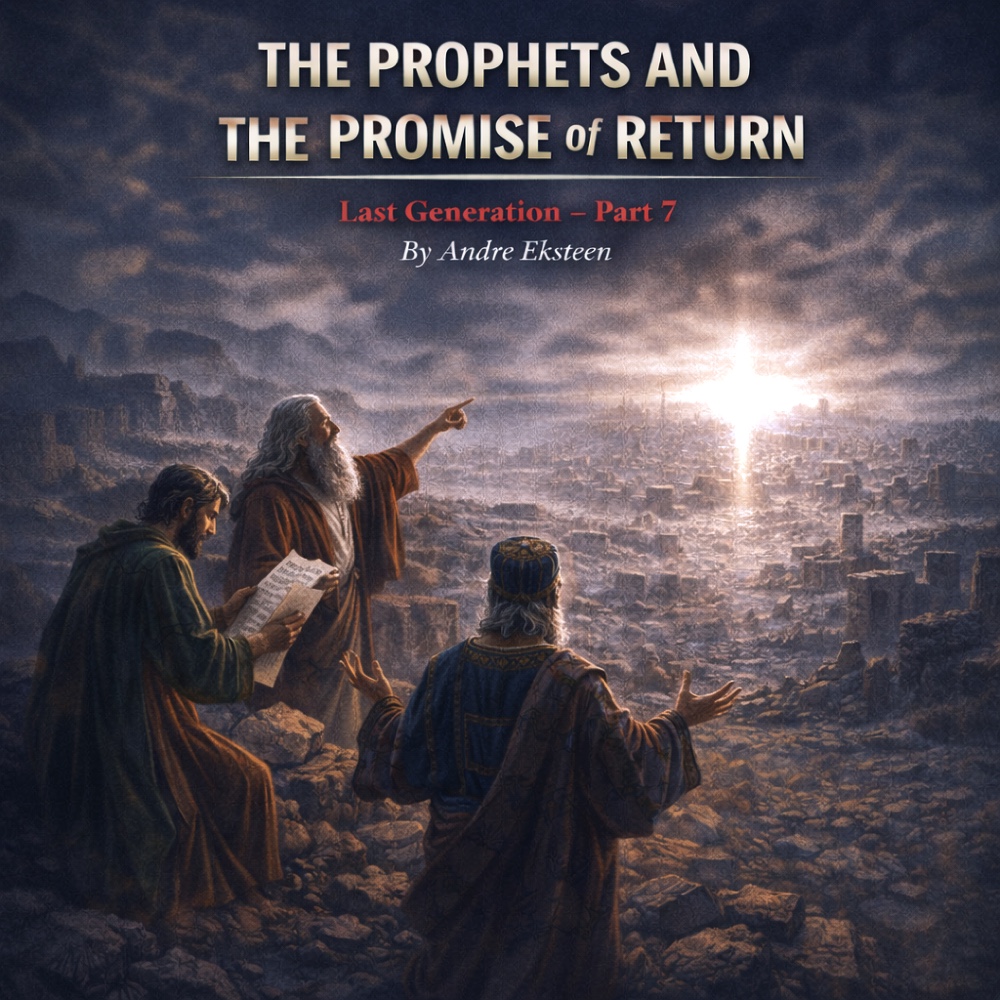
The Prophets and the Promise of Return – Last Generation Part 7
By Andre Eksteen
If you read Scripture honestly, you will notice something that simply refuses to go away. Even in the middle of judgment, even in the darkest passages of exile, even when the text is describing the complete dismantling of everything Israel had built — God keeps speaking about return. Not vaguely. Not in coded language that requires a specialist to decode. Directly, specifically, with geographical detail and covenantal weight. And that creates a tension that most people who write about prophecy do not deal with properly. They resolve it too quickly in one direction or the other, and in doing so they miss what the text is actually doing.
On one side, you have the historical reality we traced in Part 6 — Israel scattered, broken, dispersed across the nations for centuries, the land under foreign control, the temple gone, the covenantal structure dismantled. That is the observable fact. It lasted for a very long time. On the other side, you have promise after promise, from prophet after prophet, speaking about a return that goes beyond anything that had happened up to the time of writing — a gathering from all nations, a restoration of the land, a transformation of the people, and a renewed relationship between Israel and God. These two realities sit in tension. And how you handle that tension determines almost everything else about how you read the prophetic literature and how you evaluate modern events in the Middle East.
So let us go back into the text. Not to cherry-pick the passages that support a predetermined conclusion, but to read what is actually there — both the breadth of the promises and the specific character of what they describe. Because until you know precisely what was promised, you cannot assess the degree to which any historical event represents its fulfilment.
The Consistency of the Promise
The promise of return is not confined to one prophet or one period. It runs through the prophetic literature with a consistency that is hard to explain away if you are reading honestly. Jeremiah, Ezekiel, Isaiah, Amos, Zephaniah, Zechariah — they all speak to it, each from their own historical context, each with their own emphasis, but all pointing in the same direction.
Jeremiah 30:3 — “For, lo, the days come, saith the LORD, that I will bring again the captivity of my people Israel and Judah, saith the LORD: and I will cause them to return to the land that I gave to their fathers, and they shall possess it.” Return. To the land. Possess it. These are not metaphors. Jeremiah was writing to people who had been physically removed from a physical land, and he was telling them, on behalf of God, that they would physically return to it. The language is as concrete as it gets.
Ezekiel 36:24 — “For I will take you from among the heathen, and gather you out of all countries, and will bring you into your own land.” Gather. From all countries. Not from one country, not from Babylon specifically, but from all countries. Into your own land. Again, the specificity is striking. This is not a description of the partial return from Babylon under Cyrus. The Babylonian exile involved one country, one deportation, one return. What Ezekiel is describing is something categorically larger — a gathering from the entire diaspora, from every nation where the Jewish people had been scattered across the centuries.
Amos 9:14-15 — “And I will bring again the captivity of my people of Israel, and they shall build the waste cities, and inhabit them; and they shall plant vineyards, and drink the wine thereof; they shall also make gardens, and eat the fruit of them. And I will plant them upon their land, and they shall no more be pulled up out of their land which I have given them, saith the LORD thy God.” Plant. Build. Inhabit. And then — critically — “they shall no more be pulled up out of their land.” That phrase is a permanent establishment, not a temporary return. It describes a restoration that, once achieved, is final. The people are planted and stay planted. Whatever your view of when this prophecy is fulfilled, you cannot read “no more be pulled up” and apply it to the return from Babylon, because that return was followed by centuries of further displacement. If the promise means anything, it describes something that has not yet fully happened.
Zephaniah 3:19-20 — “Behold, at that time I will undo all that afflict thee: and I will save her that halteth, and gather her that was driven out; and I will get them praise and fame in every land where they have been put to shame. At that time will I bring you again, even in the time that I gather you: for I will make you a name and a praise among all people of the earth, when I turn back your captivity before your eyes, saith the LORD.” The gathering is global. The transformation involves honour replacing shame. And it is tied to a specific time — “at that time” — that is clearly associated with the broader eschatological events Zephaniah describes in the surrounding chapters.
This is consistent. Across different prophets, different centuries, different historical contexts — the same picture keeps emerging. A gathering from all nations. A return to the specific land given to their fathers. A planting that is permanent. A restoration that involves both physical return and spiritual transformation. You cannot read this literature honestly and conclude that it is speaking about something purely internal or spiritual. The physical and geographical specificity is too pronounced for that reading to hold without significant hermeneutical violence being done to the text.
The Two Dimensions of the Promise
Now here is where a critical mistake gets made, and it is worth slowing down to name it precisely. When people see that the prophets describe both a physical return to the land and a spiritual transformation of the people, they tend to handle this in one of two ways — and both ways are incomplete.
The first approach takes the physical promises literally and largely ignores the spiritual ones. It gets excited about land, borders, geopolitics, and the state of Israel’s territory, but pays relatively little attention to whether the spiritual conditions the prophets described are present. This tends to produce a kind of theological cheerleading for the modern Israeli state that treats any development in Israel’s favour as prophetic fulfilment, without asking whether the deeper covenantal conditions are in place.
The second approach spiritualises the physical promises entirely by emphasising the spiritual ones. It says that the real restoration is internal — new hearts, new spirit, knowledge of God — and that the physical return to a geographical land is either already accomplished in the church or irrelevant to the New Covenant. This approach tends to produce either replacement theology or a kind of disinterest in modern Israel’s existence that treats 1948 as politically interesting but prophetically inconsequential.
Both approaches are selective readings. The text gives you both dimensions simultaneously and presents them as inseparable. Go back to Ezekiel 36. Verse 24 gives you the physical gathering — “I will take you from among the heathen, and gather you out of all countries, and will bring you into your own land.” Verse 25 gives you cleansing — “Then will I sprinkle clean water upon you, and ye shall be clean.” Verse 26 gives you internal transformation — “A new heart also will I give you, and a new spirit will I put within you.” Verse 28 ties them together — “And ye shall dwell in the land that I gave to your fathers; and ye shall be my people, and I will be your God.”
The land is there. The spiritual renewal is there. They are not presented as alternatives. They are presented as sequential stages of a single restorative work. Physical return comes first. Spiritual transformation follows. And the completion of the promise requires both. A physical return without the spiritual transformation is real but incomplete. A spiritualised reading that removes the physical return is not a reading of this text — it is a replacement of this text.
Now that framework — physical return followed by spiritual transformation, both necessary, neither cancelling the other — is the right lens through which to evaluate any modern development in Israel’s history. The question is never simply “are Jewish people living in the land?” That can be true while the full prophetic picture is still incomplete. The question is: where in the sequence does the current situation fall? What has been restored? What awaits restoration? And what must yet happen for the full picture the prophets described to be in place?
When Was This Fulfilled?
Now let us address directly the question that the consistency of these promises raises. When were they fulfilled? Or more precisely — were they fulfilled already, are they being fulfilled now, or do they remain ahead?
The standard answer in most conservative Christian circles is that the return from Babylon in 536 BC was the primary fulfilment of these promises, and that any remaining prophetic significance has been transferred to the church. But this answer has serious problems when you hold it against the text.
The return from Babylon was real. Approximately forty-two thousand people returned under Zerubbabel (Ezra 2:64). The temple was rebuilt. The city walls were restored under Nehemiah. Worship resumed. But now compare that return against what Ezekiel and Amos and Zephaniah described. Was the gathering from all countries? No — it was a return from one country, Babylon, by a portion of the exiles. Was it permanent — were they planted so they would no more be pulled up? No — the land remained under foreign domination through Persian, Greek, and Roman periods, and the people were eventually scattered again after 70 AD. Was it accompanied by the spiritual transformation Ezekiel described — new hearts, new spirit, universal knowledge of God — in a way that fulfilled the promise at a national level? No. The books of Ezra and Nehemiah record ongoing spiritual failure and compromise even within the returned community.
The return from Babylon was a partial fulfilment. It is typologically significant — it pointed toward and anticipated a fuller restoration — but it does not exhaust the meaning of the promises. The promises are larger than that event. Their language exceeds what that return accomplished. And the simple test of Amos 9:15 — “they shall no more be pulled up out of their land” — is enough to establish that the promise was not fully satisfied by a return that was followed by centuries more dispersion. A promise about a permanent, final establishment was not fulfilled by a temporary, partial restoration.
Now some will argue that the New Testament reinterprets these promises by applying them to the church. Paul’s use of Hosea in Romans 9, his discussion of the olive tree in Romans 11, his treatment of Abraham’s seed in Galatians 3 — these are complex passages that require careful handling. I am not dismissing them. But I want to make a specific point about interpretive method. When the New Testament reapplies language from the Old Testament, that reapplication does not automatically cancel the original reference. Jesus is described as the true vine, which draws on Psalm 80 and Ezekiel 15 where Israel is described as a vine — but that does not mean that every subsequent use of vine imagery in the New Testament has cancelled Israel’s identity as a vine. The New Testament regularly expands and fulfils Old Testament promises without annulling them. The fullness of the promise includes both the church receiving the blessing of Abraham and the physical descendants of Abraham receiving the fulfilment of the specific geographical and national promises made to them.
Romans 11 is explicit on this point in a way that makes the replacement theology reading very difficult to sustain. Paul asks, “Hath God cast away his people?” and answers his own question: “God forbid.” He describes the current state of Israel’s partial hardening as temporary — “until the fulness of the Gentiles be come in” — and then states plainly: “And so all Israel shall be saved” (Romans 11:26). The context makes clear that this refers to the nation, not just to Jewish individuals who become believers. There is a future, national dimension to Israel’s restoration that Paul presents as certain. Whatever you do with the specifics of how and when, you cannot read Romans 11 honestly and conclude that God is entirely finished with Israel as a distinct covenantal entity.
The Isaiah Picture
Isaiah adds another dimension to the prophetic picture that is worth examining separately, because his language about restoration goes further than any of the other prophets in describing what the completed restoration looks like — and that furtherness is itself important. If you want to know whether any given historical moment constitutes the fulfilment of the prophetic promises, Isaiah gives you the clearest reference point for comparison.
Isaiah 11:11-12 — “And it shall come to pass in that day, that the Lord shall set his hand again the second time to recover the remnant of his people, which shall be left, from Assyria, and from Egypt, and from Pathros, and from Cush, and from Elam, and from Shinar, and from Hamath, and from the islands of the sea. And he shall set up an ensign for the nations, and shall assemble the outcasts of Israel, and gather together the dispersed of Judah from the four corners of the earth.” The second time. That phrase alone is significant. The first recovery was from Egypt. The second recovery is from a global diaspora — from the four corners of the earth. Isaiah is describing a gathering that is categorically larger than the Exodus and categorically different from the Babylonian return. And he places it in the context of what precedes it in chapter 11 — a world under the rule of the shoot from Jesse’s root, in which the wolf dwells with the lamb, in which the earth is full of the knowledge of the Lord as the waters cover the sea. This is eschatological restoration at the fullest possible scale.
Isaiah 43:5-6 repeats the global gathering — “Fear not: for I am with thee: I will bring thy seed from the east, and gather thee from the west; I will say to the north, Give up; and to the south, Keep not back: bring my sons from far, and my daughters from the ends of the earth.” Every direction. The ends of the earth. Again, the scale exceeds anything accomplished in the return from Babylon. This is a description of something that has either happened in our own time, is happening in our own time, or awaits a fulfilment still ahead. You can make arguments for each of those positions. What you cannot do is honestly argue that it was exhausted in 536 BC.
Isaiah 49:22 adds an interesting detail that has particular resonance with the modern period: “Thus saith the Lord GOD, Behold, I will lift up mine hand to the Gentiles, and set up my standard to the people: and they shall bring thy sons in their arms, and thy daughters shall be carried upon their shoulders.” The Gentile nations are involved in the return. They carry Israel’s sons and daughters. Whatever else you make of that, the British Mandate, the United Nations partition plan of 1947, and the international recognition that followed Israel’s declaration of independence in 1948 are at least suggestive of this pattern — Gentile nations acting, whether intentionally or not, in a way that facilitates the return of the Jewish people to their land. That is not a proof. It is a correspondence worth noting honestly rather than either dismissing or over-reading.
How Prophetic Fulfilment Actually Works
Before we leave this part and move toward the modern events this series has been building up to, it is worth establishing something about how prophetic fulfilment works in Scripture, because misunderstanding this has been the source of enormous confusion in the history of interpretation.
Prophetic fulfilment in the Bible is often layered. A prophecy can have an immediate, partial fulfilment that is real and intended by God, and also a later, more complete fulfilment that the earlier one pointed toward. This is not an evasion of the text. It is a pattern the text itself demonstrates repeatedly. The clearest example is probably Joel 2 and Acts 2. Peter stands up at Pentecost and says, “This is that which was spoken by the prophet Joel” — and then quotes Joel’s prophecy about the outpouring of the Spirit. The Pentecost event was a genuine fulfilment of Joel’s prophecy. But Joel’s prophecy also includes cosmic signs — blood, fire, smoke, the sun turned to darkness, the moon to blood — that did not happen at Pentecost. The full fulfilment of Joel awaits a later moment, of which Pentecost was the beginning. Both fulfilments are real. Neither cancels the other.
The same principle applies to the restoration promises. The return from Babylon was a real, partial fulfilment. The modern return of Jewish people to the land may be another stage of fulfilment — also real, also partial. The complete fulfilment — gathering from all nations, permanent planting, spiritual transformation, Davidic king ruling in righteousness, the earth full of the knowledge of the Lord — remains ahead. And the fact that we may be living through a stage of fulfilment does not mean we should treat that stage as if it is the completion. Pentecost was not the end. It was the beginning of something that is still in motion.
This is the framework that does justice to both the reality of what has happened in modern Israel and the incompleteness of the full prophetic picture. Something real has happened. Something larger is coming. And the generation that sees the full sequence — the complete unfolding from beginning to end — is the generation defined in Matthew 24:34. Whether we are at the beginning of that generation’s moment, in the middle of it, or still approaching it, is the question the rest of this series will press. But you can only press it honestly if you understand what the full sequence involves. And you can only understand that if you have followed the prophetic promises carefully enough to know what completion looks like.
That is what this part has established. The promises are real, they are specific, they are not exhausted by history, and they remain active. The silence has broken. And what broke it, and what it means for where we are now — that is where we are going.
The Promises Remain Active
Now bring all of this back to the practical question. Given the consistency of the prophetic promises, given that the return from Babylon did not exhaust their meaning, given that Paul explicitly affirms a future national restoration of Israel — where does that leave us?
It leaves us with promises that are not cancelled, not fully fulfilled, and not yet complete. They are active. They are moving. The long silence we traced in Part 6 was not a period of cancellation. It was a period of waiting. And the question that Part 7 sets up — the question we will begin to press in the parts ahead — is whether the modern return of Jewish people to the land of Israel, culminating in the establishment of the state in 1948, represents the beginning of the fulfilment of these promises, or a preparatory movement toward a fulfilment that is still ahead, or something else entirely.
That question cannot be answered by counting years from 1948. It can only be answered by measuring what has happened against what the prophets described. The physical dimension of the return is undeniable — Jewish people have returned to the land from many nations, cities have been built in what were waste places, the land that was largely barren under centuries of neglect has been made productive. The language of Amos 9 — building the waste cities, planting vineyards, making gardens — has a resonance with what has happened in modern Israel that is hard to dismiss entirely.
But the spiritual dimension described by Ezekiel — the new heart, the new spirit, the universal knowledge of God among the people, the complete restoration of covenant relationship — is not yet present in the modern Israeli state. It is a secular state. The majority of its population is not living in covenant relationship with God. The temple is not standing. The priesthood is not functioning. The Davidic throne is not occupied. The picture the prophets painted is not yet complete.
Which means we are likely looking at something in the middle of a process. A physical return that has begun. A spiritual restoration that has not yet come in its fullness. A foundation being laid for a completion that remains ahead. That is a very different thing from either dismissing modern Israel as prophetically irrelevant or treating 1948 as the definitive fulfilment of everything the prophets described.
It also means that the generation question — the question this whole series is building toward — cannot be answered without understanding where in this process the full sequence Jesus described in Matthew 24 falls. The return is part of the picture. But it is not the whole picture. And until the whole picture is assembled — until all these things are in view — the generation has not yet been defined. We are still laying the foundations. But the silence has broken. And what breaks silence in Scripture is never random. It is always purposeful. And understanding that purpose is what this series is for.