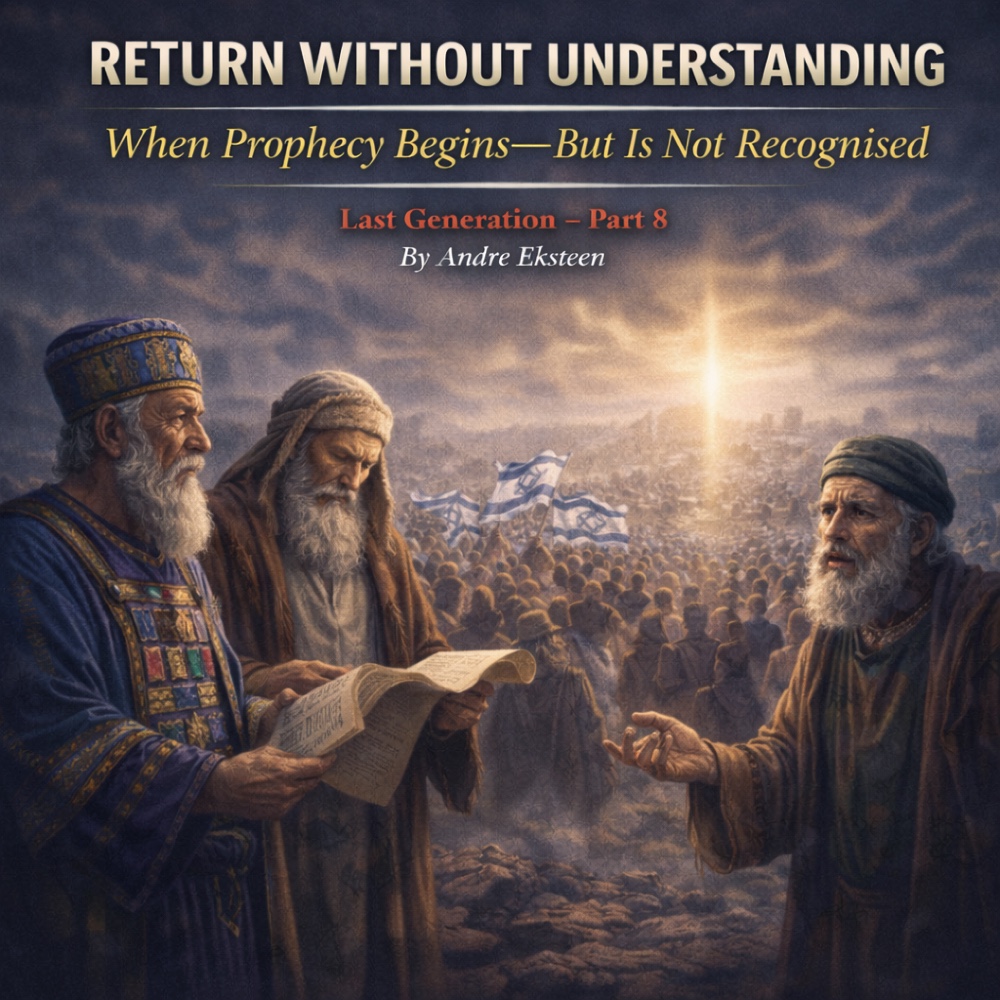
Return Without Understanding: When Prophecy Begins — But Is Not Recognised – Last Generation Part 8
By Andre Eksteen
There is something that happens in Scripture again and again, and if you miss it, you will miss what is happening right in front of you. God moves. Prophecy begins to unfold. Events start aligning. And the people living in that moment — not the indifferent ones, not the outsiders, not the people who never opened a Bible — do not recognise it. The ones who miss it are the ones who had the Scriptures. The ones who studied. The ones who taught. The ones who could quote the relevant passages from memory. They saw the words, but they could not see what was happening. Not because the evidence was hidden. Because they were not looking correctly.
That is not a rare exception in the biblical record. It is the pattern. And if you do not understand it as a pattern — if you treat it as a one-time historical oddity rather than a repeating dynamic that speaks directly to how human beings receive prophecy — then you will approach your own moment in history with exactly the same blind spots that caused people in previous generations to miss what was unfolding right in front of them.
The First Coming and the Pattern It Sets
Go back to the first coming of Christ. Because this is where the example becomes impossible to avoid. The Messiah was promised. Clearly. Repeatedly. Over centuries. The prophets described Him in detail — His lineage, His birth location, the character of His ministry, the nature of His death, even the circumstances surrounding His betrayal and execution. Daniel gave timing. Micah gave geography. Isaiah gave character. The cumulative prophetic testimony to the coming Messiah was about as detailed and specific as prophetic testimony gets.
And the people who had that testimony were ready. They were expecting a Messiah. The expectation was not vague cultural background noise. It was active, urgent, and in some periods almost feverish. First-century Judaism was alive with messianic expectation. Different groups had different frameworks, but the expectation itself was widespread. The Pharisees expected a Messiah. The Essenes expected a Messiah. The Zealots expected a Messiah. The ordinary people in the synagogues and the villages expected a Messiah. The disciples of John the Baptist were asking whether John himself might be the one. The woman at the well in Samaria told Jesus, “I know that Messias cometh, which is called Christ” — John 4:25. This was not a fringe belief. It was mainstream expectation.
And yet when He came, most of the people who had studied the prophecies most carefully rejected Him. The chief priests. The scribes. The Pharisees. The Sadducees. The religious establishment of first-century Judaism — the people whose entire professional and spiritual identity was organised around the Scriptures — looked at Jesus of Nazareth and concluded that He was not the one. They had the evidence. They had the text. They had, in many cases, personal observation of the miracles He performed. And they rejected it.
Why? Not because they were stupid. Not because they were lazy readers. Because they were confident. They had a framework — a detailed set of expectations about what the Messiah’s arrival would look like, what He would do, what political and national role He would fulfil, how the sequence of events surrounding His coming would unfold. And when Jesus did not match that framework — when He rode into Jerusalem on a donkey rather than a war horse, when He washed His disciples’ feet rather than organising a military campaign, when He allowed Himself to be arrested rather than calling down angels — they concluded that the framework was intact and He was the problem. The framework was not questioned. The reality was rejected.
That is how deception works. Not by removing the truth. By shaping expectation so thoroughly that when the truth arrives in a form that does not match the expectation, it is filtered out. Jesus Himself identified this in His exchange with the Jewish leaders in John 5:39-40 — “Search the scriptures; for in them ye think ye have eternal life: and they are they which testify of me. And ye will not come to me, that ye might have life.” They were searching the Scriptures. They were not indifferent. But their searching was producing something other than recognition, because the framework through which they searched was shaping what they were able to see.
Why This Should Unsettle You
Now bring that forward to the present, because this is not merely a historical observation. It is a warning with direct application. If the people most engaged with Scripture, most committed to prophetic study, most certain of their interpretive frameworks missed the first coming of Christ while it was happening around them — what makes anyone confident that the same thing cannot happen with the events surrounding His return?
The disciples themselves did not understand fully until after the resurrection. Even then, in Acts 1:6, they asked Jesus, “Lord, wilt thou at this time restore again the kingdom to Israel?” — still working from a framework that expected an immediate political restoration of Israel’s national sovereignty. Jesus did not condemn them for the question. He redirected them. But He did not give them the information they wanted. He told them that the times and seasons were not for them to know, and that what they needed was the power of the Holy Spirit and the task of witness. Even at the final moment before the ascension, the disciples were still working with an incomplete framework.
Now think about what that means. The people who walked with Jesus, who heard His teaching firsthand, who witnessed His resurrection and ate with Him in the forty days after it — they still had framework issues that affected their understanding of how prophetic events would unfold. If that was true of them, how much more should it give us pause about our own frameworks? We have the completed New Testament. We have two thousand years of theological reflection. We have access to scholarship and commentary that the disciples could not have imagined. And we have two thousand years of the accumulated weight of human expectation pressing down on how we read the text. That accumulated weight is not neutral. It shapes what we see and what we are prepared to accept.
This is not a call to abandon your framework. Frameworks are unavoidable. You read every text through some set of assumptions and prior commitments, whether you acknowledge them or not. The question is not whether you have a framework but whether you hold it loosely enough to have it corrected by the text when the text pushes back. The scribes and Pharisees did not hold their framework loosely. They held it with the kind of certainty that made correction feel like betrayal. And that certainty was what closed their eyes to what they were seeing.
Prophecy Does Not Come Labelled
Here is something about the nature of prophetic fulfilment that Scripture demonstrates repeatedly but that almost nobody talks about when they are building prophetic timelines. Prophecy, as it unfolds, does not come with a label. It does not arrive with a sign in the sky saying “This is the event described in verse fourteen.” It unfolds through real events in real history, involving real people and real politics and real contingencies — and the recognition of its prophetic significance requires exactly the kind of watching that Jesus described. The events are there. Whether any given person sees their significance depends on the posture they bring to the watching.
The clearest biblical example of this, outside the first coming itself, is the Exodus. God told Abraham in Genesis 15 that his descendants would be afflicted in a foreign land for four hundred years and then come out. That was a specific prophecy, given centuries before the event. And yet, when you read the book of Exodus, the Hebrew people in Egypt are not sitting around tracking a timeline to see when the four hundred years runs out. They are suffering. They are crying out. Exodus 2:23 — “and the children of Israel sighed by reason of the bondage, and they cried, and their cry came up unto God by reason of the bondage.” They did not recognise themselves as living in the fulfilment of a prophecy given to Abraham. They experienced themselves as people trapped in an unbearable situation, crying out for relief.
God was responding to their cry. The prophecy was in motion. The appointed time was arriving. But from inside the experience, it looked like suffering without end, not like prophetic fulfilment on schedule. The recognition came later — at the Red Sea, at Sinai, in the narrative retrospect of Psalm 105 and Psalm 106 — not in the middle of the experience itself, where it mostly looked like things getting worse before they got better.
Now apply that principle to any prophetic fulfilment you might be living through. The events that constitute prophetic fulfilment rarely announce themselves as such while they are in motion. They are embedded in history — in politics, in wars, in population movements, in the decisions of governments and the suffering of peoples. The prophetic significance is real, but it is not stamped on the outside of the event. It is recognised by those who know the pattern, who have followed the text carefully enough to see the shape of what is happening, and who are watching rather than locked into a framework that pre-determines what they are prepared to accept.
This is why Jesus’ instruction in Matthew 24 is to watch — not to calculate, not to build systems, not to produce timelines, but to watch. The person who is genuinely watching knows the shape of what they are looking for, can recognise it as it emerges, and is not thrown off course when the details do not conform to inherited expectations. The person who is calculating is looking for confirmation of their arithmetic, not for the thing itself. These are different activities, and they produce different kinds of readers.
The Danger of Confident Misidentification
There is another dimension to this pattern that needs to be stated plainly, because it has direct implications for how you handle any claim about prophetic fulfilment — including claims made in this series. Confident misidentification is more dangerous than honest uncertainty. This sounds obvious, but the pressure of prophetic culture consistently runs in the opposite direction — toward confidence, toward certainty, toward the boldly stated declaration that “this is the moment” rather than the careful “this may be part of what is coming.”
When the religious leaders of Jesus’ day misidentified the Messiah, the consequences were enormous. Not just for them, but for the people who trusted their authority and their certainty. The confidence of the religious establishment was itself an obstacle to ordinary people recognising Jesus, because the people who were most trusted to know — who had spent their lives in the text — were saying He was not the one. Their certainty filtered the perception of the crowds. Misplaced confidence in prophetic interpretation is not a neutral error. It carries other people with it.
The same principle applies in the reverse direction. When someone confidently declares that a specific historical event is the definitive fulfilment of a specific prophecy, the people who trust that declaration will calibrate their entire understanding of subsequent events around it. If the declaration is wrong, or partial, or premature, then everything built on top of it leans in the wrong direction. And when the events that follow do not conform to the expected pattern — because the expected pattern was based on a misidentification — the result is the disorientation and sometimes the faith crises we described in Part 4.
This is why the careful work this series has been doing matters. Not because careful work eliminates the possibility of error. But because it reduces the risk of confident error — the kind that carries other people with it and leaves them with no foundation when the confidence proves to have been misplaced.
The Emmaus Road Principle
Luke 24 contains one of the most instructive passages in the entire New Testament for understanding how prophetic fulfilment gets missed, and it is worth sitting with in detail here because it captures something about the dynamic we are describing that is hard to find so clearly stated anywhere else.
Two disciples are walking from Jerusalem to Emmaus on the day of the resurrection. They are devastated. Their world has collapsed. The one they believed was going to redeem Israel has been crucified and buried. Then Jesus Himself joins them on the road — and they do not recognise Him. They walk with Him, talk with Him, pour out their grief to Him, and do not know who He is. Their explanation for their confusion is revealing: “But we trusted that it had been he which should have redeemed Israel” — Luke 24:21. They had expected a specific kind of redemption. The crucifixion did not fit that expectation. And the mismatch between what they expected and what had happened was so complete that it had produced not just grief but a kind of interpretive paralysis. Even the reports of the resurrection, which had reached them that morning from the women at the tomb, did not penetrate. It was too far outside the framework they were working with.
Then Jesus responds. And what He does is instructive. He does not give them a mystical experience. He does not overwhelm them with a vision. He opens the Scriptures. Luke 24:27 — “And beginning at Moses and all the prophets, he expounded unto them in all the scriptures the things concerning himself.” He walks them through the full sweep of what had been written, and He shows them how the entire trajectory pointed to exactly what had happened — including the suffering. “Ought not Christ to have suffered these things, and to enter into his glory?” — Luke 24:26. The suffering was not a deviation from the prophetic picture. It was central to it. They had missed it because they had built their expectation around the glory without reading carefully enough to include the suffering.
Now apply that to prophetic interpretation today. Most people who study end-times prophecy are, in various ways, doing the same thing those two disciples did on the Emmaus road — building their expectation around the parts of the picture that fit their framework and not reading carefully enough to include the parts that do not. The result is an expectation that is real but selective, and when reality arrives in a form that includes the parts they filtered out, they miss it. Not because they did not have the text. Because they read it through a framework that selectively emphasised some elements over others.
The remedy Jesus applied on the Emmaus road is the same remedy this series is applying — going back through the full sweep of Scripture, following the argument from the beginning, refusing to skip the difficult or unexpected parts, and building a picture that is shaped by the whole text rather than a selection of it. That is not a comfortable process. The disciples’ hearts burned within them as He opened the Scriptures to them — Luke 24:32. It was not comfortable. But it was clarifying. And clarity, even when it is uncomfortable, is better than the warm certainty of a framework that cannot survive contact with reality.
The Disciples on the Mount of Olives After the Resurrection
There is one more New Testament passage worth examining here, because it is the direct precursor to the question about the last generation and it shows exactly how framework issues persist even after the resurrection itself.
Acts 1:6-8. The disciples are with Jesus on the Mount of Olives — the same location where He gave the Matthew 24 discourse. They have spent forty days with the risen Christ. They have received multiple post-resurrection appearances. They have had the Scriptures opened to them in the way Luke 24 describes. And yet their first question when they gather with Him for the last time before the ascension is: “Lord, wilt thou at this time restore again the kingdom to Israel?” They are still working with the political restoration framework. Even after everything — the crucifixion, the resurrection, the forty days of teaching — the framework is still there, shaping the question they ask.
Now Jesus does not rebuke them for the question. He does not say, “That question is based on a misunderstanding of what I have been teaching you.” He simply redirects: “It is not for you to know the times or the seasons, which the Father hath put in his own power. But ye shall receive power, after that the Holy Ghost is come upon you: and ye shall be witnesses unto me both in Jerusalem, and in all Judaea, and in Samaria, and unto the uttermost part of the earth.” He neither confirms nor denies that Israel’s kingdom will be restored. He simply says it is not the present concern. The present concern is witness — carrying the message to the ends of the earth.
That response is itself prophetically loaded, because the proclamation of the gospel to the uttermost part of the earth is one of the specific conditions Jesus named in Matthew 24:14 — “And this gospel of the kingdom shall be preached in all the world for a witness unto all nations; and then shall the end come.” The task the disciples are being given in Acts 1 is part of the sequence that leads to the end. The kingdom’s restoration is not denied. But its timing is placed in the Father’s authority, not in human calculation. And the task in the meantime is not calculation. It is witness.
Now bring all of this back to the central theme of Part 8. Prophecy begins to unfold while people continue to work with frameworks that shape — and often distort — what they are able to recognise. This was true at the first coming. It was true in the disciples even after the resurrection. And there is no reason to believe it is not equally true in the present moment. The question is not whether people have access to the relevant Scripture. The question is whether they are reading it from the right starting point, in the right order, with the right posture. The disciples on the Emmaus road had access to Moses and all the prophets. What they lacked was the full picture that connected the suffering to the glory. Once they had that, they recognised what had happened.
The same principle applies here. Once you have the full picture — the original design of Israel, the prophetic promises, the pattern of return, the sequence Jesus described, the nature of a generation as defined by what it sees rather than what year it was born — then you can look at what is actually happening in the world and recognise its shape. Not force events into prophecy. Recognise the shape of what is unfolding. That is the difference between watching and calculating. And it is the difference between the disciples who walked with Jesus for three years and still missed things until the full picture was opened to them, and the disciples who came out of the upper room at Pentecost able to say with clarity — “This is that.”
That is where we are heading. Slowly. Carefully. Step by step.
Recognising Without Forcing
Now here is where this part of the series needs to land, because the principle being established here has a very specific application to everything that follows.
If we are approaching a period in which prophetic events are beginning to align — if the long silence of Israel’s dispersion has genuinely broken and the return to the land is a real stage in the fulfilment of what the prophets described — then we are, by definition, at risk of the same failure mode that has characterised every previous generation that lived through prophetic movement. We risk either missing it because it does not look the way we expected, or forcing it into our framework in ways that distort what is actually happening.
The only protection against both errors is exactly what this series has been doing: going back to the original design, following the prophets’ own words about what restoration looks like, establishing the full sequence Jesus described in Matthew 24 as the benchmark, and then evaluating events against that benchmark rather than against inherited expectations. Not forcing events into prophecy. Not dismissing events that do not fit inherited frameworks. Reading what is happening against what was described, with enough honesty to acknowledge both what matches and what does not yet.
This requires the same posture that genuine watching has always required. Humility about what you do not yet know. Attentiveness to what is actually happening. Willingness to update your understanding when the evidence calls for it. And refusal to let the pressure toward confident declaration push you into certainty you have not earned from the text.
The next part of this series is where we step from principle into specifics. We have built the framework. We understand the pattern of missed recognition. We understand what the prophets actually described. We understand what Israel was established as and what its full restoration would look like. We understand what Jesus said in Matthew 24 and what “all these things” actually encompasses. Now we begin to ask, directly and honestly: is the silence broken? What has returned? What has not yet returned? And where, in the full sequence Jesus described, does the present moment fall?
That is where we go next. And we go there the same way we have gone through every part of this series — slowly, honestly, with the text in one hand and the humility to follow it wherever it leads.