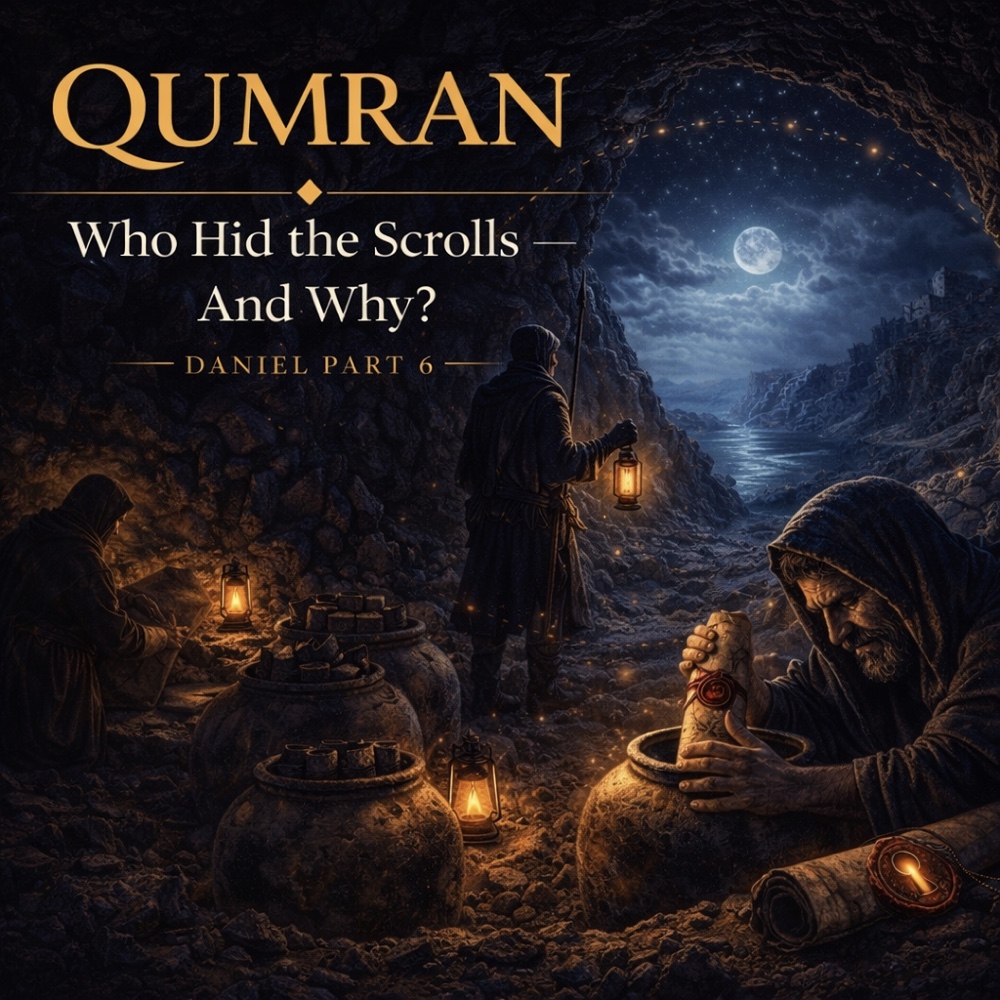
Qumran: Who Hid the Scrolls — And Why? – Daniel Part 6
By Andre Eksteen
Up to this point, we have been moving carefully.
Not rushing. Not forcing conclusions. Just following what the text actually says and what history demands we acknowledge.
Daniel wrote a real book. That book was preserved. It moved through generations. And for centuries, it remained sealed. Not lost. Not removed. Sealed in understanding.
Now we arrive at a point where the silence begins to shift.
Because the question we ended with is not a small one. Who carried those words forward? And what did they do with them?
At some point, something happens. The words that were preserved through generations are no longer just being copied and passed on. They are being gathered. Collected. Handled with unusual care. And eventually — hidden. Not by Daniel. Long after him. By people who recognised something. People who did not write the words — but knew they mattered.
And this is where most people jump ahead again. They hear “Qumran” or “Dead Sea Scrolls” and immediately start drawing conclusions. They try to force meaning into the discovery before they have even understood what happened. So let us do this properly. Step by step. No assumptions.
Qumran was a real place. Not an idea. Not a theory. A physical location near the Dead Sea where a community lived, worked, and preserved writings. They did not just hold one scroll. They held many. Scriptures. Writings. Fragments. Copies. And among those — were copies of Daniel.
That alone should already get your attention. Because now you are not dealing with a theory that Daniel survived. You are dealing with physical evidence that it did. Fragments of the Book of Daniel were found among what we now call the Dead Sea Scrolls. Not one. Multiple. That tells you something immediately. Daniel was not marginal. It was not ignored. It was not forgotten. It was copied. Preserved. Handled with care. By a community that took these texts seriously.
Now pause there. Because this is where the thinking must stay disciplined.
We are not asking yet what they believed. We are not asking yet how they interpreted Daniel. We are not building a system around their theology. We are asking something simpler. Why did they preserve it? Why did they go to such lengths to keep these writings intact?
Because what they did was not casual. They did not just keep a few scrolls lying around. They stored them. Protected them. And when pressure came — they hid them.
That is a deliberate act. You do not hide something unless you are trying to preserve it from destruction. That means at some point, they knew something was coming. Conflict. Threat. Loss. And instead of abandoning what they had, they made a decision. Protect the scrolls.
That decision matters. Because it tells you how they viewed what they were holding. These were not ordinary writings to them. These were not disposable. These were worth preserving even if everything else was lost.
Now let us stay grounded again.
The scrolls were hidden. Not by Daniel. But by people living centuries after him. Most likely around the time the Roman Empire was advancing and destroying everything in its path. That places the hiding of the scrolls roughly around 68 to 70 AD. So now your timeline looks like this. Daniel writes the words. They are copied and preserved through generations. A community gathers them. And then — they are hidden. Placed in caves. Sealed away from the world. Not for a few years. Not for a generation. For nearly two thousand years.
Now stop there. Because this is where people start to rush again.
They hear that and immediately want to jump to conclusions. But do not do that yet. Just look at the pattern. Words written. Words preserved. Words gathered. Words hidden. That is not random. That is a chain. And every link in that chain matters. Because if you remove one part, the rest does not hold.
Now let us ask the obvious question. Why hide them? Not why preserve them — that part is clear. Why hide them? Because hiding is different from preserving. Preserving keeps something in circulation. Hiding removes it from circulation. That is a shift. A deliberate one. And that means something changed. The environment changed. The risk changed. The cost of keeping those scrolls visible became too high. So they were taken out of sight. Protected. Left in caves. And then — silence.
No one comes back for them. No one retrieves them. No one continues copying them in that place. They sit there. Untouched. Unseen. For centuries.
Now let that settle.
Because this is where the weight of this begins to build. You have a book that was sealed in understanding. Now you have copies of that book physically hidden. Two different things. But they are now moving in parallel. The meaning is sealed. The scrolls are hidden. That is not something you dismiss lightly. But we are not drawing conclusions yet. We are observing.
Now let me bring this into something simple.
If something is hidden for a short time, it is temporary. If something is hidden for centuries, it becomes something else. It becomes preserved beyond human control. Because no one is managing it anymore. No one is maintaining it. It is just there. Waiting. And that raises another question. What are the chances that something like this survives? Through time. Through environmental change. Through neglect. And is still there — waiting to be found?
Because that is what we are dealing with. Not just preservation. Preservation without intervention.
Now let me say something carefully. Because this is where people tend to overreach.
We are not saying Daniel told them to hide the scrolls. He did not. We are not saying they understood everything they were holding. There is no evidence of that. We are not building conclusions about their full beliefs yet. We are doing something much simpler. We are recognising that Daniel’s words were preserved, collected, and then hidden. That is fact.
Now here is the part that should start forming in your mind, even if you do not fully articulate it yet.
If the words were sealed until a specific time — and the physical scrolls were hidden for centuries — then something has been carried forward in a very unusual way. Not through continuous teaching. Not through constant explanation. But through preservation and silence.
And silence does something. It removes noise. It removes interpretation. It removes systems that build up over time. What remains is the text. Unchanged. Waiting.
Now think about that. Because when something reappears after that kind of silence, it does not come back with layers of explanation attached to it. It comes back as it was. And that forces a confrontation. Not with what people think it means. But with what it actually says.
We are not going to step into that yet. Not fully. Because if you rush this point, you will miss what is building here.
For now, hold onto something simple. Daniel’s words did not disappear. They were carried through history. At some point, they were gathered. And then they were hidden. Left in caves. Out of sight. For centuries.
That is where we are. And that leaves us with a question you cannot ignore anymore. If something was hidden like that — then when did it come back? And more importantly — what was happening in the world when it did?
That is where we go next.