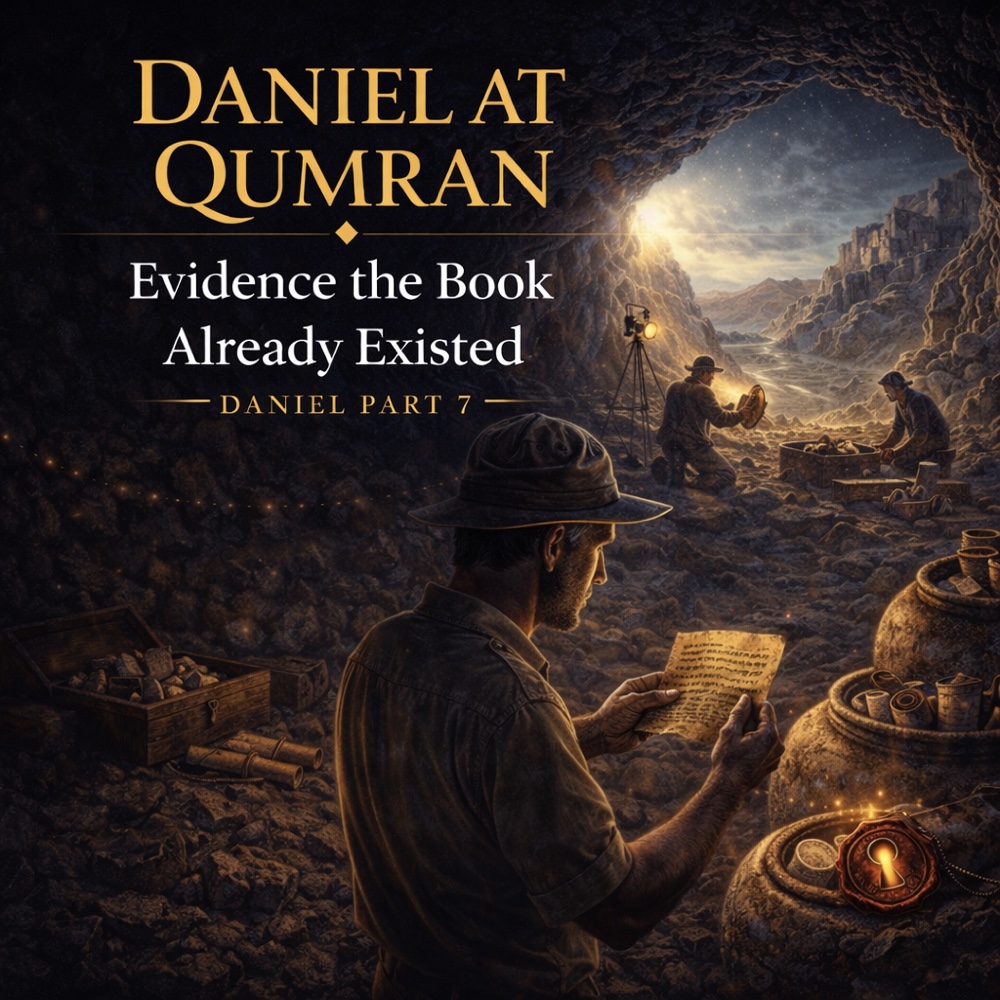
Daniel at Qumran: Evidence the Book Already Existed – Daniel Part 7
By Andre Eksteen
Before we move any further, we need to correct something.
Not because it changes the direction. But because if this step is missing, everything that follows loses its weight.
We spoke about preservation. We spoke about the silent centuries. We spoke about scrolls being hidden. But we have not yet dealt with one simple, unavoidable question.
How do we know Daniel was actually there?
Not in theory. Not in belief. In reality.
Because if you are going to build anything on history, you cannot rely on assumption. You need evidence. Not opinions. Not systems. Evidence.
And this is where Qumran forces the issue. Because at Qumran, we are not dealing with ideas. We are dealing with physical remains. Fragments. Scrolls. Copies. Actual material that existed long before modern debates ever began. And among those scrolls — were copies of Daniel.
Now stop there. Because this is where the weight of this begins to settle.
This is not someone quoting Daniel centuries later. This is not a church tradition saying, “we believe Daniel existed.” This is physical evidence that Daniel’s words were written, copied, and preserved long before our time. Fragments of the Book of Daniel were found among the Dead Sea Scrolls. Not one isolated piece. Multiple fragments. Different sections. Different parts of the book.
That matters. Because it tells you something very direct. Daniel was not a late invention. It was already in circulation. Already being copied. Already treated as something worth preserving.
Now let me say this plainly.
This removes one of the easiest ways to dismiss Daniel. You cannot say it was written later to fit events. You cannot say it was shaped by the church to support a system. Because here it is. Before all of that. Written. Copied. Handled. Hidden. That is not theory. That is evidence.
Now let us stay disciplined. We are not jumping to conclusions. We are not building theology on this yet. We are establishing something foundational. Daniel existed as a written document long before modern interpretation ever touched it.
Now ask yourself something. What does that mean for everything people say about Daniel today? Because if the text is older than the systems built around it — then the systems cannot define the text. The text must define the systems. And that is where most people get it backwards. They start with what they have been taught and then read Daniel through that lens. Instead of starting with Daniel and testing everything else against it.
Now let me take this one step deeper. Because this is where it becomes more than just historical.
If Daniel was already being copied and preserved at Qumran, then it means something else. The people there recognised its importance. They did not treat it as ordinary. They did not ignore it. They copied it. Stored it. Protected it. That tells you something. Because people do not preserve what they do not value. They do not carefully copy what they consider irrelevant. So even without fully understanding it — they knew it mattered.
Now hold that. Because this is where the tension builds again.
The words are preserved. But the meaning is still sealed. That is the pattern we have been following. And Qumran confirms it. Not by explaining Daniel. But by showing that Daniel was there. Alive. Present. Moving through history.
Now let me say something directly. This is where many people make another mistake. They assume that because Qumran had Daniel, they must have understood it fully. There is no evidence of that. They had the text. But having the text is not the same as understanding it. We have already seen that. Daniel himself did not fully understand what he was given. So the presence of the scroll does not automatically mean clarity. It means preservation. That is all.
Now let me bring this into something simple.
If you find an ancient document that has been carefully preserved for centuries, you do not immediately assume everyone who held it understood it completely. You recognise that it was valued. Protected. Carried forward. That is what Qumran shows us. Not full interpretation. Faithful preservation.
Now here is where things begin to sharpen. Because this is no longer theoretical. We are not talking about what might have happened. We are looking at what did happen.
Daniel was written. Daniel was copied. Daniel was preserved. Daniel was present at Qumran. And then — Daniel was hidden. That is the chain. Real. Traceable. Consistent.
Now ask yourself this. Why does that matter?
Because it changes the conversation completely. We are no longer asking whether Daniel is reliable. We are no longer debating whether it existed. That question has already been answered. Now the focus shifts. Not to the existence of the book — but to the handling of the book. What people did with it. How they interpreted it. And whether that interpretation aligned with what was actually written.
Now let me say something that should challenge you.
If the text existed before the systems — then the systems must be tested against the text. Not the other way around. That sounds simple. But very few people actually do it. Because it requires letting go of what they have been taught. And that is not easy.
Now bring this back to where we are in the series.
We have followed the words from Daniel’s lifetime through preservation through the silent centuries into Qumran. And now we have something solid. Not assumption. Evidence. The book existed. The words were real. They were copied and carried forward.
That is where we stand. And that allows us to move forward without guessing. Because now we are not chasing a missing link. We are following something that has already been confirmed.
Now the question changes again. If Daniel was present at Qumran, if it was preserved carefully, if it was treated as something valuable — then what happened next becomes even more significant. Because this was not a random text that was hidden. This was something recognised. Something protected. And then deliberately placed out of sight.
That is where the weight increases. Because now the question is no longer, “did Daniel exist?” The answer is clear. It did. The question becomes — why would something so carefully preserved be taken out of circulation and hidden away?
That is where we go next. Because once you answer that, you begin to see that this is not just a story about preservation. It is a story about timing.