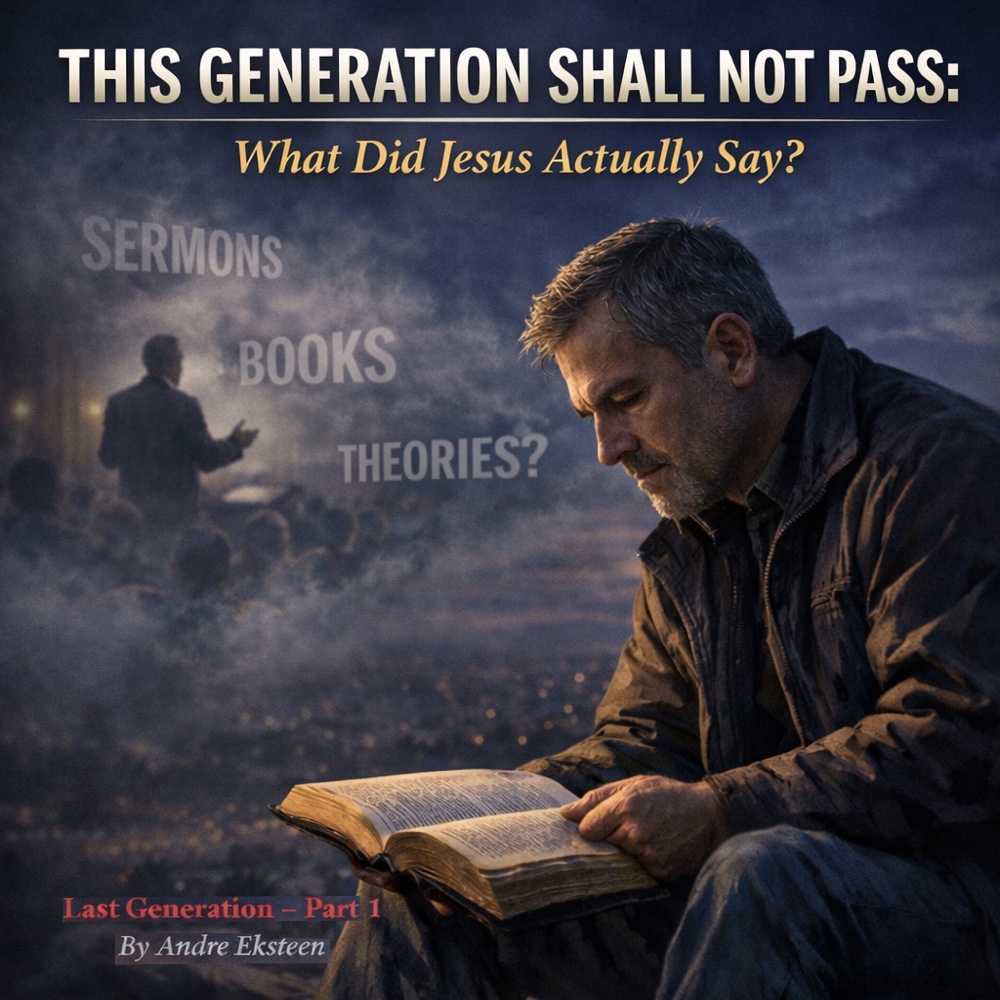
This Generation Shall Not Pass: What Did Jesus Actually Say? – Last Generation Part 1
By Andre Eksteen
Few phrases in Scripture have been quoted more, repeated more, and misunderstood more than this one: *“This generation shall not pass…”* You hear it in sermons. You see it in books. It comes up constantly in conversations about the end times, in online forums, in Bible study groups, in prophecy conferences, and in the quiet arguments people have at kitchen tables when the news gets bad enough that someone inevitably reaches for their Bible. And almost every time it surfaces, people already think they know what it means. That is exactly the problem. When people think they already understand something, they stop reading it carefully. They stop asking questions. They stop examining what is actually being said. They just repeat what they have been told, often with a confidence that is entirely unearned.
Now I want to say something plainly before we go any further. This series is not about scoring theological points. It is not about dismantling one tradition just to replace it with another. What it is about is going back to the text — carefully, honestly, without dragging in conclusions before we have done the reading. That sounds simple. In practice, for most people, it is one of the hardest things to actually do. Because we all carry assumptions into Scripture. We carry the Sunday school lessons we grew up with, the preachers we trusted, the books we read, the systems we absorbed. And those things shape what we see — and what we miss — before we even get to the words on the page.
So before we talk about Israel, before we talk about timelines and dates and modern geopolitics, before we talk about the world we are living in right now and what it might mean prophetically — we need to do something far more basic. We need to go back to the words themselves. Not what we think they mean. Not what we have been told they mean. What was actually said, in context, in sequence, as part of a coherent answer to a specific question.
—–
**The Verse Everyone Thinks They Understand**
Matthew 24:34 — *“Verily I say unto you, This generation shall not pass, till all these things be fulfilled.”*
Short. Direct. And on the surface, uncomplicated. This is one of those verses that looks simple until you sit with it long enough to realise that almost every significant disagreement in end-times theology somehow circles back to it. Preterists use it to argue that everything in Matthew 24 was fulfilled before AD 70. Futurists use it to argue that a future generation will see everything come to pass. Dispensationalists tie it to 1948 and Israel’s rebirth as a nation. Others attach it to 1967 and the recapture of Jerusalem. Some say a generation is forty years. Others say seventy. Others argue that the word “generation” here does not refer to a time span at all but to a type of people — a race, a lineage, a category of humanity that persists through history.
All of these positions have been argued by intelligent, serious people. And all of them cannot be right simultaneously. Which means some — possibly most — of them are importing meaning that is not actually in the text. The question is not which tradition you were raised in or which commentary you find most convincing. The question is what the text actually says, and what it says in context.
The first thing you need to do is stop reading that verse in isolation. Pulling a single sentence out of a flowing discourse and treating it as a standalone statement is one of the most common ways errors get introduced into biblical interpretation. Verse 34 is not a standalone statement. It is the conclusion of something. It sits at the end of a long, detailed answer that Jesus gave to a specific question. And if you want to understand the conclusion, you must first understand the question, and then follow the answer from the beginning.
—–
**The Question That Started Everything**
Go back to Matthew 24:3 — *“And as he sat upon the mount of Olives, the disciples came unto him privately, saying, Tell us, when shall these things be? and what shall be the sign of thy coming, and of the end of the world?”*
Now notice several things about this question. First, it is asked privately. This is not a public debate. This is the disciples — people who had walked with Jesus, who had listened to Him teach, who had watched Him work — coming to Him away from the crowd and asking directly. They wanted to understand. Second, notice that the question has three distinct parts. When will these things happen? What is the sign of your coming? What is the sign of the end of the world? Those are not the same question asked three ways. They are three separate lines of inquiry bundled together in a single urgent moment.
Why does that matter? Because when you read Jesus’ answer, you need to hold in mind that He may be addressing all three, or He may be addressing them in a particular order, or He may at certain points be speaking to one while the others wait. This is not unusual in Scripture. Jesus often answered layered questions in ways that required careful reading to untangle which part of the question was being addressed at any given moment. The disciples did not always recognise that themselves, which is part of why misunderstanding accumulated around this discourse very early.
The disciples had just left the temple. Jesus had said something extraordinary — that not one stone of that magnificent structure would be left upon another, that it would all be thrown down. That is what triggered the question. They were shaken by it. They wanted to understand when. And in their minds, the destruction of the temple, the coming of the Messiah in power, and the end of the age were probably all part of the same great event. That assumption — that these things all belong to a single moment — is itself one of the earliest sources of confusion. Jesus does not correct that assumption directly, which means His answer requires even more careful reading, not less.
—–
**He Started With a Warning**
Jesus’ first words in response are not a timeline. They are not a sign. They are a warning. Matthew 24:4-5 — *“And Jesus answered and said unto them, Take heed that no man deceive you. For many shall come in my name, saying, I am Christ; and shall deceive many.”*
Think about that carefully. The disciples ask for signs and timing. Jesus begins with deception. That is deliberate. He is not warming up before getting to the real answer. He is telling them something fundamental about the nature of the entire period they are asking about. This age — the period between His first coming and the consummation of all things — is characterised above everything else by the possibility, even the likelihood, of being misled. That is the first thing He says. Not a date. Not a sign. A caution.
And here is what makes that significant. If Jesus leads with deception, it means that the signs and events He is about to describe will be susceptible to misinterpretation. It means that people will look at the same events and reach wrong conclusions. It means that the urgency and drama of what unfolds will itself become a mechanism for deception — because urgency bypasses careful thought, and dramatic events tempt people to jump to conclusions. He is saying, from the very beginning: be careful. Think. Do not be swept along by the noise.
That warning does not get less relevant as the discourse continues. It gets more relevant. Everything that follows — wars, famines, false prophets, signs in the heavens, the abomination of desolation — all of it sits under that initial caution. The person who reads Matthew 24 looking for confirmation of what they already believe is doing the exact thing Jesus warned against. The honest reader goes in slowly, willing to be corrected, willing to sit with uncertainty, willing to follow the text rather than lead it.
—–
**The Beginning of Sorrows**
Jesus continues in verses 6 and 7 — *“And ye shall hear of wars and rumours of wars: see that ye be not troubled: for all these things must come to pass, but the end is not yet. For nation shall rise against nation, and kingdom against kingdom: and there shall be famines, and pestilences, and earthquakes, in divers places.”*
Wars. Rumours of wars. Nations in conflict. Kingdoms rising against each other. Famines. Pestilences. Earthquakes in various places. Anyone who reads this list in the twenty-first century immediately starts cataloguing current events. The wars in the Middle East. Global food insecurity. Recent pandemics. Earthquake activity. The temptation is almost irresistible — to look at the world around you and say, “This is what He was talking about.”
But then verse 8 arrives and it stops that impulse cold. *“All these are the beginning of sorrows.”* The beginning. Not the end. Not the climax. Not the sign that the end has arrived. The beginning of a process that has much further to run. Jesus is explicitly saying: do not mistake the early stages for the conclusion. Do not see war and famine and disaster and assume you have arrived at the moment. These things are the labour pains — they indicate that something is coming, but they are not the delivery.
This is one of the most practically important statements in the entire chapter, and it is one of the most consistently ignored ones. Every generation since the first century has looked at the turbulence of its own time and concluded that the end must be near. The Black Death. The World Wars. Every empire’s collapse. Every major pandemic. Every string of natural disasters. And every time, people pointed to Matthew 24 and said, “Now. This is the moment.” And every time, they were wrong — not because the end is not coming, but because they mistook the beginning of sorrows for the fulfilment of all things. Jesus told them not to do that from the very start. And people have been doing it ever since.
Now notice what Jesus does not say here. He does not say these events are irrelevant. He does not say they should be ignored or that they have no prophetic significance. He says they are the beginning. They set the stage. They signal that the process is underway. But they do not tell you where in the process you are. That requires following the sequence He lays out, not cherry-picking the parts that seem most dramatic.
—–
**The Sequence That Follows**
From verse 9 onward, Jesus continues building. Persecution of believers. Nations hating those who follow Him. People falling away. Betrayal. False prophets rising and deceiving many. Lawlessness increasing until the love of most people grows cold. And then — and this is often missed — verse 14: *“And this gospel of the kingdom shall be preached in all the world for a witness unto all nations; and then shall the end come.”*
That is a condition. A global one. Before the end comes, the gospel must reach every nation. That is not a minor logistical detail. That is a planet-wide precondition for the close of the age. And it is worth noting that Jesus places it in the sequence before He says “and then shall the end come.” He does not say the end comes when there are wars. He does not say it comes when there are earthquakes. He says it comes after this worldwide proclamation has gone out. That is a very specific marker — and one that people in their rush to identify the end often skip past entirely.
Then from verse 15, Jesus moves into territory that is more specific and more contested. *“When ye therefore shall see the abomination of desolation, spoken of by Daniel the prophet, stand in the holy place, (whoso readeth, let him understand)”* — and the parenthetical is significant, because Jesus himself flags it for careful attention — then comes a period of tribulation such as has not been seen since the beginning of the world and will never be seen again. He describes it as so severe that if those days were not shortened, no flesh would survive. He warns again about false Christs and false prophets who will show great signs and wonders, so convincing that even the elect could be deceived if it were possible.
Then the cosmic signs — sun darkened, moon not giving light, stars falling, the powers of heaven shaken. And then the sign of the Son of Man appearing in the sky, with all the tribes of the earth mourning as they see Him coming in the clouds with power and great glory. Angels gathering the elect from the four winds, from one end of heaven to the other.
That is the full sequence. From the beginning of sorrows all the way to the return of Christ in unmistakable, visible, undeniable glory. Jesus builds it out in layers. He does not jump from point A to point Z and ask you to fill in the blanks. He gives you a progression. And only after all of that — only after the entire sequence has been laid out — does He come to the fig tree parable and then to verse 34.
—–
**The Fig Tree Parable**
Verses 32 and 33 — *“Now learn a parable of the fig tree; When his branch is yet tender, and putteth forth leaves, ye know that summer is nigh: So likewise ye, when ye shall see all these things, know that it is near, even at the doors.”*
This parable is doing something very specific. It is not naming a timetable. It is establishing a principle of recognition. When you see a fig tree putting out leaves, you do not need a calendar to know that summer is approaching. The signs are readable. The season announces itself. In the same way, when you see these things — the things Jesus has just described — you will know that the end is near. Not that it has arrived. That it is near.
Now notice the phrase “all these things” in verse 33. When you see all these things. Not some of them. Not the ones that match your current news cycle. All of them. That is the condition for recognising the nearness. A partial fulfilment does not trigger the recognition. The full sequence does. And it is this same phrase — “all these things” — that appears again two verses later in verse 34. This is not coincidental. The language is connected deliberately.
—–
**The Statement Itself**
And then comes the verse — Matthew 24:34: *“Verily I say unto you, This generation shall not pass, till all these things be fulfilled.”*
“All these things.” The same phrase from verse 33. The complete sequence. Not one event, not one sign, not one dramatic moment — the entirety of what Jesus described from the beginning of chapter 24. The generation that sees all of it will not pass away before all of it is fulfilled. That is what He is saying.
Now here is where most of the debate concentrates, and where most of the errors are made. People read “this generation” and immediately want to put a number on it. Forty years is the most popular figure — based on the idea that a biblical generation is forty years, and that if the clock started in 1948 with Israel’s establishment as a state, then 1988 would be the end. That date came and went. Then the clock was reset to 1967 and the recapture of Jerusalem, which gave 2007. That came and went too. Then people started arguing that a generation could be seventy years, or eighty years, or a hundred years. The goalposts move because the approach is wrong from the start.
The text does not give a duration. It says “this generation.” That is a reference to a group, not a time period. The question is not how long a generation lasts. The question is which generation is being described — and the answer is right there in the context. The generation that sees all these things. That is the anchor. Not a calendar date. Not a historical event used as a starting gun. The full sequence of events that Jesus described. When that sequence is running — when all of these things are in motion — the generation living through it will not pass away before it is complete.
Now there is a secondary debate about what “generation” means in the original Greek. The word is *genea*, and it does carry a range of meanings. It can mean a group of people alive at a particular time. It can mean a lineage or family line. It can also be used in a broader sense to describe a type or category of people defined by shared characteristics. Some interpreters argue that Jesus is using it in the third sense here — referring to the Jewish people, or to unbelieving humanity, or to the generation characterised by the kind of wickedness described in the chapter. These are not frivolous arguments. They deserve to be examined honestly, and we will examine them as this series continues.
But what I want to establish firmly at this stage is simpler. Before you choose a meaning for “generation,” you need to know what “all these things” refers to. Because the generation is defined in relation to those things. The two phrases are inseparable. “This generation shall not pass, till all these things be fulfilled.” Change what you think “all these things” means, and you change your understanding of the generation. Get “all these things” right, and the generation question becomes far more manageable.
—–
**Why Most People Get It Wrong**
There is a pattern in how people misread Matthew 24, and it is worth naming directly. They come to the chapter with a system already in place. They have been taught a framework — whether dispensational, preterist, historicist, or something else — and they read Matthew 24 through that framework rather than letting the chapter speak for itself. The framework tells them what to look for, and they find it. Confirming evidence is everywhere. Contradicting evidence gets smoothed over or explained away.
This is not a criticism unique to any one tradition. It is a human pattern. We are all prone to it. The dispensationalist sees 1948 and immediately reaches for his timeline. The preterist sees the destruction of Jerusalem in AD 70 and immediately reaches for his. The historicist maps everything onto the church’s long centuries of struggle. Each one is reading the same text and arriving at a different answer, not primarily because the text is ambiguous, but because each one is reading it through a different set of prior commitments.
The way out of this is not to pretend you have no prior commitments. You cannot do that. What you can do is hold them loosely enough to follow the text where it leads, even when it leads somewhere that disrupts your system. That requires a kind of intellectual honesty that is genuinely uncomfortable. It means sitting with questions longer than you would like. It means saying “I don’t know yet” when you would prefer to say “I’ve got this figured out.” It means going back to the words again and again, resisting the shortcuts.
Jesus warned about deception first. He did not warn about it because deception was an unlikely danger. He warned about it because it was, and remains, the primary danger for anyone trying to understand the times. And the most effective deception is the kind that feels like clarity — the kind that gives you a system, a timeline, a confident answer that makes everything fit. That kind of false clarity is far more dangerous than honest uncertainty.
—–
**What This Series Is Doing**
I want to be straightforward about where this series is going, because it matters for how you read each part. We are not going to rush through this. We are going to work through the text methodically — following the sequence Jesus laid out, examining the language carefully, and only drawing conclusions when the text itself supports them. That means some parts of this series will feel like groundwork rather than payoff. But the groundwork is not optional. You cannot build something accurate on a foundation you have not examined.
In the parts ahead, we will look at what “all these things” actually encompasses — going through each element of Jesus’ discourse carefully and asking what it means and whether it has been, is being, or is yet to be fulfilled. We will examine the abomination of desolation and what Daniel actually said about it, and how that connects to what Jesus is describing. We will look at the fig tree in the context of the rest of Scripture and ask whether it refers to Israel or to something else. We will examine the word *genea* in depth — looking at how it is used elsewhere in the Gospels and what that tells us about how Jesus is using it here. And we will eventually arrive at a conclusion about which generation Jesus was describing.
But none of that is possible if we skip the beginning. And the beginning is this: go back to the question, follow the answer in sequence, do not detach verse 34 from its context, and do not assign a meaning to “this generation” before you have established what “all these things” means. That is the foundation. Everything else is built on it.
So hold this much going forward. Jesus began with a warning about deception. He laid out a sequence of events from the beginning of sorrows to His own visible return in glory. He told His disciples that the generation which sees all of these things will not pass away before all of them are fulfilled. The question we are working toward is not, “How many years is a generation?” It is, “Which generation is this, and what exactly does it witness?”
Until you answer that from the text, you are not interpreting Scripture. You are repeating tradition and calling it understanding. And there is a difference — one that matters enormously if you want to know what Jesus actually said.