Daniel Is Not Revelation: Two Visions, Two Assignments – Daniel Part 13
By Andre Eksteen
There is a mistake so common, so widely accepted, that most people do not even see it anymore.
They read Daniel, then they read Revelation, and without thinking, they treat them as the same thing. Not similar. Not connected. The same. Two versions of one timeline. Two angles of one vision. Two prophets describing one continuous sequence.
That assumption sits underneath almost everything people say about prophecy today. And it is wrong. Not slightly off. Fundamentally wrong. And the reason it matters is simple. If you start by merging what God kept separate, everything that follows will be distorted. Not obviously. Subtly. Convincingly. But still wrong.
So before we go any further, we need to do something most people never do. We need to separate Daniel from Revelation completely. Not to deny that they relate. But to stop blending them before we understand them. Because that blending is exactly where the confusion begins.
Now let us start where we should have started all along. With the text.
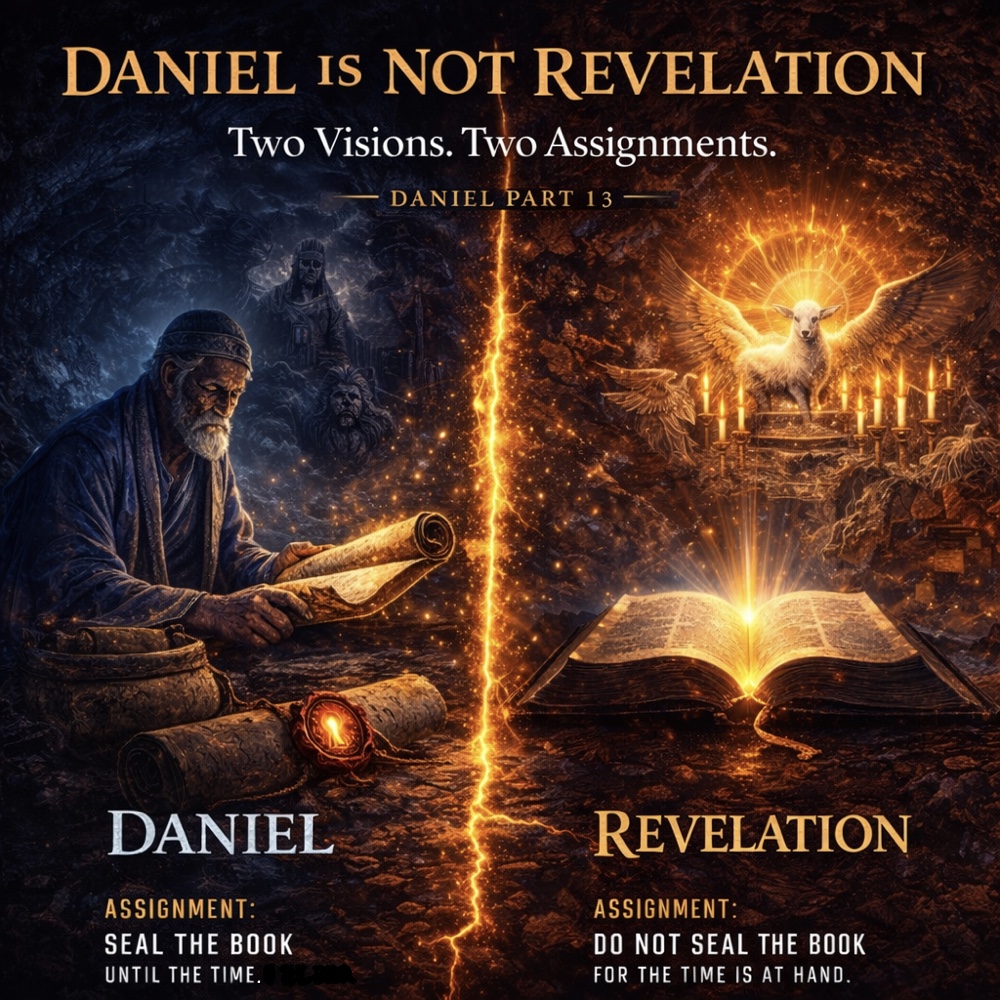
Daniel is given visions. Structured. Layered. Progressive. He sees kingdoms rising and falling. He sees sequences. He sees movement through time. And in the middle of all that, he is told something specific. Seal the words. Seal the book. Until the time of the end. That is his assignment. Receive. Record. Seal. That is it.
Now move forward. Centuries later, another man receives visions. John. On an island. Exiled. Alone. And he is shown things. Not the same way Daniel was. Not the same structure. Not the same flow. Something different. And when his vision is complete, he is told something that should stop you immediately.
“Seal not the sayings of the prophecy of this book: for the time is at hand.”
That is not a small difference. That is a direct opposite instruction.
Daniel: seal the book. John: do not seal the book.
If those two are describing the same thing in the same way, that makes no sense. You do not seal something — and then later say, do not seal the same thing — without there being a shift in position. That tells you immediately you are not dealing with a repeated message. You are dealing with two different assignments.
Now let that settle. Because this is where the entire framework people rely on begins to crack.
Daniel is given a framework that is sealed. John is given a revelation that is not sealed. That means they are not operating from the same point. Daniel is looking forward. John is standing much closer to the unfolding. That alone should change how you read both books. But most people ignore it. They take Daniel’s visions, they take John’s visions, and they start stitching them together. They match symbols. They align timelines. They merge language. And they build a system that feels complete. But it is built on something that was never instructed.
Now let me say something plainly. Just because two books speak about similar themes does not mean they are describing the same sequence in the same way. And if you force them into that shape, you will create something that looks right — but is not grounded.
Now let us go one step deeper.
Daniel’s visions are anchored in kingdoms. You can see progression. You can trace movement. There is order. There is sequence. You can follow it from one point to the next. Now look at John. What he sees is not presented the same way. It is layered differently. It is not simply one straight line. There are cycles. Overlapping scenes. Spiritual dimensions being revealed. You are not just watching history unfold. You are seeing something behind it. That is a different perspective. And if you try to force that into Daniel’s structure, you will distort both.
Now here is where people push back. They say, “but they must be connected.” Yes. But connection is not the same as sameness. That is the mistake. Connection does not give you permission to merge. It requires you to understand each one properly first. And that is what almost no one does. They jump straight to the connection without establishing the separation. That is like trying to combine two machines without understanding how either one works on its own. You might get something that runs — but it will not run correctly.
Now bring that back to the bigger issue.
If Daniel was sealed — and Revelation was not — then they are operating under different conditions. Daniel is limited in understanding. John is told the time is at hand. Those are not the same positions. That means you cannot read them as if they are interchangeable. And yet that is exactly what happens. People take Daniel’s timelines and plug Revelation into them. Or they take Revelation’s imagery and push it back into Daniel. And then they build conclusions from that mixture. That is not careful reading. That is construction.
And once that construction becomes familiar, people stop questioning it. It becomes “the way it is.” Even if it was never stated that way in the text.
Now let me say something that will challenge you. If you have always read Daniel and Revelation as one blended system — then you have never actually read either one properly on its own. You have read an interpretation. Not the text in its original form. And that is not your fault. That is how it has been taught. Repeated. Reinforced. Until it feels natural. But natural does not mean correct.
Now let us bring this back to where we are in this series.
We have been following a pattern. Words sealed. Scrolls preserved. Scrolls hidden. Scrolls revealed. Israel restored. Knowledge increasing. Deception through mixing. And now we arrive at the clearest example of that mixing. Daniel and Revelation being treated as one. That is not a small error. That is foundational. Because once you merge those two incorrectly, everything built on top of that merge carries the distortion. Timelines shift. Symbols get reassigned. Sequences get forced. And the result is something that feels complete — but does not align cleanly with either text.
Now let me bring this down to something simple.
If God wanted Daniel and Revelation to be read as one continuous, identical timeline — He would not have given opposite instructions about sealing. That alone should be enough to make you pause. But most people do not. Because they are not reading what is written. They are reading what they have been told.
Now here is where we stop. Because this is the point where things begin to separate. Not in theory. In reading. In how you approach the text. We are not going to rebuild the entire framework yet. We are doing something much more important. We are removing what does not belong together. Because until that is done — you cannot see clearly.
So hold this. Daniel was told to seal. John was told not to. Two visions. Two assignments. And if you do not respect that difference — you will continue reading both through a lens that was never given in the text.
That is where we go next. Because once you separate them — you begin to see something that was always there, but hidden under everything that was added.