From Genesis to Revelation: The One Story – The Golden Thread that Explains Everything – Part 1
By Andre Eksteen
For most of my life, I accepted the creation story as it is taught in most churches: the familiar six-day creation. God speaks, and out of nothing everything comes into being. In six days He forms heaven and earth, light and darkness, sea and land, the animals and finally man. On the seventh day He rests, and with that the creation is complete — perfect, finished, complete. It is simple, it makes sense, and it is what I heard and was taught from childhood.
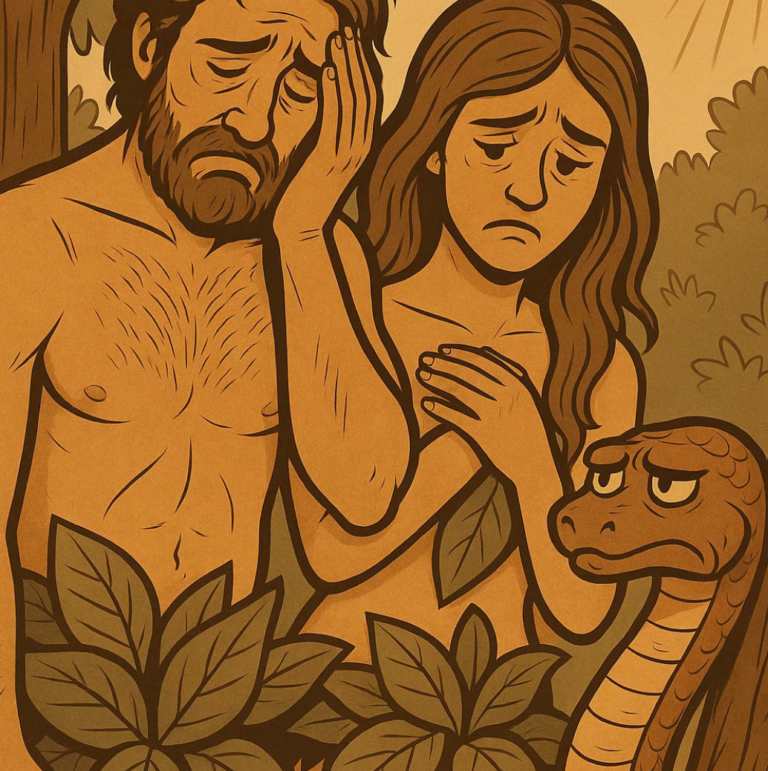
But then certain things I later read in the Bible no longer made complete sense. Let us look at the very first and simplest example: the serpent and Eve. If everything in Eden was perfect, how could evil enter? Why does the serpent appear in a perfect creation and deceive Eve? This is not an innocent event — it reveals a heart that already carried hatred towards God and towards those made in His image. And that hatred had to come from somewhere. You do not get rebellion in a world that has never seen sin. Something had to have happened before Eden, long before man ever drew his first breath.
It was then that I later began looking at Genesis again the way I look at engineering problems in my normal life, without the filters of tradition, without any filters at all — and right there something made me stop. The text itself does not fit the picture I had believed for years.
Because if you read carefully, you see that Genesis 1:1 and 1:2 are not part of day one of the six-day creation. There is no “evening and morning” in those two verses. The first day only begins in verse 3, when God says: “Let there be light.” What comes before those words therefore happens before the six days ever begin.
That realisation hit me like a slap in the face. “In the beginning God created the heavens and the earth” — not just one heaven, but “heavens” — plural. The original Hebrew text says ha’shamayim, which literally means “the heavens.” This does not refer only to the blue sky or the starry heavens above, but to all the realms of God’s creation: the physical world, the spiritual realm, and the throne heaven itself. In other words, God created everything — the visible and the invisible world, the material and the supernatural. It is perfect, it is complete, it is finished.
But then comes that shocking verse that breaks everything: “And the earth was without form, and void; and darkness was upon the face of the deep.” How can something God created perfectly suddenly be in chaos? God does not create destruction. He brings order. He is light — He does not make darkness.
And there I sat with my Bible in my hand, but the world before my eyes looked nothing like the perfect beginning described in verse 1. I read of order, but I see chaos. I read of light, but I see darkness. Something does not fit. Something broke somewhere — not in God, but in the history of His creation itself. It is as if a tear was pulled through time, something that was once perfect but then became twisted.
The world, of course, tries to give its own answers. The first one, presented by science as “fact,” is the Big Bang theory. They say everything originated from an explosion out of nothing — that chaos was the mother of all order. I never believed that theory. You cannot make something out of nothing; even science admits that — yet they cling to it when it comes to their Big Bang. It is illogical and spiritually absurd.
And yet, as wrong as their conclusion may be, science can still measure the marks of that heavenly event they call the Big Bang today with reliable instruments. They call it cosmic microwave background radiation — the afterglow of a cosmic explosion that comes from all directions in the universe. It is a thin, even glow of energy, a remnant of something that once happened with unimaginable power. They measure it in kelvins, they chart it in frequencies, and they know that the measurable cosmic microwave background radiation is real — they can measure it, they can prove it. That is true science: it works with facts, measurement, and repeatable results.
But then there is the other kind — theoretical, pseudo-science that builds on assumptions and deductions without any real proof. That is the kind that places its own reasoning above the Word of God and proclaims its own theory as truth. They take the data that proves something great happened, and twist it into a story that everything came from nothing. They then call it “the Big Bang.”
And this while science itself admits that nothing cannot come from nothing. It is a direct contradiction: they believe in an explosion without a cause, a creation without a Creator, and call it knowledge. No proof — just human pride turning its own ignorance into theology.
But if it was not the Big Bang, what then caused this radiation that is measured across the entire universe?
To understand what that “afterglow” really means, we have to go back — further back than Genesis 1:1. Because the Bible does not begin with the beginning of God; He has no beginning. The Bible begins with the beginning of man. It is the point where our story connects with His. The Bible was given to man — not to explain God’s origin, but to show us who we are, where we come from, and why the world we live in no longer looks the way it was meant to.
Proverbs 8 gives us a glimpse of what happened before Genesis 1:1: “When he prepared the heavens, I was there: when he set a compass upon the face of the depth.” Here Wisdom itself speaks — Christ — and He says He was there when God prepared the heavens, not when He first created them. Job 38 asks: “Where wast thou when I laid the foundations of the earth? … when the morning stars sang together, and all the sons of God shouted for joy?” The “sons of God” therefore already existed when God laid the foundations of the earth. Heaven was full of life long before the earth and long before man.
The Book of Enoch and the Book of Jubilees tell of this heavenly order — beings of light, the “Sons of God,” who carried His glory and executed His will. Psalm 148 confirms this: “Praise ye him, all his angels: praise ye him, all his hosts. For he commanded, and they were created.” The Odes of Solomon call it a realm without shadow, filled with the light of His knowledge. This was not a world of dust and flesh, but of spirit and fire.
But here we must understand something important: God created everything — not only the visible world, but also the invisible. “For by him were all things created, that are in heaven, and that are in earth, visible and invisible, whether thrones, or dominions, or principalities, or powers” (Colossians 1:16). And He created each one with a will of its own. That is what makes the difference between a slave and a son, between mere function and true worship. The heavenly beings did not worship because they had to, but because they chose to. Love cannot exist without choice.
Many doctrines portray God as a dictator — a cruel ruler who forces obedience. But that is not the God of the Bible. God does not force love; He invites it. He even gave the bearer of light, Lucifer himself, a will — the freedom to obey or to rise up. And in that lies His divine justice: He did not want robots repeating His glory, but beings reflecting His glory by free choice.
That heavenly realm was more than just music and worship — it was a civilisation. A divine order of beings who did not only sing, but also governed. The Book of Jubilees describes how each angel had a domain, a task to fulfil, a region of influence within creation. The Book of Enoch says they shared knowledge like streams of fire — exchanging wisdom, truth, and instruction. The Sibylline Oracles speak of the “trade of light,” where beings passed on the secrets of creation to one another: the laws of energy, motion, time, and life.
Ezekiel 28 confirms this when God says of Lucifer: “By the multitude of thy merchandise they have filled the midst of thee with violence, and thou hast sinned.” This trade was not buying and selling as we know it — it was the exchange of heavenly knowledge, of power and influence. This is what I call the heavenly economy — a system of divine order where every being received something in order to serve, and gave something back to sustain the whole. That is why heaven functioned so perfectly: it was not chaos, it was cooperation.
And among these beings was one who stood out above the rest. The prophet Ezekiel calls him “the seal of perfection, full of wisdom, and perfect in beauty.” He was the anointed cherub who covers, at the throne of God, walking among the fiery stones of His presence. His name was Lucifer, the bearer of light. His very being was worship itself; according to the ancient writings he was, as it were, a living instrument, made to let praise resound through heaven. He carried the light of God over creation, and his brilliance was a reflection of God’s own glory.
But in the midst of that perfection, something happened that would change the universe forever. Isaiah 14 describes it: “How art thou fallen from heaven, O Lucifer, son of the morning! … For thou hast said in thine heart, I will ascend into heaven, I will exalt my throne above the stars of God.”
The first sin was not born on earth — it was conceived in heaven itself. Lucifer, the bearer of light, looked at his own glory and thought he deserved more than merely to reflect. He wanted to be what God is. In him, the channel of light became a reservoir of pride. The civilisation he was meant to lead began to tilt — the trade of light turned into a trade of power. The perfect balance of order began to fracture.
2 Esdras describes this as “the great transgression” — the moment one of God’s own beings said: “I am also god.” Revelation 12 gives us the outcome: “And there was war in heaven: Michael and his angels fought against the dragon … and his tail drew the third part of the stars of heaven.”
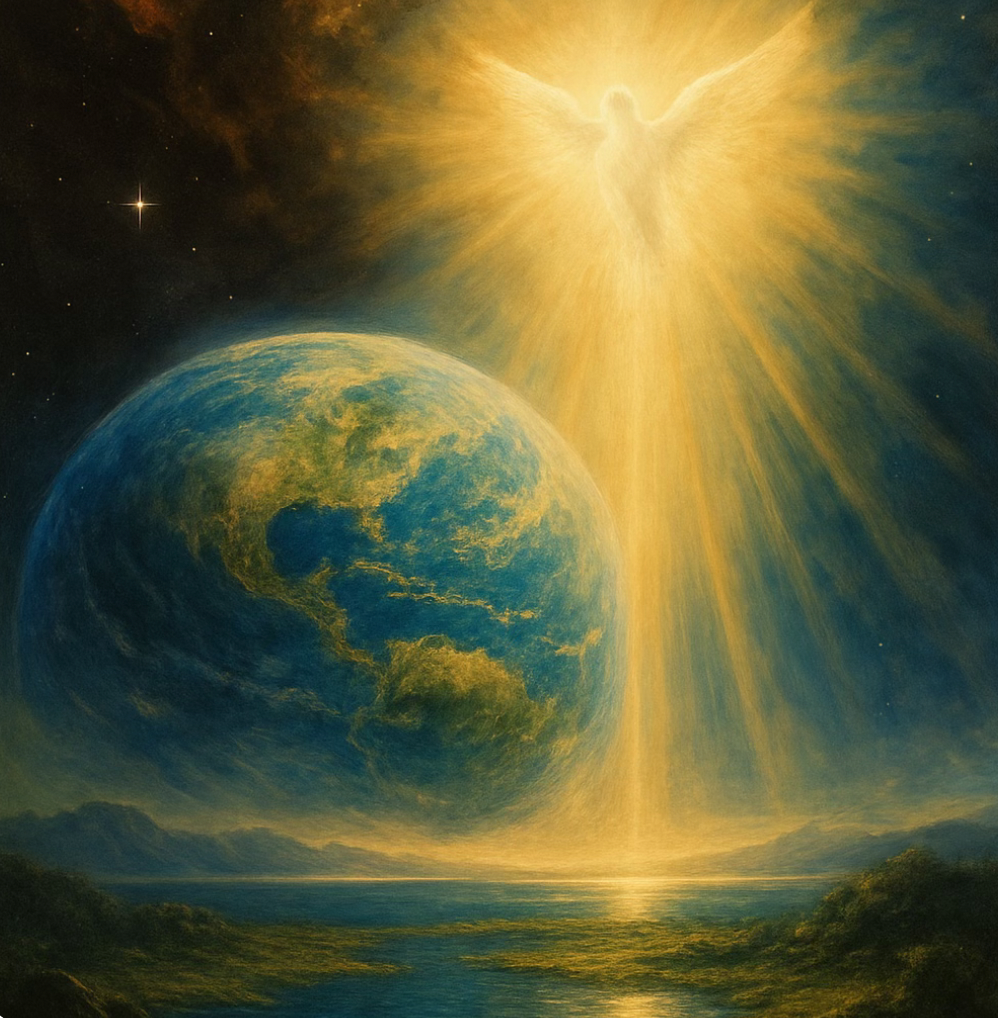
That fall was not only spiritual — it was cosmic. When Lucifer was cast down from heaven, he struck the world and the heavens with such force that the entire creation shuddered. A collision of heavenly energy with matter — something so great that it shook the order of space and time itself. Light dimmed, harmony broke, and chaos came into being. The power of his fall was so intense that it tore at the foundations of the earth — mountains collapsed, oceans began to boil, and even the heavens burst with fire and smoke. The stars lost their light, and the world that had once been perfectly created became “without form and void.”
And the mark of that upheaval is still there. Science calls it cosmic microwave background radiation — that even glow of heat that comes from all directions in the universe. They say it is the remnant of the so-called Big Bang, but I believe it is the aftershock of Lucifer’s fall — the visible scar of a spiritual catastrophe. The universe itself bears the mark of that collision. The measurements are real, but the meaning has been lost. What they see as the beginning of life is, in reality, the measurable proof of the moment when the bearer of light rose up against the Source of light — and fell.
Genesis 1:2 therefore does not describe the beginning of creation, but the consequences of judgement. The earth lies devastated under the weight of rebellion, and the heavens bear its scars to this day. That is why the six-day creation does not tell the full story, and why the Big Bang theory collapses. The one ignores the gap; the other tries to fill it with lies. But the truth stands simple: there was a creation before man’s creation — and there was a fall that tore the universe apart before God ever said: “Let there be light.”
And then, in the silence after the storm, the Spirit of God began to move over the waters. He did not turn away. He hovered over the rubble of what was once perfect — over a world without form, without light, without life. The heavens were silent, and the earth waited. Nothing spoke, but everything knew: something was coming.
For where His Spirit moves, nothing happens by chance. He does not hover over desolation without reason. It is the breath before the word, the silence before creation. And in that holy stillness, the story of restoration slowly begins to take shape.
But that, my friend, is where we will continue next time. In Part 2 we will look at what happens when that silence is broken — when the Creator speaks again — when we step into His story.