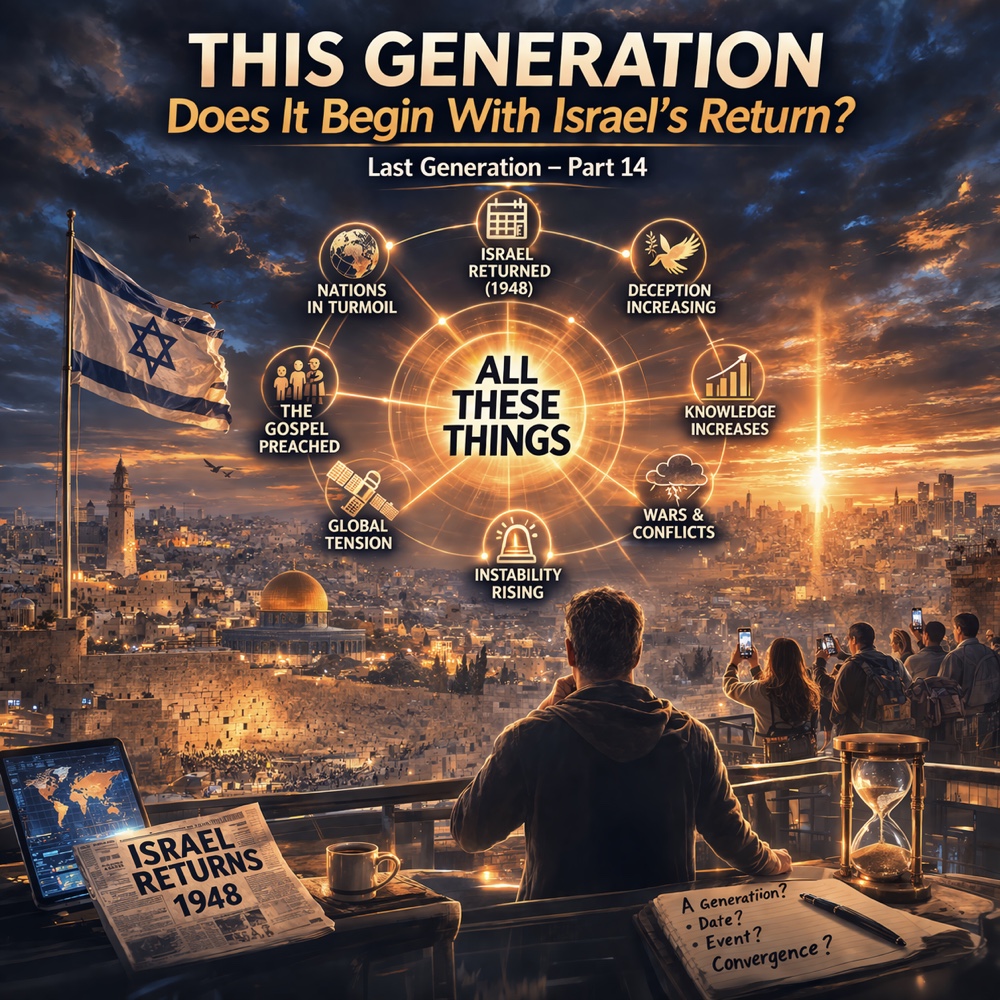
This Generation: Does It Begin With Israel’s Return? – Last Generation Part 14
By Andre Eksteen
Now we arrive at the question most people assume has already been answered. Not because they worked through it carefully. Because they were told. “This generation began in 1948.” “Israel became a nation.” “The clock started.” And from there, everything is built — timelines, predictions, expectations, confident declarations about how much time remains. The answer feels settled because it has been repeated so often, by so many teachers, in so many books, that questioning it feels like questioning the obvious.
But we have spent thirteen parts doing exactly what nobody wants to do with this topic: going back to the words. Following the text. Removing the assumptions. And now, with all of that groundwork in place, we are finally able to ask the central question of this entire series with the precision it deserves. Not what people say the generation is. Not what feels logical given the framework most of us inherited. What does Scripture actually allow us to conclude? Because if you answer this incorrectly, everything that follows will be forced. And once you start forcing, you are no longer reading — you are constructing. And the difference between those two activities is the difference between something that will hold and something that will eventually collapse.
The Anchor the Text Actually Gives
Let us go back to the verse one more time. Not because we have not read it, but because now, after fourteen parts, we can read it with everything else properly in place.
Matthew 24:34 — “Verily I say unto you, This generation shall not pass, till all these things be fulfilled.”
The anchor of that statement is not “this generation.” The anchor is “all these things.” We established that in Part 1 and we have built on it through every subsequent part. The generation is defined by its relationship to “all these things” — to the full sequence Jesus described from the beginning of Matthew 24, from the warning about deception through the return of Christ in visible glory. The generation is the group that sees the full sequence. The full sequence is what defines the generation. They are inseparable.
Now ask the question plainly: does Israel’s return in 1948 alone constitute “all these things”? The answer is self-evidently no. Israel’s return is one element — real, significant, potentially part of the prophetic picture as we argued in Part 12 — but it is one element within a sequence that includes false Christs and deception, wars and rumours of wars, famines and pestilences and earthquakes as the beginning of sorrows, persecution of believers, the rise of false prophets, spreading lawlessness, the cooling of love, the global proclamation of the gospel, the abomination of desolation, tribulation of unparalleled severity, cosmic signs, and the visible return of Christ in power and great glory.
One event from the beginning of that sequence cannot define the generation any more than the first domino falling defines the full run. The generation is the one that sees the run completed. And the run has not been completed.
The Two Assumptions Hidden in the 1948 Framework
Now let me be precise about what the popular framework actually claims, because it is worth naming the specific assumptions embedded in it rather than arguing against a caricature.
The first assumption is that “this generation” in Matthew 24:34 must be anchored to a specific historical starting event. The generation begins when something happens. You mark the beginning, you define the duration, you calculate the end. That is the logical structure of the framework. And it is not unreasonable on its face. If a generation is a span of time, it must start somewhere. The question is whether the text actually presents the generation as a span of time with a calculable beginning, or whether it presents it differently — as a group defined by what it witnesses.
We dealt with this directly in Parts 2 and 3. The Greek word genea, as Jesus uses it in Matthew, is not consistently used to mean a fixed time span. It is used to describe groups of people defined by their character, their condition, and what they witness. And in Matthew 24:34 specifically, the group is defined by witnessing “all these things.” The text does not give you a starting date. It gives you a defining experience. These are different structures, and forcing the time-span structure onto a text that uses the witness structure produces the predictive failures we have documented throughout this series.
The second assumption is that 1948 is specifically the event Jesus was pointing to when He described the fig tree putting forth leaves. We dealt with this in Part 13. The fig tree parable in Matthew 24:32-33 does not explicitly identify the fig tree with Israel. That identification is an inference from the broader biblical pattern of fig tree imagery. It may have some validity as a secondary resonance. But it is not stated in the text. And Luke’s parallel account, which expands the reference to “all the trees” rather than the fig tree specifically, pushes against the Israel-specific identification rather than supporting it. The fig tree parable illustrates a principle of seasonal recognition from visible indicators. It does not provide a textual anchor for treating 1948 as the beginning of a calculable generation.
Now when you remove those two assumptions — the time-span structure for “generation” and the fig tree equals 1948 identification — what remains? You still have a genuinely significant event in 1948. You still have a real correspondence between aspects of modern Israel’s return and elements of the prophetic picture. But you no longer have a textual basis for treating 1948 as the starting gun for a last generation calculation. The significance of 1948 remains. The specific use people have made of it — as a calculation trigger — loses its textual support.
The Difference Between Watching and Waiting for a Date
There is a practical distinction here that is worth drawing out carefully, because it describes two completely different postures toward the end times — and one of them is what Jesus described, and one of them is what most popular prophecy culture produces.
The person who is waiting for a date is essentially passive between now and the date. They have been told the end must come before a certain year. Between now and that year, they watch for confirmation — events that seem to fit the expected pattern, headlines that can be mapped onto prophetic passages, developments in the Middle East that appear to be moving toward the expected climax. Their activity is confirmatory rather than genuinely observational. They are looking for what fits, not for what is. And when their date passes, they are left with a choice between rebuilding their framework or disengaging from prophetic study entirely. Most choose some version of quiet disengagement, at least temporarily, before a new teacher comes along with a new calculation that feels more convincing.
The person who is genuinely watching is active in a completely different way. They know the sequence — not as a system but as a description, a picture of what the end will look like when it comes. They are observing the world against that picture with enough precision to distinguish between events that genuinely resemble what Jesus described and events that merely feel dramatic enough to match the urgency of the framework they inherited. They are not looking for confirmation of a timeline. They are watching for the shape of the thing itself. And because they are watching for the shape rather than for the confirmation, they are protected against both premature identification — declaring that the generation has arrived based on one event — and late recognition — being so caught up in the noise of a failed timeline that they miss the actual convergence when it begins.
This is the posture the fig tree parable describes. Not “count from this moment and you will know when the season ends.” But “when you see the leaves, you will know the season has come.” The leaves are the visible, unmistakable, convergent evidence of what is actually happening. Not one sign. Not a dramatic event that can be mapped onto the framework. The leaves — the full, visible pattern that announces the season to anyone who is paying attention.
Now here is the thing that matters most practically. The person waiting for a date does not need to do the work this series has been doing. They have their starting point. They have their duration. They wait. But the person who is watching must know what to look for. They must have the full picture clear enough in their mind that when the elements begin to appear — when the leaves begin to show — they recognise them for what they are. That is why the work of this series is not optional groundwork for the curious. It is the necessary preparation for genuine watching. Without it, you are standing in front of a fig tree in winter and spring and summer, unable to tell the difference because you never learned what the leaves look like.
How Convergence Becomes Recognisable
One more thing needs to be said about the convergence model before we move into the specific elements of the sequence in the parts ahead. And it is this: convergence, when it is genuine, is not subtle. It is not a matter of carefully arranged circumstantial evidence that requires expert interpretation. It is the kind of thing that is visible to the careful observer the way summer is visible to anyone who looks at the leaves. Jesus is not describing an end that will be recognised only by specialists who have decoded the right prophetic system. He is describing an end that will be self-announcing to people who are watching with the right posture.
That means the genuine convergence will have a quality of unmistakability that is hard to replicate with a careful selection of current events. You can always find current events that look like they might be pointing toward the end. You can always construct a plausible case that the present moment is significant. That is exactly what every generation of end-times teachers has done, and it is exactly what Jesus was warning against when He said the signs would be so convincing that they could deceive even the elect if it were possible. The pressure to misidentify the moment will be intense because the imitations will be convincing.
But the genuine convergence — when the specific and unprecedented elements Jesus described are actually unfolding — will not require that kind of careful construction. It will not need to be argued. It will be visible. The abomination of desolation standing in the holy place is not a subtle sign requiring expert interpretation. Tribulation of a severity unlike anything in history is not something you have to work to identify. Cosmic signs and the visible return of Christ are not events you might miss if you are not watching closely enough. These are the leaves of Jesus’ fig tree — unmistakable, self-announcing, recognisable to anyone who is paying attention.
Which means that if you currently have to work hard to argue that the convergence is already fully present, it probably is not. Pieces may be in motion. The stage may be being set. But the season that Jesus described will not require a specialist to identify it. It will announce itself the way summer announces itself. And the generation that lives through it will know it, not because they calculated it in advance, but because they are watching with clear enough eyes to see what is in front of them.
That is the generation Jesus described. Not defined by a date. Defined by what they see. And what they see will be, by its nature, impossible to miss for anyone who has been watching for it. The question is not whether we will be able to identify the moment when it comes. The question is whether we are watching with the right posture to receive it when it arrives.
That is where we go next. Into the sequence itself. Event by event. Element by element. Until the picture is either recognisable or we know honestly that it is not yet complete.
Why the Convergence Model Is More Honest
Now let me develop the alternative framework more carefully, because saying “the generation is defined by convergence rather than a starting date” is easy to say and harder to work out in practice. What does it actually mean? How does it change what you are looking for and how you are looking for it?
The convergence model says this: the generation Jesus described in Matthew 24:34 will be identifiable not by their proximity to a single historical event but by the fact that the full sequence He described is in visible motion during their lifetime. The generation is the group that sees all these things — plural, sequential, cumulative. Their defining characteristic is not that they were born within a certain number of years of 1948. Their defining characteristic is that they live through a period in which the complete sequence Jesus described is unfolding around them.
Now here is what that means practically. You are not looking for a starting gun. You are watching for a convergence — a point at which multiple elements of the sequence are simultaneously visible in a way they have not been before. Some elements of the sequence have been partially present in various historical periods. Wars and rumours of wars have been present in every generation. Famines and pestilences have been present in most generations. False prophets and religious deception have been persistent throughout the church age. But Jesus says the generation is defined by seeing all these things — the full set, including the specific and unprecedented elements that distinguish the end from what preceded it.
The specific and unprecedented elements are not the beginning of sorrows — Jesus explicitly says those are the beginning, not the end. The specific and unprecedented elements are the ones that have no historical parallel: the abomination of desolation standing in the holy place, the tribulation of a severity “such as was not since the beginning of the world to this time, no, nor ever shall be,” the cosmic signs, and the visible return of Christ. Those elements cannot be found in any previous historical period. They are still ahead. And the generation that sees them is the last generation — not because they were born in 1948 but because they live through a period in which those unprecedented events are actually happening.
Now under the convergence model, 1948 may well be the beginning of a movement toward that convergence. The physical return of Jewish people to the land is potentially an element in the setup for events that must still occur — particularly events involving Jerusalem and the temple mount, which are central to the abomination of desolation and the end-time scenario Jesus described drawing on Daniel. A generation cannot see the abomination of desolation unless there is a functioning Israel in the land with a temple context. That context did not exist before 1948. Its existence now is potentially preparatory for what must still happen. But preparatory is not the same as definitive. The stage being set is not the same as the play beginning.
What Recognition Actually Looks Like
Now let me address something practical that the convergence model raises. If the generation is not defined by a calculation from a fixed date, how does anyone know when the generation has arrived? If there is no starting gun, how do you know when to start watching for the convergence?
The answer is in the fig tree parable itself, properly understood. You do not know by calculation. You know by recognition. The leaves are visible. When the full sequence is in motion — when the specific and unprecedented elements Jesus described are not just abstractly approaching but actually unfolding — the generation living through it will not need someone to calculate the timing for them. They will see it. The evidence will be visible the way the leaves of a fig tree are visible to anyone paying attention in the right season.
Now this is very different from waiting for your date to arrive. The person who is calculating is looking for the end of a time period. The person who is watching is looking for the shape of events. When those events take the shape Jesus described — specifically, unmistakably, convergently — the watching person recognises them. Not because they did the arithmetic but because they know what to look for. That is what this series has been building — the knowledge of what to look for, so that when it becomes visible, the reader can say with integrity: this is what was described, this is what was promised, this is the season the text was pointing toward.
Now there is a further implication of this. The recognition is not instantaneous and universal. Not everyone living in the same time will recognise the same thing. We established this in Part 3 when we examined the pattern of generations — how in Noah’s time, in Elijah’s time, in Jesus’ own time, the majority of people living through the moment did not recognise its significance. The last generation will have the same internal division. Some will watch and recognise. Some will be present in the same events and miss their significance entirely — either through the distractions of ordinary life or through the active deception Jesus warned about at the outset. Being alive in the generation is not the same as belonging to it in the watching sense. You belong to it, in the sense that matters, by the posture you bring to what is happening around you.
Israel in the Picture Without Being the Picture
Now let me state clearly where Israel fits in this framework, because we have spent significant time examining 1948 and I do not want the examination to leave a false impression that Israel is somehow being diminished.
Israel’s return to the land is real. It is historically unprecedented. It corresponds in significant ways to the prophetic picture of a physical return that the prophets described. The existence of a Jewish state in the land, with Jerusalem as its capital, with Jewish sovereignty over the territory where the temple stood, is a necessary precondition for events that must still occur in the end-time sequence Jesus described. The abomination of desolation, described in Daniel and referenced by Jesus in Matthew 24:15, requires a context — a “holy place” — that had not existed since AD 70. That context now exists again. Whatever else 1948 represents, it represents the restoration of the geographical and political context within which the end-time sequence Jesus described can actually unfold. That is not nothing. It is significant.
But Israel’s existence is the context for the sequence, not the sequence itself. The stage is necessary. The play requires more than the stage. And the generation that Jesus described is the one that sees the play run from beginning to end — including the acts that have not yet occurred. The stage being set is evidence that the play may be approaching. It is not evidence that the play has begun. And treating it as if the generation clock started when the stage was set — rather than when the sequence Jesus described begins to run — is the specific error that this series has been dismantling from its first part.
The Deception Connection
Let me come back to where Matthew 24 begins, because it bears on this question directly. Jesus starts with deception. That warning is not a preamble. It is the frame for everything that follows. And the specific form of deception most relevant to the last generation question is not the obvious false Christs who claim to be Jesus. It is the subtle deception of people who have genuine Scripture, genuine prophetic interest, and genuine expectation — but who are looking in the wrong direction because their framework was built on an assumption the text never made.
The most effective deception does not present you with a lie alongside the truth. It presents you with the truth, arranged incorrectly. It takes real events — Israel’s return, the fig tree, Matthew 24:34 — and places them in a framework that claims textual grounding but actually rests on inferences the text does not support. The person who accepts that framework is not reading something false. They are reading something real, rearranged. And the rearrangement is precisely what makes it hard to see, because everything in it is recognisable and feels right, and the specific error — the assumption of a calculable generation beginning with a specific date — is buried under layers of genuine biblical material.
This is why the work of this series has been so methodical. Not because the truth about the last generation is impossibly complex. But because the deception that surrounds it is sophisticated enough to require careful dismantling before the simpler truth underneath becomes visible. Strip away the date-based calculation. Strip away the fig tree equals 1948 identification. Strip away the fixed generation length imported from outside the text. And what remains is exactly what Jesus said: a group of people, defined by what they see, who will witness the full sequence He described, and who will not pass before it is completed.
That is the last generation. Not a calculation. Not a group defined by proximity to a single historical event. A group defined by the completeness of their witness. And the question of whether we are that group — whether the convergence is now visible enough to be recognised — is the question the remaining parts of this series will press directly, event by event, element by element, with the same honesty we have brought to every part that preceded it.
We are not there yet. But we are close. And close, in a series that has been built on patience and precision, means something. It means the next step is worth taking carefully. Because what comes after the foundation is built is the moment when you finally look up and ask: is what I see the shape of what was described?
That is the question. And we are about to ask it.