
From Genesis to Revelation: The One Story – The Golden Thread that Explains Everything – Part 4
By Andre Eksteen
And this now brings us to Genesis chapter 6 — the point where the war that began in the spirit becomes flesh.
But first I need to get something off my chest. As expected, the comments have started pouring in. Some ask honest and sincere questions, others simply attack blindly — and of course there are those who immediately declare this series to be “false” or “unbiblical.” But as I said from the beginning, this series looks at all the writings that, together with the Word of God, form a fuller picture — the same sources the early church and the first believers themselves worked with, long before modern theology began tampering with the text to elevate man above what he is.
I know I am stepping on toes, especially when it comes to the Sethite view and other man-made doctrines that try to explain away the supernatural truth of Genesis 6. That is fine — because honestly, much of the mess Christianity finds itself in today comes directly from church history itself: centuries of tradition, translation errors, and theological pride plastered over the truth until the original meaning is barely recognisable.
So if the first three parts have already unsettled you, let me warn you now — what follows will definitely not make you more comfortable. If you prefer to bury your head in the sand of tradition, you are welcome to stop here. This series is not for people like that — not for the comfortable — it is for those who want to dig deeper, who want the full story, even if it shakes long-held beliefs.
I will say it again: do your own research. Go and look for yourself. Jesus Himself said: “Search the scriptures; for in them ye think ye have eternal life: and they are they which testify of me.” (John 5:39).
He was not speaking about the modern Bible as we know it today — He was referring to the writings of His time: the Torah, the Prophets, and the other ancient texts that all pointed to Him.
He does not say: “Believe what someone like me — a simple, fallible human being just like you — says while trying to help others.”
He says: do it yourself, and then — as He commanded in Mark 16:15 — go out and preach the gospel to every creature.
In the early church, this chapter was never a mystery. The first Christians — and the Jews before them — understood it literally and taught it as such. The “sons of God” were heavenly beings who crossed their boundaries, and their actions changed the world. This understanding was not optional or symbolic; it was the established truth. Ancient writings such as Enoch, Jubilees, and Baruch confirm this repeatedly, and even the New Testament refers to it (Jude 1:6 and 2 Peter 2:4).
But then came the centuries of reasoning — the time when man began to place his own wisdom above God’s revelation. The supernatural truth of Genesis 6 was first spiritualised, then retranslated, and eventually denied. This is how the Sethite doctrine was born: the theory that the “sons of God” were merely the descendants of Seth and the “daughters of men” the line of Cain. It sounded safe, orderly, academically acceptable — but it was a lie with devastating consequences.
And as I write this part, I cannot help but think of the comments on the previous three parts of this series. I shudder when I see how people today still try to spiritualise the entire biblical message. It is as if nothing has changed — as if centuries of murder, slavery, and deception have taught them nothing. They still insist that everything is symbolic, that the Bible was never meant to be taken literally. And so, just like the old church that cut the supernatural out of Scripture, they try once again to tame the Word of God — to make it fit their own comfort and worldview.
That doctrine did not merely remove the supernatural from Scripture — it distorted the entire message. It turned the spiritual war into a moral story and placed man at the centre. Where God Himself established a separation between light and darkness (Genesis 1:4), this teaching began drawing lines between people — not according to faith, but according to skin colour and race. In this way, the Sethite doctrine laid the foundation for centuries of racism and slavery — a false idea that God favours certain groups and rejects others.
But the problem was that this teaching was used completely out of context, as we will later show clearly. If God had indeed separated races in Genesis 6, the Great Flood would logically have resulted in only one race, because only Noah and his family survived. And yet later we see where diversity arises — different peoples, languages, and appearances as we know them today. The Bible clearly shows where and when those divisions arose, and we will discuss this in detail in a later part.
From the late fifteenth century, this false doctrine moved from the pulpit to the deck of ships. Portuguese and Spanish colonial powers claimed so-called “biblical right” to conquer and sell non-European peoples. By the seventeenth century, the transatlantic slave trade had become a global industry. More than 12 million people were taken from Africa, torn from their families, and sold like possessions. European theologians mixed Genesis 9 and 10 with the Sethite idea and argued that certain “lines” were cursed to servitude.
By the eighteenth century, this theological distortion had become a full-blown economy of human exploitation. Britain only abolished the slave trade in 1807 and slavery itself in 1833. The United States did the same only with Lincoln’s Emancipation Proclamation (1863) and the Thirteenth Amendment (1865). But the scars of this spiritual blindness are still visible and very active in the world’s culture and economy.
The Sethite doctrine created a false hierarchy: people began to believe that their value lay in skin colour rather than in the image of God. Where God drew boundaries in Eden to protect His image, this error drew boundaries to divide people. That is the direct fruit of a theology that cut the supernatural out of Scripture.
Even today this pattern continues — just in different forms. The world still uses human hierarchies to justify power: human trafficking, exploitation, economic slavery, and the destruction of entire peoples in the name of “order” or “progress.” It is the same spirit, the same serpent, the same strategy — just in modern packaging.
But Scripture remains clear: Genesis 6 is not about race or culture — it is about rebellion against God and the first manifestation of the curse of Genesis 3:15, where Satan’s seed begins to interfere with mankind created in the image of God. Here we do not see separation between human beings, but the beginning of a separation between God’s seed and Satan’s seed — a war that now begins to manifest in the flesh.
But who were these “sons of God” that Genesis 6 speaks of?
As we have already discussed, God did not only create the earth and mankind — He created a multitude of beings of light long before the forming of dust and flesh. Today we call them angels, but it is important to understand this: the word angel does not describe a species — it describes an office, a function. The Hebrew malak simply means “messenger.” An angel is therefore not a type of being, but a title of service — one who is sent on behalf of the Most High.
Among these beings there were many orders and ranks — some were worshippers, others protectors, others rulers over regions, elements, and natural laws. Psalm 148 and Colossians 1 confirm that God created everything in the heavens and on the earth — visible and invisible, thrones, dominions, rulers, and authorities. Heaven was therefore not an empty space filled with wings and harps, but a perfect hierarchy of light and order — a cooperation of beings carrying out God’s will and sustaining His creation.
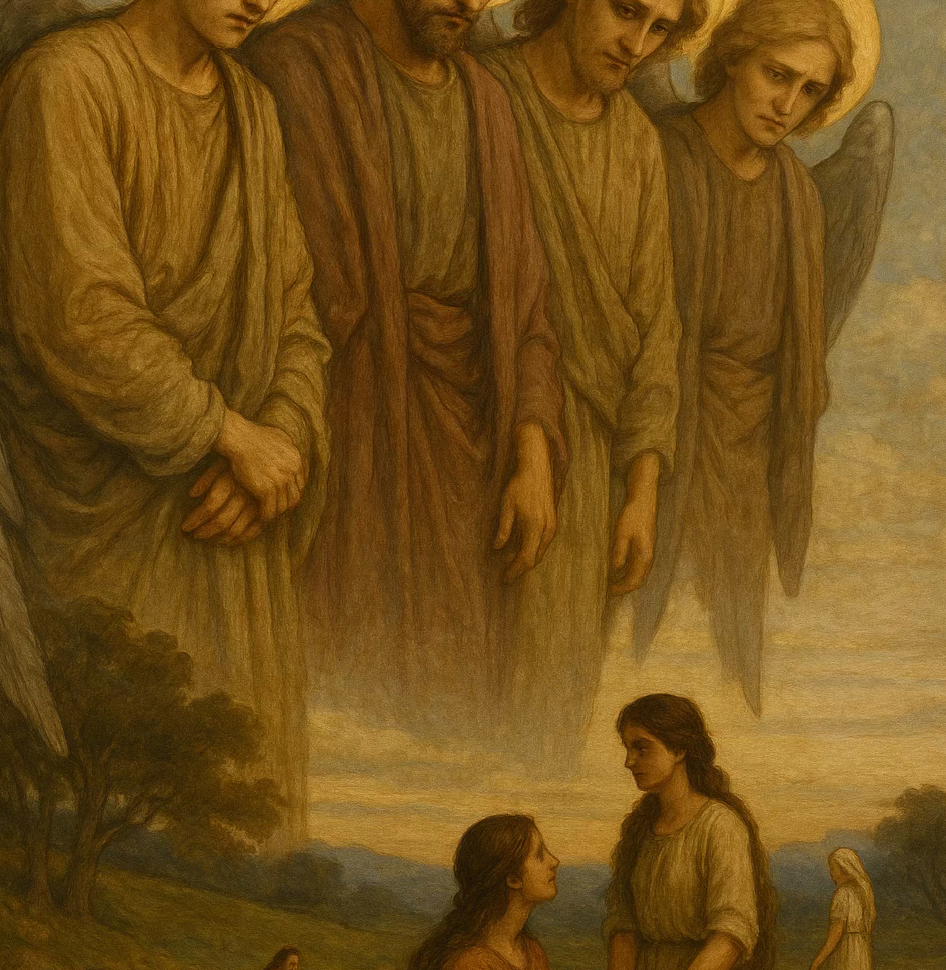
This group of beings we encounter in Genesis 6 are often called Watchers in the ancient writings — the Watchers of God. They had an assignment: to watch over mankind and protect creation. The Book of Enoch describes them as “the holy ones who look down and see the ways of men.” They were not evil, not fallen, but appointed as guardians. Today we call them “guardian angels,” and they still serve in the same role — ensuring that God’s will is done on earth.
But according to the Book of Enoch, it was not all the Watchers who abandoned their post — only a limited group of about two hundred, under the leadership of Semjaza and Azazel, chose to break the boundary between heaven and earth. The rest of the Watchers remained loyal to their assignment. This sin was therefore not a universal rebellion, but a specific revolt by a separated group that chose to corrupt the order of creation.
And the Bible clearly shows that the original assignment of the Watchers continues to this day. In Daniel 4:13 we read how Nebuchadnezzar says: “I saw in the visions of my head upon my bed, and, behold, a watcher and an holy one came down from heaven.” And again in verse 17: “This matter is by the decree of the watchers, and the demand by the word of the holy ones.” These verses confirm that God still appoints heavenly overseers over the world — beings who carry out His will, proclaim His judgements, and maintain the boundaries of nations (cf. Deuteronomy 32:8).
In other words, the idea of Watchers is not a mystical story from Enoch — it is biblical and still relevant. There are still heavenly guardians today, faithful servants who maintain God’s order and protect His children (Psalm 91:11: “For he shall give his angels charge over thee, to keep thee in all thy ways”).
But what we must also understand clearly here is that the specific group of Watchers in Genesis 6 were not part of the third of the angels who fell with Lucifer. No — these were not ordinary angels. They were not messengers, but rulers: Watchers with authority, responsible for nations, elements, and eras. They were beings of high rank, entrusted with holy knowledge directly from God. They understood the order of creation — the codes of life, energy, matter, and spirit.
And it was precisely this knowledge that they later abused. When they began to desire the daughters of men, something changed in them. The light with which they were clothed began to flicker under the heat of desire. They saw the beauty God had created — the beauty of the woman — and what began as admiration degenerated into lust.
The later church simply could not cope with this idea. The thought that heavenly beings — beings of light — could experience sexual desire and actually take on flesh became too uncomfortable for the new, sophisticated theology of the human-centred era. They wanted God’s creation neat and tidy, without the discomfort of the supernatural. And so, through philosophical thinking rather than faith, they began to “reinterpret” this passage. It was not because Scripture was unclear, but because human pride could not accept that sin could go so deep — that even beings of light could choose to fall.
This discomfort eventually gave rise to the Sethite doctrine — a man-made theory that solves the problem by simply denying it. They said: “No, the sons of God are not angels — they are just the descendants of Seth.” In this way, the church, instead of understanding God’s warning, cut the supernatural out of the Bible.
But the Bible has always been clear. Genesis 6 does not say “the sons of Seth”; it says “the sons of God.” And every time that phrase appears in the Old Testament — in Job 1:6, 2:1, 38:7, as well as in Psalms and Daniel — it always refers to heavenly beings, not humans.
Then the spirit of temptation began to persuade them — just as it first happened with Cain. Satan always works the same way: he begins in the spirit. He whispers, he persuades, he cultivates desire. Sin does not happen in a moment; it is planned slowly. And when the decision was settled in their hearts, they took the next step — action.
But even that step was not impulsive. Enoch tells us that they first deliberated among themselves, in the shadow of Mount Hermon. They knew what they intended to do was against God’s law and would bring judgement. That is why they swore an oath together — a covenant of rebellion — that none of them would turn back. “Come,” said Semjaza, their leader, “let us swear an oath and bind ourselves by mutual imprecations not to abandon this plan.” They then swore together, and Enoch says: “They took the Lord of heaven as witness to their oath.”
They therefore did not act in ignorance, but with full awareness of who God is and what they were doing against Him. They were no longer the Watchers of heaven — they made themselves the rebels of the earth.
And this is where we must stop for now. Because what happens next changes everything.
In Part 5 we will look at the consequences of this oath — how it began to corrupt creation itself, how humanity was altered, and why God ultimately said: “My Spirit shall not strive with man for ever.”
The story is too big, too important, and too close to our own time to rush through it. What began in Genesis 6 continues to this day.


