From Genesis to Revelation: The One Story – The Golden Thread that Explains Everything – Part 7
By Andre Eksteen
When the waters of the Flood finally receded, silence lay over the earth. Noah began working the soil again. His animals multiplied, his crops grew, and for the first time in a long while, peace settled over the earth. But beneath the surface, the old seed was still alive — the seed the Flood was meant to wash away had survived with them.
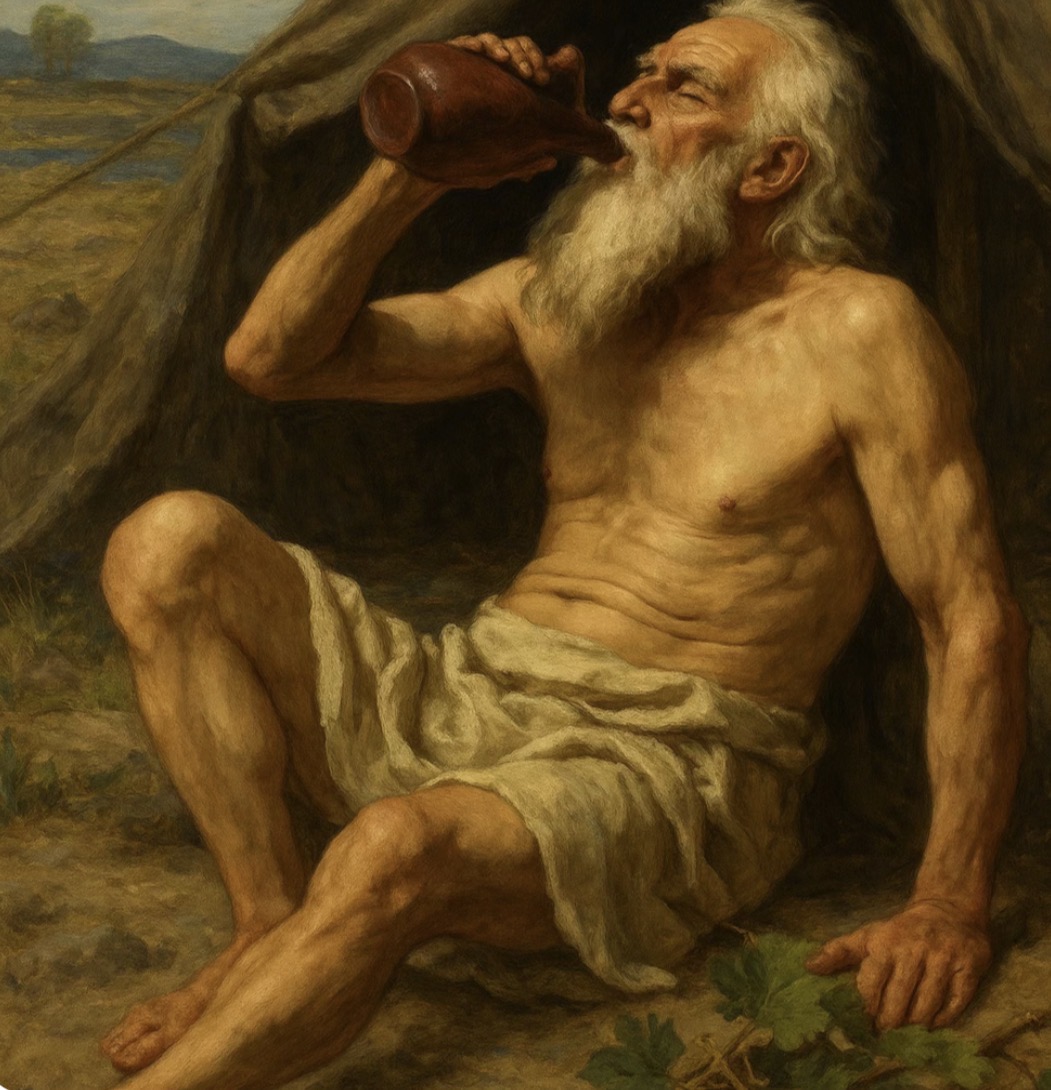
And then something happened that remains a puzzle to many people. Noah drank from the wine he had made himself. It was stronger than he expected, and he became drunk. He lay naked in his tent, and then the mystery begins. His son Ham came in, saw him naked, and laughed. That is all we read — or so it seems to the superficial eye. Yet when Noah woke up, he did not curse Ham, but his grandson Canaan. And it is here that the church once again gets stuck in a shallow moral story about “respect and honour,” because it is still blinded by the Sethite doctrine that spiritualises everything.
But let us look at what Noah really saw. Let us look at why he did not curse Ham, but Canaan — and how this connects to what we already know about the Nephilim.
This is one of the most important connections in the entire Bible: how the corrupt bloodline of the Nephilim survived the Flood and appeared again in Canaan.
Scripture states it clearly. Genesis 6 says there were giants on the earth in those days — and also afterwards. “Afterwards” means after the Flood. The Bible is not unclear; it is man — the church — that twists and spiritualises it. The Nephilim line was not wiped out — it found its way onto the ark and multiplied again once the waters withdrew.
Genesis says that Noah, his wife, his three sons, and their wives entered the ark — eight people in total. Four women, three of whom were to carry the future of mankind. But the Bible never tells us who they were or where they came from. And here the ancient writings once again bring light. The Book of Jubilees says that Ham’s wife, Na’elatamauk, may have come from a mixed bloodline. That explains a great deal, because as soon as the waters were gone, the same old corruption immediately surfaced again — and it began in Ham’s tent.
Scripture says Ham “saw his father’s nakedness.” In Hebrew, this does not simply mean looking. In Leviticus 18 we read that “to see someone’s nakedness” is an expression for sexual violation. Some of the ancient Jewish writings say Ham mocked his father; others say he dishonoured him. Whatever happened, Noah’s reaction was not mere anger — it was prophetic.
Noah woke up, looked at his son, and said: “Cursed be Canaan.” Not Ham — Canaan. Because Noah saw something the others did not see. He recognised the traits. He saw that the corruption still lived on in Canaan’s blood — that something of the old world had returned. This curse was not punishment; it was revelation.
Here we see the words of Genesis 6 fulfilled: “There were giants on the earth in those days — and also afterwards.”
And look at what follows. Canaan becomes the father of Sidon, Heth, the Jebusites, the Amorites, the Girgashites, the Hivites, the Arkites, the Sinites, the Arvadites, the Zemarites, and the Hamathites — all giant peoples, all descendants of Canaan. And it is precisely in that land — the land of Canaan — that God would later say to Abraham: “This is the land I give to you and your descendants.” The same ground. The land God’s children were to inherit was the land contaminated with the old blood — the seed of Satan.
Now we understand why. Ham’s wife carried the seed of Satan’s corruption, and through her it passed into Canaan. And through Canaan it filled the entire land.
Later, when the twelve spies entered Canaan, they said: “We saw the giants there, the sons of Anak, who come from the Nephilim; and we were in our own sight as grasshoppers.” (Numbers 13:33)
There it is — not symbolic, not mythical, but literal. After the Flood.
The Anakites, Rephaim, Emim, and Zamzummim — all came from Canaan. And from that line came the Philistines, and among them Goliath — six cubits tall, a descendant of the giants whose line Noah’s curse did not stop, only delayed. And once again we hear the Word: “There were giants on the earth in those days — and also afterwards.”
I say it again: Noah’s curse was not simply about bad behaviour — it was a prophetic declaration about Satan’s bloodline. Noah knew this line would again stand against God’s people, just as before the Flood. That is why God later commanded Israel to wipe out the Canaanites: “You shall save alive nothing that breathes… so that they do not teach you to do according to all their abominations.” (Deuteronomy 20:16–18). This was not hatred; it was protection — not war against people, but against corruption, against the seed of Satan.
The Book of Jubilees further says that Noah’s sons cried out to God after the Flood, because the spirits of the giants began to torment mankind.
And it is here that we again see the golden thread — because the seed itself did not disappear. The bodies were destroyed, but the DNA of Satan’s seed continued to exist. The spirit that inhabits it simply found new flesh. Whether in the giants before the Flood, in the peoples of Canaan, or in people today who carry Satan’s blood — it is the same line, the same nature, the same rebellion against God.
We must also carefully observe how this seed changed over the centuries. In the beginning they were grotesque — giants hundreds of cubits tall, half-spirit and half-flesh. But with each generation, as interbreeding with humans continued, they began to look more and more like ordinary people. Today they have the same eyes, the same voice, the same smile — but in their DNA they still carry the ancient corruption of the fallen seed. Satan’s line has learned to live in the open, indistinguishable to the eye, but obvious to those with spiritual discernment.
And that is exactly what Jesus warned about when He said:
“As it was in the days of Noah, so shall it be at the coming of the Son of man.” (Matthew 24:37)
He was not only speaking of ordinary sinful behaviour, but of a time when the earth would again be filled with the same corrupt seed — the mixing of flesh and spirit, the blending of what God separated. Jesus points us back to Genesis 6, because He knew that the spirit and blood of that rebellion would rise again just before His return.
That is why Genesis says “all flesh had corrupted its way.” The corruption was not only spiritual — it was physical, in the blood itself, in the DNA. God’s Spirit cannot dwell in what does not bear His image. And it is still the same today: the spirit of Satan remains in his seed, just as the Spirit of God remains in those who are born of Him.
This separation — the Adamic line and the line of Satan — is the true meaning of the conflict of Genesis 3:15: “I will put enmity between your seed and her seed.” That conflict is still playing out today — in flesh and blood.
God then commanded that most of the spirits be bound, but allowed a tenth to remain to test mankind. That is why we are still tormented by spirits today, even though the bodies are long gone.
That is also why Israel’s war against Canaan was not an ordinary war. It was God’s hand moving to wipe out the old seed once more. He would not cleanse the earth with water again, but with fire and judgement — through the obedience of His people.
The line of Canaan was therefore not merely evil — it was contaminated. And the curse Noah pronounced over him was not revenge — it was a description of what would come. Satan’s seed had taken root again, but God would ensure that it would never again dominate the earth as it did before.
And so the next chapter of this golden thread begins — the war between the pure seed of Adam and the corrupt seed of Canaan. The same war, in a new time.
The Flood did not end it; it merely wiped the board clean for the next round.
In the next part we will finally come to the true formation of different cultures, nations, and even skin colours.