
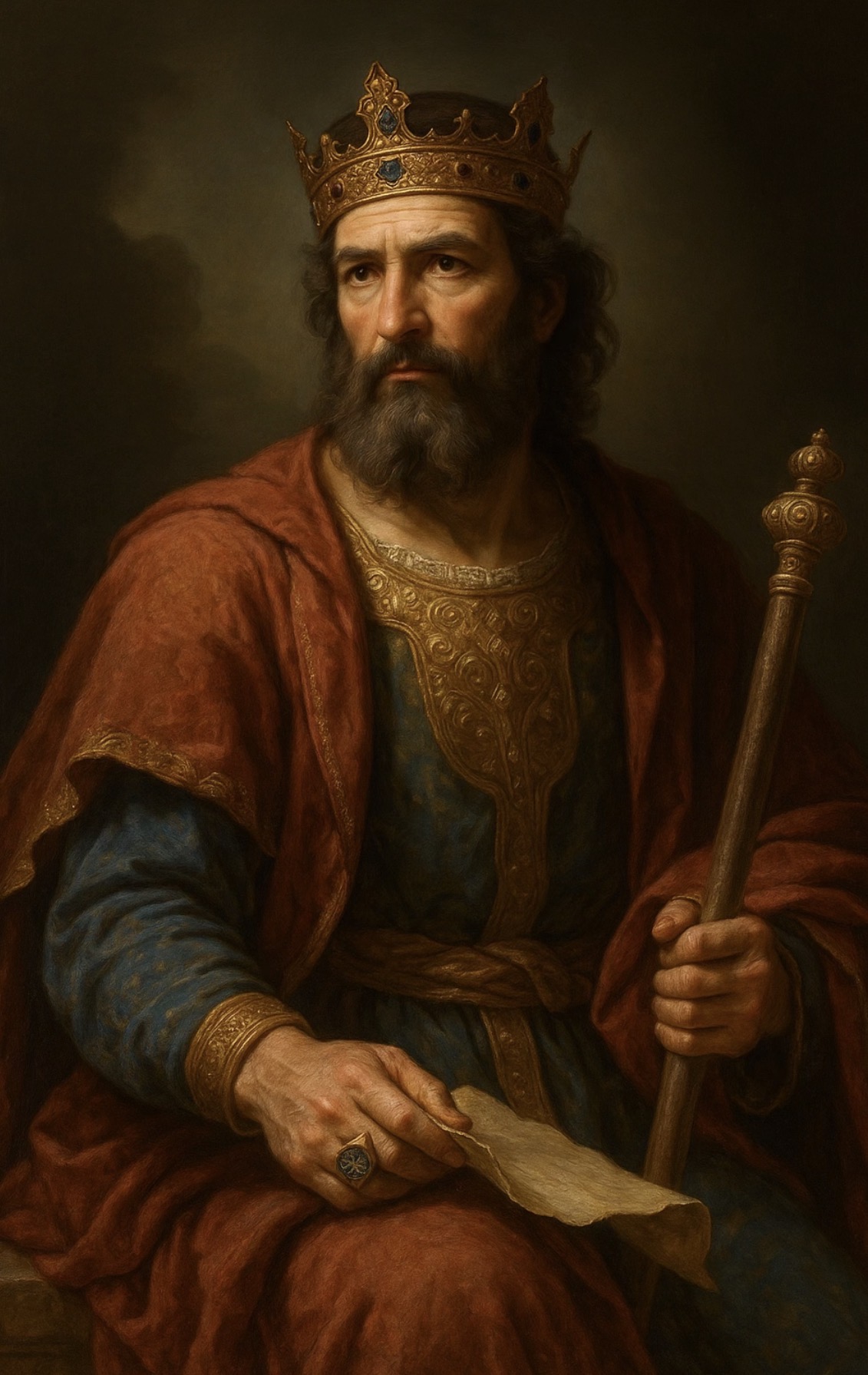
From Genesis to Revelation: The One Story – The Golden Thread that Explains Everything – Part 17
By Andre Eksteen
The war was over.
The giants were dead.
The blood infected with Satan’s seed no longer flowed through the veins of half-human beings.
For the first time in generations, Israel could breathe again.
David’s sword was silent, his hands covered in blood, but his inheritance was clean.
God had kept His promise. The land was pure, the throne established, the enemies silenced.
And then came Solomon, the son of David.
Not a warrior, but a builder.
Not with a sword, but with a pen.
The son of the man who had wiped out the last drops of a corrupted bloodline.
He rose in a time when heaven was quiet and the earth was flourishing.
God Himself spoke to him and said: “Ask what you want.”
And the young king did not ask for riches or fame — he asked for wisdom.
And God gave him wisdom, but with the wisdom came the test.
Because it is always so.
The greater the light, the sharper the shadow it casts.
Solomon’s wisdom was like sunlight — bright, sharp, immeasurable.
People came from everywhere to hear his words.
He understood the riddles of creation: the voices of birds, the patterns of the wind, even the movements of the stars.
But as the Book of Wisdom says:
“When he praised his own soul above the wisdom given to him, the light began to grow dim.”
He began to build — and the building never stopped.
First for God, then for the people, and then for himself.
What began as worship slowly turned into display.
The temple that was meant to glorify God became the centre of human pride.
Palaces rose, gold poured in, and with every wall that grew, another wall formed between him and God.
There is a part of Solomon’s story that few people know — and it is precisely the part where wisdom becomes dangerous.
The ancient writings tell us that God gave Solomon something extraordinary: a ring bearing the seal of His Name — a holy sign of authority.
The Talmud says that seal carried the Tetragrammaton — the four letters of God’s Name: YHWH.
Josephus writes that God gave Solomon the ability to subdue spirits and heal people from sickness through the power of His Name.
And the Testament of Solomon says that this ring was not merely symbolic, but an instrument by which Solomon could command the spirits of the air — the same heavenly powers that had ruled over the nations since Babel.
With this ring he placed them under authority.
They obeyed him — not out of love, but out of fear of the Name the ring carried.
Solomon commanded them to work for him, and they did so:
carrying stones, laying foundations, smelting metal, and even sharing knowledge that no human was ever meant to possess.
The Testament of Solomon describes it like this:
“When I held the seal of God against them, they trembled and cried out, ‘We are doomed, for the seal of the Almighty burns like fire!’”
In this way Solomon completed the temple with help that did not come from men.
And this is exactly where the danger began.
Because this was not ordinary labour — it was holy work done by unholy hands.
And although they appeared obedient, they never stopped hating.
Later Jewish sages understood this.
They said: “Even if you build for God, if you use unclean workers, the work itself becomes unclean.”
This is precisely why the purification through the Red Heifer (Numbers 19) was instituted — and why it is still regarded today as a requirement for temple service.
According to the Law, every object, every tool, every person who touched the holy things had to be sprinkled with the ashes of the red heifer, mixed with water from a pure source.
Not because the dust or the water was magical, but because it symbolised complete separation from everything unclean.
For the people learned this lesson: even when you build for God, unholy hands contaminate the ground of worship.
Josephus writes:
“God gave Solomon wisdom to command spirits, and he left behind an art by which we still cast out demons today.”
And the Wisdom of Solomon says:
“God gave me knowledge of the workings of the elements, the powers of spirits, and the secrets of the times.” (7:17–22)
In other words — Solomon saw what others could not see.
He understood the world of flesh and spirit at the same time.
And that made him great, but also vulnerable.
Because the more you see, the greater the temptation to look where you should not.
The Testament of Solomon tells of a spirit called Ornias, a spirit of desire who had “fallen from the stars”.
Solomon asked him: “Who made you this way?”
And Ornias replied: “I was once among the heavenly bodies, but I fell because of the sight of women.”
Solomon asked again: “Who is your master?”
And he answered: “He who rules over the depths and seeks to rule over the light of mankind.”
From that moment, Solomon began to do something that was never his calling.
He did not only seek to understand — he began to seek control.
He wanted to know how these powers worked, and the more he learned, the more they began to speak back.
One of the spirits said to him:
“You may command me today, but tomorrow I will find your heart.”
And that is exactly what happened.
According to tradition, there was a woman from distant lands — possibly from Egypt or Sidon — who asked him to show her the ring that gave him authority.
He showed it to her, smiling, without fear.
And when she touched it, the writings say, the power of the ring vanished.
The seal of the Almighty was defiled, and the power that had once been under his authority turned against him.
In that moment, the wisest man on earth began serving the very same heavenly princes his father’s generation had driven out of the land.
Look closely — this is how the devil works.
Not through violence, but through access.
Not through hatred, but through love without discernment.
Not through power, but through curiosity.
Solomon wanted to understand the darkness — and in the end, he allowed it.
His temple remained, his palaces stood, but the light within them grew dim.
Because no man can mix the fire of God with the breath of fallen beings and expect it to keep burning.
What began as holy authority ended as spiritual compromise.
The ring was no longer a seal of holiness, but a reminder that even the wisest man can fall when he crosses the boundary between revelation and temptation.
That is why his end is so tragic.
Not because he was foolish, but because he believed he could use darkness without becoming dark himself.
What David wiped out with flesh and blood, Solomon allowed to return through pride — not in people, but in powers.
That is why God said:
“Because you have broken My covenant, I will tear the kingdom from you.”
Not as punishment, but as mercy — to prevent the contamination from taking root again in the Golden Thread.
Wisdom without obedience always becomes pride.
And pride always asks: “Why not more?”
Solomon began to investigate things that were never meant for man.
He spoke with spirits, learned their names, and asked about their purposes.
And with every answer, something in him changed — curiosity gave way to control, and control to pride.
Near the end of his life, Solomon realised what he had lost.
He said:
“I heard the voice of the Lord, and I did not follow Him. I repeated the sin of Adam.”
And that is exactly what he did — he chose knowledge over obedience.
The Golden Thread did not break, but it grew dim.
And as always, when light grows dim, darkness draws closer.
The princes of the air, who had long been silent, began to stir again — not in the flesh, but in the spirit of the nation.
And that is where the next part begins:
When the voice of God grows quiet and the prophets begin to speak again.
When fire falls from heaven to consume the altars of false gods.
When the Golden Thread passes through judgement to be washed clean again in truth.
In the next part — Part 18 — we meet Elijah, the man of fire, the prophet who stood alone against kings and gods and said:
“If the LORD is God, follow Him.”
Because Solomon’s story teaches us one thing:
wisdom without obedience is nothing more than enlightened rebellion — and God never tolerates it for long.


