From Genesis to Revelation: The One Story – The Golden Thread that Explains Everything – Part 39
By Andre Eksteen
The world sees peace, but heaven prepares for war. The smoke of the abyss has not yet lifted; the earth still smells of sulphur and blood, yet people celebrate. They think the judgement is over. They believe the new world order has brought peace. While the world bows before the false trinity, John hears a voice from heaven:
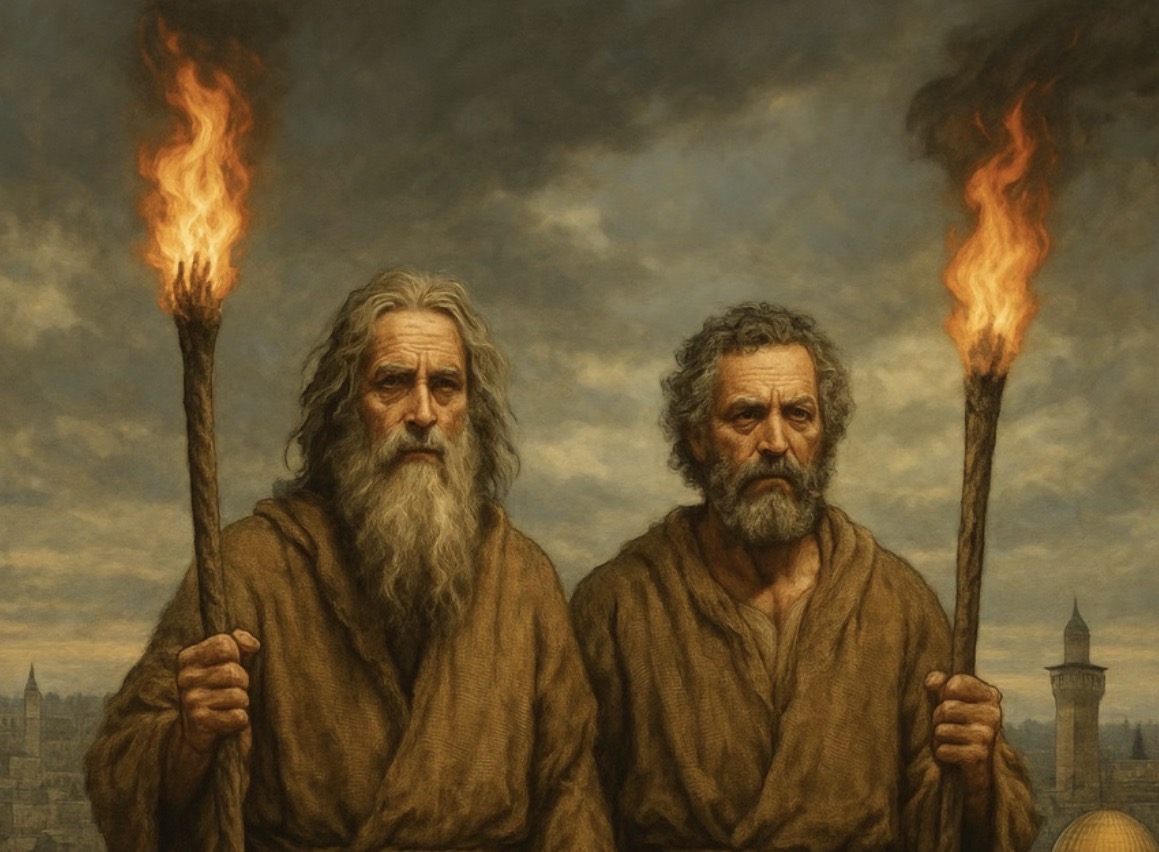
“I will give power unto my two witnesses, and they shall prophesy a thousand two hundred and threescore days, clothed in sackcloth.” (Revelation 11:3)
This is God’s final warning before grace falls silent forever. The two witnesses do not stand in secret places — they stand in the streets of Jerusalem, where the world has built its new religion of unity. They do not wear splendour, but sackcloth. Not because they are defeated, but because they mourn a world that has rejected its Creator. They do not preach acceptance, but truth. They do not speak softly, because the time for softness is over.
And the church? They declare it symbolism. “The two witnesses,” they say, “are the Old and New Testament.” Others say, “It is merely a representation of the church and Israel.” That is how theologians speak — people trying to explain what they do not understand. They see two, because they look with human eyes. They do not understand that the Holy Spirit Himself stands between them. The Spirit of God dwells in each of them, just as He dwelt in people before the Rapture — and through them He speaks again. The two are not merely prophets; they are the mouthpieces of the Holy Spirit — His voice in the final three and a half years of grace. They are two bodies, but one message; two mouths, but one Spirit speaking.
That is why they are not two — they are three.
For Scripture says: “I will give power unto my two witnesses.” The power with which they speak is not their own. It is the Spirit of God in them who speaks. It is the same Spirit who burned in Elijah when he said, “If I be a man of God, let fire come down from heaven.” It is the same Spirit who spoke through Moses when he said, “Let the waters of the Nile be turned into blood.” It is the Holy Spirit who testifies in them of the Father and the Son. The church sees only people; heaven sees the fullness of God’s Spirit speaking through people once again.
Even today, while the Holy Spirit is still in the world and the church still has the ability to discern, they do not see Him. They speak about the Spirit, but they do not know Him. They call Him a feeling or an atmosphere. They preach about the two witnesses as if they are fables, but they miss the One who speaks through them. They see the prophets, but they do not hear the Spirit in the prophets. And that is why the world is blind — because the church is blind.
The two whom John sees are not figures or ideas. He describes them as he sees them: “These are the two olive trees, and the two candlesticks standing before the God of the earth.” (Revelation 11:4) Olive trees represent the Spirit — the oil of anointing. Candlesticks represent light — testimony. The one cannot exist without the other. Without the Spirit there is no light. Without light there is no testimony. The church explains the symbol, but misses the meaning: the Spirit in the two makes them three.
They have adopted the world’s reasoning and removed the supernatural from Scripture. They believe the Bible must be explained, not believed. They look at John’s description and say, “It cannot be literal.” But John did not write what he thought — he wrote what he saw.
And what he saw were two men in the spirit of Moses and Elijah — the same two who appeared on the mountain with Jesus, the same two who stood in the presence of God when the world was still young. The Law and the Prophets — now filled with the Spirit who speaks through them. They return not in their own name, but in His. They come to say: “God has not changed. Judgement is here.”
For three and a half years they testify. They warn against the false church and the false peace. They call people to repentance, and their words bring fire. John says: “And if any man will hurt them, fire proceedeth out of their mouth, and devoureth their enemies.” (Revelation 11:5) This is not figurative language — this is exactly what happens. When they speak, the Spirit of God moves through them, and His judgement becomes visible in the streets. The fire that comes from their mouths is literal — it devours, it burns, it kills. The world will see it and fear, because no one will be able to stop or explain it.
And the greatest shock will come to those who before the Rapture believed in the false Jesus — the one who forgives everything, approves everything, and never judges. They now see that the true Christ is not a tame, gentle figure of human mercy, but the King of judgement who clothes His messengers with fire. They fear, because they do not recognise Him. They realise too late that they followed another Christ their entire lives — an imitation of love without truth, peace without righteousness. Now they look at the fire and know: this God no longer forgives; He judges.
Thus God reveals His authority before the eyes of a world without fear. As in the days of Pharaoh, we see again how He lets His judgement flow through His messengers. As Moses’ staff challenged the powers of the earth, and as Elijah’s fire consumed the false prophets of Baal, so these two — with the Holy Spirit in them — will let His judgement descend upon the earth. It is God acting through them, not human strength. And once again we see His righteous judgement in the streets: everyone who dares to rise against His messengers falls under the same fire they try to silence.
The world will fear them, yet the hearts of many will remain hardened — just as in Egypt. They will see the fire, but will not believe. They will know it is God, yet still turn away. And in doing so they fill the measure of their own judgement.
Here we clearly see how the whole world fears and despises them. They stand in the streets of Jerusalem, and the world watches in dread. The media declares them “dangerous.” Governments call them “threats to peace.” Politicians warn against them as “fundamentalists.” Religious leaders cry out for them to be silenced. But no one can do it. Their power is too great; their authority too holy. They stand untouchable, and no army or weapon on earth can destroy them. Even when the world’s powers try, they are stopped by fire from heaven — the presence of God Himself guarding His messengers.
They bear the seal of God, and no one can touch them until their work is finished. They are hated by the world and protected by heaven. And in that collision — between hatred and protection, between man and God — the earth begins to realise that the time of grace ended with the Rapture.
When their testimony is completed, John says: “The beast that ascendeth out of the bottomless pit shall make war against them, and shall overcome them, and kill them.” (Revelation 11:7)
The world watches as they fall. The bodies of God’s witnesses lie in the streets of Jerusalem for three and a half days. People celebrate. The world sends gifts to one another and says: “The voice of judgement is silent.” They laugh at the death of those who spoke truth. The false prophets of the earth declare: “Behold, the new era has begun.” Mobile phones show their dead bodies in every home; news anchors smile and say: “The hate preachers have been silenced.” The world rejoices. But heaven is silent — for God waits.
What the world does not understand is that this scene is not defeat, but the repetition of the cross itself. As Christ was crucified and His body lay in the grave for three days, so His witnesses lie for three and a half days in the streets of the city that rejected Him. Jerusalem, where the Messiah was killed, now again becomes the place where the world thinks it has overcome God. They nailed Him to a cross once; now His witnesses lie nailed to the ground. But God does not work in human time. He waits until the world believes He is silent — and then He moves again.
John says: “And after three days and an half the Spirit of life from God entered into them, and they stood upon their feet.” (Revelation 11:11)
The world watches, and fear falls upon all. They see the bodies move. They hear a voice from heaven say: “Come up hither.” And the two are taken up in a cloud — visible, real, literal. As the Son ascended from Bethany, so these two are taken up by the same Spirit before the eyes of their enemies. It is not symbolism; it is a second resurrection, a second testimony that the power over life and death still lies in God’s hand.
The world’s celebration turns into terror. The cameras that broadcast their death now show them standing. The people who sent gifts scream. The prophets of the world flee. And the city trembles, for they know: the One they thought they had “silenced” lives again — and this time He does not come to save, but to judge.
This is the final confirmation of God’s authority — three in one: the Father who sends, the Son who testifies, the Spirit who gives life.
The death of the two witnesses is the visible reaffirmation of Golgotha, and their resurrection the proof that the Spirit of God has not grown old. As Jesus said: “I am the resurrection, and the life: he that believeth in me, though he were dead, yet shall he live.” Now the world sees it again, but this time without grace, without time, without delay.
And yet — even in this moment the modern church tries to explain it away. They say: “It is spiritual language,” “an image of faith’s victory,” “a representation of the church rising again.” They soften everything until it becomes meaningless. They cannot believe that the Spirit of God literally gives life, because they wrote Him out of their theology long ago. They believe in ideas, not in power; in faith, but not in reality. They call it “the symbolism of hope,” but John did not describe symbolism — he wrote what he saw.
After the witnesses ascend, the seventh trumpet sounds. John hears the voice say: “The kingdoms of this world are become the kingdoms of our Lord, and of his Christ; and he shall reign for ever and ever.” (Revelation 11:15)
Heaven celebrates, but the earth begins to burn. The world system that promised peace begins to collapse. Babylon, the great city, falls. The voice of God says: “Babylon the great is fallen, is fallen, because her sins have reached unto heaven.” (Revelation 18:2,5)
What began with Jesus at the cross, God now completes before the eyes of the world — the resurrection of His messengers before the eyes of the godless. It is the final proof that He still reigns, that His Word has never changed, and that even in judgement His plan remains perfect.
The church says it is merely symbolic of moral decay. But look around you — this is Babylon in the flesh: a world that builds its wealth on lies, its religion on compromise, its authority on deception. John describes her as a woman clothed in purple and scarlet, adorned with gold and jewels, drunk with the blood of the saints. It is not poetry; it is the description of the world’s system — the false church, the harlot of the nations.
Before judgement falls, God calls out one last time: “Come out of her, my people, that ye be not partakers of her sins.” (Revelation 18:4)
This is the final warning — the last chance. Those who remain choose to share in her destruction.
The world that rejected the two witnesses now sees the city fall. Those who silenced the voice of God now hear the trumpet of judgement. And heaven says: “Hallelujah; for the Lord God omnipotent reigneth.” (Revelation 19:2)
The church asks: “Is it really literal?”
I ask: if the cross was literal, why would the judgement be symbolic?
From Genesis it has always been the same: God warns, man laughs — and then fire comes.
The witnesses were the last prophets. Babylon is the last warning. The next sound is not a sermon — it is a trumpet.