Where Is the Youth?
By Andre Eksteen
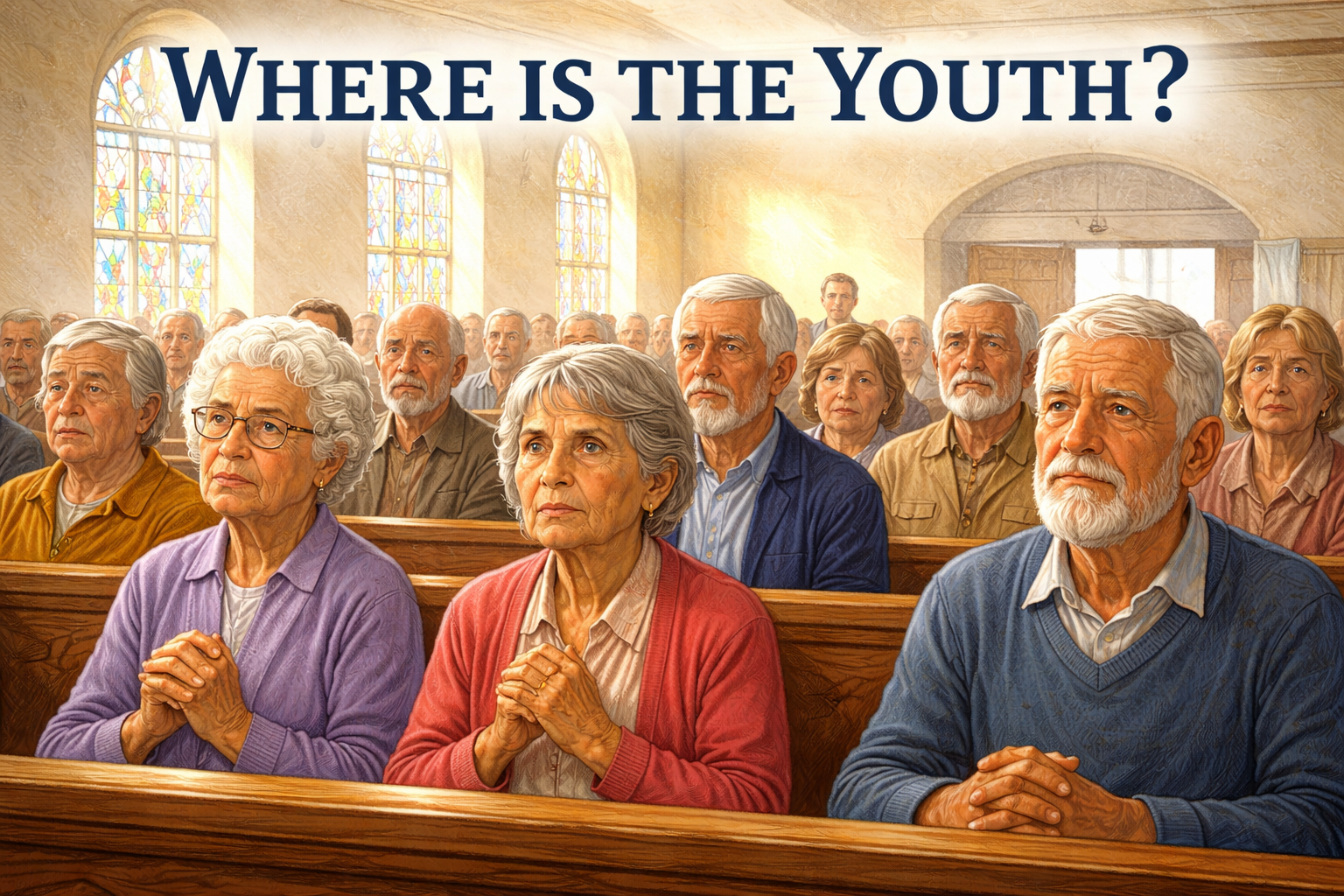
The people sitting in the church pews are getting older, and that should force us to ask the question: where is the youth? We are not talking about small children who are dragged to church by their parents. We are talking about young people who are independent, who make their own choices, and who have decided: “Church is not for me.” They are slowly but surely disappearing from our services, and we are not even paying close enough attention to notice it.
Let us be honest — Gen Z lives differently from anything we older people know. They are the first generation to have grown up from early childhood in a digital world. They are no longer fed information from a single source. They are used to checking everything you say immediately, and within seconds comparing different sources with one another. You are not going to silence them with “do not ask questions, just believe”. They test everything you say. They are not looking for a preacher who shouts from the pulpit, “accept it as it is”. They are looking for the full truth that still stands when you go and check it. For them it is simple: true science must arrive at the true Bible, otherwise they walk away. If your teaching cannot stand up to questions and research, you have lost them before you have even finished preaching.
The numbers prove it: in studies among South African school leavers, only about 22.4% said they still identify as Christians who are actively involved. And believe me, that is actually high. In many other countries it is far, far lower. It is therefore precisely that 22% who are still sitting in our pews, trying to hold on. The rest? They go looking elsewhere. They go to the internet, to forums, to games and to films. They ask the same questions, but the answers they receive are not biblical. Before you can blink, they are involved in the occult, because it looks as if the questions are at least answered honestly there, while the church simply silences them.
The biggest reason for this falling away lies in the way we as the church handle questions. Questions are smothered. Think of Genesis 1:2: “And the earth was without form, and void; and darkness was upon the face of the deep.” A preacher stands and preaches about creation. He tells how God made everything perfectly. But then a young person raises his hand and asks: “But why did God make such a mess if He is perfect?” The answer he receives is: “We do not know. Do not ask. No one understands God’s ways.” End of conversation. But for Gen Z it is not the end. He goes home, takes his phone, types it in, and suddenly discovers something that shocks him: the Hebrew text shows that it was not God who made a mess, but that there was already a cosmic conflict and chaos when the story of Adam begins. He sees that the Bible itself acknowledges this. He thinks: “Why did my preacher not just tell me that?” He would not have had to understand everything, but at least he would have felt that there is depth behind the text. Instead, he received a cheap answer. Right there, the church loses him. Not because he turns against God, but because the church has wronged him by burying his questions.
Then there are the stories we handle so superficially. Look at the Flood. God drowns everything that breathes, except those on the ark. The preacher says: “Yes, it was simply because of sin.” But the young people listen and think: “Wait a minute… you say God is love. How can a loving God wipe out innocent children who cannot even think for themselves yet, let alone commit sin?” It does not fit together. And again they go home, start reading, and discover that for centuries the church has used the easy Sethite view to hide discomfort — the idea that the “sons of God” were just ordinary people. But the young person reads further and sees it says something else: the Nephilim. Beings that were themselves worshipped as gods and demigods. Giants who filled the world with violence and corruption. Now the Flood makes sense. Not because God wanted to kill children, but because the human bloodline had become so corrupted that there was no other outcome. The Flood was not merely about sin, it was an intervention to save the existence of humanity.
And suddenly a child’s eyes open. He plays God of War, and he sees that the game is full of gods and demigods who behave exactly like those he is now reading about in Genesis 6. He thinks: “But wait, my church always told me these gods in my games are just fiction. Just stories. Just mythology.” And now he discovers that the Bible itself speaks about them. A whole new world opens up to him, a world the church itself buried because it was supposedly too difficult or too dangerous to explain. And right there the church loses another young person. Not because he no longer believes, but because he sees that the church is not honest. The church dismissed the real danger of the gods and demigods in the games as fiction, while they were real beings that tried to corrupt God’s creation.
Then there are the hard questions the church simply does not know how to deal with. Many young people say it outright: “I cannot even ask my questions in church, because I get silenced.” They ask about suffering. Why must children in Gaza or in the Eastern Cape starve if God is love? They ask about science. How can the Bible speak of a six-day creation while they hear every day on TikTok and YouTube about billions of years, fossils, and stars? They ask about the devil. Why does it look as if evil always wins, even though the church says Jesus has already won? They ask about heaven and hell. How can a good God punish people forever? And what do they hear? “Do not doubt like that, you must just believe.” They do not only feel rejected, they feel humiliated. Because they know that within minutes they can find a thousand other sources that at least try to take the questions seriously.
Here lies the heart of the problem. The youth are not leaving God, they are leaving a church that is afraid of questions. They are leaving a church that plays around with programmes, music, and beautiful buildings, but does not have the courage to dig into the Bible with them. They are leaving a church that would rather build a façade of certainty than honestly say: “We do not know everything, but let us search together.” They are leaving a church that buries God’s truth under comfortable answers. They are leaving a church that refuses to recognise that knowledge has increased and instead clings to dogma from the Reformation era.
The danger is deadly serious. That 22% who still believe are hanging on by a thin thread. They are the last of a generation willing to still give the church a chance. If we lose them, it is over. The rest of the young people already have their feet in other worlds. They look to games, films, online forums. They get answers from mythology, from New Age, from satanism and occult influences. They think: “At least here is someone who is not afraid of my questions.” And before you can blink, they are deceived by the enemy himself.
We as the church are so busy playing church that we have become blind to the fact that our children are quietly walking away. We hold conferences, build beautiful buildings, boast with music and lights, argue about doctrines and positions. Our egos sit behind pulpits and tell people how big our ministries are. Meanwhile, the next generation is being driven straight into the arms of the enemy. The enemy does not hold conferences. He does not hold worship concerts. He answers questions. Even if his answers are lies, he gives them. And our children listen to his voice rather than ours, because he is at least willing to take them seriously.
If we do not wake up now, we will lose the next generation. Not because they are not thirsty for God, but because they no longer believe that the church truly represents Him. They do not want sermons that only sound nice. They do not want programmes full of gloss. They want the truth, even if it cuts deep. They want the full Bible, not the castrated version we have been prescribing for centuries. They want to hear about the Nephilim, about the cosmic conflict, about the reality of the devil, about the full gospel of Jesus Christ. They want to see that true science and the true Bible do not contradict one another, but together cry out the truth.
And this is our test. We can keep playing, or we can get serious. We can keep reducing the Bible to children’s stories, or we can open up the truth and tackle the hard questions together with the youth. We can keep building a façade, or we can admit that we lost the way long ago. The time for nice talk is over. If we are not willing to proclaim the truth of God honestly and fully, the darkness will do it for our children.