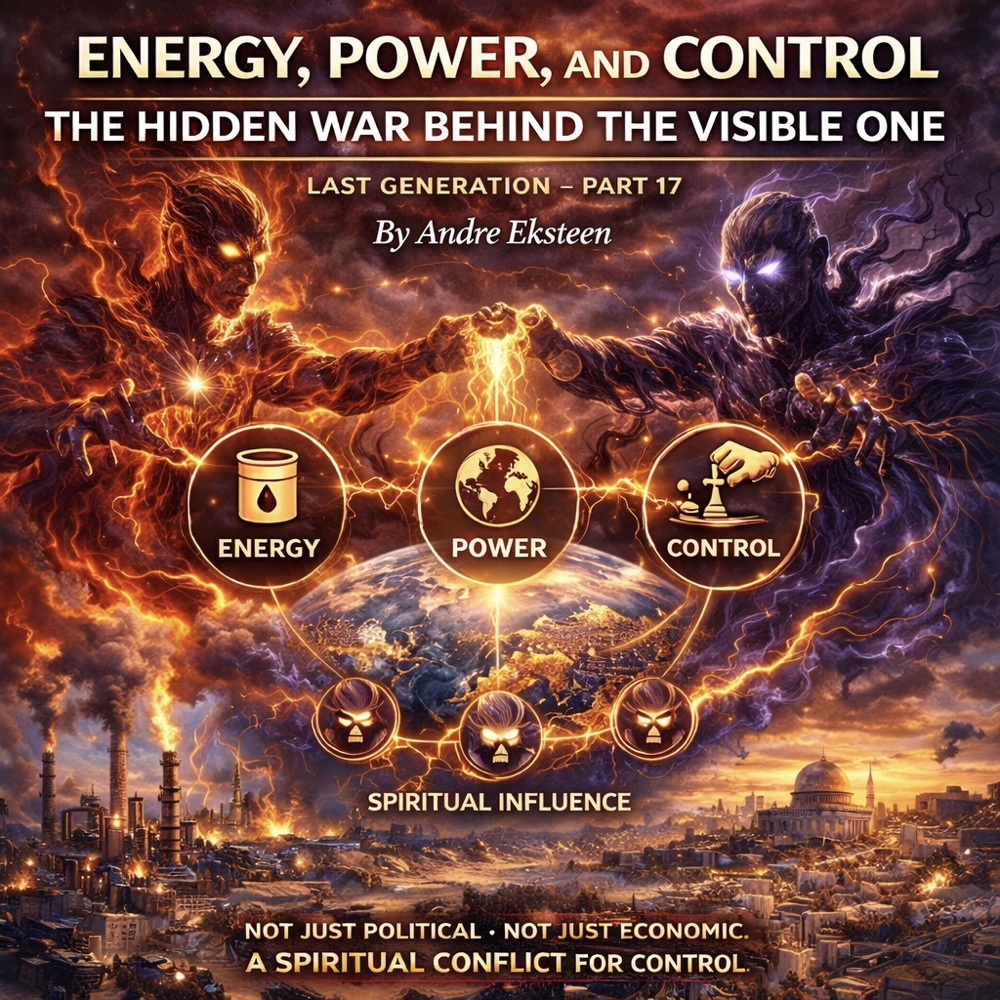
Energy, Power, and Control: The Hidden War Behind the Visible One – Last Generation Part 17
By Andre Eksteen
Up to this point in this series we have looked at what is visible. Wars. Regions under pressure. Israel back in the land. Global instability increasing. The structural reasons why the Middle East remains the focal point of global tension. All of that is observable, documentable, and arguable from publicly available information. But now we need to step one layer deeper. Because if you only look at what is visible, you will never understand what is driving it. And the remarkable thing is that Scripture does not leave us blind to that deeper layer. It lifts the veil, briefly but explicitly, and shows us something that most of our contemporary analysis — including most of our prophetic analysis — either ignores or dismisses as metaphor.
There is more happening behind nations than governments. There are forces operating at a level beneath the visible that shape the decisions of nations, the directions of history, and the alignment of powers in ways that purely political or economic analysis cannot fully explain. Now before that makes you reach for the label of conspiracy theory, let me be clear about where this claim comes from. It does not come from current events analysis or from alternative media. It comes from the book of Daniel. And it is stated there as directly and concretely as anything in that book.
What Daniel 10 Actually Reveals
Daniel 10 is one of the most significant chapters in the entire Bible for understanding the structure of spiritual influence over nations, and it is one of the most consistently underread chapters in prophetic study. People quote the seventy weeks of Daniel 9. They quote the beasts of Daniel 7. They quote the abomination of desolation from Daniel 11 and 12. Daniel 10 gets far less attention, which is unfortunate because it provides the framework within which all those other passages must be read.
In Daniel 10, Daniel has been fasting and praying for three weeks when an angelic messenger arrives. The messenger explains the delay: “But the prince of the kingdom of Persia withstood me one and twenty days: but, lo, Michael, one of the chief princes, came to help me; and I remained there with the kings of Persia” — Daniel 10:13. Then, looking ahead to what is coming, the messenger says: “And now will I return to fight with the prince of Persia: and when I am gone forth, lo, the prince of Grecia shall come” — Daniel 10:20.
Now read that carefully, because the language is precise. The prince of the kingdom of Persia is not a human king. The human kings of Persia at the time were Cyrus and his successors, who are mentioned by name in surrounding chapters. The prince who “withstood” the angelic messenger for twenty-one days is a spiritual entity — a powerful being operating over the Persian empire, shaping its policies, influencing its decisions, resisting divine purposes in the heavenly realm while the earthly drama played out below. Michael — described elsewhere as the great prince who stands for Israel — comes to assist. The prince of Greece is coming. These are spiritual powers connected to and operating through the great empires of the ancient world.
This is not metaphorical language. Daniel 10 is not a vision in the same sense as Daniel 7 or Daniel 8. It is a direct experience — an encounter between Daniel and a heavenly messenger — in which the messenger explains something about how the world actually works at a level most people do not see. Nations have spiritual princes. Those princes engage in conflict in the heavenly realm, and that conflict is directly connected to what happens in the earthly realm. The angelic messenger was delayed for twenty-one days by the resistance of the prince of Persia. Michael came to help. And these spiritual confrontations directly correspond to the rise, fall, and succession of empires on earth.
Now if you take that at face value — which the text asks you to do — it changes how you read history. The rise and fall of Persia, Greece, Rome, and all subsequent empires is not purely the product of military strategy, economic resources, and human political calculation. Those things are real and they matter. But behind them, shaping them, influencing their direction, there are spiritual forces engaged in a conflict that the earthly players mostly cannot see and whose logic the earthly players mostly do not understand.
Paul reiterates this structure in Ephesians 6:12 — “For we wrestle not against flesh and blood, but against principalities, against powers, against the rulers of the darkness of this world, against spiritual wickedness in high places.” The same structure Daniel glimpsed — spiritual princes over regions, powers operating through earthly kingdoms, rulers of darkness shaping human events — is present in Paul’s framing of what the believer is actually engaged with. It is not presented as an analogy. It is presented as a description of reality.
What Revelation 18 Adds to the Picture
Before we move into the hidden architecture of global control, it is worth pausing on one more passage that sits directly at the intersection of the spiritual, the economic, and the end-time sequence — Revelation 18. The chapter describes the fall of Babylon the Great, and what is striking about it is how specifically economic the description is. Babylon is not described primarily as a military power or a religious system in chapter 18. It is described as an economic system — the merchants of the earth made rich by her, kings who committed fornication with her, a voice crying “Babylon the great is fallen” and the merchants weeping because no one buys their goods anymore.
Revelation 18:11-13 gives a remarkable list of the commodities in which Babylon trades — gold, silver, precious stones, pearls, fine linen, silk, costly fabrics, wood, ivory, iron, marble, cinnamon, spice, perfume, frankincense, wine, oil, wheat, cattle, sheep, horses, chariots, and slaves — and then, at the end of the list, the most startling item: “and souls of men.” The economic system of Babylon trades in everything including human souls. It is a system in which human beings are ultimately commodified — their labour, their compliance, their data, their participation in the system, their very identity.
Now whether Babylon in Revelation 18 refers to a specific city, a specific nation, a global economic system, or some combination of all three is a question that has generated significant debate and does not need to be resolved here. What is significant is the economic character of the description. The end-time system that falls is not primarily a military empire or a religious institution. It is an economic system — one that has drawn the entire world into financial dependency on it, that enriches the merchants and kings who participate in it, and whose fall is mourned by those whose wealth depended on it. The character of that system — comprehensive economic integration, global dependency, commodification of everything including human beings — is recognisably related to the trajectory of the present global economic order, even if the final form that trajectory produces is not yet fully visible.
The person who reads Revelation 18 alongside the present-day integration of global supply chains, digital financial systems, and the drive toward central bank digital currencies is not being sensationalist. They are noticing a structural correspondence between the prophetic description and the direction of observable trends. That correspondence does not prove the tribulation is imminent. It does mean the prophetic picture and the present trajectory are moving in the same direction. And that is worth holding carefully as you watch.
The Church’s Blindness to the Structural Layer
Now let me say something about the Christian community’s response to the structural picture that has been building across the last several parts of this series, because it is directly relevant to the warning Jesus gave at the beginning of Matthew 24.
Most of the church — particularly in the Western world — is functionally blind to the structural layer we have been describing. Not because the information is unavailable. Because the frameworks within which most Western Christians read the world have been shaped by cultural assumptions that make the structural analysis feel like paranoid thinking rather than sober observation. Christians who raise concerns about centralised economic control, about the trajectory of digital identity systems, about the concentration of power in multilateral institutions, are regularly dismissed as conspiracy theorists — even within the church — in ways that prevent the serious structural engagement the prophetic picture requires.
There is a painful irony in this. Jesus warned, at the very beginning of His end-time discourse, against deception. He described a period in which the signs would be so convincing that even the elect could be deceived if it were possible. And the primary mechanism through which deception operates — as we have argued throughout this series — is not obvious falsehood but the rearrangement of real things into a misleading framework. The person who dismisses structural analysis of global control systems because it “sounds like conspiracy theory” has already been shaped by a framework that prevents them from seeing what Daniel 10 plainly shows: that spiritual powers operate through nations and their systems, shaping the direction of history in ways that go beyond what purely political or economic analysis can account for.
The dismissal is often framed as theological sophistication — “we should focus on the gospel, not on geopolitical speculation.” But there is a difference between unhealthy obsession with conspiracy thinking and the sober, grounded, text-anchored structural observation that this series has been attempting. Jesus told His disciples to watch. He described a sequence that required watching at exactly the level of structural awareness we have been building. The person who refuses to watch because watching feels uncomfortable or socially awkward is not displaying theological maturity. They are displaying exactly the sleepiness that Jesus was warning against.
The other dimension of this is that the church’s blindness to the structural picture makes it more, not less, vulnerable to the specific deceptions of the end-time period. A person who understands the trajectory of centralised economic control is much better positioned to recognise the significance of developments in digital currency, digital identity, and economic access than a person who has been conditioned to dismiss those concerns as paranoid. A person who understands that spiritual powers operate through nations is much better positioned to understand why certain geopolitical alignments have the character they have than a person who reduces everything to purely human political calculation. The structural understanding is not paranoia. It is preparation. And it is the kind of preparation that Jesus’ instruction to watch was pointing toward.
Now none of this is a call to political activism or to building bunkers or to withdrawing from ordinary life. The watching that Jesus described is not anxious or reactive. It is the calm, informed, grounded awareness of someone who knows the shape of what is coming and can therefore recognise it when it appears, without being destabilised by either the events themselves or the pressure to misinterpret them. That is the posture this series has been building throughout. And it applies here as much as anywhere: know the structure, watch the alignment, hold the framework loosely enough to be corrected by the text, and trust the faithfulness of the One who described the end from the beginning.
Energy as a Control Point
Now bring that structural insight into the present, and specifically into the role of energy in the current global order. Because energy is not simply an economic resource. In the current world, control of energy is control of nations. And the contest for that control is not driven purely by economic calculation.
The modern global economy runs on energy. Not metaphorically. Literally. Agriculture depends on fertiliser, which depends on natural gas. Food processing, distribution, refrigeration — all energy-dependent. Manufacturing, transport, communications, healthcare — all energy-dependent. A nation that controls its energy supply is a nation that can maintain its economy, its military, its social order. A nation whose energy supply is controlled by others is a nation whose sovereignty is, to that degree, conditional.
The Middle East’s position as the world’s largest concentration of easily accessible hydrocarbons gives its nations, and the powers that operate within and around them, a leverage over the global economy that is entirely disproportionate to their size, population, or conventional military power. Saudi Arabia’s decision to cut or increase oil production moves global energy prices immediately. Iran’s ability to threaten the Strait of Hormuz gives it a weapon against the global economy that is almost as powerful as military force. Russia’s control of gas pipelines into Europe — before the restructuring forced by the Ukraine war — gave it political leverage over European governments that constrained their foreign policy options for decades.
Now ask the question that Daniel 10 raises in this context. If spiritual powers operate through nations, shaping their policies and their alignments, then the contest for energy control is not simply an economic or geopolitical competition. It is one of the arenas in which the deeper contest for influence over the direction of human civilisation is being fought. The nations and powers competing for control of energy resources are not doing so only for economic reasons. They are positioning for a world in which control of the basic material conditions of human life — food, warmth, movement — constitutes a form of authority over populations that approaches the comprehensive in its scope.
Now this is where the prophetic picture begins to connect. Revelation 13 describes a system in which economic participation — buying and selling — is controlled by a single authority that requires allegiance. The specific mechanism described is the mark — “that no man might buy or sell, save he that had the mark, or the name of the beast, or the number of his name” (Revelation 13:17). Whether that system is digital, biometric, or takes some other form is not specified. What is specified is a level of control over economic participation that is comprehensive enough that those who refuse allegiance cannot participate in the economy at all. That kind of control — over buying and selling at a global level — requires the prior existence of integrated global economic systems with centralised control points. It requires exactly the kind of energy-dependent, digitally connected, increasingly centralised global economy that has been building for the past several decades.
Now I am not saying the mark of the beast has arrived or that the system is complete. I am observing that the conditions for such a system — technically, economically, infrastructurally — are being assembled in the present period in ways that have no historical parallel. A hundred years ago, a global system controlling all buying and selling was a physical impossibility. Today it is a technical possibility that multiple governments, central banks, and international organisations are actively working toward in the form of central bank digital currencies, digital identity systems, and the integration of financial and biometric data. Whether those specific developments are the thing itself, the preparation for it, or simply the general conditions within which it could emerge — that is a question requiring more careful treatment than a paragraph allows. What can be said honestly is that the infrastructure is being built.
The Hidden Architecture of Global Control
Now let us go one level deeper into something that most people who write about the end times either avoid because it sounds like conspiracy thinking, or embrace so uncritically that they lose the precision that honest analysis requires. The question of global systems of control — who is building them, toward what end, through what mechanisms.
The honest answer is that there are real, documentable, publicly stated efforts by real organisations and real governments to build more integrated, more centralised global systems of economic, health, and information governance. The World Economic Forum’s stated agenda of the Great Reset, the IMF and World Bank’s work on central bank digital currencies, the WHO’s expanded international health regulations, the G20’s work on digital identity standards — these are not secret conspiracies. They are publicly documented institutional projects, discussed in public documents, announced in public statements, debated in public forums. The people driving them are not hiding. They believe genuinely that more integrated global governance is the solution to the interconnected global problems — climate change, pandemics, financial instability, security threats — that no single nation can adequately address alone.
Now the question is not whether these people are secretly evil or whether their motivations are sinister. Many of them are sincere in their belief that global coordination is necessary and beneficial. The question is whether the systems they are building — regardless of the motivations of those building them — are moving in the direction the prophetic picture describes. And the answer to that question is observable without requiring conspiracy: systems that increase the integration of economic, health, and identity data, that centralise control over participation in the global economy, that reduce the effective sovereignty of individual nations in favour of multilateral governance — these are moving in the direction of the system Revelation 13 describes, regardless of whether anyone building them intends to produce that outcome.
Daniel 10 tells you that spiritual powers operate through nations and their leaders, shaping their decisions and their alignments, often without the human actors being aware of the larger purposes their actions serve. The people building the infrastructure for a more integrated global control system are mostly doing so with entirely sincere motivations, believing they are solving genuine problems. But the structure they are building may serve purposes beyond what they intend — purposes that align with the prophetic picture of a system that eventually requires comprehensive allegiance as the price of participation in economic life.
Now this is where precision matters enormously, and where this series must be careful not to make the mistake it has been criticising throughout. The existence of trends toward more integrated global control does not prove that the mark of the beast has arrived, that the tribulation has begun, or that the last generation is here. It proves that the conditions for those things are being assembled. The stage is being set. And the generation that sees the stage fully set — that witnesses the specific and unprecedented events Jesus described — will be the generation that looks back on the present period and recognises it as the period in which the conditions came together.
We are in that period. Not at its end. Not necessarily near its end. But in it. And the person who understands the structure — who sees the visible wars, the Middle Eastern pressure, the energy control contests, and the systems of global integration as parts of a single converging picture rather than as isolated phenomena — is positioned to recognise the season when the leaves become unmistakable. That is what watching looks like. Not panic. Not certainty. Structured, informed, spiritually grounded attention to a world that is, by any honest structural analysis, moving in the direction the prophetic picture describes.
The hidden war behind the visible one is real. Scripture named it. History has demonstrated it. The present is displaying it. And the generation that sees all these things — the visible and the structural, the surface and the layer beneath it — will not pass before everything is fulfilled. That is the promise. And the promise is not dependent on our ability to calculate the timing. It is dependent only on the faithfulness of the One who made it.
Now here is what this means for how the rest of this series must proceed. We have been building a picture — part by part, layer by layer — of a world that is moving in the direction the prophetic sequence describes. Not arriving at the end. Moving toward it. The visible elements are real: Israel in the land, wars and rumours of wars, the Middle East as a permanent focal point, energy as a lever of control, global systems integrating in ways that match the prophetic trajectory. The structural elements are real: spiritual powers operating through nations, the architecture of comprehensive economic control being built, the trajectory toward a system that will eventually require allegiance as the price of participation.
Now what is missing from the picture we have built is the most specific and most decisive element of the sequence Jesus described. The one He explicitly flagged as requiring careful attention. The one He drew from Daniel and told His disciples to understand when they saw it. The abomination of desolation. The event that triggers the great tribulation — the period of unprecedented severity that marks the climax of the sequence, not its beginning. We have been circling it. Describing the conditions that must precede it. Establishing the structural context within which it becomes possible. But we have not yet looked at it directly.
That is where the series goes next. Because once you understand what the abomination of desolation actually is — what Daniel described, what Jesus pointed to, what the context of its appearance requires — you are finally positioned to ask the question this entire series has been building toward with the precision it deserves. Is the generation that sees it already alive? Are the conditions for its appearance now in place in a way they were not before? And if they are — what does the watching person do with that recognition?
That is Part 18.