Modern Marxism The New Gospel
By Andre Eksteen
There is a strange shift happening in the world, and even people who cannot yet explain it can feel that something has changed. Conversations that were once simple have become tense. Ideas that used to be obvious now have to be defended. Words have begun to change their meanings, and people who question those changes often find themselves quietly pushed to the margins.
Most people try to describe this shift using political language. They talk about the left and the right, capitalism and socialism, conservatives and progressives. But if you step back and look at what is actually happening, you begin to realise that this is not primarily a political battle.
It is a worldview war.
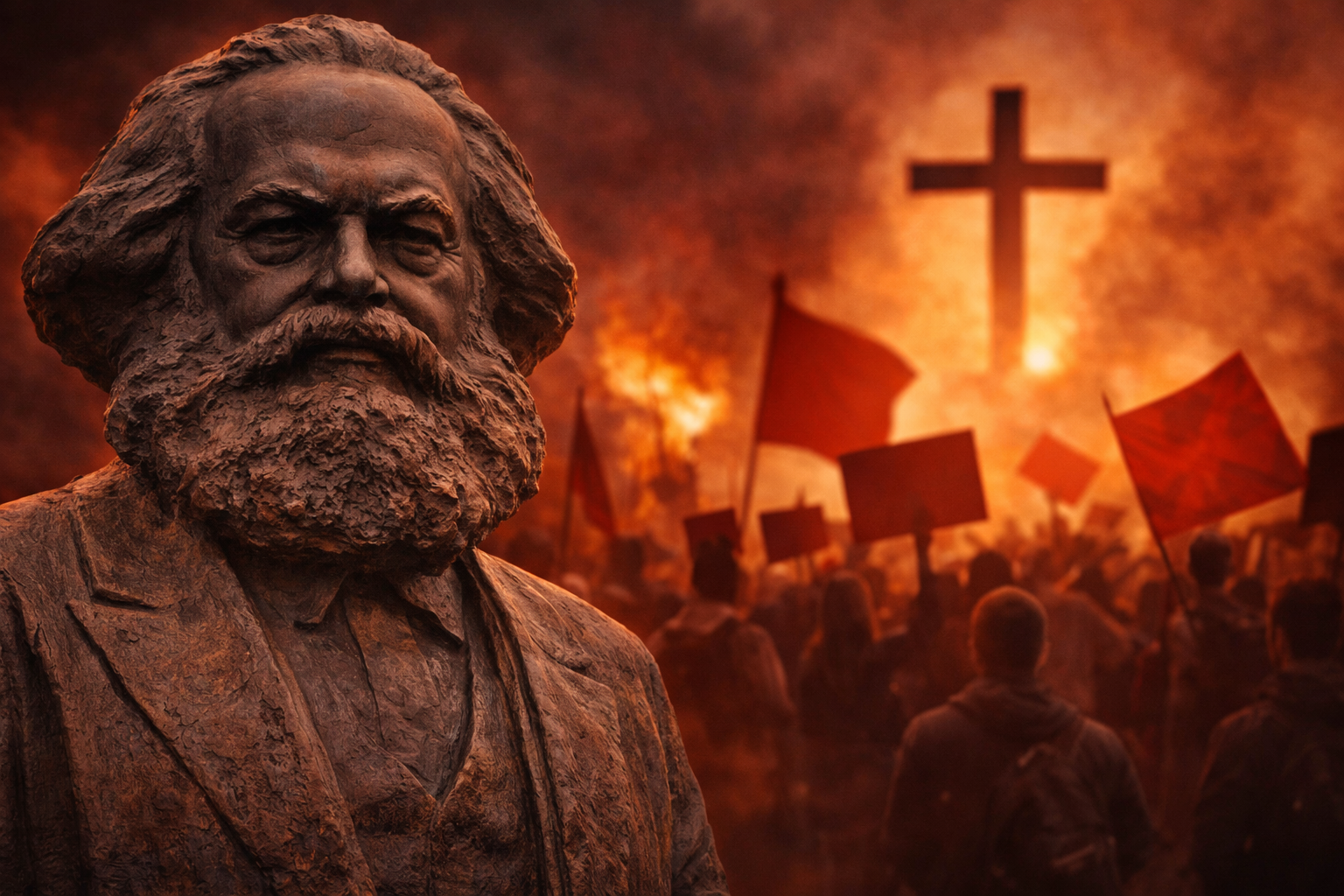
The ideas reshaping our societies today are not simply economic theories or political strategies. They are rooted in something far deeper. They are rooted in a philosophy that seeks to replace the authority of God with the authority of man. That philosophy, in its modern form, traces back largely to the ideas of Karl Marx, and although many people do not realise it, Marxism has always functioned more like a religion than a political system.
Like every religion, it begins with a story about the world. It explains why humanity suffers, who is to blame, and how salvation will supposedly come. It divides people into moral categories, it identifies enemies, and it promises redemption through a coming transformation of society. In that sense it mirrors the structure of religion almost perfectly, except for one crucial difference.
In Marxism there is no God.
And when there is no God, something else must take His place.
The Bible tells us that this struggle over authority did not begin in the nineteenth century with Karl Marx. It began in a garden long before any political theory was written.
In Genesis 3 we read about the moment that changed the course of human history. The serpent approached Eve with a simple but devastating question: “Yea, hath God said…?”
Those four words opened the door to everything that followed. The question was not merely about a piece of fruit. It was about authority. It was about whether God’s Word would remain the final standard of truth, or whether human beings would decide truth for themselves.
That same question still echoes through history. Every philosophy that rejects God’s authority ultimately begins with that same challenge: Did God really say?
Once that question takes root, everything else follows naturally. If God’s Word is no longer the foundation of truth, then morality becomes flexible. Right and wrong become matters of opinion. Human beings begin to redefine justice, identity, and purpose according to whatever ideas dominate a particular culture at a particular time.
Marxism is simply one of the most powerful expressions of that rebellion.
Karl Marx looked at the world and concluded that the central problem of human history was economic inequality. In his view, society was divided into two primary groups: oppressors and the oppressed. The powerful controlled wealth and resources, while the poor suffered under systems designed to keep them in submission.
According to Marx, the solution was revolution. The oppressed would eventually rise up, overthrow the oppressors, and create a new society where wealth and power would be redistributed equally.
On the surface this idea sounds appealing. It appeals to humanity’s natural sense that injustice exists in the world. But the deeper problem lies in what Marx removed from the equation.
God.
When Marx removed God from the explanation of human nature, he replaced a biblical understanding of sin with a political theory of oppression. Instead of recognising that every human heart is capable of evil, Marx believed that evil was primarily the result of unjust social systems.
Change the system, he argued, and human beings will flourish.
But history has shown us something very different.
Wherever Marxist revolutions succeeded in taking power, the promised utopia never arrived. Instead, the twentieth century witnessed some of the most brutal regimes the world has ever known. From Stalin’s Soviet Union to Mao’s China, from Cambodia under the Khmer Rouge to North Korea’s dynastic dictatorship, Marxist experiments consistently produced suffering on a massive scale.
Millions died in purges, famines, forced labour camps, and ideological purifications.
Why did the theory fail so catastrophically?
Because Marx misunderstood the true problem of humanity.
The Bible explains that the core problem of the human condition is not economic inequality but sin. In Romans 3:23 we read, “For all have sinned, and come short of the glory of God.” Human beings are not simply victims of unjust systems. We are fallen creatures whose hearts are capable of pride, greed, envy, violence, and corruption.
Changing political structures cannot remove sin from the human heart.
But the modern world has largely forgotten that truth.
Instead, many of the ideas that once belonged openly to Marxist theory have quietly filtered into mainstream culture. They no longer always appear under the name “Marxism,” but the underlying worldview remains the same. Society is increasingly described in terms of competing identity groups. People are sorted into categories of privilege and oppression. History is reinterpreted as a constant struggle between those who dominate and those who suffer under that domination.
Within this framework, traditional Christianity is often portrayed as part of the oppressive structure.
The irony is almost breathtaking.
For two thousand years the Christian message has proclaimed that every human being stands equal before God as a sinner in need of redemption. The gospel tears down divisions by declaring that salvation comes not through power, race, wealth, or status but through faith in Jesus Christ.
Yet the new ideological environment increasingly paints Christianity as an enemy.
This should not surprise us. Whenever a worldview attempts to replace God, it inevitably comes into conflict with the message of Scripture. The Bible does not allow human beings to place themselves at the centre of moral authority. It insists that truth comes from outside of us, from the Creator who made the world and revealed His will through His Word.
The conflict between these two foundations—God’s Word and man’s word—has become one of the defining struggles of our time.
In many places around the world we are already beginning to see the practical consequences of that conflict. Social pressures are increasing on those who hold to biblical convictions about morality, identity, and truth. In universities, corporations, and even some churches, ideas rooted in Marxist philosophy have begun to reshape the way people think about justice, equality, and human nature.
The language used to promote these ideas often sounds noble. Words like equity, inclusion, liberation, and justice appear constantly in public discussions. But the meaning of these words has gradually shifted away from biblical definitions toward ideological ones.
The result is a society that increasingly rewards conformity and punishes dissent.
People who question the new moral framework sometimes find themselves losing jobs, reputations, or opportunities. Public shaming campaigns erupt on social media. Voices that challenge the prevailing ideology are labelled dangerous or hateful.
In many ways this resembles the early stages of systems that history later recognised as totalitarian.
The difference today is that the pressure often appears softer. Instead of armed soldiers enforcing conformity, the enforcement frequently comes through cultural pressure, corporate policy, and digital platforms that shape public conversation.
Yet the underlying principle remains the same.
Who determines truth?
If God determines truth, then human societies must conform to His Word. But if human beings determine truth, then those who control institutions gain enormous power to shape reality itself.
That is why this conflict matters so deeply.
The battle we are witnessing is not ultimately about economic policy or political parties. It is about the authority of God’s Word in a world that increasingly prefers to create its own moral universe.
The Bible warned long ago that such times would come. In 2 Timothy 3:1 we read, “This know also, that in the last days perilous times shall come.” The passage continues by describing a world where people become lovers of themselves, lovers of money, proud, disobedient, and hostile to truth.
That description sounds remarkably familiar.
Yet Scripture also gives believers a clear response. Instead of panicking or retreating, Christians are called to stand firmly on the foundation of God’s Word. Jesus Himself described this principle in Matthew 7 when He spoke about two men building houses. One built his house on rock, the other on sand.
When the storm came, the house built on sand collapsed.
The house built on rock stood.
The storm gathering around modern society may feel overwhelming at times, but storms have a way of revealing foundations. Ideas built on human pride eventually collapse under the weight of reality. Systems that attempt to replace God inevitably fail because they ignore the deepest truths about human nature.
The gospel offers something Marxism never could.
It does not promise salvation through revolution. It promises redemption through Christ. It does not divide humanity into permanent classes of oppressors and victims. It declares that every person stands equally in need of forgiveness and grace.
And unlike the ideologies of this world, the gospel does not attempt to replace God.
It calls us back to Him.