
From Genesis to Revelation: The One Story – The Golden Thread that Explains Everything – Part 14
By Andre Eksteen
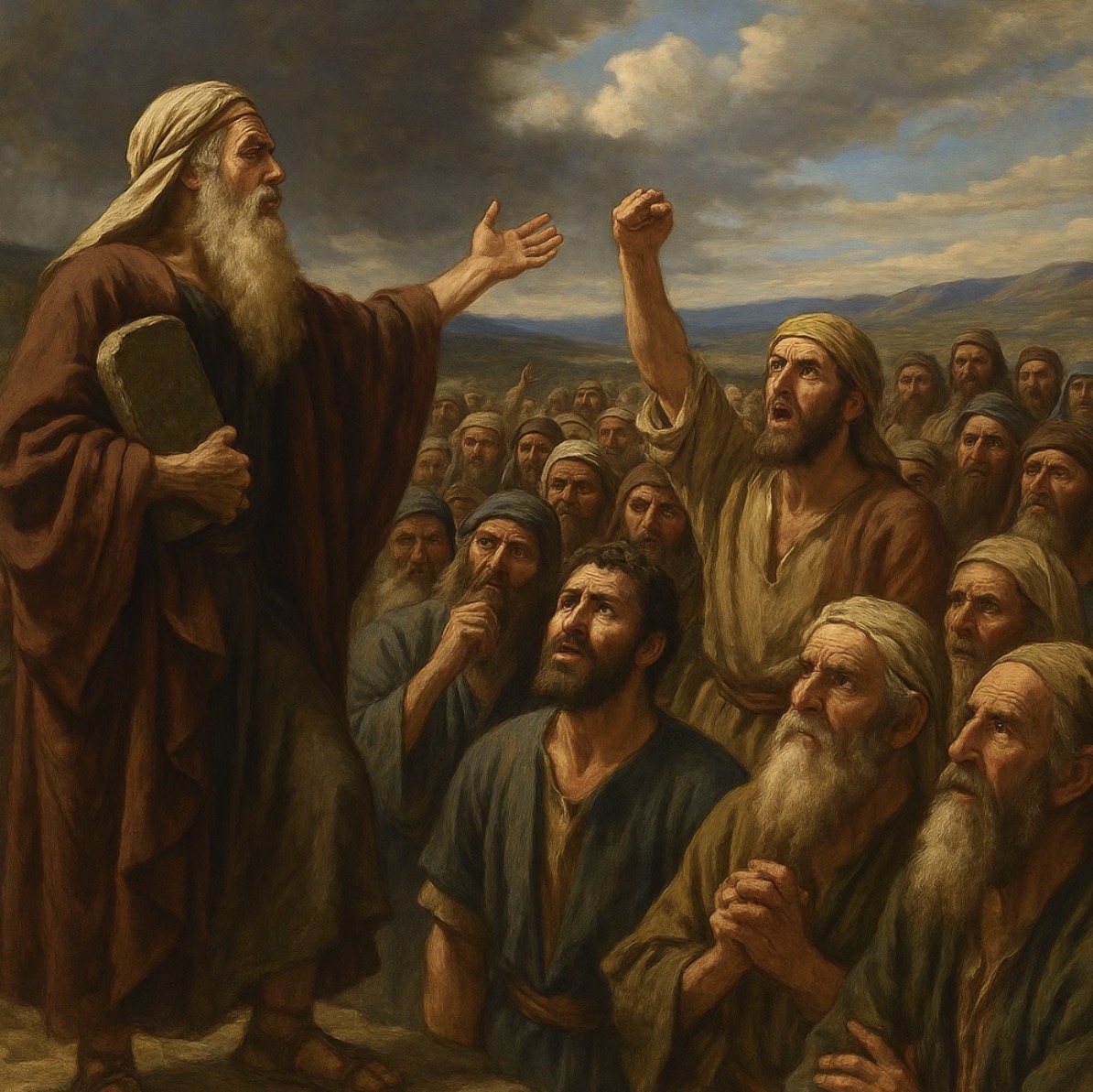
Israel was different. They did not have heavenly princes ruling over them. They did not have gods made by sculptors. They did not have kings sitting on earthly thrones. They did not build bridges between heaven and earth, because they had the God of heaven Himself.
They did not need a king — because their King spoke to them from fire.
Not through priests, not through human authority, but directly.
And yet, over time, they grew tired of this freedom.
Tired of faith. Tired of obedience without visible authority.
They wanted what the world had — something they could see, something they could touch, something they could control.
They looked at the nations around them — the pagans with their kings, their armies, their splendour — and they said: “We want to be like them too.”
This is the danger of every people who once knew God.
It is the trap into which even the modern church has fallen:
If you look at the world long enough, you begin to believe you lack what they have. You start believing the lie and justifying it, and before you know it, God’s voice grows quiet.
And that is exactly what Israel did.
1 Samuel 8 tells it plainly:
“And all the elders of Israel gathered together, and came to Samuel, and said unto him,
Make us a king to judge us like all the nations.”
Those words sound innocent, but they are the greatest betrayal in Israel’s history.
Not because they wanted a man to lead them, but because they no longer wanted to hear the voice of God.
They wanted a king they could see — something tangible, something manageable, something they could manipulate.
God says to Samuel:
“They have not rejected thee, but they have rejected me, that I should not reign over them.” (1 Samuel 8:7)
Notice this — He does not say they forgot Him.
They rejected Him.
They did not want Him as King.
And the irony is this: the people who stood under no prince now chose to place themselves under human authority — exactly like the nations ruled by fallen princes.
They asked for a king, and God gave them Saul — not as a reward, but as a lesson.
He warned them beforehand:
“He will take your sons for his chariots… your daughters for perfumers… your fields and vineyards he will take and give to his servants.” (1 Samuel 8:11–15)
In other words: “You want a king? Then you will pay the price of kingship.”
Because every earthly king takes what belongs to God.
But they did not listen.
They wanted a crown — even if it cost them their covenant.
And in that moment, Israel’s protection breaks.
The people once ruled by God Himself now sit under a man.
The voice of heaven is replaced by the command of a throne.
And the Golden Thread — the pure line of faith, obedience, and holiness — begins, for the first time, to bend.
What the world could not do through war, Israel does to itself through foolish choices.
Not through violence, but through compromise with sin.
They exchanged God’s rule for the comfort of a human king. They chose their own man above God.
And that is how every spiritual falling away begins — not with rebellion, but with weariness.
It is easy to point at Israel, but let us be honest — it is exactly the same today.
The church no longer wanted the Holy Spirit to lead them; they wanted structures, plans, councils, committees, and “ministries”.
They wanted people to rule — not God.
And then they received exactly that: kings in suits, priests in status, and a people in bondage.
They call it order, but it is not order — it is control.
It is Babel in new clothes.
The Holy Spirit made way for management meetings, the voice of God was replaced by votes, and “calling” was replaced by “qualification”.
The church did not choose one king — they created thousands of little kingdoms.
Each with its own flag, its own doctrine, its own “exclusive path to heaven”.
And this is how we arrived here:
One body of Christ, divided into hundreds of denominations — each convinced that they alone are right.
Exactly like Israel under Saul — everyone fighting over throne and title, but no one listening to the voice of the King anymore.
They call it “church families”, but it is nothing more than spiritual tribes slandering one another.
They fight over baptism, music, women behind pulpits, how to fold hands, whether you speak in tongues or not —
because it is easier to fight one another than to stand against sin.
And that is exactly how the enemy wanted it.
Because when the body is divided, it has no hands to serve,
no feet to walk,
and no mouth to speak.
It is ironic — the world sees the church fighting and says: “If that is God’s people, I want nothing to do with Him.”
And you cannot blame them.
How can the world believe in a God of peace if His so-called children fight like rabid animals against one another?
My denomination, my church, my doctrine!
Rubbish. Rubbish. Rubbish.
It is nothing but pagans in suits who think they serve God while working for their own princes.
The spirits ruling over them wage war against one another — and the people on earth carry it out without knowing whose orders they obey.
They think it is holy conviction, but it is just old spirits fighting over territory again.
Not holy war — just demonic possession in church pews.
I say it again: this is Babel.
One body divided into languages, ideas, and opinions — each building its own tower into heaven,
and God looks down and says: “Behold, the people are one — but in their own name.”
They no longer build for Him; they build for themselves.
They no longer preach Christ; they preach their own brand.
They call it ministry, but it is business.
They call it faith, but it is PR.
And when someone dares to say, “Stop, this is not what Jesus meant,” they shout: “Judgement!”
No — it is not judgement; it is truth.
Because God never started a denomination.
He never registered a church.
He formed only a body — one people, one Spirit, one Lord.
But look now: the body of Christ lies in pieces, each with a logo and a leader.
And every fragment believes it is the whole body.
That is why the world no longer sees the true church — only fragments of what it once was.
They exchanged the unity of the Spirit for the politics of religion.
And the Holy Spirit simply departed — not loudly, just quietly.
Because He does not work where people appoint themselves as king.
God never intended His people to be ruled by men.
He wanted them to live by His voice — by revelation, by obedience, by faith.
But when they asked for a king, He gave them Saul — a man who looked good on the outside, but was empty on the inside.
A symbol of what comes when you choose form over substance.
Saul was the fleshly answer to a spiritual desire.
And that is what the world still gets: beautiful, strong, charismatic — but spiritually dead.
God looks at Saul and says: “It repenteth me that I have made Saul king.” (1 Samuel 15:11)
From here on, God’s line is no longer carried by obedience, but by grace alone.
Even Samuel mourns for Saul, but God says to him: “How long wilt thou mourn for Saul? Fill thine horn with oil, and go — I have provided me a king among the sons of Jesse.” (1 Samuel 16:1)
Look closely at that verse — “I have provided me a king.”
Not for Israel. For Me.
Because God’s plan never ended with Saul — it merely changed the stage.
Out of the chaos of human rule, He would call His own king — not from the palace, but from the field.
Not from blood and status, but from faith.
And so David appears.
A shepherd, not a ruler.
A man who understood silence better than politics.
And it is to him that God says:
“I have found a man after mine own heart.” (1 Samuel 13:14)
There the Golden Thread becomes clear again — not through royal lineage, but through divine choice.
Because every time people try to replace God, He shows them that the throne was never made for men — it is His alone.
And those who truly listen to His voice become kings without crowns — saints in the quiet, ruling through obedience.
And that is where we are headed next.
To the establishment of Israel’s kingdom — where God shows that even out of human rebellion He still builds His plan.
For even when the people choose a king for themselves, God chooses one for Himself, through whom His promise remains alive.
We will see how He calls David, the shepherd boy from Bethlehem — not only to lead Israel, but to wipe out the last remnants of the corrupt seed.
Because the war of blood and spirit has not yet ended.
And through David, God begins the final chapter of that ancient struggle between His people and the last descendants of the Nephilim — the giants of the land He promised to Abraham.
It is there that judgement and grace meet:
in the sword of a shepherd who fights not for honour or power, but for the holiness of God’s Name.
For even in war His grace remains visible —
and even in kings His voice remains audible.


