
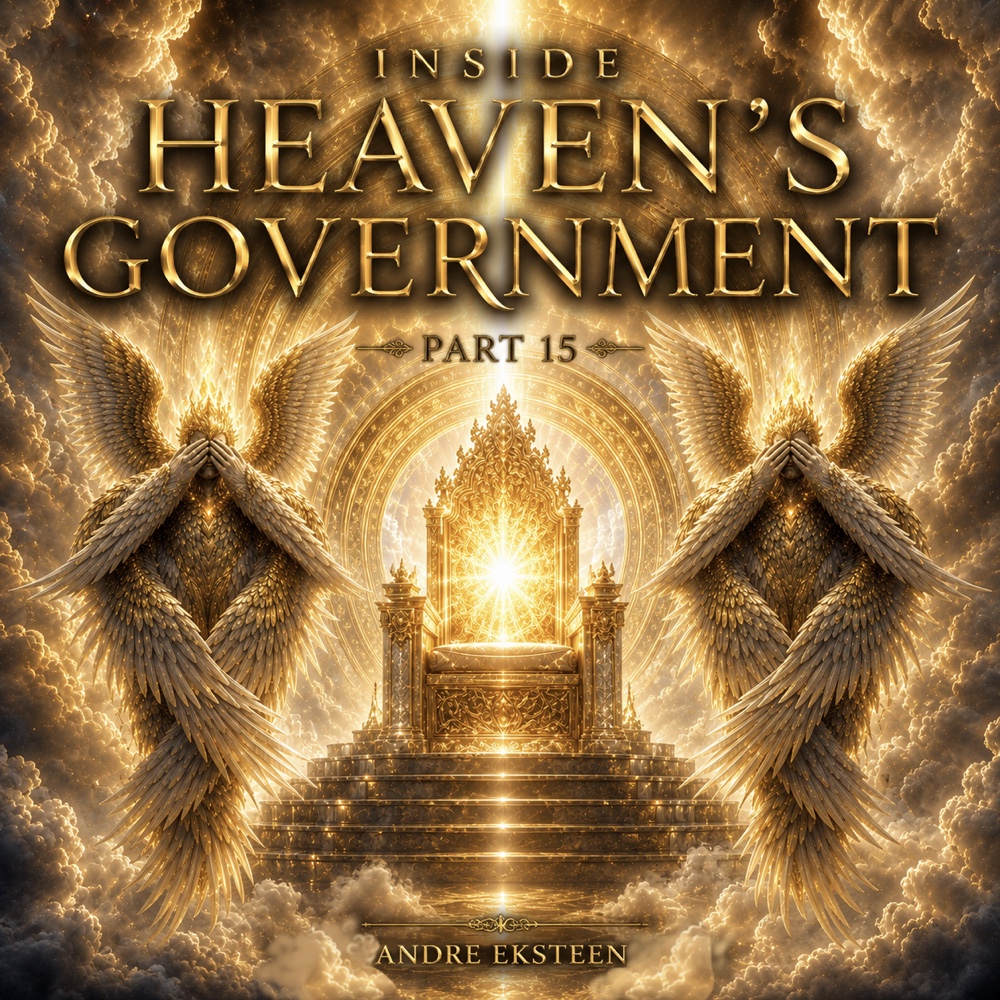
Inside Heaven’s Government – Part 15
The Story of the Heavenly Host from Creation to the Coming Kingdom
Written by Andre Eksteen
The previous article ended with one of the greatest appointments ever made anywhere within God’s creation. The earth had been fully restored. Mankind had been created directly in the image of God. Adam had been given dominion over the earth as God’s own appointed steward, and for a brief time everything stood exactly as God had intended it to stand, with nothing yet out of place.
Scripture tells us that the LORD walked together with man in the garden during that time. Genuine fellowship existed between the Creator and His newest creation, the kind of fellowship we still long for ourselves today. The conflict we already know is coming had not yet broken out anywhere upon the earth. The serpent had not yet spoken a single word. Sin had not yet entered anywhere into the human race. For one brief, shining moment, God’s fully restored order could be seen clearly again, exactly as it should be, without any shadow hanging over it.
It is right here that we are going to pause our story for a little while. Before we watch that fragile peace eventually shattered in the garden later in this series, we first need to become a great deal better acquainted with the heavenly kingdom itself. Throughout this whole series so far we have spoken repeatedly about cherubim, about principalities, about powers, about archangels, and about plenty of other members of the heavenly host besides. We have watched them serving faithfully within God’s government, and we have watched some of them fall tragically into rebellion against it. Yet we have never really stopped properly to meet any of them individually, one at a time.
Who exactly are these particular beings? Why did God choose to create so many genuinely different orders instead of simply one uniform kind, the way we might expect from a less imaginative creator? What specific responsibilities did each one of them actually receive from Him personally? How do they each serve within His larger government, day to day? And what part do they still play, even today, within God’s ongoing purposes for creation, long after the events we have already studied? Over the next several articles we are going to leave the garden behind for a little while and turn our full attention back toward heaven itself. One by one, we are going to examine the different orders making up the heavenly host directly from Scripture, taking each one carefully on its own terms. By the time we eventually return to the garden later in this series, we will understand a great deal better exactly who the serpent really was, what exactly he had once been before any of this happened, and why his sudden appearance before mankind changed the entire course of history forever afterward.
We begin this part of our study with the beings who stand nearest of all to the throne itself. The seraphim. Isaiah introduces them to us in one of the single most breathtaking scenes found anywhere in the whole of Scripture. “In the year that king Uzziah died I saw also the Lord sitting upon a throne, high and lifted up, and his train filled the temple. Above it stood the seraphims.” Isaiah 6:1 to 2.
Notice something remarkable here immediately, right from the opening line. Throughout this entire series we have repeatedly discovered that the closer a particular being serves to the throne of God, the greater the responsibility that gets entrusted to him there. The seraphim now take us directly to the very centre of God’s whole government. They are not described anywhere standing off in some distant part of heaven, removed from the action. They stand directly above His throne itself. Their entire ministry begins exactly where every true government always begins, with the King Himself sitting at the centre of it.
The word seraphim literally carries the idea of the burning ones. That particular description immediately grabs our attention, because nowhere else does Scripture describe any other order of heavenly being in quite that same striking way. Cherubim get described by their appearance and by their specific responsibilities. The living creatures get described by the faces they bear and by the throne they surround continually. Angels are usually identified simply by whatever specific work they happen to be performing at the time. But the seraphim are introduced to us first and foremost by what they actually are, in their very nature. They burn.
That immediately raises an obvious, honest question worth asking before we go any further. What exactly are they burning with, in that case? The passage itself quietly supplies us with the answer, if we keep reading carefully. “And one cried unto another, and said, Holy, holy, holy, is the LORD of hosts: the whole earth is full of his glory.” Notice carefully what occupies their full attention in that moment. They are not speaking about themselves at all. They are not drawing any attention toward their own beauty, toward their own rank, or even toward their own faithful service. Every single word out of their mouths points away from themselves entirely and directly toward God instead. Their whole ministry revolves completely around His holiness, nothing else.
That alone creates a striking, deliberate contrast with everything we have already learned together about Lucifer earlier in this series, almost as though the two pictures were placed side by side on purpose for us to compare. Lucifer’s heart became occupied entirely with himself over time, slowly turning inward until nothing else mattered to him. Thine heart was lifted up because of thy beauty, as Ezekiel told us plainly in an earlier article. The seraphim, by complete contrast, never once look inward at themselves, not even for a moment. Their entire existence points consistently upward instead, toward the throne above them, never wavering from that single focus. One became utterly consumed with self in the end, until nothing of his original glory remained untainted. The others remain entirely consumed with God instead, without wavering, exactly as they were created to be.
Perhaps that is exactly why Isaiah specifically calls them the burning ones rather than reaching for some gentler description. Throughout the whole of Scripture, fire repeatedly accompanies the revealed presence of God wherever it appears, almost as a signature of His arrival. Moses met God directly in the burning bush out in the wilderness, a bush that burned without ever being consumed. Israel saw His glory resting upon Mount Sinai as a consuming fire visible to the whole camp gathered below it. Ezekiel saw flashes of fire surrounding God’s throne in his own visions elsewhere in his prophecy. Hebrews reminds us plainly elsewhere that our God is a consuming fire, in no uncertain terms, leaving no room for a tamer picture. Whether the actual burning of the seraphim is meant literally, symbolically, or perhaps somehow both at the very same time, one thing becomes immediately obvious from all of this. They dwell so close to the unveiled holiness of God that everything about them visibly reflects the glory of the very One they continually serve there.
Notice something else here that gets easily overlooked on a quick read, hidden in a single short verse. Each individual seraph has six wings in total, not the two we might casually assume from popular art. “With twain he covered his face, and with twain he covered his feet, and with twain he did fly.” Even these particular exalted beings, standing nearest of all to the throne, do not stand there casually in God’s presence the way we might lounge in a familiar room. With two of their wings they cover their own faces. Even they do not dare to gaze carelessly upon the full, unveiled majesty of God’s glory directly, no matter how close they stand to it. With two more wings they cover their own feet as well. Throughout the rest of Scripture, feet often represent a person’s walk through life, or their particular service rendered to God. Even their own service, then, is marked through and through by humility before the King they worship continually, never taken for granted. Only with the one remaining pair of wings do they actually fly at all, carrying out whatever specific ministry God assigns to them in that moment. Everything about this whole picture speaks plainly of deep reverence, layer upon layer of it.
This should genuinely reshape the way we think about heaven from here on out. Modern pictures of heaven often portray it as relaxed, almost casually informal, a place where everyone simply enjoys God’s presence without any real thought or purpose attached to it. Isaiah paints us something entirely different from that comfortable image. Heaven is genuinely filled with real joy, that much is certainly true. But it is also filled, at the very same time, with deep reverence running through it. There is worship taking place there, but there is also careful order surrounding it. There is glory on full display, but there is also real humility underneath it. Everything there centres entirely upon the holiness of God, with nothing else competing for that same centre.
That word holy genuinely deserves our special attention here, more than we usually give it on a quick reading. The seraphim do not simply say it once and move on to something else entirely. Holy, holy, holy. Throughout the whole of Scripture, repetition is consistently God’s own way of placing extra emphasis on something of truly supreme importance to Him, a kind of underlining built into the language itself. Jesus Himself often said, verily, verily, specifically to draw attention to whatever important statement followed right after it, making sure His listeners did not miss the weight of it. In Hebrew writing more generally, repetition like this consistently strengthens whatever statement is being made, doubling or tripling its force. Here, in this throne room, holiness gets declared a full three times in a row, not simply once or even twice over.
God is not merely holy in some general sense. He is holy, holy, holy, layered three times over for emphasis. Every other single attribute belonging to God gets properly understood only through that one foundational truth sitting underneath it. His love is holy love, never separated from His holiness. His justice is holy justice. His mercy is holy mercy. His government, the very subject of this whole series, is a holy government through and through. His judgements, which we have already studied at length earlier in this series, are holy judgements every time.
Everything we have studied together throughout this whole series ultimately flows directly out of that one foundational reality. Lucifer’s rebellion, when you really stop to think it through properly, was never simply rebellion against raw power for its own sake. It was rebellion against holiness itself, at its very root. That single fact explains clearly why judgement became genuinely unavoidable once that rebellion had taken hold. A holy King simply cannot overlook corruption festering within His own government without ceasing, in the process, to be holy Himself. The seraphim understand that single truth perfectly, better than we ever could ourselves. That is exactly why they never once cease proclaiming the one truth that stands above every single other truth there is.
There is another remarkable detail buried inside Isaiah’s vision that genuinely deserves our attention before we leave the seraphim behind for now in this article, easy as it is to miss on a casual reading. Although they stand nearer to the throne than any other order we have studied so far in this series, Scripture never once presents them anywhere as rulers in their own right. It never once speaks of them governing nations, administering kingdoms, or carrying messages out to mankind the way other orders do. Those particular responsibilities belong elsewhere entirely within God’s wider heavenly government, assigned to other orders suited to that work. The seraphim have an entirely different ministry altogether, one uniquely their own.
They preserve and maintain the very atmosphere surrounding the throne itself, nothing more and nothing less than that, and yet nothing could be more important than that single task. Everything about them proclaims the holiness of God continuously, without pause, day and night without rest. Their words proclaim it out loud for all of heaven to hear. Their posture reflects it physically, in every wing carefully placed. Their continual, unceasing worship declares it without ever once stopping for breath, age after age. Before God’s wider government ever reaches outward into the rest of creation at all, it begins right here first, with the absolute, unshakeable holiness of the King who sits upon that throne, untouched by anything that happens beyond it.
That is a genuinely important lesson for every one of us to take from this, whatever stage we happen to be at in our own walk with God. The true foundation of God’s entire kingdom is not raw power, however much we might be tempted to think of kingdoms that way from watching the kingdoms of this world. It is not bare authority for its own sake either. It is not even judgement itself, as significant as judgement has already proven to be throughout this series. It is holiness, sitting underneath everything else built on top of it, the bedrock that everything else rests upon. Everything else in God’s kingdom flows directly out of that single foundation, without exception anywhere we have looked so far.
That also helps explain clearly why the first rebellion we studied earlier in this series could never simply have been ignored or quietly overlooked by God, no matter how patient He is by nature. Lucifer did not merely challenge raw authority when he rebelled. He brought genuine corruption directly into a kingdom whose very centre and foundation is holiness itself. The closer we come to properly understanding God’s throne through passages like this one, the more clearly we begin understanding exactly why sin absolutely had to be judged, and why genuine restoration became so necessary before mankind could ever be properly appointed to govern the earth in the first place.
There is one final detail worth noting that Isaiah records for us in this same vision, a small physical detail easy to miss on a first read. “The posts of the door moved at the voice of him that cried, and the house was filled with smoke.” Even heaven itself, in some physical sense, visibly responds to this continual proclamation of God’s holiness ringing out, as though the very building could not stay still in the presence of it. Isaiah does not describe excitement breaking out in that moment, the kind we might expect at a celebration. He does not describe celebration of any kind taking place either. He describes pure, overwhelming awe instead, the kind that strips a man bare. Standing directly before that throne, the prophet immediately cries out, woe is me, for I am undone. That particular reaction tells us something genuinely profound about this whole encounter. The nearer anyone ever comes to the true holiness of God, the more clearly that same person sees himself exactly as he truly is underneath everything else.
We will return properly to Isaiah’s own cleansing in the very next article of this series, because one of the seraphim goes on to perform a particular ministry there that reaches far beyond Isaiah himself and what happened to him personally that day. It becomes a genuinely beautiful picture of exactly how God prepares sinful people to stand properly in His own presence despite everything standing against them, a picture worth sitting with carefully.
For now, though, it is enough simply to leave that throne room exactly as Isaiah first found it himself, without rushing on to the next thing too quickly. The burning ones still stand exactly where they have always stood, unmoved by anything that has happened since, whether on earth or in heaven. Their worship has never once ceased, not for a single moment across all of recorded history. Their cry has never once changed across all of recorded history either, the same three words ringing out continuously. Holy, holy, holy, is the LORD of hosts. Long before kingdoms ever rose and fell across the earth, one after another, century after century. Long before mankind was ever created in the first place, back when only the heavenly host stood watching. Long before the very first rebellion we have studied so carefully throughout this series ever took place, when heaven still knew nothing but perfect order. And long after this present world has finally passed away completely, when every earthly kingdom has crumbled to dust. God is, and always will remain, holy.


