From Genesis to Revelation: The One Story – The Golden Thread that Explains Everything – Part 37
By Andre Eksteen
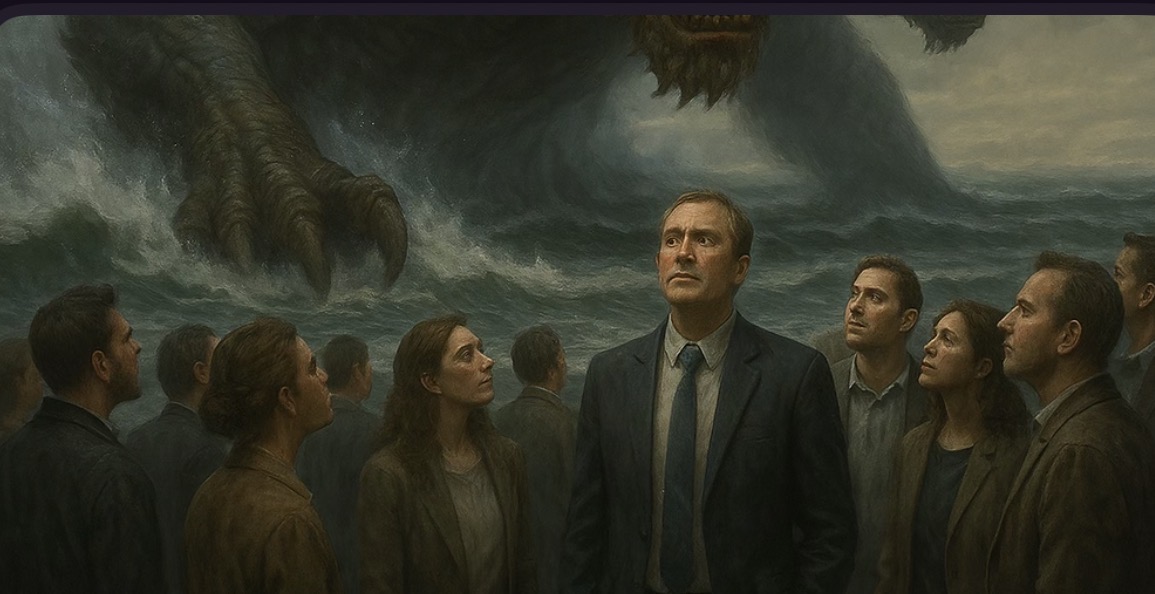
The world lies in silence after the chaos. The dust of war, famine, and death still hangs heavy in the air. The people who were left behind after the Rapture thought the locusts were the worst of it, but that was only the beginning. Now they stare upwards — exhausted, confused, without hope. And then he appears. Not an ordinary man, not a politician with grand dreams, but something else — something that looks like a man and speaks like one, yet carries the light the world has been longing for: peace. He brings it, and the world falls before him.
No one asks anymore who or what he is. They simply say: “What does it matter, as long as there is peace?” The nations lay down their weapons, the media calls him “the Man of Unity,” and the churches call him “God’s envoy.” He smiles, and the world feels safe. He promises that hatred between religions, races, and nations is now over. He says that all can worship under one heaven. People weep with joy. They think God has finally intervened. But God withdrew His hand long ago. What they now see is the one Jesus Himself called the liar and murderer from the beginning.
John describes him like this:
“And I stood upon the sand of the sea, and saw a beast rise up out of the sea, having seven heads and ten horns, and upon his horns ten crowns, and upon his heads the name of blasphemy. And the beast which I saw was like unto a leopard, and his feet were as the feet of a bear, and his mouth as the mouth of a lion: and the dragon gave him his power, and his seat, and great authority.”
(Revelation 13:1–2)
This is what John saw — not a political party or a world order, but a living being. The word he uses, thērion, means a living creature of beastly nature. Nowhere in Scripture is it applied to a system or ideology. The Beast is a conscious entity with voice, will, and authority.
But look at what the modern Church has made of this. They say each head is a world system, each horn an economic power, and the whole description merely “symbolism of human corruption.” They say the “sea” means “nations,” and that the Beast is simply “a political amalgamation.” This is the delusion of our time — people who believe John wrote an allegory. That is not what he said. He wrote what he saw.
Do you see now how deeply Constantine’s influence cut? He tore the Church out of the Spirit and turned it into a political body — an institution with emperors as heads and priests as officials. He transformed the supernatural into symbolism, prophecy into state documentation, and spiritual warfare into diplomatic language. And the Church still follows him today with great zeal, proclaiming the literal Word as metaphor and the devil as a system.
But why did he do this? Because he needed to unify an empire — not the Kingdom of God, but a Roman Empire on the brink of collapse. He wanted one religion everyone could accept, one faith that would not threaten the emperor’s authority. A true God of holiness and judgement does not fit such an empire. A God who exposes sin causes division; a god of symbolism brings peace. That is why Constantine removed the supernatural and politicised the Word. He made the Church compatible — but toothless.
And to this day the Church proclaims his legacy: a faith without fear of God, a prophecy without meaning, a Bible that must be interpreted by men. They preach about governments and parliaments, but no longer about beings — because they have forgotten that John saw, he did not imagine. They mock Jesus’ appearance to John and present him as a confused old man hallucinating on an island. They read his revelation like a dream, not like an encounter.
This is the greatest insult to the Holy Spirit Himself — to say that the vision Jesus gave John was merely “symbolic.” The Church has forgotten that Jesus Himself said: “Whosoever shall not receive the kingdom of God as a little child shall in no wise enter therein.” (Mark 10:15) A child does not read to reason — a child believes what he hears. That is how God intended His Word: simple, direct, living, and understandable to those who seek truth.
But the modern Church tries to explain the supernatural with logic, and therefore sees nothing anymore. They reason where they should have believed, and analyse where they should have worshipped. They read God’s voice like a riddle, while He has always spoken plainly. They dissect God’s words, yet accept Satan’s works without resistance.
John was not mad — he was obedient. He saw what the world is about to see.
He says it himself, again and again:
“And I John saw these things, and heard them… and when I had heard and seen, I fell down to worship before the feet of the angel which shewed me these things.” (Revelation 22:8)
“I was in the Spirit on the Lord’s day, and heard behind me a great voice, as of a trumpet.” (Revelation 1:10)
“And immediately I was in the Spirit: and, behold, a throne was set in heaven, and one sat on the throne.” (Revelation 4:2)
He does not say he “dreamed.” He says: I was in the Spirit — I saw. This is eyewitness language, not symbolism. John did not try to interpret; he described what Jesus showed him.
When John says he saw “a beast rise up out of the sea,” he uses the same imagery as Daniel 7:3: “And four great beasts came up from the sea, diverse one from another.” In both cases the “sea” is the place of chaos — the prison of fallen beings. The Hebrews called it tehom: the depths of judgement. It is the place where, according to Enoch 10, the spirits of the Watchers were bound until the time of their release. When John therefore sees this Beast rise up, he sees a being released from that abyss — not a human government.
Enoch 60 describes it: “And I saw a being rise up from the depths of the sea, and his eyes were like flaming fire, and his voice thundered like a great multitude.” The same description — the same origin, the same eyes, the same voice.
John says the Beast has seven heads and ten horns. The Church says these are “seven empires” or “ten coalitions,” but John says they have names of blasphemy. A name can only be given to a conscious being, not to a system. He describes a composite of spirits under one authority, just as “Legion” in Mark 5: “My name is Legion: for we are many.”
The prophets saw it long before John. The beasts of Daniel 7 — lion, bear, leopard, and dreadful beast — were all living beings that spoke, issued commands, and received worship. John unites them in one final being — the complete manifestation of Satan’s kingdom.
The dragon gives him his power, his throne, and his authority. In Luke 4:6 Satan himself says: “All this power will I give thee.” Now he gives it to this Beast. This is not symbolism — it is a transfer of power.
The Church’s error is believing these things are political. They believe the seals, the riders, and the Beast are merely human developments. They have cut the supernatural out of Scripture. That is why they say the Beast is a system — because it is safer than admitting there is something beyond their understanding.
But John saw him. He describes eyes like fire, a voice like breaking metal, and a face full of authority. He hears people say: “Who is like unto the beast? who is able to make war with him?” (Revelation 13:4) That is not how people speak about a government — that is how they speak about a god.
This Beast is the physical manifestation of Satan’s kingdom. He comes from the same abyss as the locusts of Revelation 9 — from the pit itself. He is the crown of that release.
The modern Church describes him as systems and coalitions, but John describes him as life. The Church says his heads are countries, but John says they have names. The Church says his horns are political powers, but John says they wear crowns. Everything points to consciousness, authority, and movement.
That is why John sees him being worshipped: “And all that dwell upon the earth shall worship him, whose names are not written in the book of life of the Lamb.” (Revelation 13:8) No government has ever been worshipped worldwide. This is the worship of a being — a devil in embodied form.
Ironically, the Church already worships him without knowing it. They sing about peace and unity, preach inclusion, and praise the world’s “multi-faith unity.” They believe the Beast is a system, but they worship his spirit.
He looks like a man. He speaks like a man. But his eyes are like fire, his voice like breaking metal. The world hears peace and sees light, but the light is false — it comes from the abyss. He masterfully controls what each person sees in him: to politicians he is a saviour of systems, to scientists proof of progress, to churches the long-awaited prince of peace. He adapts like water — always taking the shape of the vessel into which he is poured.
But John sees him for what he is: the beast from the sea, the flesh of the dragon, the final manifestation of heaven’s rebellion.
The world sees a man. John sees a being.
And that is the difference between light and darkness.
If you cannot or will not see the spiritual realm for what it is, you will never understand Revelation. The Bible is not a book of riddles; it is a record of things that truly happened — and will happen. The Golden Thread that runs from long before Genesis 1:1 through Scripture reaches its climax in Revelation. But how will you understand what happens at the end if you do not understand what happened at the beginning?
If you do not know what took place before the Fall — why Satan hates humanity with an eternal hatred — then you read Revelation like a story without beginning or end. If you do not understand what happened in Genesis 6, that real beings, monsters, lived on earth among humans, you will see the Second Coming as a metaphorical drama instead of a literal war. If you do not understand what happened at Babel, when the Lord Himself divided the nations and appointed heavenly princes over them, you will never understand why every nation today lives under spiritual control.
This is the Golden Thread — the line that runs through everything: the conflict between the Creator and the rebels who fell from His presence. From Eden to Hermon, from Babel to Armageddon — it is the same war, the same powers, the same spirit of rebellion now reaching its final manifestation.
The unbeliever laughs and says it is mythology, fairy tales, “symbolism.” They hear the truth, but the spirits behind them scream through them to mock it — because they know: if people begin to believe these things are real, their deception collapses. But in the heart of every truly born-again child of God, the Holy Spirit confirms that it is true. He brings peace where the world feels panic. He gives certainty where the world mocks.
Those of us who know Him, and in whom He lives, can and must warn. We do not cry out because we are afraid, but because we know what is coming. The rest must choose for themselves. God forces no one — every person decides what they will believe. But if they deny Him in this life, they will bear the consequences forever.
And remember this: there is not a single “antichrist” in hell. There are only lost souls — all of them know Him now, and they know: He was right. They know the Word was literal, that God meant what He said. But it is too late.
The world looked at a man, but John saw the being.
And that is the difference between light and darkness — between those who believe, and those who saw, yet still refused to believe.