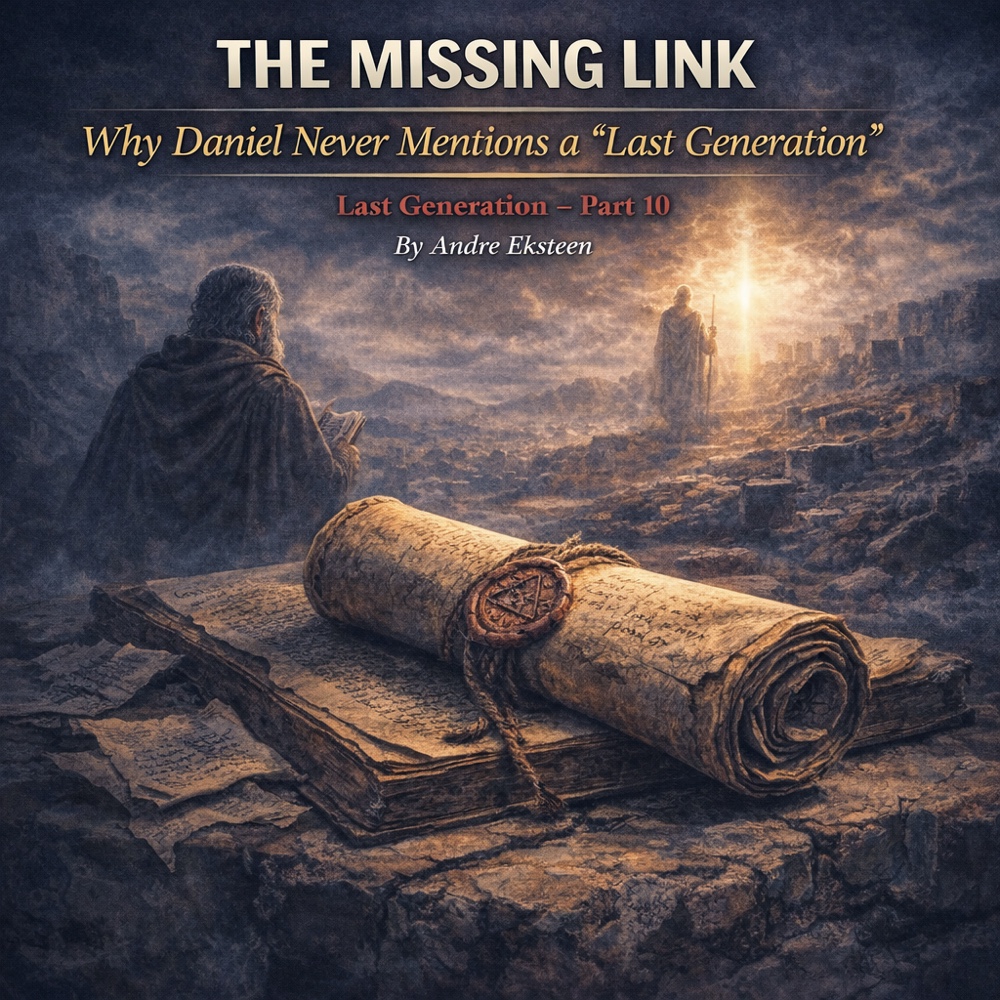
The Missing Link: Why Daniel Never Mentions a “Last Generation” – Last Generation Part 10
By Andre Eksteen
If you have followed carefully through the first nine parts of this series, something should already be sitting clearly in your thinking. The idea of a “last generation” is everywhere in modern end-times teaching. People speak about it with confidence. They build timelines around it. They connect it to dates, to events, and especially to Israel’s modern re-establishment. They treat it as if it is a well-defined biblical concept with clear textual support across both Testaments. But now, after nine parts of careful groundwork, we are in a position to ask a question that almost no one in that culture of teaching stops to ask.
Does Daniel ever actually say that?
Not what we assume Daniel says. Not what the system tells us Daniel means. What does the text of Daniel actually say? Because if Daniel is as central to end-times prophecy as people claim — if the seventy weeks and the time, times, and half a time and the abomination of desolation are the backbone of what the last generation will witness — then you would expect Daniel to speak clearly about a last generation. You would expect to find the concept there, defined, described, anchored in the text.
When you read Daniel carefully, you will not find it. Not once. Daniel does not define a group of people called the last generation. He does not use that language. He does not frame his visions around the identification of a particular generation the way Jesus does in Matthew 24. And that absence is not a minor textual footnote. It is a structural fact that changes how the relationship between Daniel and Matthew 24 must be read.
What Daniel Actually Describes
Let us be precise about what Daniel does say, because part of the problem is that people extract from Daniel far more than is actually there by merging it with other texts before they have read it on its own terms.
Daniel receives a series of visions across several chapters that describe the rise and fall of empires. Chapter 2 gives Nebuchadnezzar’s dream of the statue — four successive kingdoms represented by different metals, followed by a stone cut without hands that destroys the statue and becomes a great mountain filling the earth. Daniel interprets this as a sequence of world empires culminating in a kingdom established by God that will never be destroyed. Chapter 7 gives Daniel his own vision of four beasts — the same sequence of empires, described from a different angle, with greater emphasis on the character and behaviour of the final empire and the judgement scene in which the Ancient of Days presides and the Son of Man receives the kingdom. Chapters 8, 9, 10, 11, and 12 add progressively more detail — particularly about a figure described as the little horn, about desolations, about the seventy weeks, about a king of fierce countenance who magnifies himself against God, about the time of the end.
What Daniel consistently describes is a sequence of events, a pattern of power and conflict, a series of kingdoms and their ultimate replacement by God’s eternal kingdom. He describes timing — weeks, days, periods. He describes specific events — the removal of the daily sacrifice, the setting up of the abomination of desolation, the scattering of the holy people, the standing up of Michael the great prince, the time of trouble such as never was. He describes outcomes — the resurrection of the dead, some to everlasting life and some to everlasting contempt, the shining of the wise like the brightness of the firmament.
What he does not describe is a generation. He does not say, “The people who see all of this will not pass until it is complete.” He does not frame his visions around the witness of a particular group in the way that Matthew 24 does. The concept of the last generation — as a group defined by what it sees, as a generation whose passing is tied to the completion of the full sequence — is not Daniel’s language. It is Jesus’ language. And you cannot import it into Daniel without distorting both texts in the process.
The Roles of Each Text
Now here is the structural point that needs to be made precisely, because this is where the mixing happens and where the damage is done. Daniel describes the sequence of events associated with the time of the end. Jesus identifies the generation that sees that sequence completed. These are different functions performed by different texts, and they must be kept distinct.
Think of it this way. A structural engineer produces a set of drawings that shows exactly what a building will look like when it is complete — every dimension, every material, every connection. Then, separately, someone who has studied those drawings says, “The team of workers who are on site when the last section is completed will be the ones who see this finished.” The engineer did not identify the workers. The engineer described the building. Someone else, looking at the drawings, identified the group whose witness is tied to the completion. If you go back to the engineer’s drawings and try to find the workers described there, you will not find them. Because that is not what the drawings are for.
Daniel is the drawings. Jesus is the identification of the witnesses. You need both. But you cannot ask Daniel to do what Jesus does, and you cannot read Jesus as if He is simply repeating Daniel. He is doing something different — connecting Daniel’s sequence to a specific group in a specific temporal relationship. “This generation shall not pass, till all these things be fulfilled.” All these things is Daniel’s sequence. The generation is Jesus’ addition. The connection between them is made in Matthew 24, not before it.
Now look at what Jesus does in Matthew 24:15 — “When ye therefore shall see the abomination of desolation, spoken of by Daniel the prophet, stand in the holy place, (whoso readeth, let him understand).” Jesus explicitly connects His discourse to Daniel. He does not pretend Daniel is irrelevant. He points His disciples to Daniel and tells them to read carefully. But He does not say, “Daniel defines the generation.” He says, “Daniel describes the event — and when you see that event, along with all the others I am describing, the generation that sees it will not pass before everything is completed.” The abomination of desolation is Daniel’s content. The generation and its relationship to all these things is Jesus’ framework. They are connected. They are not the same.
What Happens When You Mix Them Incorrectly
The practical consequence of failing to keep these two texts in their proper roles is visible throughout the history of popular end-times teaching, and it produces a specific kind of error that is worth naming.
When you take Daniel’s numbers — the seventy weeks, the 1,260 days, the 1,290 days, the 1,335 days — and you use them to calculate the duration of the last generation, you are asking Daniel to answer a question Daniel was not given to answer. You are not interpreting Daniel. You are extracting data from Daniel and inserting it into a framework that Daniel does not provide. And once you have done that — once you have built a generation-length calculation on Daniel’s numbers — you have a system that looks as if it is derived from Scripture but is actually derived from the method you applied to Scripture.
This is precisely the pattern we described in Part 4 when we examined how most popular teaching starts in the wrong place. The generation-from-Daniel approach is a specific instance of that broader problem. It starts with Daniel’s numbers, assigns them a role they were not given in the text, uses them to define the duration of the last generation, then connects that duration to a historical starting point, and produces a timeline. The timeline has biblical language attached to it at every step. But the crucial moves — the assignment of Daniel’s numbers to the definition of a generation, the selection of the historical starting point — are not coming from the text. They are coming from the method.
The result is that you end up with something that neither Daniel nor Jesus actually said. Daniel said certain events would unfold in certain periods. Jesus said the generation that sees all these things would not pass before they are completed. The combination of “Daniel’s periods define the generation’s length” is a third statement that is not made by either text. It is constructed by merging them in a way that neither invites.
The Problem With Daniel-Revelation Merging
There is a related issue that flows directly from the mixing problem just described, and it is worth addressing directly because it is one of the most common sources of confusion in popular end-times teaching. People do not only mix Daniel with Matthew 24. They merge Daniel, Matthew 24, and Revelation into a single combined system, and then treat that combined system as if it is what each of those texts individually says.
Revelation draws extensively from Daniel. The imagery of beasts, the language of times and half a time, the figure who exalts himself above God, the references to the holy city and the sanctuary — Revelation is saturated with Danielic language and imagery. That connection is real and intended. John was writing within the tradition Daniel established, and his visions build on and extend what Daniel received. So the connections between Daniel and Revelation are textually grounded in a way that the connections between Daniel and many popular prophetic systems are not.
But even the legitimate Daniel-Revelation connection does not mean the two books can be freely merged into a single document and read as if they are one continuous text. They were written in different historical contexts, to different audiences, addressing different immediate concerns, and the relationship between them is one of typological and thematic resonance rather than identical content. The beast of Daniel 7 and the beast of Revelation 13 are related. They are not the same description of the same moment in time requiring the same calculation. The desolation of the sanctuary in Daniel and the trampling of the holy city in Revelation share a pattern. They may refer to the same future reality, to different stages of the same reality, or to different but related events. Treating them as if they must slot into the same timeline without argument is not interpretation. It is assumption.
Now add Matthew 24 into that mix. Now you have three texts, each complex in its own right, being read as a single combined document. And the generation concept from Matthew 24 gets layered over the numbers from Daniel and the imagery from Revelation, producing a system that appears comprehensive but is in many places assembled from elements that none of the three texts ever place in direct relationship. The result is a structure that looks like Scripture from a distance — because all the parts are drawn from Scripture — but that cannot survive close reading of any of the source texts individually, because the connections between them are built by the system rather than by the texts.
This is not a criticism of the careful study of biblical themes across multiple books. That kind of study is legitimate and necessary. The problem arises when the connections made between texts are treated as textually grounded when they are actually system-generated — when a relationship is created by the interpretive framework and then read back into the texts as if the texts created the relationship themselves. The test is always the same: go back to each text, read it in its own context, and ask whether the connection is supported by the text or imported into the text.
Daniel does not define the last generation. Revelation does not define it either — Revelation does not use the language of “this generation” in the way Matthew 24 does. The concept is Jesus’, it is anchored in Matthew 24, and it must be interpreted from there. Daniel and Revelation provide content for what “all these things” encompasses. They do not provide the generational framework. That distinction, maintained consistently, keeps you reading what is actually written rather than what a merged system tells you must be there.
The Practical Implication: Asking Better Questions
Now let me bring all of this down from the level of textual method to the level of practical consequence. Because the point of this series is not just to produce better hermeneutical habits, although that would be worthwhile in itself. The point is to arrive at an honest answer to the question: are we the last generation? And to arrive at that answer honestly, you need to be asking the right question.
The question most popular end-times teaching asks is: does the current date fall within the generation-length window from the relevant starting event? That is a calculation question. It requires you to have already defined what the starting event is, what generation-length is, and what the relevant text says — and as we have seen repeatedly, all three of those definitions are usually being imported from outside the text rather than derived from it.
The question this series has been building toward is different: is the full sequence Jesus described in Matthew 24 now sufficiently in motion that the generation living through it can be identified as the one He described? That is a recognition question. It requires you to know the sequence in detail, to be watching the world with the right posture, and to be honest about which elements of the sequence are present and which are not yet visible.
Those are genuinely different questions. The first can be answered at a desk with a calendar and a concordance. The second requires the posture Daniel modelled — seeking, watching, humility before God, willingness to have frameworks corrected. The first produces confident predictions that fail when dates pass. The second produces watchful readiness that remains oriented to the right things regardless of how long the sequence takes to complete.
And here is the thing that ties all of this together. If you are asking the calculation question, you will use Daniel to define the generation — because Daniel’s numbers are what you put into the calculation. But if you are asking the recognition question, you will use Daniel for what it actually gives you — a description of the events that define the time of the end, which, when you see them aligning, tell you the season is near. The fig tree does not give you a calendar. It gives you leaves. And the leaves tell you summer is near, not next Tuesday.
That is the level of certainty the text offers. Not a date. Not a generation-length calculation. A sequence to recognise. A posture to maintain. A season to watch for. And a generation — defined not by its duration but by what it sees — that will not pass before everything is completed.
Daniel gives you part of what that generation will see. Jesus tells you that the generation who sees it all will not pass before it is done. And the question that sits at the end of this series, toward which every part has been moving, is whether the sequence is now in sufficient motion for a careful, watching, humble reader to say with integrity: this may be that generation, and here is why.
Not forcing. Not calculating. Recognising. That is where we go next.
What Daniel Does Give You
Now let me be careful here, because I am not arguing that Daniel is irrelevant to the question of the last generation. I am arguing that Daniel must be read for what it actually gives you, not what a system imported into it claims it gives.
What Daniel actually gives you is essential to the last generation question. He gives you the description of the abomination of desolation — which Jesus explicitly connects to the trigger for the great tribulation and places within the sequence of “all these things.” He gives you the description of a king of fierce countenance who exalts himself above every god, who causes the sacrifice and oblation to cease, who sets up the abomination of desolation — details about the character and actions of the figure associated with the climax of the sequence Jesus describes. He gives you the time of trouble such as never was since there was a nation — which Jesus quotes almost directly in Matthew 24:21, “For then shall be great tribulation, such as was not since the beginning of the world to this time, no, nor ever shall be.” He gives you the standing up of Michael the great prince, which stands in the background of the cosmic events Jesus describes in Matthew 24:29-31.
Daniel is load-bearing in the structure of Matthew 24. Jesus is drawing from it deliberately and explicitly. But Daniel is not doing the work of identifying the generation. That work is done by Jesus, in Matthew 24, through the precise language of “this generation shall not pass, till all these things be fulfilled.” Daniel fills in the content of “all these things.” Jesus provides the generational frame. Read together, in their proper roles, they illuminate each other. Read with Daniel forced to do Jesus’ work, or Jesus reduced to a repetition of Daniel, and both are distorted.
The Knowledge Question
Daniel 12:4 ends with the statement that at the time of the end, “many shall run to and fro, and knowledge shall be increased.” We touched on this in Part 9, but there is a specific application here that connects to the last generation question and deserves direct treatment.
If Daniel’s visions were sealed until the time of the end, and if at the time of the end knowledge increases — including, as we argued, knowledge of the visions themselves — then the unsealing of Daniel is itself a characteristic of the period in which the last generation lives. The last generation is not just the generation that witnesses the events Daniel described. It is the generation for which Daniel’s visions finally become clear. The unsealing of the book and the arrival of the generation are connected. They happen together.
Now think about what that means practically. If you are living in a period when Daniel’s visions are beginning to make sense in ways they did not before — when the events unfolding in the world provide the context within which previously obscure passages suddenly become intelligible — that is itself a sign that you may be in the vicinity of the time of the end. Not a proof. A signal. A signal that needs to be tested against the full sequence, but a signal nonetheless.
And conversely: if Daniel’s visions are still as contested and unclear as they have ever been — if the diversity of interpretation is as wide as it has ever been — that would suggest the unsealing has not yet fully occurred. The test is not whether you personally find Daniel clear, but whether the body of people who watch carefully and seek with the right posture are arriving at aligned understanding in a way they did not before. Confused diversity of interpretation is a sign of sealing. Convergent clarity is a sign of opening. The last generation will be characterised by the latter, not the former.
That is not a comfortable standard for anyone who is confident in a particular reading of Daniel. But it is the standard the text itself establishes. The wise will understand. Understanding, in context, means understanding that aligns with what was actually written — not understanding that is diverse, contradictory, and endlessly revised. And the generation that achieves that alignment is, by definition, the generation for which the sealing has lifted.
The Distinction That Holds Everything Together
Let me state the conclusion of this part plainly, because it is the structural principle that everything from here forward depends on.
Daniel describes the events. Jesus identifies the generation that sees them. These two things must be kept in their proper roles. You interpret the events from Daniel, carefully, staying within what the text actually says. You identify the generation from Jesus, carefully, staying within what Matthew 24 actually says. The connection between them is made by Jesus Himself — He points you to Daniel, He tells you to understand what Daniel wrote, and He places Daniel’s key event inside the sequence that defines the last generation. That is the correct relationship.
Once you have that relationship established, the question of whether we are in the last generation becomes sharper and more answerable. Not by calculating Daniel’s numbers to define a generational duration. But by asking whether the full sequence Jesus described — including the events drawn from Daniel — is now in sufficient motion to characterise the present moment as the generation’s beginning. That is a question about recognition, not arithmetic. It requires watching, not calculating. And it is the question that the rest of this series is now positioned to engage.
Not forcing. Not rushing. Following the pattern. The same way we have followed it from the beginning.