
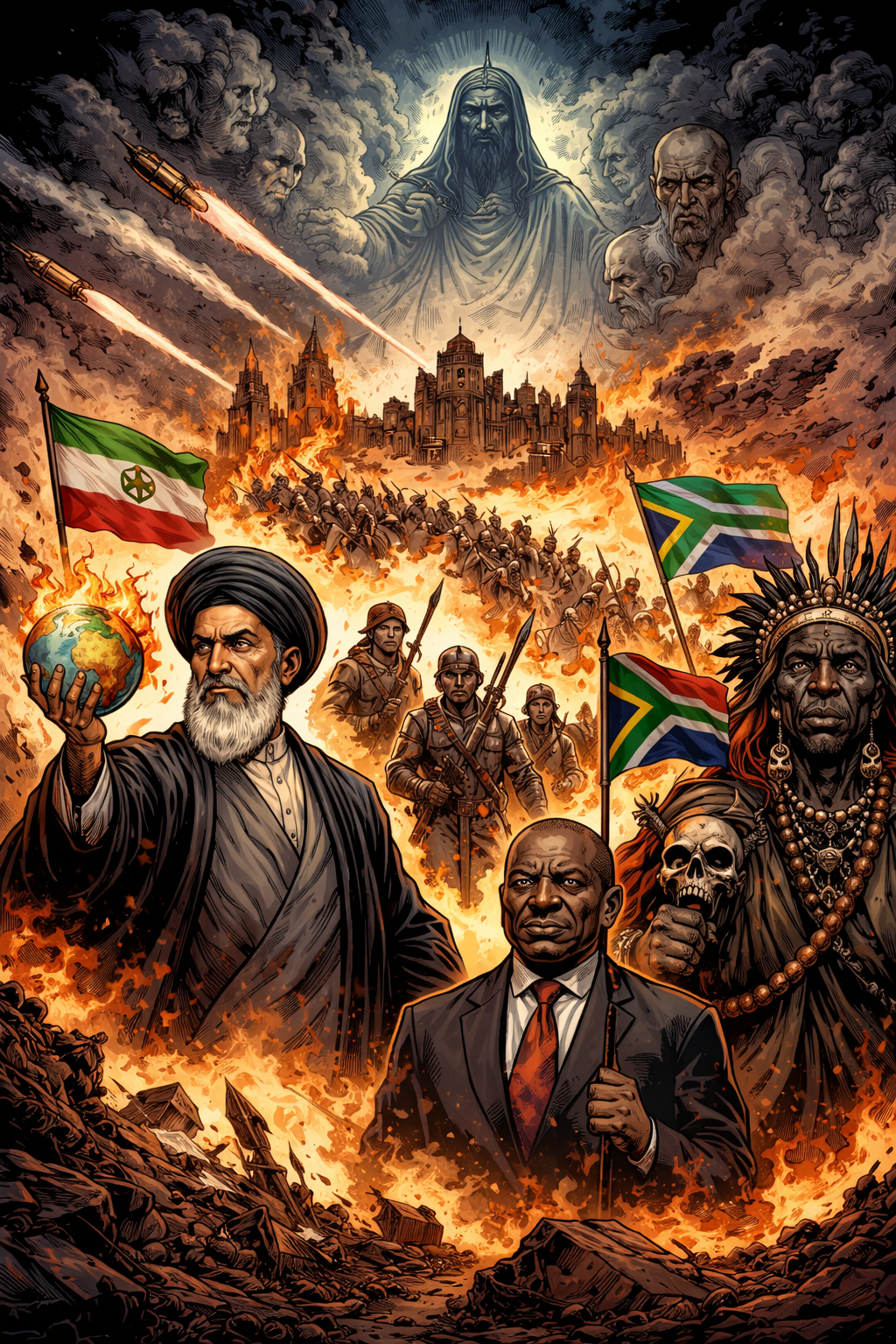
Why Governments Choose Collapse Over Stability
By Andre Eksteen
I grew up in a home where political science was not an abstract subject discussed only in lecture halls or academic journals. My father was a professor in political science. I may not have followed in his footsteps formally, but eighteen years under that roof shaped how I see the world. Politics, in our home, was never reduced to slogans, elections, or party loyalty. It was discussed in terms of power, belief systems, historical cycles, human behaviour, and the unseen forces that move nations long before laws are written or wars are declared.
Very early on I learned something most people never do: politics is never just politics. It is the public expression of private belief. It is theology with uniforms, budgets, and weapons. And when you understand that, the world suddenly makes sense in a way it never did before.
That lesson has stayed with me all my life, and it is the reason I do not interpret global events the way most Christians do. When governments make decisions that look irrational, self-destructive, or outright insane, I do not default to incompetence. I do not start with corruption. I do not assume stupidity. I ask a far more uncomfortable question: what do these people believe about destiny, about judgment, about history, and about the end of the age?
Because once you understand belief, behaviour stops looking mad.
It starts looking intentional.
Right now, the eyes of the world are fixed on the Middle East as the United States and Iran remain locked in what analysts describe as a “battle of wills.” That phrase is revealing, because it already exposes how shallow the modern Western mind has become. This is not a contest of wills. It is not a misunderstanding between rational actors. It is not simply about sanctions, oil, borders, or regional dominance.
What we are watching is a collision of religious worldviews — and one side is openly apocalyptic.
This is the part almost entirely ignored by secular commentators and by comfortable Western Christians who still believe politics is neutral. Iran is not governed as a secular state with Islamic symbolism. It is an Islamic theocracy built on a very specific doctrine: Velāyat-e Faqīh, the guardianship of the Islamic jurist, developed and enforced during the 1979 revolution. According to this doctrine, Islamic clerics must rule in the absence of the hidden Imam and must actively prepare the world for his return.
This is not poetic language. This is not fringe belief. This is state theology.
At the heart of Twelver Shiite Islam lies belief in the Mahdi, the Twelfth Imam, who went into occultation and will return at the end of days to establish global Islamic justice. But here is the point most analysts refuse to touch, because it terrifies them: within Shiite theology, there is a deep and explicit conviction that the Mahdi’s return will be hastened by global chaos, bloodshed, and war.
Iranian clerics do not hide this. They speak openly of “preparing the ground.” They refer to the present time as the “era of emergence.” War is not feared as failure; it is embraced as necessity. Instability is not avoided; it is cultivated. Destruction is not tragic; it is transformative.
This is why Iran behaves the way it does.
Why would a nation knowingly cripple itself under sanctions that devastate its own population? Why would it provoke Israel repeatedly, fully aware that retaliation is inevitable and overwhelming? Why would it fund proxy wars across the Middle East while its economy collapses? Why would it pursue nuclear capability while openly declaring the destruction of Israel?
Because from its theological perspective, these actions are not irrational.
They are obedient.
This is why Joel Rosenberg’s description of the Iranian regime as “an apocalyptic, genocidal death cult” is not sensationalism. It is precision. Polite language cannot describe an ideology that views mass death as a theological accelerant.
And this is where biblical prophecy stops being theoretical and becomes unavoidable.
More than 2,600 years ago, the prophet Ezekiel described a future invasion of Israel by a coalition of nations led by Gog of the land of Magog. Among the explicitly named nations is Persia — modern-day Iran. This prophecy is not symbolic allegory. It is geographically specific. It is militarily specific. And it is end-time specific.
Persia is drawn into this conflict not because it is wise, but because it is deceived. God Himself says He will put hooks in their jaws and draw them into the land, not to reward them, but to destroy them on the mountains of Israel.
Here is the bitter irony that most Christians miss: Iran believes it can force the arrival of its messiah through war. Scripture says that belief itself may be the very deception God uses to bring them into judgment.
They believe chaos summons the Mahdi. God says chaos exposes them.
At this point, many Christians relax. They see Iran as “over there,” distant, foreign, safely removed from their own reality. They tell themselves this is a Middle Eastern problem, an Islamic issue, irrelevant to Africa or South Africa.
That assumption is catastrophically wrong.
The same spiritual mechanics that drive Shiite Islam are active far closer to home — just clothed in different language.
In South Africa, most Christians still interpret government behaviour through a shallow political lens. They speak endlessly about corruption, incompetence, or poor leadership. Those things exist, but they are symptoms, not causes. What we are witnessing is not merely bad governance. It is governance shaped by a religious worldview that predates the Constitution and rejects the God of the Bible outright.
At the heart of much of African traditional belief lies forefather worship. Ancestors are not merely remembered; they are consulted. They are invoked. They are believed to guide leaders, bless nations, punish disobedience, and determine destiny. This is not cultural nostalgia. It is spiritual allegiance.
And here is the truth most Christians are too uncomfortable to say out loud: African forefather religion and Islam are structurally almost identical.
Both deny the final authority of Christ.
Both operate through intermediaries.
Both believe the dead actively influence the living.
Both frame history as a struggle toward enforced “justice.”
Both accept suffering, collapse, and bloodshed as legitimate tools to achieve that end.
In Islam, the Mahdi is the returning figure who establishes order through conquest. In African traditional religion, the ancestors are the unseen governors who demand continuity, loyalty, and submission — often enforced through fear, ritual, and blood. In both systems, authority does not flow directly from God, but through lineage — clerical or ancestral.
This is why government actions in South Africa often look irrational to Christians who still expect biblical morality to produce stability. Stability is not the goal. Alignment is the goal.
When infrastructure collapses, when energy systems fail, when agriculture is undermined, when lawlessness is tolerated, Christians ask, “How can any government allow this?” The answer is simple: because collapse serves the belief system.
Just as Iran believes chaos hastens the Mahdi, many African leaders believe disruption restores ancestral balance. Crisis is not a problem to be solved; it is a condition to be endured until the “correct order” emerges.
And this is where Christians must wake up.
You are not watching accidental decay.
You are watching deliberate alignment.
This is why appeals to “common sense” fail. You are judging religious movements with secular expectations. Scripture warned us this would happen. Jesus said deception would be the defining mark of the last days — not war, not famine, not earthquakes, but deception. Deception strong enough to mislead entire nations.
Paul warned that God Himself would send strong delusion because people refused to love the truth. That delusion does not stop at individuals. It settles over governments.
And this is why the world is accelerating toward conflict, not away from it.
These systems are not trying to preserve themselves.
They are trying to fulfil themselves.
And that is why they will willingly walk into destruction if they believe it brings prophecy closer.
What most Christians still refuse to accept is that the convergence we are witnessing is not accidental, and it is not chaotic in the way Hollywood chaos is imagined. It is structured chaos. Directed chaos. Belief-driven chaos. Different religions, different myths, different languages — but the same destination.
This is why restraint is disappearing everywhere at the same time.
When you understand that multiple belief systems are operating with an end-of-age expectation that rewards collapse, the global picture suddenly sharpens. Iran is not alone. It is simply more honest about what it believes. Others hide their theology behind political language, cultural rhetoric, or historical grievance, but the mechanics are identical.
The Bible never presents Gog and Magog as a single religious movement. It presents it as a coalition — a convergence of nations drawn together not by friendship, but by deception. Ezekiel is explicit that these nations are not acting rationally. They believe the moment is right. They believe the conditions are favourable. They believe Israel is vulnerable. But Scripture says God Himself is the one drawing them in.
That means their confidence is false.
And that false confidence is produced by belief.
Here is where modern Christianity completely misreads what is happening. Christians are trained to look for moral improvement as a sign of God’s blessing and moral decay as a sign of human failure. That framework works in personal discipleship, but it collapses when applied to prophetic history. Prophecy does not move toward reform. It moves toward exposure.
In the last days, God does not restrain deception everywhere. He allows it to mature.
This is why political systems that appear suicidal are allowed to continue. This is why economic self-harm is tolerated. This is why military escalation happens when de-escalation would preserve life. These systems are not trying to save themselves. They are trying to fulfil a story.
Iran believes destruction accelerates the arrival of the Mahdi. African forefather religion believes collapse clears the way for ancestral restoration. Secular globalism believes crisis enables total restructuring. Each system uses different language, but all of them accept suffering as a necessary price for arrival.
This is what unites them.
And this is what terrifies the biblical Christian who still believes governments exist primarily to preserve life.
Scripture never promised that.
In fact, Scripture warns the opposite. It warns that in the last days, rulers will call evil good and good evil, darkness light and light darkness. That is not confusion. That is conviction — conviction rooted in belief.
This is why South Africa matters in this conversation.
South Africa is often treated as a failed state, a tragic accident of corruption and incompetence. That analysis is shallow. South Africa is a laboratory where belief-driven governance is playing out in real time. Policies that erode agriculture, energy, policing, and borders are not corrected even when the damage is undeniable. Why? Because reversal would betray the narrative.
When leaders speak of land, blood, history, and ancestors, they are not speaking metaphorically. They are invoking a spiritual framework where justice is not measured by outcomes, but by alignment with the dead. In that framework, present suffering is justified if it honours the past and reshapes the future.
This is identical in structure to Shiite apocalyptic belief.
In both systems, the living are expendable. The present is sacrificial. The future is mythic. And obedience is measured not by mercy, but by loyalty to the story.
This is why these systems can absorb failure without repentance. Failure does not disprove them; it validates them. Collapse becomes evidence that “the old order is dying,” which means the new one must be close.
That is why Christians who expect repentance from governments are perpetually disappointed. Repentance would require abandoning the theology. And that is the one thing these systems cannot do.
Now we must confront the most uncomfortable truth of all: God allows this.
This is where Christians retreat into slogans, because the alternative is terrifying. If God is sovereign, and if prophecy is real, then the convergence toward Gog and Magog is not merely tolerated — it is permitted for a purpose.
Scripture is explicit that God uses deception to expose hearts. He does not create evil, but He removes restraint. When nations refuse truth, He allows lies to govern them. When leaders reject righteousness, He allows false righteousness to rule.
This is why Ezekiel says God Himself puts hooks in the jaws of Gog. That imagery is violent, deliberate, and unmistakable. It does not describe passive allowance. It describes active orchestration.
God does not stop these nations from believing they are right.
He lets them commit fully.
This is where the modern Church panics, because it realises too late that neutrality is impossible. You either see what is happening, or you are part of the confusion. There is no third position.
And this is why the Church’s refusal to engage prophecy is not harmless ignorance. It is vulnerability.
Christians who believe politics is neutral will always be late. Christians who believe restraint is permanent will always be shocked. Christians who believe peace is the natural trajectory of history will always be unprepared.
Jesus never taught that.
He taught that the end would look convincing. He taught that deception would feel reasonable. He taught that many would be saying “peace and safety” while destruction was already in motion.
And this brings us back to the core issue: religion is not motivating conflict — it is accelerating it.
These systems are not waiting for Gog and Magog to happen accidentally. They are leaning toward it. Pressing toward it. Removing buffers that slow it down.
Iran funds proxies because regional chaos destabilises Israel. South African policies undermine self-sufficiency because dependence centralises power. Global institutions tolerate disorder because crisis enables consolidation. None of this is accidental.
The tragedy is that most Christians still evaluate these actions through a moral lens instead of a prophetic one. They ask, “Why would anyone do this?” when the correct question is, “What story does this serve?”
Once you ask the right question, the answer becomes obvious.
This is also why restraint increasingly comes from unexpected places. God often uses secular forces to delay judgment, while religious systems accelerate it. That pattern runs throughout Scripture. Pharaoh hardened his heart while pagan nations sometimes feared God. Israel chased idols while foreigners recognised the Lord.
Do not assume that religious language means alignment with God.
In the last days, false religion is the engine of global unity against Him.
And that unity will culminate at Gog and Magog.
Not because the nations understand what they are doing, but because they believe they are right.
That is the most dangerous form of deception.
This is where the Church must make a decision. Not about politics, but about discernment. You cannot fight what you refuse to name. You cannot prepare for what you refuse to see. And you cannot warn others if you insist on comforting lies.
The Church is not called to stop Gog and Magog. Scripture is clear that it will happen. But the Church is called to recognise the season, to understand the mechanics, and to refuse participation in the deception.
That means abandoning the idea that governments will save us. It means abandoning the fantasy that collapse always signals failure. It means accepting that some systems are running toward destruction on purpose.
And it means recognising that God’s people are not called to fix the world, but to be faithful as it is exposed.
The convergence is real.
The acceleration is intentional.
The beliefs are ancient.
And Gog and Magog will not arrive by accident.
They are being prepared.
The only remaining question is whether the Church will finally admit that political conflict is religious at its core — or whether it will keep calling prophecy “conspiracy” until the mountains of Israel prove otherwise.


Dagsê Andre. Ja, definitief n onderwerp vandag op meeste mense se tong.
Vir interessantheid – verstaan jy ook dat daar n verskil is tussen die oorlog waarna die Psalm digter in Psalm 83 verwys en die oorlog dan daarna met verwysing na Gog en Mahog!
Yes — there is a clear and important distinction, and you’re asking exactly the right question.
Psalm 83 and the Gog and Magog war are not the same conflict, and they do not occur at the same stage in the prophetic timeline.
Psalm 83 describes a regional war against Israel, carried out by immediate neighboring nations. The intent is explicit: “Come, let us wipe them out as a nation; let the name of Israel be remembered no more.” The peoples listed (Edom, Moab, Ammon, Philistia, Tyre, Assyria) are all geographically and ethnically close to Israel. This looks like a Middle Eastern coalition, driven by hostility toward Israel’s existence itself. It is humanly motivated, politically and religiously fueled, and aimed at erasing Israel before something larger unfolds.
Gog and Magog, described in Ezekiel 38–39, is fundamentally different. This is a multinational invasion involving distant nations, led by Gog of Magog, coming primarily from the far north and the outer reaches of the world. The goal here is not merely Israel’s destruction, but a direct challenge to God’s purposes through Israel. In this conflict, God intervenes supernaturally—through earthquakes, fire, confusion, and divine judgment—without Israel winning the battle by its own strength. This places Gog and Magog in a later, clearly eschatological phase.
Many understand Psalm 83 as a precursor conflict, one that reshapes the regional landscape and removes immediate threats, effectively setting the stage for what follows. Gog and Magog then becomes the climactic confrontation, not the opening act.
So the distinction is this:
• Psalm 83: regional, neighboring nations, human-driven attempt to erase Israel’s name.
• Gog and Magog: global, distant nations, direct divine intervention, end-times escalation.
When this distinction is recognized, the prophetic sequence begins to align far more coherently.
Dankie vir jou antwoord en vir my om te weet ek verstaan reg 😉 Alles aan die gebeur nou in Midde Ooste en Trump se ” Board of peace” so verteenwoordigend van die 10 horings (konings) waarna verwys word in Openbaring 17. Gaan n kort “oorlog” wees met verwysing daarna dat hulle net n uur van “fame” sal hê maar vers 14 is duidelik dat God hulle gaan oorwin. Ekt al van te vore gelees in n uiteensetting van Psalm 83 dat die nasies genoem heel waarskynlik sal wees:
Tente van Edom – Palesteinse vlugtelinge en Suid Jordanië
Ismaeliete – Suid Arabië
Moab – Palesteinse vlugtelinge en Sentraal Joardanië
Hagriete – Egipte
Gebal – Noord Lebanon
Ammon – Palesteinse vlugtelinge en Noord Jordanië
Amalekke – Arabiere suid van Israel
Philiste – Palesteinse vlugtelinge en Hamaz in die Gaza strook
Bewoners van Tire – Hezbollah en Suid Lebanon
Syrie – Syrieërs
Kinders van Lot – Moab en Ammon
Andre, sorry vir die “verkeers opeenhoping” by Ammon.
Dit moet lees “Palesteinse vlugtelinge en Hamaz in die Gaza strook” 😃
Thank you for your message. I need to stop you here, respectfully but clearly, because this line of interpretation is exactly what I dismantle in Chapter 24 of Van Genesis tot Openbaring: Die Goue Lyn wat Alles Verklaar.
You are mixing two things that Scripture never mixes:
1. Psalm 83
2. Revelation 17 (the ten horns / ten kings)
That is the core error.
1. Psalm 83 is NOT an end-time prophecy
Psalm 83 is a historical war psalm and imprecatory prayer, not a future Gog-type event. The Bible never places Psalm 83 in the eschatological timeline, and no early Jewish or early Christian source treated it as such.
The modern habit of re-labelling ancient tribal names as modern political entities (Edom = Palestinians, Tyre = Hezbollah, etc.) is not biblical exegesis. It is post-1948 speculative theology, popularised mainly in 20th-century American dispensational and Zionist circles.
That framework does not come from Scripture.
2. The ten horns of Revelation 17 are NOT human governments
This is the second major error.
In Chapter 24, I show in detail that:
• The ten horns receive authority, not territory
• They rule for one hour only
• They act in unison
• They give their power to the Beast
• They wage war against the Lamb
No human kings, councils, boards, or modern political alliances meet those criteria.
Scripture is explicit: these are not human rulers. They are part of a supernatural dominion structure, consistent with Daniel 7 and Revelation 13.
Trying to map them onto Trump, peace boards, Middle Eastern coalitions, or temporary political movements is newspaper exegesis, not biblical interpretation.
3. Where this teaching comes from
This entire approach:
• Did not exist in the early Church
• Did not exist in Second Temple Judaism
• Did not exist before the 20th century
It arose after 1948, driven by geopolitics, not by the text.
That is precisely why I wrote Chapter 24—to warn believers against this very train of thought, which feels logical but ultimately pulls prophecy down to the level of human politics, exactly where Scripture says the final conflict is not.
4. A sincere encouragement
I’m not dismissing your interest or your effort. I am warning you.
Please read Chapter 24 carefully. The moment you understand:
• what “horns” mean in biblical language
• what “kings” represent in Daniel and Revelation
• and why Scripture never identifies the “sea” or the Beast as human systems
this entire framework collapses.
Prophecy is not fulfilled by headlines.
It is fulfilled exactly as written.
Hi Andre. Ek waardeer jou terugvoer met respek. Van ek op jou Facebook blad afgekom en als lees en probeer verstaan, leer ek net. Ek het nog so baie om te leer en waardeer dit opreg as ek op die lyn gewys word. Ek gaan als waana jy verwys weer lees om die lyn te begryp en te verstaan. Dankie dat jy help!
Met teregwysing het ek nog nooit n probleem gehad nie. Vir my is dit wel belangrik om te voel soos ek die Woord lees en bestudeer, dat dit die regte veronderstelling is.
Uit my hart uit dankie!
Hi, thanks for your message — I really appreciate the way you say it.
Ever since you joined my Facebook page, it’s been clear that you’re reading everything carefully and genuinely trying to make sense of it all, and I respect that. None of this is “light reading”, and I know it takes effort to work through the material and test it for yourself.
If you’re still busy trying to put all the pieces together, that’s perfectly normal. Just keep going. Ask whenever something doesn’t make sense — I’d much rather walk the road with someone who tries than someone who just skims and assumes.
You’re welcome here, and I’m glad you reached out.