From Genesis to Revelation: The One Story – The Golden Thread that Explains Everything – Part 18
By Andre Eksteen
After Solomon, heaven began to stir again.
Not with blessing, but with movement.
For when Solomon opened his heart to foreign gods, he did not only change his own fate — he shifted the boundaries of heaven itself.
For the first time, the fallen princes of the air gained legitimate access to Israel again.
Not through war, but through worship.
Not through violence, but through an altar.
What had been suppressed with sword and blood now returned through song and incense.
Scripture says:
“And the LORD was angry with Solomon, because his heart was turned away from the LORD God of Israel.” (1 Kings 11:9)
But the 1933 Afrikaans translation carries the weight better: “His heart had turned aside.”
That is the key — not his hands, but his heart.
And when the heart of the king turned aside, the spirit of the people opened up.
Previously, Israel belonged to God alone.
The world was, according to Deuteronomy 32:8–9, divided among the “sons of God” — heavenly beings appointed over the nations.
But Israel was the exception:
“For the LORD’s portion is His people; Jacob is the lot of His inheritance.”
They belonged directly to the Almighty.
No prince, no intermediary, no other spirit — only God Himself.
But when Solomon allowed foreign gods, he did something no king before him had done:
he personally broke open the heavenly protection.
The Testament of Solomon tells that the king, in his old age, married a woman from Sidon — a worshipper of Astarte.
She persuaded him to show her the ring with which he controlled the spirits.
When she touched it, the ancient writings say, the seal of the Almighty lost its power.
And the spirits that had been under his command were released again — not to build, but to destroy.
In this way the powers of the air, which had been kept away from Jerusalem for centuries, gained access once more for the first time.
The Book of Jubilees describes what happened next:
“And the spirits of the giant kinds began again to wander over the earth, to lead astray the children of men and to rule over them.” (Jubilees 10:8–9)
Not giants in the flesh — giants in spirit.
Ancient beings who began to rule over human thoughts and desires.
Israel, the people of light, now fell under the same authorities as the nations of Ham and Japheth.
What began at Babel now ended in Jerusalem.
And through that breach, the entire nation began to slide.
The land was torn apart — ten tribes in the north, two in the south.
The temple remained standing, but the voice that once spoke within it fell silent.
The people brought offerings, but God no longer answered.
The altar that was once His throne now became a seat for foreign gods.
The king of the northern kingdom, Jeroboam, had golden calves made and said:
“Here are your gods, O Israel, who brought you up out of the land of Egypt.” (1 Kings 12:28)
Those words were not mere disobedience — they were betrayal.
For the calf was the symbol of El, the heavenly bull-god of Canaan, the one the ancient peoples called “father of the gods”.
And when Israel worshipped the calves, something terrible happened:
they did not merely begin serving idols — they fell under the powers of the air.
Up to that day, Israel belonged to no one but the LORD Himself.
They were the only people on earth who stood directly under His hand, without any heavenly prince ruling over them.
But when they began calling on the gods of the nations, God withdrew His protection,
and the old princes — those same fallen spirits who ruled over the nations of Ham and Japheth — now also began to rule over Israel.
This is the moment when everything changed.
The covenant people, who had lived in the light for generations, placed themselves under the same darkness from which God had rescued them long before.
The prophets called this spiritual adultery — bearing the Name of the LORD while loving the gods of others.
And from that day on, Israel was never again completely free.
They remained in the land, but the heaven above them had changed.
For the God who was over them fell silent,
and the princes who ruled over the nations began to whisper.
The Book of Enoch says:
“And the sons of heaven gave their names to men and taught them how to offer fire and smoke to the stars.” (Enoch 8:1–3)
And that is exactly what happened.
Israel began to worship what God had rejected — the stars, the planets, the authorities of the air.
They built altars to Baal, to Astarte, to Chemosh, to Molech.
And the air began to tremble from the sacrifices.
Silence fell — not because God was gone, but because He withdrew Himself.
He closed the heavens.
And in that silence He sent a man.
Not a king, not a priest, but a prophet of fire.
His name: Elijah.
Elijah the Tishbite came out of the wilderness — not with words of comfort, but with judgement.
For this is how God works.
He judges, He punishes injustice, He speaks truth and He cleanses.
He is not the false god of our time who accepts everything, forgives everything, overlooks everything — the spineless idol the modern church has created in His place to keep people comfortable in their sin.
The true God is holy.
He does not speak gently to rebellion, and He does not caress sin — He cuts it out, so that life may remain.
“As the LORD God of Israel lives, before whom I stand, there shall be neither dew nor rain these years, except by my word.” (1 Kings 17:1)
With those words he shut the heavens, and the earth became dry.
The Wisdom of Solomon describes it like this:
“He shut the heaven by his word, and three times brought down fire from heaven.” (Wisdom 48:3)
Elijah’s voice was the voice of judgement — the voice that once again brought separation between light and darkness.
For three years Israel heard nothing.
No prophet, no rain, no voice.
Until the day God said: “Go to Ahab, for I will make My Name known again.”
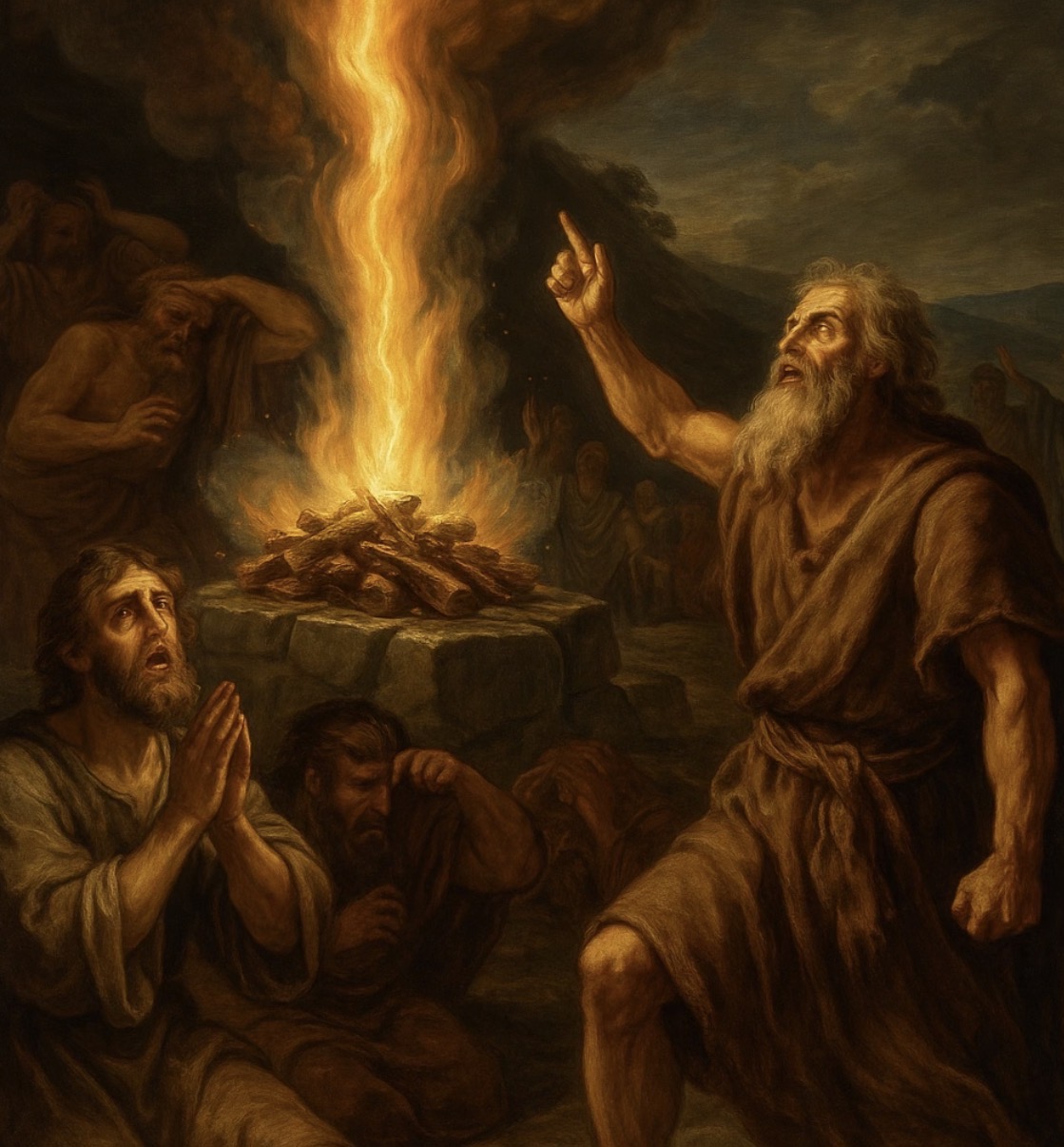
And on Mount Carmel, heaven and earth met again.
Four hundred and fifty prophets of Baal, four hundred of Astarte, against one man of God.
Not a battle of flesh, but of spirit.
Elijah said:
“Call on your gods, and I will call on the LORD; and the God who answers by fire, He is God.” (1 Kings 18:24)
They shouted, they cut themselves, they let blood flow — exactly as Enoch 69 describes the fallen beings taught their followers to do.
But there was no voice, no fire, no answer.
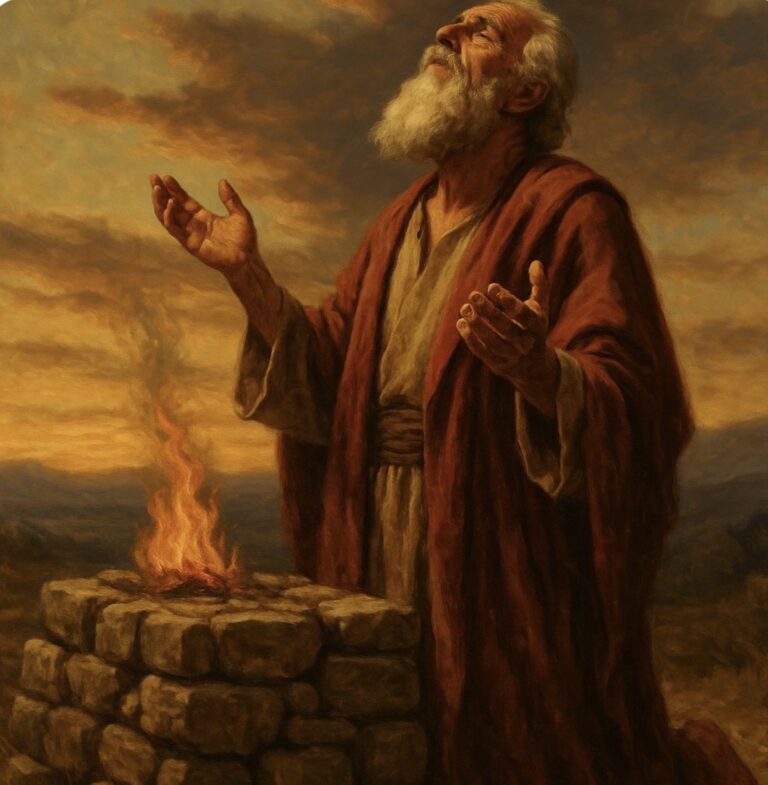
And when Elijah rebuilt the altar with twelve stones — one for each torn tribe — he said:
“LORD God of Abraham, Isaac, and Israel, let it be known this day that You are God in Israel.” (1 Kings 18:36)
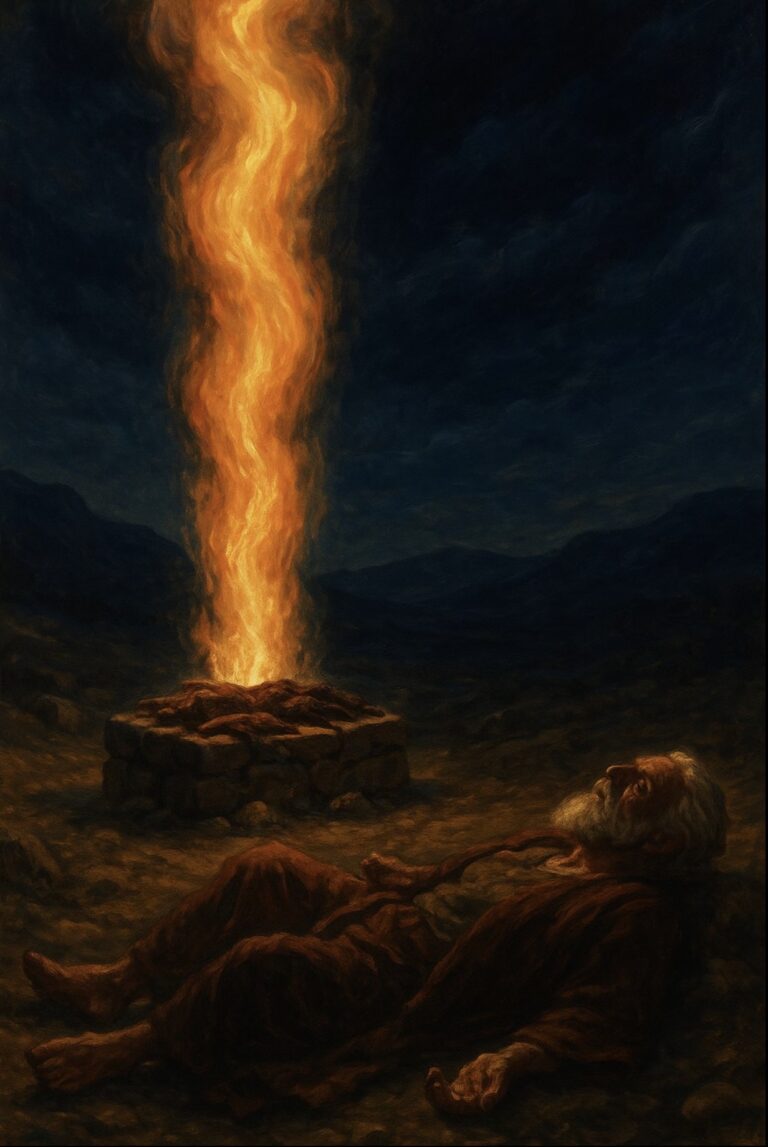
Then fire fell.
Not only on the sacrifice, but on the ground itself.
The fire drank up the water, split the stones, and consumed the dust — because God’s fire purifies what human hands have defiled.
For the first time since Solomon, heaven spoke again.
The people fell on their faces and cried:
“The LORD, He is God! The LORD, He is God!” (1 Kings 18:39)
But even that fire did not last long.
For the powers of the air were not destroyed — they were only driven back.
Enoch says:
“They are not destroyed, but bound until the judgement is completed.” (Enoch 10:12–14)
And so they waited again, just out of sight, until the people forgot once more.
After Elijah’s days, the prophets began to speak in a different tone.
Isaiah, the son of Amoz, saw what was coming:
“The whole head is sick, and the whole heart faint. From the sole of the foot even to the head there is no soundness in it.” (Isaiah 1:5–6)
For the people fell back again — not to fleshly giants, but to the spirits behind them.
The authorities of the air began once more to expand their influence — through idols, through kings, through human pride.
But Isaiah also saw further ahead:
A light that would break the darkness,
a King who would subject the authorities.
“For unto us a Child is born, unto us a Son is given; and the government shall be upon His shoulder.” (Isaiah 9:6)
He looked forward to the day when the Son of David, the Son of God, would finally overcome the princes of this world.
But until that day, the earth would remain in shadow.
For although Elijah brought the fire back, the world had not yet seen the Light that would drive away all darkness.
The Golden Thread ran through Solomon’s pride and Elijah’s fire — through judgement, through silence, through grace.
And still it runs — thin, pure, unbroken.
For God’s promise stands:
He will restore His people, He will establish His kingdom,
and He will once again subject the powers of the air, as He did in the beginning.
In Part 19 we will look at how God’s prophets — such as Elisha, Amos, and Hosea — warned against these unseen rulers; how Daniel lifted the curtain to reveal their battles in heaven; and how the great empires of Assyria, Babylon, and Persia were merely earthly shadows of spiritual thrones in the air.
For the world sees kings, but the Word shows us princes.
And those princes are not gone — they live, they work, and they are preparing for the final rebellion against the Light.