From Genesis to Revelation: The One Story – The Golden Thread that Explains Everything – Part 43
By Andre Eksteen
The Lion of Judah sits on His throne, and for the first time since Eden there is peace. The devil is bound. The beast and the false prophet are in the lake of fire, and the earth rests. The war is over. The blood has dried. The weapons lie rust-brown on the ground. And the world, which rebelled against God for centuries, finally kneels — not out of love, but out of recognition.
Jesus Christ now reigns literally from Jerusalem. This is not a dream. It is not symbolism. It is fulfilment. The prophets said centuries ago that He would sit on the throne of David, and now it is so. Isaiah wrote: “For unto us a Child is born… and the government shall be upon His shoulder… He shall sit upon the throne of David and over His kingdom.” (Isaiah 9:6–7) The Lamb came to save — now the Lion rules.
The nations go up year after year to Jerusalem to worship Him. Zechariah foretold it clearly: “And every one that is left of all the nations… shall go up from year to year to worship the King, the Lord of hosts, and to keep the Feast of Tabernacles.” (Zechariah 14:16) The world now lives under His rule. There is no deception, no corruption, no war. The earth is filled with the knowledge of the Lord as the waters cover the seas. (Isaiah 11:9)
This Feast of Tabernacles, or Sukkot, was from the beginning a prophetic picture of what is now taking place. In the days of Moses, Israel lived in temporary shelters to remember how God protected them when He delivered them from Egypt. They lived in tents, but God dwelt among them in the tabernacle — His presence among people. The Feast of Tabernacles was therefore not only a festival of gratitude, but a festival of God’s presence.
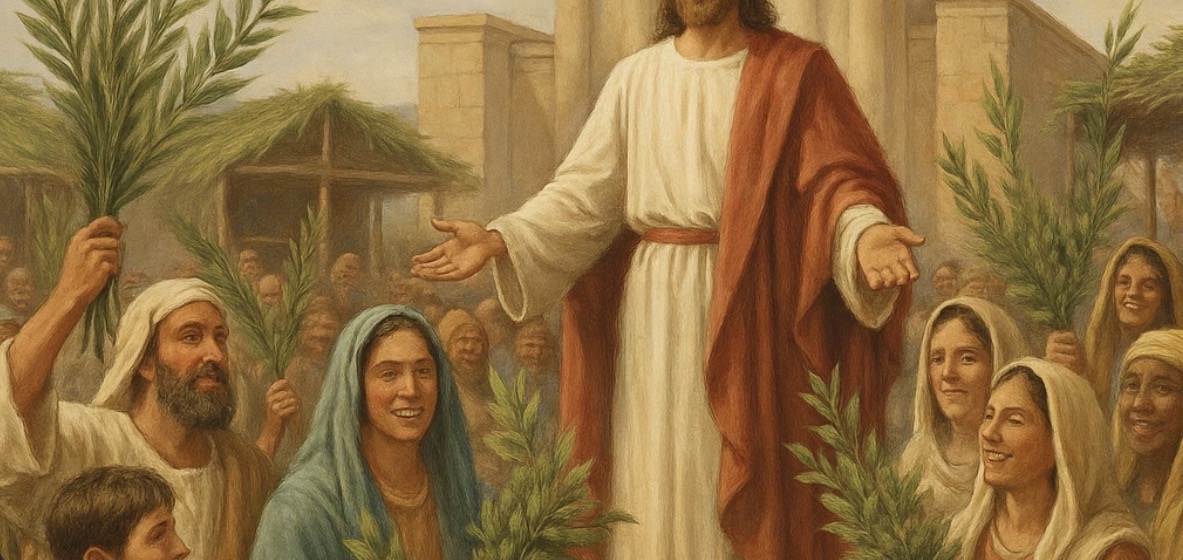
Now, in the thousand-year kingdom, that picture finds its full meaning. The King Himself dwells among people. What was once only a shadow is now reality. The nations go up to Jerusalem to celebrate the Feast of Tabernacles — no longer as a remembrance of the past, but as a celebration of the fact that God once again dwells among mankind. Revelation 21:3 says: “Behold, the tabernacle of God is with men, and He will dwell with them.”
In this time, the Feast of Tabernacles becomes the world’s worship festival. The nations bring their honour to the King of the earth. This is not a symbolic, spiritual “celebration” like today — it is physical, real. People from all over the earth come to Jerusalem, and the Lord Himself receives their worship. Zechariah says that those who refuse to come will receive no rain. (Zechariah 14:17) In other words, obedience is not optional. Christ reigns in righteousness, and worship is part of His government.
For the bride, this feast is more than a ritual — it is a reminder of a fulfilled promise. She dwells permanently in the presence of the King; she herself is His tabernacle. The Feast of Tabernacles no longer points forward to God’s coming, but back to the moment when He came. What was for Israel a temporary shelter is for the bride an eternal dwelling — the presence of God Himself.
But note this carefully: the peace is not achieved through negotiation — it is through victory. He rules with a rod of iron, not with compromise. Psalm 2:9 says: “Thou shalt break them with a rod of iron; thou shalt dash them in pieces like a potter’s vessel.” The King of heaven sits on the throne of David, and His authority extends over the whole earth.
Under Him reigns His bride — the true Church that ascended with Him at the Rapture. She is not a symbolic “church on earth”; she is the glorified body of Christ Himself. Scripture says: “And they shall reign on the earth as kings.” (Revelation 5:10) The modern church ignores this truth, because it reminds her that she is not a passive spectator, but a co-ruler. The bride of Christ is not there to sing and sit; she is there to rule. She sits on thrones with Him, judges with Him, and upholds righteousness with Him.
That is why Revelation 20:4 says: “And I saw thrones, and they sat upon them, and judgement was given unto them.” This is the bride. These are the saints who returned with Him on white horses. They no longer wear mortal bodies — they wear glory. They are now kings and priests of the Most High. They no longer stand against sin — they rule in righteousness.
For a thousand years Christ reigns with His bride over the earth. The remnant of Israel, the 144,000 sealed ones, become the first citizens of His kingdom — the national people He promised to restore. The small group of believers from the nations who went through the great tribulation without taking the mark now live under His rule as mortal people. They survived the fire, and their children will fill the earth again.
These thousand years are a time of complete justice, but not of perfect holiness. The world is ordered, but not renewed. The devil is bound, but the human heart remains sinful. People obey because they must, not because they believe. They honour the King out of fear, but not all out of love.
And yet, even these thousand years of peace are not the utopia the modern church dreams of. The church that buried the literal truth of Revelation under symbolism and philosophy preaches this time as “the golden age of human harmony.” They speak of “a restored earth,” “a new Eden,” “a world without evil.” But that is not what the Bible says. Scripture is clear: there is peace, yes — but it is peace under authority. It is peace under a rod of iron, not under free will.
The world is quiet because the King rules, not because people have changed. They are submissive, but not all are faithful. They honour the Lord because they must, not because they love Him. The Feast of Tabernacles is celebrated yearly, but it is worship under supervision. Zechariah warns that any nation that does not go up to Jerusalem will be punished with drought. (Zechariah 14:17) This is not the picture of a world without sin — it is proof that the sinful nature still lives, even though the deceiver is bound for a time.
The modern church proclaims the thousand-year reign as “the perfect world” — a time of peace, prosperity, and moral progress. They say it is humanity’s ultimate victory over evil, as if Christ’s reign were a democracy where everyone “works together.” But the truth is the opposite: this time proves that humanity, even without the devil, will still sin. It shows that rebellion does not come from hell, but from the human heart itself. Man always chooses evil over good — even in the presence of perfect righteousness.
That is why Satan is released again after the thousand years — not because God gives him another chance, but to expose humanity’s true nature. This is the final testing of mankind. He goes out to deceive the nations — Gog and Magog — to gather them for war. Their number is like the sand of the sea. It is unthinkable: even after a millennium of peace, humanity still rebels against its Maker.
But this time there is no battle. John says: “And fire came down from God out of heaven, and devoured them.” (Revelation 20:9) The rebellion is ended in an instant. The devil, the old serpent, is finally cast into the lake of fire — with the beast and the false prophet — and they are tormented day and night for ever and ever. (verse 10)
The rebellion that began in Eden ends here. The deceiver is silenced, the earth is cleansed, and the throne stands firm. The world tried for the last time to resist God — and lost. Now everything lies bare before Him who sees all. The history of sin is finished.
What comes next is the judgement itself. Heaven opens for the final time. The Great White Throne appears.