There Will Be Many Believers in Hell
By Andre Eksteen
There will be many believers in hell. I know that sounds shocking, but it is the truth. I am not talking about atheists who mock God and say He does not exist. I am not talking about the open enemies of the cross who shake their fists at heaven. I am talking about people who call themselves believers—people who say they believe in God, people who may even sit in church every Sunday—and who will one day wake up in a place of eternal fire and torment. And then they will believe. They will believe with everything in them, but it will be too late.
I know what many people immediately think when they hear this. They assume I am talking about lukewarm Christians, the people Jesus spoke about when He said: “I never knew you: depart from me, ye that work iniquity.” (Matthew 7:23, KJV). Yes, that group is large. They exist. They fill churches and sing songs, but their hearts are unclean. They live like the world lives and think that a quick hand raised at an evangelistic meeting secured their place in heaven. They are going to hell, yes. But it is not only them.
I am talking about something far more uncomfortable—something most people never consider. Hell will be full of believers. Yes, you heard that correctly. In hell every knee will bow and every tongue will confess that Jesus Christ is Lord. In hell there will not be a single atheist left. Everyone will believe. Everyone will know that God exists. But it will not save them.
Because faith after death means nothing. Repentance after death does not exist.
The Bible is clear: “And as it is appointed unto men once to die, but after this the judgment.” (Hebrews 9:27, KJV). One life. One chance. No appeals afterwards.
I once had someone say to me, “But I do believe in God. Surely that must be enough?” My answer was simple: “The devils also believe, and tremble.” (James 2:19, KJV). Do you really think you are better off than a demon simply because you acknowledge that God exists? Faith without obedience, without repentance, without the blood of Christ washing you clean, is nothing but empty noise. You are standing in the same position as the demons—aware, convinced, and still condemned.
Picture the rich man in Luke 16. He is burning in the flames, crying out: “Father Abraham, have mercy on me… for I am tormented in this flame.” (Luke 16:24, KJV). He believes now. He knows now. He even prays now. But it helps nothing. His faith arrived when the door was already closed.
Our generation has created a false image of God—a soft grandfather in heaven who is only love and never judgement, who will let everyone in because He would not be cruel. People say, “A loving God would never send anyone to hell.” That lie comes straight from hell itself. God does not send people to hell because He is unloving. People choose that path by rejecting Christ. God is love, yes—but He is also holy and just. And He has already said: “For the wages of sin is death.” (Romans 6:23, KJV). You make the choice. He honours it.
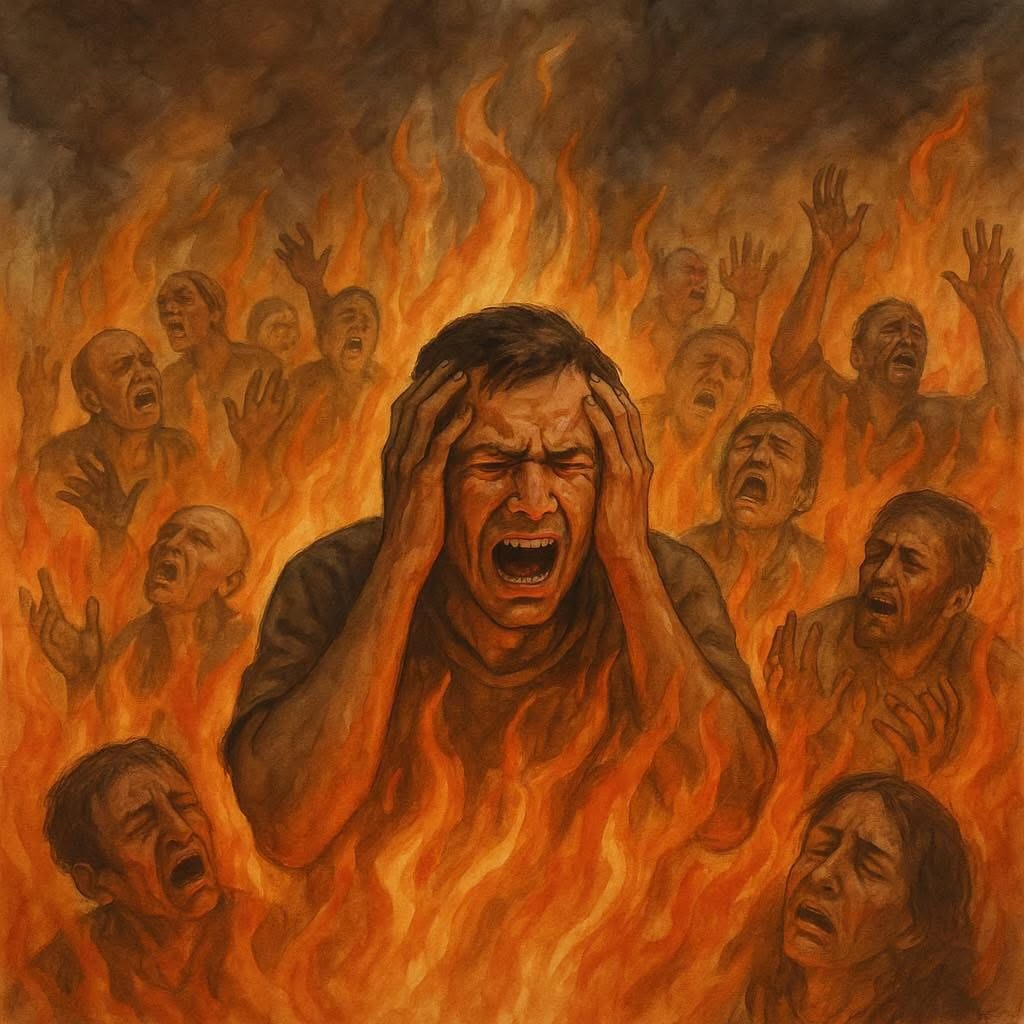
I can no longer speak gently about this. Hell is full of believers—but believers who believed too late. They weep. They gnash their teeth. They scream in the darkness. And they know it is finished. They believe just as strongly as you and I do now, but without hope, without escape, without a second chance. They believe because they can no longer deny the truth. They believe because they now see it with their own eyes. And it counts for nothing.
This is the great deception of our time. People think that if their name is in a church register, if their children were baptised, if they sing the right songs and say the right prayers, then they are safe. Others cling to traditions, rosaries, sacraments, and church rules. But Jesus has already said it plainly: “I am the way, the truth, and the life: no man cometh unto the Father, but by me.” (John 14:6, KJV).
Religion cannot save you. Good works cannot save you. Your parents’ faith cannot save you. Your clever reasoning cannot save you. Only the blood of the Lamb can.
I know this message makes people uncomfortable. Many would rather hear about a Jesus who only loves, only forgives, only smiles and fulfils your dreams. But that Jesus does not exist. The real Jesus said: “Whosoever will come after me, let him deny himself, and take up his cross, and follow me.” (Mark 8:34, KJV). The real Jesus demands your life. All of it. Complete surrender.
So let us strip away the excuses and ask the only question that matters. If you take your last breath tonight, will you wake up in heaven—or in hell as yet another believer who believed too late? The answer does not lie in how much Bible knowledge you have. It does not lie in how many people call you a good person. It lies in one thing only: have you bowed your knee, turned away from your sin, and given your life to Christ?
Because it really is that simple. Here and now you have a choice. Later there is no chance. In the realm of the dead there are only tears, pain, and faith that arrived too late. And those tears will flow forever.
There will be many believers in hell. Do not be one of them.
And it is exactly here that many questions begin to surface. After this article was first published, there were disagreements—especially about the ancient writings, and particularly the Book of Enoch. Some argued that Enoch does not align with the New Testament. But the real question is this: do they truly not align, or are people reading one without understanding the context of the other?
This is where we must slow down and dig deeper.
Many of you know that I have spent years studying and collecting the ancient writings. I do not claim to have all the answers. I never have. But I do believe that these texts provide critical background that helps us understand what the Bible already teaches. They are not replacements for Scripture. They are context.
The heart of the disagreement usually comes down to one question: where does a person go after death?
Most people answer quickly: heaven or hell. That is the simplified version drilled into us from childhood. No nuance. No structure. No depth. You are saved and go to heaven, or lost and go to hell. End of discussion. But that simplicity has made the church lazy and robbed believers of the depth God placed in His Word.
When you dig deeper, both the Bible and the ancient writings reveal a far more ordered and deliberate picture.
In the Book of Enoch, Sheol is not chaos. It is structured. In 1 Enoch 22, Enoch is shown a great mountain with deep hollows—appointed places for the spirits of the dead. Four compartments. One for the righteous who died in faith, waiting for redemption. One for the wicked in torment, exactly as Jesus describes in Luke 16. One for the fallen beings bound in darkness until judgement, as confirmed by Jude 6. And one for those who died without knowledge of the true God, awaiting the Great White Throne judgement of Revelation 20.
This aligns perfectly with what Jesus teaches in Luke 16. Two conscious states. Comfort and torment. Separated by a chasm that cannot be crossed. Both aware. Both waiting.
Paul later writes: “We are confident… and willing rather to be absent from the body, and to be present with the Lord.” (2 Corinthians 5:8, KJV). At first glance, people think this contradicts Enoch. It does not.
The key is the cross.
Before Christ’s sacrifice, the way to the Father was not yet open. The righteous of the Old Testament died in faith but waited. That is why Jesus speaks of “Abraham’s bosom.” It was not heaven—it was a place of rest. A holding place.
When Jesus died and rose again, everything changed. He preached to the spirits in prison. He led captivity captive. He emptied the place of rest and brought the righteous with Him. That is why Paul could confidently say that to die in Christ is to be immediately present with the Lord.
The ancient writings confirm this. The Wisdom of Solomon declares that the souls of the righteous are in the hand of God. The Odes of Solomon testify that Sheol could not hold them. Christ took the keys of death and hell.
That chamber of rest is now empty. It will never be filled again.
The other compartments remain. The wicked still await final judgement. The fallen beings remain bound. And at the Great White Throne, death and hell themselves will be cast into the lake of fire.
This is not contradiction. It is progression.
The Bible shows us what changed after the cross. The ancient writings show us how things were before it. Read together, they reveal one continuous, ordered plan.
Hebrews confirms this: the righteous of old were not made perfect apart from us. Now, Hebrews 12 speaks of “the spirits of just men made perfect.” They are no longer waiting.
And one final shift is still coming.
After the rapture, the age of free grace as we know it closes. During the Great Tribulation, salvation comes through endurance and martyrdom. Revelation shows us that these martyrs do not enter Sheol. They appear directly before God’s throne. They are later raised to reign with Christ in the thousand-year kingdom.
But Sheol continues to fill with the lost.
These truths were never meant to be hidden. They were buried under centuries of tradition. Read lightly, they confuse. Read properly, they illuminate. The Bible is the foundation. The ancient writings provide depth, not doctrine.
Read them together, and the full picture of God’s plan emerges—clear, ordered, and unbroken from beginning to end.