Remarriage After Divorce — Luke 16:18
By Andre Eksteen
There are few questions that reveal the brokenness of our time as clearly as the question of divorce and remarriage. Every time it is raised, it carries more than curiosity. It carries grief. It carries regret. It carries confusion, anger, fear, and often shame. People do not ask about divorce and remarriage when life is going well. They ask when something has collapsed, when promises have failed, when dreams have died, and when the future feels uncertain and frightening.
That is why this subject must never be treated lightly or discussed as a theological puzzle detached from real life. We are not dealing with abstract doctrine. We are dealing with human beings, broken homes, wounded children, and decisions that echo through generations. At the same time, we are dealing with something even weightier than human pain: the holiness of God, the seriousness of covenant, and the truth that vows spoken before God are not casual words.
The Bible never speaks of marriage as a lifestyle choice or a private arrangement. From beginning to end, marriage is presented as a divine institution created by God Himself. It is deliberately designed to reflect something far greater than companionship or romance. Scripture uses marriage as a picture of covenant—first between a man and a woman, and ultimately between God and His people.
That is why divorce is never merely a horizontal issue between two people. It is always a vertical issue involving God. When a marriage breaks, something more than a relationship is affected. A covenant made before God is either honoured or violated. And that is why Jesus speaks so directly, so sharply, and so uncompromisingly about divorce and remarriage.
The modern world finds His words uncomfortable. Many churches avoid them. Many teachers soften them. Many believers reinterpret them through the lens of emotion and personal experience. But the words remain unchanged, because truth does not adapt itself to culture. Culture must either submit to truth or resist it.
Jesus’ words recorded in Luke 16:18 are among the clearest and most confronting in Scripture. He states plainly that remarriage after an unlawful divorce is adultery. There is no emotional cushioning. No explanation. No footnote. He is not addressing feelings; He is declaring covenant reality.
To understand why Jesus speaks this way, we must first understand why so many marriages today fail before they even begin.
Before we talk about divorce, we must talk honestly about why people marry in the first place. One of the greatest tragedies of our time is that most people enter marriage for reasons that have nothing to do with God, covenant, or true love. They marry for reasons that cannot sustain a lifelong union.
Many people marry for status. Marriage has become a social marker, a symbol of success or adulthood. The wedding day matters more than the vows. The venue, the dress, the photographs, the guest list, and the public approval often carry more weight than the promises spoken before God. Marriage becomes a performance, not a covenant. People are more concerned with how the wedding looks than with what the marriage actually is.
Others marry for lust. Physical attraction is mistaken for love. Desire is confused with commitment. Modern culture teaches that sexual chemistry is proof of destiny, and that resisting it is repression. But lust has no endurance. It is intense but shallow. It burns quickly and fades just as fast. When novelty disappears—as it always does—there is nothing left to carry the marriage through ordinary life.
Many marry out of loneliness. They do not want to be alone, so they choose companionship over covenant. The other person becomes a solution to an emotional ache rather than a partner in obedience to God. But loneliness is not cured by marriage. It is cured by right relationship with God. When loneliness returns, as it inevitably does, the marriage is blamed for failing.
Some marry for security. Financial stability, shared resources, social protection, or escape from a difficult home environment become the motivation. Marriage becomes a survival strategy instead of a spiritual union. When that sense of security weakens, fear turns into resentment, and resentment into distance.
Others marry because of pressure. Family expectations, cultural timelines, religious communities, or fear of being left behind push people into marriages they have not prayerfully considered. They comply outwardly but remain inwardly uncommitted. These marriages often fracture under the weight of unspoken reluctance and regret.
Perhaps the most destructive motivation of all is self-fulfilment. Modern culture teaches that marriage exists to meet personal needs. The spouse becomes a service provider: emotional support, affirmation, validation, sexual satisfaction, and happiness are expected on demand. When those expectations are not met, the conclusion comes quickly: “This marriage is no longer working for me.”
What is striking in all of this is how rarely people marry for Godly love.
In fact, many people today do not even know what Godly love is.
Godly love cannot be understood apart from God Himself. Scripture is explicit: God is love. Love is not a floating emotion or a cultural idea. It is an attribute of God’s nature. Remove God, and love does not merely weaken—it is redefined into something else entirely.
This is why marriage without God is not simply unstable. It is loveless by definition.
Without God, what people call love is almost always soul-based. It is emotional, conditional, reactive, and self-focused. It asks, “How do you make me feel?” “Do you still excite me?” “Are my needs being met?” This kind of love has no endurance. It cannot carry suffering. It cannot absorb disappointment. It cannot remain faithful when obedience becomes costly.
Godly love is entirely different. It is rooted in the spirit, not the soul. It is sustained by covenant, not emotion. It reflects God’s own love—faithful, patient, enduring, and sacrificial. Godly love does not abandon when the relationship becomes difficult, because it was never entered into for comfort alone.
Godly love also sees differently. It does not fixate on the outer shell; it recognises the inner spirit. Where soul-based love is drawn to appearance, energy, youth, and outward attraction, godly love is drawn to the person God is shaping within. That is why you will hear some people say, with complete sincerity, that their spouse has become more beautiful with age. They are not denying wrinkles or grey hair. They simply no longer measure beauty by the shell. They see depth, character, faithfulness, shared history, endurance, and the quiet strength forged through years of walking together before God.
Others, however, only see the shell. They see ageing skin, changing bodies, fading attraction. And because their love was anchored in the outer man, not the inner spirit, they conclude that love has died. What they are really confessing—often without realising it—is that they never loved the person; they loved the shell. When the shell changed, the relationship collapsed.
Marriage built on the shell is exactly that: a shell. It may look impressive from the outside for a time, but it is hollow. It has no depth, no endurance, no capacity to carry the weight of life. When hardship comes, when illness arrives, when age advances, when beauty fades, there is nothing inside strong enough to hold the marriage together.
Godly love does not fear time, because time does not erode the spirit. In fact, time reveals it. The longer two people walk together in covenant before God, the more clearly the inner person emerges. And when love is rooted in the spirit, ageing does not diminish beauty; it refines it. The shell weakens, but the bond strengthens.
This is why marriages without God struggle so deeply with ageing, sickness, and sacrifice. They were never designed to look past the outer man. They were built on what could be seen, felt, and desired in the moment. But Scripture teaches that the outward man perishes while the inward man is renewed. Godly love aligns itself with what God values. It loves what He is forming, not what time is taking away.
Where soul-based love says, “You no longer meet my needs,” godly love says, “I see who you are becoming.” Where emotional love says, “You are not who you used to be,” covenant love says, “We are not who we used to be—and that is the point.”
Marriage without this vision is fragile. Marriage without this depth is vulnerable. Marriage without God never learns to see beyond the shell, and therefore never learns to love beyond the moment.
This is why Scripture describes love in terms of patience, longsuffering, self-denial, and faithfulness. These are not natural human traits. They are fruits of the Spirit. They cannot be manufactured by willpower or emotion.
When people who do not walk with God attempt to build a marriage, they attempt to build a covenant without the source of covenant love. They may succeed for a season. They may even appear happy for years. But eventually, the foundation reveals itself.
This is not because God is cruel. It is because He designed marriage to function within a spiritual framework. Remove the framework, and collapse is inevitable.
This also explains why many modern marriages do not end in dramatic conflict, but in quiet indifference. Couples do not always hate each other. They simply stop caring. The emotional fuel runs out, and nothing replaces it. Where there is no covenant before God, there is nothing left to bind two people together once emotion fades.
This is the world into which Jesus speaks His words about divorce. He is not addressing naïve romantics who were shocked by hardship. He is confronting a culture that had already learned to manipulate God’s design for convenience.
In Jesus’ time, men were divorcing their wives for trivial reasons while maintaining religious respectability. They preserved the appearance of righteousness while hollowing out the heart of covenant faithfulness. Jesus confronts this hypocrisy directly. He does not negotiate with it. He exposes it.
When He says that remarriage after an unlawful divorce is adultery, He is not being cruel. He is stating a spiritual reality: God does not recognise the dissolution of a covenant He Himself has not dissolved.
This offends modern thinking because modern thinking assumes sincerity legitimises action. “If I feel justified, I must be justified.” Scripture does not operate this way. Scripture teaches that truth exists outside of emotion, and that obedience often requires us to submit our feelings rather than obey them.
This is where the difference between covenant and contract becomes critical.
A contract is based on mutual benefit. It lasts as long as both parties believe the terms are being met. When it no longer serves its purpose, it can be terminated. Modern marriage is largely built on this model.
A covenant is based on commitment. It is not conditional on satisfaction. It is sealed by promise, not sustained by convenience. Covenants do not dissolve because one party becomes unhappy.
Marriage, in God’s design, is not a promise between two people alone. It is a covenant between two people and God. When vows are spoken, God is not a witness in the background; He is a participant in the covenant.
This is why Jesus says, “What God hath joined together, let not man put asunder.” The emphasis is not on human choice, but on divine action. God joins. Man does not have authority to separate unless God Himself has provided lawful grounds.
Scripture gives only two such grounds.
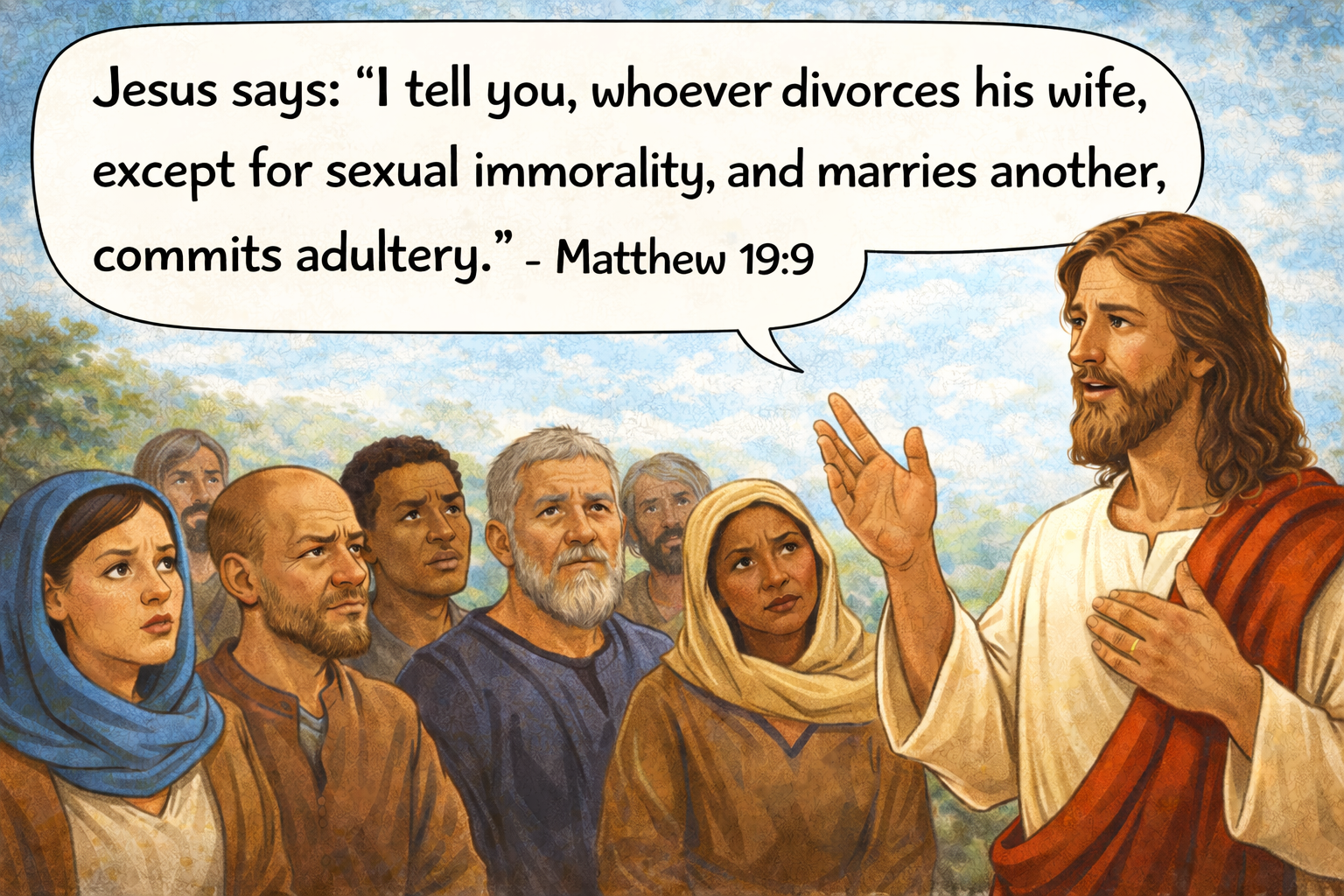
The first is adultery. Jesus explicitly acknowledges this in Matthew 19:9. Adultery is not merely a moral failure; it is a covenantal rupture. It breaks the “one flesh” bond. The covenant is torn by the one who commits adultery, not by the one who remains faithful.
In such a case, the innocent party is free—not emotionally relieved, but covenantally released. Freedom here does not belong to the guilty party. Sin does not create liberty; it creates accountability.
The second ground is abandonment, addressed by the apostle Paul in 1 Corinthians 7:15. When an unbelieving spouse abandons the marriage and rejects the covenant entirely, Paul states that the believer is “not under bondage.” This means the covenant has been destroyed by the deliberate refusal of one party to remain bound.
Outside of these two grounds—adultery and abandonment—Scripture does not recognise divorce as a legitimate dissolution of covenant.
This is where Luke 16:18 becomes so confronting. Jesus is not condemning wounded people. He is declaring that covenant reality does not change because people declare it over. Legal paperwork does not dissolve what God established. Courts may issue decrees, but only God recognises covenant endings.
That is why remarriage after an unlawful divorce is called adultery. Not because God lacks compassion, but because He does not lie about reality. To pretend a covenant no longer exists when it does would be to deny His own faithfulness.
This is also why the language of covenant is so uncomfortable today. Covenant demands permanence. It demands sacrifice. It demands faithfulness even when it hurts. Contracts can be renegotiated; covenants cannot.
Marriage is not about mutual benefit. It is about mutual surrender—first to God, then to one another under His authority.
When this framework is removed, marriage becomes a modern lie. When emotion shifts, the marriage collapses. Divorce then becomes not a tragic last resort, but a logical outcome.
Many people stumble over the fact that Matthew includes an exception clause while Mark and Luke do not. This is not contradiction. It is context.
Matthew writes to a Jewish audience familiar with Mosaic divorce law. He addresses adultery explicitly because his readers understood the legal framework. Mark and Luke write to Gentile audiences unfamiliar with that law. They present the principle without legal detail: if the covenant has not been lawfully broken, remarriage is adultery.
Together, the Gospels and Paul’s teaching form a unified doctrine. Adultery breaks the covenant. Abandonment breaks the covenant. All other reasons leave it intact.
This is why Luke 16:18 is so often misunderstood. It is read in isolation, filtered through modern emotion, instead of through the full witness of Scripture.
None of this is easy to hear. These truths cut close to lived experience. They confront decisions already made and consequences already unfolding. But God’s truth is not given to destroy. It is given to protect.
Marriage is guarded fiercely in Scripture because it is holy. Covenant is upheld because God is faithful. Even where human failure has occurred, grace is not absent. Grace does not rewrite truth, but it meets people within truth.
God does not abandon those who come to Him in humility and repentance. Where lives are tangled, He offers wisdom. Where hearts are broken, He offers healing. Where the past cannot be undone, He offers mercy—without denying reality.
The call of Scripture is not to justify our choices, but to realign our lives with God’s design. That design is always rooted in holiness, faithfulness, and covenant love.
Marriage is holy because God is holy. The covenant stands because God stands. And even in a broken world filled with regret and sorrow, His grace remains sufficient for those who seek Him in truth.
Modern marriage without God is not merely a weakened version of the real thing. It is one of the oldest and most effective deceptions Satan has ever used: a counterfeit that looks close enough to the truth to fool people, but is hollow at its core.
People stand before witnesses, exchange words, sign documents, hold ceremonies, and call it marriage. Society affirms it. Governments recognise it. Friends celebrate it. But when God is not at the centre, when the covenant is not made before Him in reverence and obedience, it is not marriage as God defines it. It is a contradiction—a union that borrows the language of covenant while rejecting the very One who establishes covenant.
Satan has always worked this way. He does not usually attack God’s designs by openly opposing them. He imitates them. He creates substitutes that look righteous, feel meaningful, and promise fulfilment, while quietly removing God from the centre. A marriage without God is one of his most devastating imitations. It carries the appearance of stability and legitimacy, but it is built on sand.
Because it is not anchored in God, it cannot carry the weight marriage was designed to bear. It may hold together for a time—sometimes for many years—but eventually the cracks appear. When pressure comes, when suffering arrives, when age advances, when sacrifice is required, the foundation reveals itself. What was called love proves to be preference. What was called commitment proves to be convenience. What was called covenant proves to be an agreement with an escape clause.
And when such a false marriage collapses, it does not end quietly. It brings deep pain to the people involved. It wounds hearts. It scars children. It breeds bitterness, regret, and confusion. People are left asking why something that felt so real, so sincere, and so celebrated could end in such devastation.
Scripture gives a sobering answer: because it was never built on truth.
And while human lives are left in ruins, Satan rejoices. Not because he delights in weddings, but because he delights in deception. Every counterfeit marriage that ends in betrayal and pain reinforces his lie that God’s design does not work, that covenant is unrealistic, and that obedience only leads to disappointment. He laughs, not at the ceremony, but at the destruction that follows his imitation of the real thing.
This is why marriage cannot be separated from holiness. It is not a neutral institution that God merely blesses if invited. It is His creation. Remove Him from it, and it ceases to be what it claims to be.
Marriage is holy because God is holy. The covenant stands because God stands. And when God is excluded, what remains is not freedom, but fragility. Not love, but illusion. Not covenant, but performance.
Yet even here, grace still speaks. God does not abandon those who have been wounded by deception. He does not mock those who sincerely believed the lie. His grace remains sufficient for those who seek Him in truth—not to affirm the counterfeit, but to call them back to what is real, enduring, and holy.
And this is where truth becomes costly. If a marriage was dissolved for reasons other than the two God Himself has given—adultery or abandonment—then Scripture is clear: the covenant still stands in God’s eyes. In such cases, the call is not to seek a replacement, but to remain unmarried. This is not a punishment, nor an act of cruelty. It is the price God asks of those who truly desire to repair their relationship with Him. Obedience, in this case, means accepting the consequences of past choices and submitting to God’s order rather than rewriting it.
Grace does not remove the seriousness of covenant; it gives us the strength to live within it. For some, that strength will mean learning to walk alone with God rather than entering a new union that He does not recognise. This path is not easy, but it is holy. And God has never asked His people to choose what is easy—only what is true.
Truth exposes deception, but grace heals the damage deception leaves behind.
For those who find themselves somewhere in this story—wounded, uncertain, or burdened—there is hope. Not the shallow hope of easy answers, but the deep hope of restoration through obedience. God does not call people back to His ways to punish them, but to protect them, heal them, and lead them into life.
Truth and grace are never enemies. They walk together. And where they meet, restoration is always possible, but it dos carry a price.