
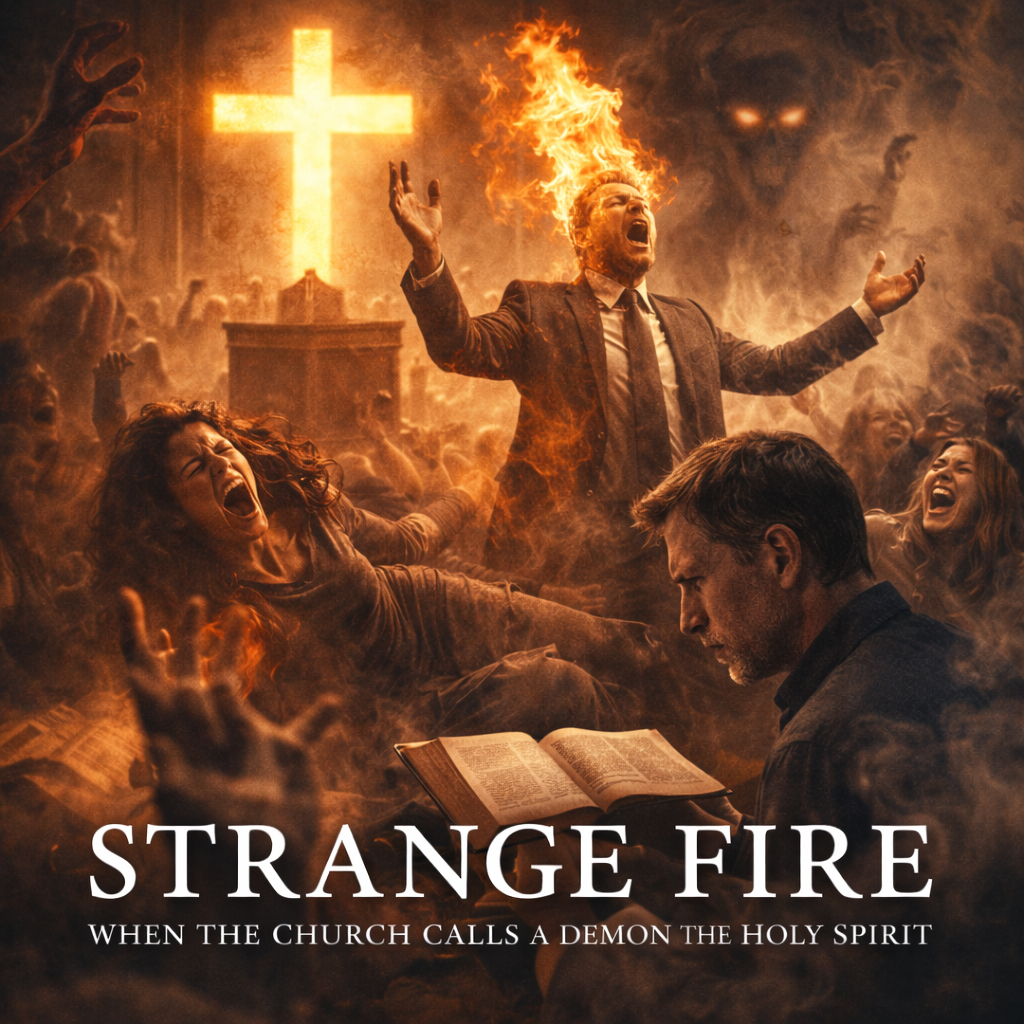
Strange Fire: When the Church Calls a Demon the Holy Spirit
By Andre Eksteen
Speaking in tongues is one of the most misunderstood subjects in the modern Church, and I am asked about it constantly. Not by critics alone. Not by sceptics. But by sincere believers who are confused. They see things happening in churches. They read the book of Acts. They hear testimonies. They watch people fall, shake, scream, utter sounds no one understands, and they are told, “That is the Holy Spirit.” And somewhere inside, something does not sit right. So they ask. And they deserve real answers.
Let me start where we must always start. God is a God of order. That is not my opinion. That is Scripture. The Holy Spirit is not wild energy. He is not chaotic force. He is not mystical electricity that overrides a human being and reduces him to an uncontrolled spectacle. The Spirit of God reveals Christ, glorifies Christ, and empowers obedience to Christ. If we forget that foundation, we will drift into spiritual confusion very quickly.
When people talk about tongues, they almost always jump to Acts 2. Good. Let us go there properly. The disciples were gathered because Jesus told them to wait. Not to experiment. Not to create atmosphere. Not to stir something up. Wait. He said that when the Spirit came upon them, they would receive power. And for what purpose? So that they could be His witnesses. That is the pattern. First, wait for the Spirit. Second, go and make disciples. That is the mission. That is the reason.
Now what happened when the Spirit came? They began to speak in other tongues. But what were those tongues? They were real, known languages. Jews from many regions were present in Jerusalem for the feast. Parthians, Medes, Elamites, people from Mesopotamia, Cappadocia, Pontus, Asia, Egypt, Rome. They heard Galileans speaking in their own languages. Not babbling. Not private syllables. Not emotional noise. Recognisable speech declaring the wonderful works of God.
A Galilean suddenly speaking fluent Greek. Another declaring truth in the dialect of Mesopotamia. The Spirit empowered communication. The result was clarity, not confusion. Peter then stood up and preached a structured sermon rooted in Scripture. He quoted Joel. He quoted David. He explained Christ. He called for repentance. Three thousand souls were added that day.
That is tongues in its first biblical appearance. It was evangelistic. It was ordered. It was purposeful. It led to repentance and baptism. There were no reports of believers collapsing uncontrollably. No descriptions of chaotic frenzy. No spectacle that needed to be interpreted as “mystery.” There was power, yes. But power that moved outward in mission, not inward in emotional display.
Jesus did not say, “Wait for an experience.” He said, “You shall receive power, and you shall be My witnesses.” The Holy Spirit equips believers to carry out the Great Commission. That is His declared function. When tongues become disconnected from mission and turn into a badge of spirituality or a proof of spiritual rank, something fundamental has shifted.
Then we move to Corinth. If there was ever a church that loved manifestations, it was Corinth. They were gifted, but they were immature. They competed. They boasted. They elevated experiences above love. Paul does not deny the gift. But he regulates it firmly. If anyone speaks in a tongue, two or at most three, each in turn, and someone must interpret. If there is no interpreter, let him keep silent in the church. Keep silent. That is not optional language.
Paul also says that God is not the author of confusion but of peace. Everything must be done decently and in order. If what we witness today cannot survive the test of 1 Corinthians 14, it does not matter how powerful it feels. Scripture governs experience, not the other way around.
Now let me address something that must be said plainly. In Scripture, when do we see people thrown to the ground, convulsing, foaming, screaming, losing bodily control? Mark 1 describes a man with an unclean spirit crying out and convulsing. Mark 9 describes a boy thrown to the ground, foaming at the mouth, grinding his teeth. Luke 4 describes a demon throwing a man down in the synagogue. Each time, it is explicitly described as demonic activity. Not once does the New Testament describe the Holy Spirit throwing believers into uncontrolled seizures.
The fruit of the Spirit includes self-control. The Spirit of God does not strip a person of awareness and dignity. When I see people shaking violently, collapsing, rolling, producing incoherent streams of sound and calling it “the Spirit moving,” I have to measure that against Scripture. Manifestation alone is not proof of holiness. Supernatural does not automatically mean divine.
And here is where I will be direct. The modern Church has made a dangerous trade. Instead of testing the spirits as commanded, it has often baptised confusion and sold it as revival. Instead of discerning, it has marketed manifestations. It has taken phenomena that Scripture clearly associates with demonic oppression and slapped a Holy Spirit sticker on them.
That is not discernment. That is negligence.
When churches present uncontrolled bodily collapse, animalistic noises, chaotic shouting and loss of reason as the pinnacle of spiritual maturity, they are not honouring the Spirit. They are misrepresenting Him. Worse, they are conditioning believers to accept anything supernatural as sacred. That is how deception spreads.
The early Jewish world understood that clearly. The literature from the Second Temple period is full of warnings about deceptive spirits. The Dead Sea Scrolls speak of the Spirit of Truth and the Spirit of Falsehood. The Book of Enoch describes fallen Watchers teaching corrupt knowledge and influencing humanity. Jubilees records spiritual corruption spreading through rebellious spirits. The ancient world did not assume that every spiritual phenomenon was from God. They tested it. They discerned it.
The early Church did the same. The Didache emphasised order and warned against false prophets who seized control of gatherings. The Shepherd of Hermas warned against ecstatic figures who dominated assemblies with emotional outbursts. In the second century, Montanism introduced prophetic frenzy and ecstatic speech that bypassed apostolic order. The broader Church rejected it precisely because it broke the pattern established by the apostles.
This is not new confusion. It is an old pattern repeating itself.
Another question I am constantly asked is whether tongues are necessary for salvation. No. Salvation is by grace through faith in Christ. Paul asks plainly, “Do all speak in tongues?” The implied answer is no. Not every believer in Acts spoke in tongues, and the epistles never command it as universal proof of Spirit baptism.
What about a private prayer language? Many defend the idea of a heavenly dialect unknown to men. They cite the “tongues of angels” phrase. But that phrase appears in a passage where Paul also says, “If I have all knowledge” and “If I have all faith to move mountains.” It is rhetorical exaggeration emphasising love. Nowhere in Acts do we see angelic syllables used in worship without interpretation. Every recorded case in Acts connects tongues to real languages or to structured interpretation.
The real danger is subtle but serious. When believers see manifestations that mirror the demonic episodes described in the Gospels and yet are taught to revere them as the Spirit’s work, spiritual discernment collapses. If the Church cannot distinguish between the behaviour of a boy convulsing under an unclean spirit and a congregant shaking on the floor in a meeting, we have a theological crisis.
The Holy Spirit glorifies Christ. He convicts of sin. He produces holiness. He leads to obedience. He empowers witness. He does not centre attention on dramatic bodily reactions. If a gathering ends with everyone discussing the manifestation rather than repenting of sin and proclaiming Christ, the focus has shifted.
I am not denying that God can act supernaturally. I am denying that chaos is His signature.
When the Spirit came at Pentecost, it pushed believers out into the streets. It did not trap them inside a room chasing another experience. It did not produce uncontrolled hysteria. It produced bold proclamation. It gave them the ability to speak clearly so that others could understand the gospel. That is the function. That is the pattern.
The tragedy is that many sincere believers have seen manifestations described in Scripture as demonic and have been told, “This is the Holy Spirit.” And because they fear questioning it, they remain silent. But Scripture commands us to test the spirits. To examine everything. To hold fast to what is good.
God is a God of order. The Holy Spirit is not confused. The apostles were not confused. The early Church was not confused. The confusion arises when experience becomes the authority instead of Scripture.
If speaking in tongues is real in any context today, it must align with the biblical model. It must serve mission. It must operate in order. It must never contradict the character of God revealed in Scripture.
Anything else, no matter how emotional or intense, must be examined carefully.
The Spirit was given so that we might proclaim Christ with boldness, clarity, and power. If we remember that, much of the confusion dissolves. If we forget it, we will keep chasing manifestations and calling them holy while drifting further from the simplicity of the gospel.
And that is why the questions keep coming. Because deep down, people know that God is not the author of chaos.




Dankie Andre, dit raak my diep aan, ek het altyd gewonder hoe die mense dit reg kry is dit die waarheid as hulle so te kere gaan, flou word , skree etc. Voor dat ek jou blog begin lees het,het ek altyd ander gelowiges gevra en na die Bybel gegaan. My ma het altyd gesê,ek moet my nie ophou met dit nie. Dankie vir al jou blogs, ek leer baie ,verstaan nou beter en neem dit aan. Ek bid dat God jou en jou familie sal dra en vir die skrywe . Baie dankie weereens