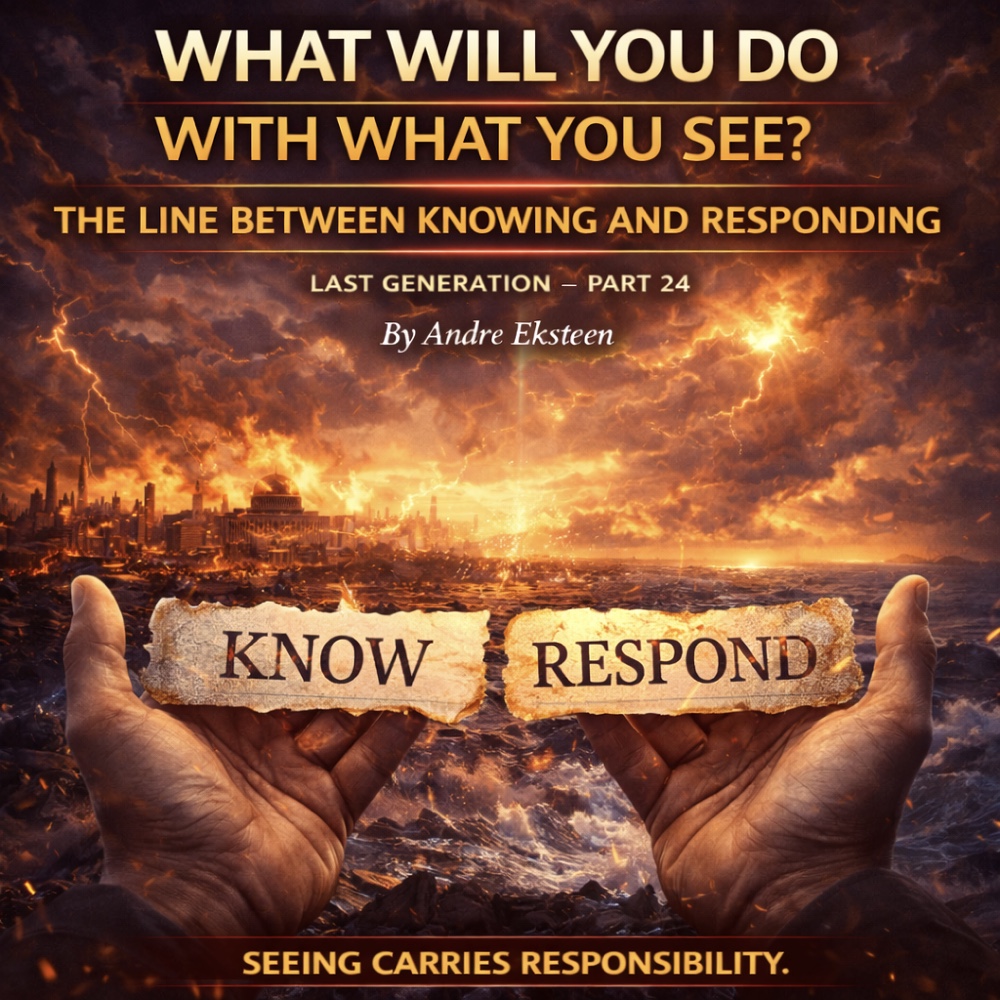
What Will You Do With What You See? The Line Between Knowing and Responding – Last Generation Part 24
By Andre Eksteen
We have reached the point where most people expect a conclusion. A clear statement. A final answer. A declaration that removes all tension and ties up the loose ends. But that was never the purpose of this series — and more importantly, it is not the purpose of the Scripture this series has been working through. Because Scripture does not exist to satisfy curiosity. It does not exist to provide intellectual completeness. It exists to confront you. To place something in front of you that demands a response. To move you — if you will let it — from the position of someone who has information to the position of someone who has been changed by what they have seen.
Now let that settle. Because if you have followed this entire series carefully, then the question that now sits in front of you is not “what is happening in the world?” We have addressed that as honestly as twenty-three parts of careful work allows. The question is not “are we the last generation?” We have addressed that too, with the precision the text supports and the honesty that requires acknowledging what the text does not specify. The question that stands at the end of all of that is simpler and harder than either of those. It is the question Jesus placed before His disciples at the end of His own end-times discourse, and it is the question this series was always building toward.
What are you going to do with what you see?
The Instruction That Ends the Discourse
Matthew 24:42-44 — “Watch therefore: for ye know not what hour your Lord doth come. But know this, that if the goodman of the house had known in what watch the thief would come, he would have watched, and would not have suffered his house to be broken up. Therefore be ye also ready: for in such an hour as ye think not the Son of man cometh.”
Watch. Be ready. Those are the two instructions Jesus leaves His disciples with at the conclusion of the most detailed prophetic discourse He ever gave. Not “calculate the date.” Not “build a system.” Not “identify the signs and announce them to everyone you know.” Watch. Be ready. Two verbs. Simple, active, personal. And both of them pointing not to an intellectual activity but to a posture — an orientation of the whole person toward the coming of the One who gave the instructions.
Now notice what Jesus does not say. He does not say “watch for the signs.” He says “watch for the Son of Man.” The watching is not primarily about tracking geopolitical developments or monitoring Middle Eastern news. The watching is person-directed. It is the posture of someone who is oriented toward a relationship — who is keeping their household ready not because they have calculated when the thief will come but because the relationship with the householder demands readiness regardless of timing. The parable of the thief in the night is not about calculation. It is about the kind of readiness that does not depend on knowing when — the kind that is maintained because of who is coming, not because of when they are expected.
That distinction is everything. The calculating posture produces readiness that is calibrated to a timeline. When the timeline is close, urgency increases and readiness peaks. When the timeline passes, urgency deflates and readiness declines. The watching posture produces readiness that is calibrated to a relationship. It does not surge and deflate with timelines. It is maintained because the relationship demands it, regardless of when the moment comes. And when the moment comes — “in such an hour as ye think not” — the watching person is found ready not because they predicted it but because they never stopped being ready.
Knowing Is Not Enough
Let me be direct about something that the popular culture around end-times teaching consistently gets wrong, and that this series has been implicitly but not yet explicitly addressing. Knowledge of the prophetic framework, however accurate and carefully grounded, is not the same as readiness. They are different things. And the person who confuses them — who treats the accumulation of prophetic understanding as the substance of what Jesus was calling His disciples to — has made the same error the scribes and Pharisees made. They had the knowledge. They had studied the texts. They had framework. And they were not ready for what came.
James 1:22 — “But be ye doers of the word, and not hearers only, deceiving your own selves.” The deception James describes — being a hearer only, not a doer — is a specific form of self-deception. Not ignorance. Not deliberate rejection. Self-deception through the substitution of hearing for doing. The person who hears the word, believes the word, knows the word, and does not act on the word has deceived themselves into thinking that the hearing was the point. It was not. The hearing was in service of the doing. The knowing was in service of the responding. And when knowing becomes the destination rather than the vehicle, it becomes precisely the thing James warns against — a form of self-deception that feels like genuine faith.
Now apply that to the prophetic framework this series has been building. The framework is not the point. It is a tool — a tool for watching clearly, for recognising the season when it arrives, for not being caught off guard by either false peace or false urgency. But a tool unused is no tool at all. The person who finishes Part 24 with a clearer understanding of the last generation question and does nothing different — who carries their improved framework as intellectual cargo rather than as a foundation for changed living — has not received what the series was for. They have done the hearing. They have not done the doing.
The Three Responses and What They Reveal
Now let me be honest about the three ways people typically respond to what this series has presented, because naming them plainly is more useful than leaving the reader to find their own response without a mirror.
The first response is intellectual acceptance without personal application. The person who gives this response has followed the argument, found it convincing, improved their framework, and put it on the shelf alongside the other convincing things they have read. Their prophetic understanding is now more carefully grounded than it was. Their ability to critique popular end-times teaching has improved. And nothing else has changed. They are not watching differently. They are not living differently. They have added knowledge without allowing it to become conviction, and conviction without becoming action. This is the response Jesus warned against in the parable of the house built on sand — the one who hears the sayings and does not do them. The house looks the same. The difference only becomes visible when the storm arrives.
The second response is reactive urgency without grounding. The person who gives this response has read the convergence material and felt the weight of it, but without the careful framework that would allow them to hold that weight calmly. They become anxious. They urgently share the material with everyone around them. They feel that they need to do something, without being clear about what. They may make practical decisions — changing their plans, withdrawing from commitments, preparing material resources — based on a sense that the end is imminent in a way the series has explicitly said cannot be calculated. This is the response of the foolish virgins who ran out of oil not through indifference but through an urgency that was not sustained. The urgency is real. The grounding is absent. And ungrounded urgency, over time, exhausts itself in ways that leave the person less ready, not more.
The third response is the one the series has been building toward. The person who gives this response receives the framework honestly — including its uncertainty about timing, including its refusal to provide the satisfying declaration they might have wanted, including its call to the personal dimensions of readiness that go beyond prophetic knowledge. They allow the convergence to press them toward the clearing of what obstructs the relationship. They allow the structural analysis to sharpen their watching without producing paralysis or panic. They continue in the daily faithfulness that Jesus described as the characteristic of the servant who will be found ready — not because they know when the lord returns, but because the relationship makes readiness the natural and continuous posture. And they hold the prophetic framework with the kind of humility that remains open to correction, that does not mistake the lamp for the oil, and that trusts the faithfulness of God to fulfil what He has promised regardless of whether any specific prediction about timing has proven accurate.
That third response is not dramatic. It does not feel like the satisfying climax of a long prophetic series. It feels like the ordinary continuation of a life oriented toward God — slightly more awake, slightly more informed, slightly more alert to the structural significance of what is happening in the world, but fundamentally continuous with the daily faithfulness that the servant was doing when the lord returned. That ordinariness is not a letdown. It is the point. The last generation will not be defined by the dramatic acts they perform in response to prophetic insight. It will be defined by the faithfulness they maintained through the long delay, through the deception that surrounded them, through the false peace that threatened to lull them, and into the moment when the season finally, unmistakably, announced itself.
The Last Word
Let me close the series with the verse that began it. Not Matthew 24:34, which has been the anchor throughout. Matthew 24:4 — “Take heed that no man deceive you.” Jesus began there. Not with signs. Not with a timeline. With a warning about the primary danger. And the primary danger, as this series has argued across twenty-four parts, is not that the truth is hidden. It is that it is mixed. That it is surrounded by enough noise to drown the signal. That it is handled by enough confident wrong frameworks to make the careful right reading seem less compelling than the confident wrong one.
The protection against that deception is not more information. It is the right posture — the posture of the person who is more committed to what is written than to what is convenient, more committed to following the text than to defending the tradition, more committed to the relationship that the text points toward than to the intellectual exercise that studying the text can become.
This series has tried to be that posture, applied to one of the most contested and most important questions in contemporary Christian thought. Not to produce a new system. To clear the ground for genuine watching. Not to declare the generation. To describe the framework within which the generation will eventually recognise itself.
The convergence is real. The preconditions are assembled. The direction is consistent. The distance is shorter than it has ever been. And somewhere in the unfolding of what remains — in the events still ahead, in the sequence still completing — the watching person will find themselves living through the moment that every previous generation anticipated and did not see. Not because they calculated it. Because they watched.
Watch therefore. Be ready. The season is announcing itself. And the One who described it is faithful.
What Readiness Actually Looks Like
Now let me be specific about what readiness means in practice, because “be ready” is a phrase that can be emptied of content if it is not given specific shape. What does it look like to be ready in the way Jesus described, for a person living in the present structural convergence this series has mapped?
The first dimension of readiness is relational. It is the condition of your relationship with God — cleared of the things that obstruct it, sustained by the practices that maintain it, marked by the kind of honesty before God that forgiveness makes possible. This is where many people stumble. They carry unforgiveness — against specific people, against God for things they have suffered, against themselves for things they have done. They justify carrying it. They have convinced themselves that the offence is too large or too legitimate to be released. But unforgiveness is not a neutral weight. It is specifically the kind of thing that corrupts the watching posture, because it substitutes a fixation on the past grievance for the forward orientation that watching requires. You cannot watch for what is coming if you are locked onto what has happened. The release that forgiveness requires is not weakness. It is the clearing of the obstructions that make genuine watching impossible.
The second dimension of readiness is practical faithfulness. Matthew 24:46 describes the blessed servant as “doing” when the lord returns. Not studying. Not waiting. Doing — the daily work of the household, the feeding of those who need feeding, the maintenance of the responsibilities that have been entrusted. The eschatological readiness Jesus describes is expressed through ordinary faithfulness, not through the suspension of ordinary life in favour of prophetic preparation. The person who is truly ready for the return of Christ is the person who would be found, at any random moment, doing the work they have been given to do. Faithfully. Without the urgency that comes from thinking the end is imminent at a specific date, and without the complacency that comes from dismissing the possibility that it could be soon.
The third dimension is the posture of clarity — the watching that this series has been building. Knowing the sequence. Understanding the structure. Holding the framework that allows genuine recognition of the season when it arrives. Being neither destabilised by dramatic events that are part of the beginning of sorrows, nor lulled into complacency by periods of apparent stability that precede decisive moments. The watching posture is the one that can hold all of that — the urgency appropriate to genuine structural convergence and the patience appropriate to a God whose timetable is not calibrated to human urgency — simultaneously, without collapsing into either panic or dismissal.
The Cost of Not Responding
Now let me say something directly about what happens when someone sees the pattern — when they have followed the argument, recognised the convergence, understood the framework — and does nothing with it. Because this is the danger the parable of the virgins in Matthew 25 addresses, and it is the danger that sits at the end of every prophetic series that produces knowledge without response.
Matthew 25:1-12 tells the story of ten virgins waiting for the bridegroom. Five are wise and have oil. Five are foolish and do not. The bridegroom is delayed — longer than anyone expected. When he finally comes, at midnight, the five foolish virgins have run out of oil and their lamps have gone out. They ask to borrow from the wise. The wise say no — there is not enough to share, go and buy your own. And while they are gone, the bridegroom arrives, the wedding feast begins, and the door is shut. The foolish virgins return and knock. And the bridegroom answers: “Verily I say unto you, I know you not.”
Now what is the difference between the wise and the foolish in that parable? They were all waiting. They all knew the bridegroom was coming. They had all heard the same teaching, been given the same expectations, maintained the same external posture of watching. The difference was the oil. The oil is not transferred knowledge. It is not inherited framework. It is the personal, daily, maintained readiness — the relationship sustained through the long delay — that cannot be borrowed from someone else’s store at the last moment.
You cannot receive someone else’s oil. The preparation this series has provided — the framework, the structural analysis, the careful dismantling of wrong assumptions — is the lamp. But the lamp is useless without the oil. And the oil is not accumulated by reading more prophecy books or following more prophetic series. It is accumulated by the daily faithfulness Jesus described: prayer, forgiveness, ordinary obedience, the clearing of what obstructs the relationship, the maintenance of what sustains it. The person who has the lamp and the oil is the one who will be found ready. The person who has the lamp without the oil will be locked out not because they lacked knowledge but because they did not maintain the relationship the knowledge was supposed to serve.
Now let me say that plainly: if you have followed this series and it has produced only a sharper understanding of prophetic structure without any corresponding response in your relationship with God and in your daily practice — you have the lamp but not the oil. And the lamp, by itself, is not enough.
Seeing Carries Responsibility
There is a principle that runs through Scripture from Luke 12:48 — “unto whomsoever much is given, of him shall be much required” — and it applies directly to prophetic understanding. The person who has been given a clear view of the structure of the end times, who has done the work of removing the wrong assumptions and building the right framework, who can recognise the convergence and understands its implications — that person carries a weight of responsibility that the person who has not done the work does not carry. Not because the framework makes them special. Because seeing carries accountability.
You cannot unknow what you know. Once you have seen the convergence — once you understand the structure, recognise the preconditions, see the direction of movement — you cannot return to a position of genuine ignorance. The choice you face is not between knowing and not knowing. It is between knowing and responding, or knowing and not responding. And the second option is not a neutral position. It is a specific failure — the failure of the person who heard and did not do, who received the lamp but did not maintain the oil, who knew the season and was found not ready when it arrived.
Now let me say something to the reader who has spent the time and effort to follow this series to its final part. You have done something that many people who study prophecy never do — you have followed the argument from the beginning, removed the assumptions, engaged with the texts honestly, held the framework loosely enough to have it corrected, and arrived at a position that is more carefully grounded than what most popular teaching provides. That is not nothing. It is real. And it carries real responsibility.
The responsibility is not to announce your improved framework to everyone around you, though sharing what you have learned honestly and humbly with those who are ready to receive it is good. The responsibility is not to build a new system and promote it as the definitive reading, though careful contribution to the community’s understanding of Scripture is valuable. The responsibility, first and most urgently, is the personal one. Return to where this all started. Matthew 24:4 — “Take heed that no man deceive you.” And the deepest form of deception is the one James describes — hearing without doing, knowing without responding, having the lamp and running out of oil while the delay extends.
So: what will you do with what you see?
Not rhetorically. Actually. Not at some future point when more of the sequence has unfolded and the evidence is even more complete. Now. With the convergence that is already visible, the framework that is already in place, and the recognition that is already available to anyone who has done the work this series has been doing.
The answer is not complicated. It is the same answer it has always been for the person who sees clearly and responds honestly. Clear the obstructions. Maintain the relationship. Do the daily work faithfully. Watch — not for confirmation of a timeline, but for the shape of the thing itself. And trust the One who described it from the beginning, who said “this generation shall not pass till all these things be fulfilled,” and who will be faithful to every word He spoke.
That is where the series ends. Not with a declaration. With an invitation. To the watching posture. To the faithful service. To the oil that cannot be borrowed and can only be accumulated daily, in the quiet practice of a life that takes the coming of the Lord seriously enough to be found doing the work when He comes.
Watch therefore. Be ready. He is coming.