From Genesis to Revelation: The One Story – The Golden Thread that Explains Everything – Part 23
By Andre Eksteen
In the wilderness of Judea stands John, son of Zechariah, with a voice that echoes through the ages. “Repent, for the kingdom of heaven has come near,” he cries. He wears camel hair, eats locusts and honey, and lives without refinement or status. He does not preach for honour, but for truth. People stream out from Jerusalem and the towns of Judea to hear him, because they know — this man is not part of the system. He is the voice of a prophet after four hundred years of silence.
What few people realise is that John was not an old prophet with a long grey beard. He was barely thirty — only a few months older than Jesus. Luke makes it clear that Mary and Elizabeth were pregnant at the same time, and that John was filled with the Holy Spirit even before his birth. They belonged to the same generation, the same century, and the same moment of revelation. John was therefore not an old man from the wilderness, but a young prophet who, in the fullness of his youth, began to cry out the words of Isaiah.
Isaiah spoke of him when he said: “A voice cries in the wilderness: Prepare the way of the Lord.” And that is exactly what John does. He does not prepare a road with stones or bricks, but with repentance. He brings the people back to simplicity, to purity, to truth.
The Pharisees and Sadducees also come. They were old men — holders of authority, voices of tradition, guardians of a system that had long since burned out. Their clothes gleam in the sun, their hands smell of incense, their eyes of judgement. They look down on John like old wine poured into water. For in those days a young man never addressed an older one, let alone a religious leader. Age was honour, and honour was power. But John did not recognise human order — he stood under command of heaven.
He looks through them as through smoke. He does not see age; he sees decay. And with a voice that cuts through centuries of silence, he cries: “You brood of vipers! Who warned you to flee from the coming wrath?” The words strike like a whip. The people stare. For in those days it was unthinkable — a young man addressing the holy men of Israel as children of the serpent. It was not mere criticism; it was a direct accusation of spiritual deception.
But John stands firm. He does not speak out of rebellion, but out of commission. The Spirit within him is older than all their learning. They preach Abraham, but he carries the voice of Elijah. They carry scrolls; he carries fire.
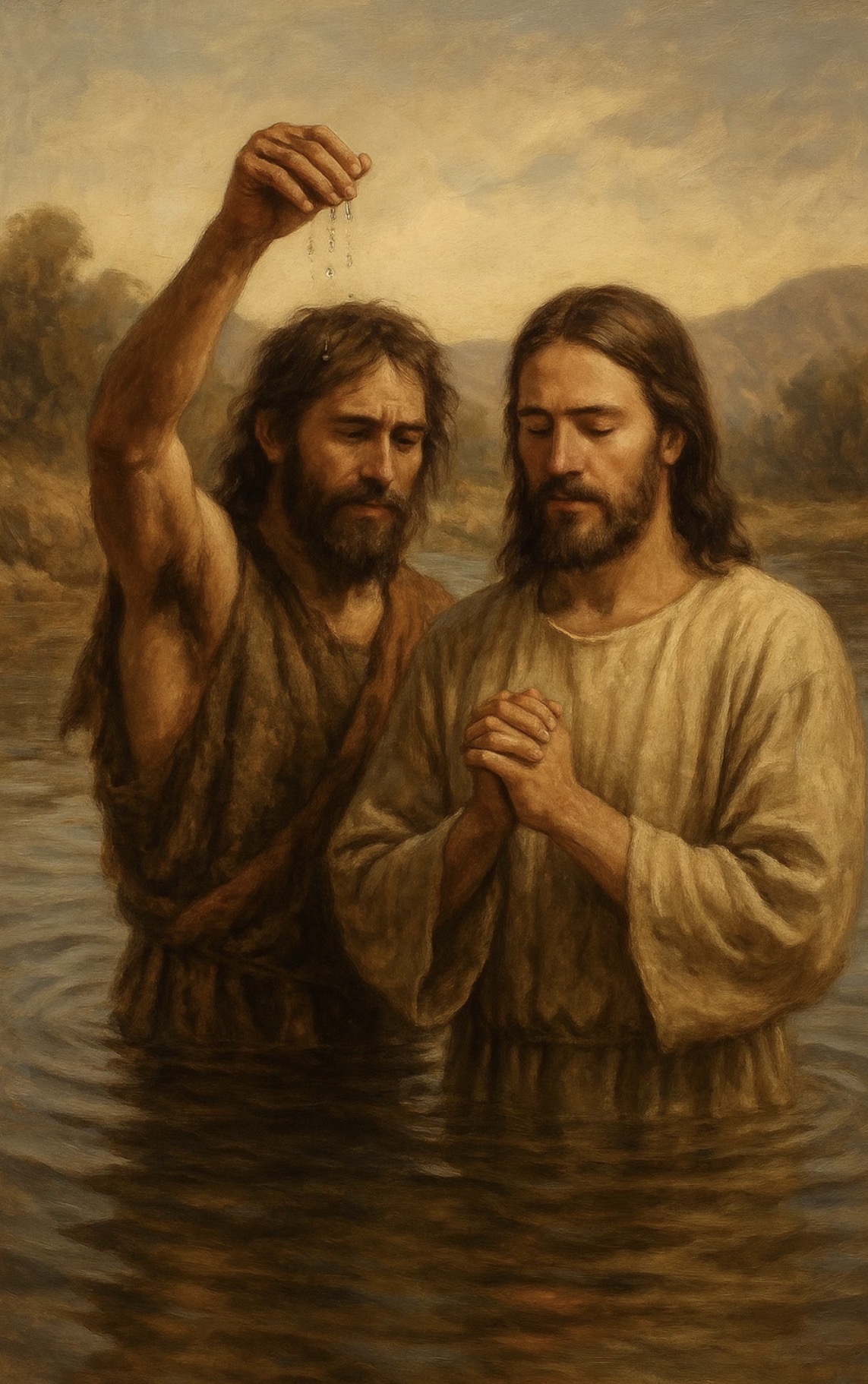
And then, in the midst of dust and water, appears the One for whom he has been waiting. The young prophet in camel hair and the young carpenter from Nazareth — two men of the same generation, yet of eternal difference in essence. The one calls for cleansing; the other brings salvation.
Jesus walks in from Galilee. There is no fanfare, no flags or soldiers — only the wind over the water and the silence of a world that does not recognise Him.
John looks up, and the Spirit within him stirs. The same Spirit who made him leap while still in his mother’s womb now shows him again: this is He. The inner voice that carried him all his days whispers clearly: “Behold, the Lamb of God who takes away the sin of the world.”
John’s eyes fill with a knowing that does not come from flesh. He understands that the One for whom he cried now stands before him. He realises his task is at its end, because the road he was sent to level has now been entered. The voice of the wilderness grows quiet, for the Word Himself has come.
But when Jesus comes to him to be baptised, John draws back. He feels the holy fear known only to those who truly encounter the presence of God. “I need to be baptised by You, and do You come to me?” he says, his voice half-choked with awe. It is the voice of a man who knows he stands before more than a prophet — before the One whose sandals he is not worthy to untie.
Jesus looks at him and answers simply: “Permit it now, for thus it is fitting for us to fulfil all righteousness.” (Matthew 3:15) He is saying, in essence: John, this is not only about sin; it is about order. I come not only to bear guilt, but to restore obedience.
And here lies the great mystery — the One without sin steps down into water meant for sinners. The Light of the world enters the mud of humanity. He stands in the place of the guilty and allows Himself to be submerged as if He were guilty. This is the first act of substitution — long before the cross, long before the nails. Here, in the Jordan, the bearing of guilt begins.
The Son of God is literally drenched in humanity’s water of guilt. He does not only take on flesh; He takes on responsibility. He is not baptised because He needs cleansing, but because we do. He does it for a world that does not yet know Him, for a people who believe purity lies in ritual, and for every soul who would one day understand that obedience is always the first step towards victory.
When He comes up out of the water, heaven is torn open. The Spirit descends like a dove, and the voice of the Father speaks: “This is my beloved Son, in whom I am well pleased.” This is the first time since Eden that heaven speaks directly to earth. The Spirit hovers again over the waters, just as in Genesis. The new creation begins at that moment.
To the people along the Jordan it was simply a beautiful scene, but in the unseen realm it erupted with movement. The princes of the air trembled, for they knew that the One who cast them out of heaven had now appeared on their ground — in flesh.
Enoch writes that “when the Son of Man appears, the powers of the air will cast down their crowns.” That is what happened. The baptism was not only an act of faith; it was a declaration of war.
Immediately afterwards the Spirit leads Him into the wilderness. Note carefully: it was not the devil who lured Him there — it was the Holy Spirit who sent Him. For the war had to begin, and the battlefield had to be bare: no city, no people, no help — only truth against lies.
Forty days without food. Forty days of silence. The body weakens, but the Spirit grows stronger. It is the same pattern as Israel’s forty years in the wilderness, but where they fell, He would stand.
Then the attack comes. The enemy waits until hunger is deep, until the body cries for bread, and he says: “If You are the Son of God, command these stones to become bread.” It is the same voice that whispered in Eden: “Did God really say?” It is always the same strategy — to sow doubt in identity.
But Jesus answers: “It is written: Man shall not live by bread alone, but by every word that proceeds from the mouth of God.” He uses no miracle, no display. He answers with the Word.
Many people read those words and think Jesus is referring to the Bible as we know it today — the sixty-six books bound between two black covers. But there was no “Bible” yet. No New Testament, no chapters, no verses. What Jesus quotes is the Torah — specifically Deuteronomy 8:3 — the Law Moses received at Sinai, the first testimony of God’s voice to humanity. It is the same “Scriptures” He later refers to when He says: “Have you not read what is written in the Law and the Prophets?”
When Jesus says, “It is written,” He is not referring to a book on a shelf, but to the living word God spoke through Moses — words passed down orally for generations and later written on parchment. He uses it as a weapon, not as a ritual. The Son of God, the Word Himself, quotes the original voice of the Father.
Notice this: He performs no miracle, no spectacle. He does not answer with power, but with truth. He shows that the greatest victory does not lie in what you can display, but in what you believe. The devil asks for a sign; Jesus gives Scripture. He reminds him that the Word of God is older than bread, stronger than flesh, and the one weapon the serpent has never been able to resist.
Then the enemy takes Him to the pinnacle of the temple — the highest point of religion and human pride — and says: “Throw Yourself down, for it is written that the angels will bear You up.” Notice: Satan now quotes Scripture. He knows it well, but he uses it without the Spirit.
He says: “It is written: He will command His angels concerning You.” (Matthew 4:6) It sounds right, it sounds biblical — but it is a twisted quotation from Psalm 91. He deliberately leaves out the part that says: “to keep You in all Your ways.” He quotes the Word, but cuts it out of context. That is how deception always works — half truth, full lie.
And this is exactly what happens today. People say: “But I believe.” They think belief is enough, even when it is without truth.
But look carefully — Satan also believes. He believes in God’s existence, he knows the Word better than any preacher, he has seen heaven itself — and yet he remains condemned. Faith without the Spirit is merely knowledge, and knowledge without obedience is rebellion. Satan believes, but he does not bow. He knows the Word, but he does not live it.
That is why Jesus does not fight him on his own ground. He does not answer with argument, but with authority: “It is also written: You shall not put the Lord your God to the test.” (Matthew 4:7)
With that sentence He cuts through the deception. He shows that the Word without the Spirit is only letters — but with the Spirit it becomes a sword that divides truth from lies.
Finally, the devil shows Him all the kingdoms of the world and says: “All this I will give You if You fall down and worship me.” This is the final trap — the promise of power without suffering, a throne without a cross, a kingdom without obedience. And that is exactly what the world still seeks today.
But Jesus says: “Go away, Satan, for it is written: You shall worship the Lord your God, and Him only shall you serve.”
Three attacks. Three answers. Body, soul, and spirit. In three sentences He breaks three thousand years of deception. Adam fell in a garden of abundance; Christ stood in a wilderness of lack.
And when the devil left Him, Luke says: “He departed from Him until an opportune time.” The war was not over, but the ground had shifted. Heaven had won the first victory.
The Book of the Ascension of Isaiah describes this moment: “When the Holy of Holies clothed Himself in flesh, the powers of the air hid their faces, for they saw their end.” That is why the Spirit sent Him into the wilderness — not to prove that He could fast, but to show that flesh, filled with the Spirit, is stronger than fallen angels.
This is what Satan never understood: God did not only come to save; He came to restore. He came to make the flesh — the body corrupted by sin — a temple for the Spirit once again.
What happened there was a spiritual battlefield. The earth saw nothing — just a man in sand and heat — but in the air thrones were shaken. The Book of the Twelve Patriarchs says that “when the Righteous One comes, the spirits of deception will lose their weapons.” And that is what happened.
Every time Jesus said, “It is written,” a chain broke. He did not merely resist temptation — He dismantled structures of control that had stood since the days of Hermon.
After the wilderness He returned in the power of the Spirit. Luke says: “And Jesus returned in the power of the Spirit to Galilee.” No longer only baptised with the Spirit, but filled with and carried by Him. He comes out of the wilderness as the Man through whom heaven now works directly.
And the princes of the air know it. The Apocalypse of Abraham describes how “the twelve throne-princes of the air” hold dominion over the earth until the Son of Man appears — then their domain begins to collapse. That is exactly what has now happened.
The world has not yet seen Him, but the unseen realm already knows: the war has officially begun. The One who calmed the waters and made the sun stand still now walks through dust among people, with calloused hands. He did not descend as God to hover above humanity, but as Man to walk among them. He is the bridge between heaven and earth, the flesh that has become a temple again.
The baptism was the declaration. The wilderness was the proof. And from this point on, the confrontation begins.
He stood in the Jordan where the Spirit descended; He stood in the wilderness where the enemy tempted Him — and now He will stand before the world.
What Adam lost, He has regained.
What Israel could not carry, He now carries Himself.
And the world does not yet know it, but heaven is beginning to break its seals.
In the days to come, He will call people, heal the sick, and cast out demons. But the core remains the same: every miracle is a battlefield, every healing a victory over a spirit that believed it still held control. This is not only grace — it is war. Heaven has begun to reclaim what was lost.
And so, while Rome holds its parades and the priests bring their offerings, there stands a Man in the shadow of Galilee who carries heaven in His eyes. No one recognises Him, but the spiritual powers tremble. For they know: the Son of Man lives, and He is no longer silent.
In the next part, the Light will move — no longer quiet or hidden, but visible and unstoppable. We will see how He calls, how He brings the baptism of fire, and how heaven opens again — not over water, but over people.
For from here the second movement of the story begins:
the Light entering the world —
and the darkness that cannot extinguish it.