From Genesis to Revelation: The One Story – The Golden Thread that Explains Everything – Part 22
By Andre Eksteen
Four centuries of waiting passed without prophets, without visions, without the voice of God. But in the darkness of a forgotten village, the light began to flicker again. Not in Jerusalem, not in a temple — in a clay house in Nazareth.
“And in the sixth month the angel Gabriel was sent by God to a town of Galilee called Nazareth, to a virgin betrothed to a man whose name was Joseph.” (Luke 1:26–27)
So begins the next chapter of the golden thread — the point where heaven speaks again.
What many people do not realise is that Gabriel is not just a messenger. He is one of the four chief angels introduced to Enoch before the Flood — the “archangel of revelation”, the one who makes God’s secrets known to men. (Enoch 40:9)
Where Michael wages war, Gabriel brings truth; where Uriel announces judgement, he brings grace.
He is the same angel who appeared to Daniel centuries earlier. “And behold,” Daniel says, “the man Gabriel, whom I had seen in the vision, instructed me and said: understand the vision.” (Daniel 8:16)
It was he who gave Daniel the prophecy of the seventy weeks — the precise timeline that would run right up to the very day of the Messiah’s coming. Yet many people think that calculation was Daniel’s own revelation, while in truth it was Gabriel’s message that Daniel merely recorded.
And now, centuries later, Gabriel appears again — the same voice, but with a new assignment. No longer to point out the time, but to complete the time. He no longer brings prophecy; he brings fulfilment. This is the greatest message ever delivered to a human being — and it reveals his rank, his authority, and his closeness to the throne of God.
Mary was probably sixteen. That is unthinkable today, but in those days it was the normal age for a betrothal. A girl was taught from a young age to run a household and to know the Law. She knew how to work, how to pray, and how to walk in the ways of the Lord. Not a priestess or a prophetess — just an ordinary girl with a pure heart. And that is where God always begins.
She was not a “holy virgin” as some teach. Scripture makes it clear: she received grace. A person who receives grace is a person who needs it. God did not choose her because she was sinless — He chose her because she would believe.
There was no aura, no beams of light, no halo around her head. Just an ordinary girl with a faith stronger than her fear of people.
The Protoevangelium of James tells that Mary spent part of her childhood in the temple, receiving instruction in the Law. That is why she would have known the prophecy of Isaiah: “The virgin shall conceive and bear a son, and shall call his name Immanuel.” (Isaiah 7:14) She would have carried those words in her heart, without knowing they referred to her.
When the angel came, she was not prepared for a vision. She was not fasting or performing a ritual. She was simply going about her day, like any other day, when heaven opened.
“Fear not, Mary, for you have found favour with God.” (Luke 1:30)
These were the first words to break four centuries of silence.
The message was too great for human logic:
“You will conceive and bear a son, and his name shall be called Jesus. He will be great and will be called the Son of the Most High.” (Luke 1:31–32)
These words were recorded by Luke — a doctor and the only non-Jewish writer of the New Testament. He wrote in Greek, the world language of that time, so that his account could be understood by Jews and Gentiles alike. That is why he uses the Greek name Iēsous (Ἰησοῦς), translated directly from the Hebrew Yehoshua or Yeshua — meaning: “Yahweh is Salvation.”
In other words, the angel’s words to Mary were originally spoken in her own language — Aramaic or Hebrew — but Luke later wrote them down in Greek for the world to understand. The meaning, however, did not change.
He literally said: “You shall call His name: Yeshua — Yahweh saves.”
Many people today claim that the name “Jesus” is pagan or derived from “Zeus”. That is a modern lie with no foundation. The Greeks simply did not have a “sh” sound, so Yeshua became Iēsous, and later in Latin, Iesus. When the Bible was translated into English, the letter “J” was added — but the meaning remains exactly the same: “The Lord who saves.”
We are not going to open the entire “Name Gospel” debate here — that comes later. I will also not answer any comments about it. What you must understand now is that God does not look at the pronunciation of a name, but at the recognition and understanding of it. A name does not save; only the blood of Jesus saves.
Whether you say Yeshua like the Hebrew,
Iēsous like the Greek,
Iesus like the Roman,
Jesu like the early African churches,
Yesu as in Swahili,
Jesu Kristu as in Zulu,
Yesus Kristus as in Indonesian,
Jezus as in Polish and Dutch,
or Jesus as we say it in Afrikaans —
if you mean Him, the Son of the Most High, the Lamb of God, then you are calling on the same Name: the Name that means “The Lord saves.”
For as Acts 4:12 says:
“There is no other name under heaven given among men by which we must be saved.”
She did not argue. She only asked: “How can this be, since I do not know a man?”
And the answer was simple:
“The Holy Spirit will come upon you, and the power of the Most High will overshadow you.” (Luke 1:35)
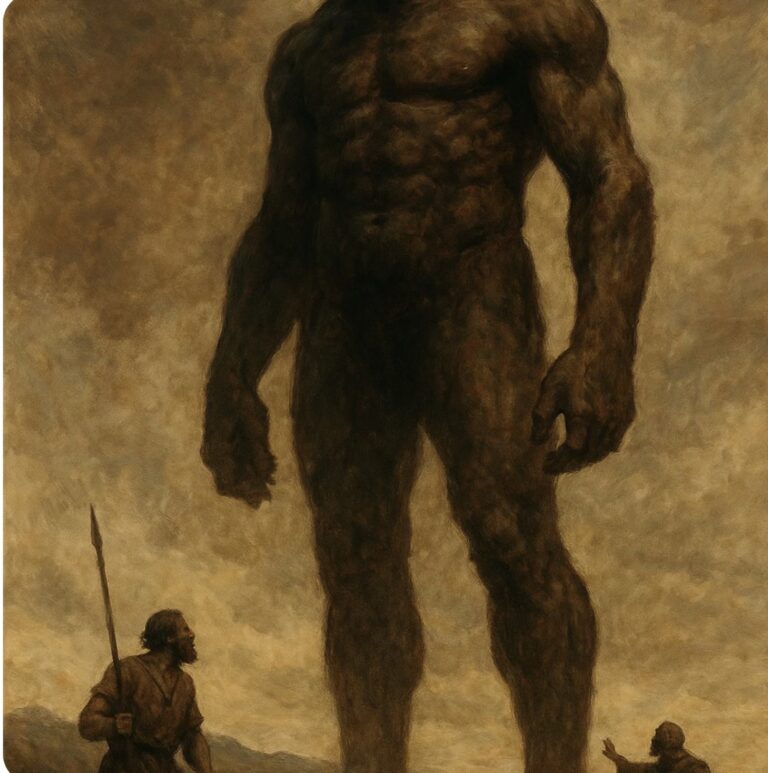
That moment was God’s answer to what began at Hermon.
The Watchers in Genesis 6 tried, through human beings, to corrupt the flesh itself — to mix creation with something not born of God. They wanted the human bloodline to never again be pure, so that the promised Redeemer could not come through human flesh.
But here, through Mary, God does exactly the opposite.
He uses flesh to restore flesh.
Where the fallen angels planted their seed to corrupt humanity, God plants His own Spirit in a woman to redeem humanity. He uses the same form they polluted to defeat them.
This is the fulfilment of what God said in the Garden of Eden:
“The seed of the woman shall crush your head.” (Genesis 3:15)
Notice — not the seed of the man, but of the woman.
Because this child would not come through human seed, but through the Spirit of God. And that is precisely what Satan tried to prevent through the fallen beings — that the Son of the Most High could ever be born in human flesh.
Now it had happened.
The One who cast them out of heaven would now appear in the very flesh they had twisted — and He would defeat them in that same flesh.
Satan tried through mankind to corrupt the flesh, but now God comes through flesh to judge him once and for all.
And on the day of judgement, Scripture says, it will be through a man that Satan’s head will be crushed — through the Son of Man who will judge in righteousness.
Here, in Mary’s womb, the war that began in heaven reached its turning point. Not through violence, but through obedience. Not through power, but through flesh — the same flesh the enemy tried to destroy, now used as the instrument of his defeat.
In that moment the spiritual realm trembled. The Apocalypse of Abraham, another ancient writing, says that “when the Light would again come in flesh, the prince of the air would tremble and his throne would shake.” That is exactly what happened.
Mary responded: “Let it be to me according to your word.” (Luke 1:38)
That sentence began to break the curse of Eden. For the first woman listened to a lie, but this woman listened to the Word. The enemy who entered through Eve would be humiliated through Mary.
When Gabriel disappeared, the war began.
Enoch says that when the heavenly beings descended, “they brought fear upon mankind.” Now the opposite happened: a human being brought fear upon the heavenly beings.
Mary went to visit her relative Elizabeth, and when the two met, the child in Elizabeth’s womb leapt. Even the unborn John the Baptist recognised the Light. And Mary sang:
“My soul magnifies the Lord, and my spirit rejoices in God my Saviour.” (Luke 1:46–47)
Notice her words — she calls Him my Saviour. Not her son, but her Saviour. She herself needed redemption.
Meanwhile, the spiritual powers were not passive. The princes of the air knew that someone was coming who would break their authority. The Apocalypse of Moses says that “the serpent would gather his powers over the air against the Son of Man.” That is why there were so many signs of stars and heavenly phenomena in that time — the heavens were moving.
When Jesus was born, a star appeared that led the wise men to Bethlehem. This was not a comet or a planetary event, as many believe. The Greek word Matthew uses, aster, literally means “light-bearer” — the same word used elsewhere for angels. It was therefore most likely not a star of gas and fire, but a being of light.
And if we think back to Part 1, we know that these beings played a role in God’s plan from the beginning. They witnessed creation, they sang when the foundations of the earth were laid (Job 38:7), and now, at the birth of the Son, one of them leads the wise men of the nations to worship Him. The light they followed was not just a sign in the sky — it was a messenger of the Light Himself.
Herod, a flesh-vessel of the spirit of Molech and Baal, exploded in rage. At this point we understand: every human being is a flesh-vessel — a carrier of spirit. There is no neutral body. You carry either one or more of the spirits of this world, or the Holy Spirit Himself.
That is the difference between a person and a temple. When flesh is filled with the Holy Spirit, it becomes a temple of God; when it is filled with spirits of rebellion, it becomes an instrument of darkness.
Herod was not just a king — he was the carrier of the same powers that from ancient times demanded child sacrifice. We again see the thirst for blood and the fear of the Light that came to destroy them. He ordered the children of Bethlehem to be killed.
This was not just political; it was spiritual. Just as Pharaoh in Egypt killed the sons of Israel, so Herod killed the sons of Judah to stop the Seed of the Woman. Same spirit, different time.
God warned Joseph in a dream to flee to Egypt. Ironically, the land of idolatry now protected the Messiah. The symbol is complete: the Light once again entered the house of darkness. Even there, under the watch of the old gods, the true God was present.
According to the Infancy Gospel of Thomas, Jesus already showed signs of extraordinary wisdom in His youth, but He was not a child of magical wonders as legends portray Him. He played with other children, helped them, and often said things that left adults silent. His mind was pure, but He still learned to be human.
Luke says it clearly: “And the child grew and became strong in spirit, filled with wisdom, and the grace of God was upon Him.” (Luke 2:40)
This is an important verse. Jesus learned and grew as a human being. He was perfect, but He learned within a human body to listen and to wait. His divinity did not exempt Him from human development — it sanctified it.
By the time He was twelve, He went with His parents to Jerusalem for the Passover. There He disappeared for three days. The picture is full of symbolism: three days gone, three days where no one knows where He is, and then He is found again in His Father’s house — a foreshadowing of the grave and the resurrection.
When Mary and Joseph found Him, He was sitting among the teachers, asking questions that left the scholars silent. His mother asked why He had troubled them so, and He answered: “Did you not know that I must be about my Father’s business?” (Luke 2:49)
Those words made heaven tremble — because the child was not speaking of Joseph. He named His true Father.
The Wisdom of Solomon writes: “From His youth, wisdom was with Him, and His light did not fade.” (Wisdom 7:25–26) Jesus was not a prodigy in the human sense — He was the human body through which the eternal Word became conscious. The golden thread of Abraham and David now had breath, eyes, and hands.
Yet even as He grew, the spiritual war continued. The Apocalypse of Abraham describes how the “spirit of twelve throne-princes” held dominion over the air above the earth until the Son of Man would appear. They exerted their influence in kingdoms and powers.
That is why the world at that time was unified under Rome — the princes of the air were organising the nations for the final clash. They thought they were preparing their own kingdom, but God was simply letting them build His.
When Jesus became a young man, He was aware of more than just the physical world. He knew of the battle between light and darkness — not through instruction, but through the Holy Spirit. Yet He lived as a man: worked, prayed, laughed. He walked under the shadow of Roman soldiers and heard the sound of their weapons, the voice of oppression and sin.
Every day the princes of the air thought they were still in control — that the world still belonged to them. They did not know that the Son of Man was already walking among them, in ordinary clothes, with rough hands and a gentle heart.
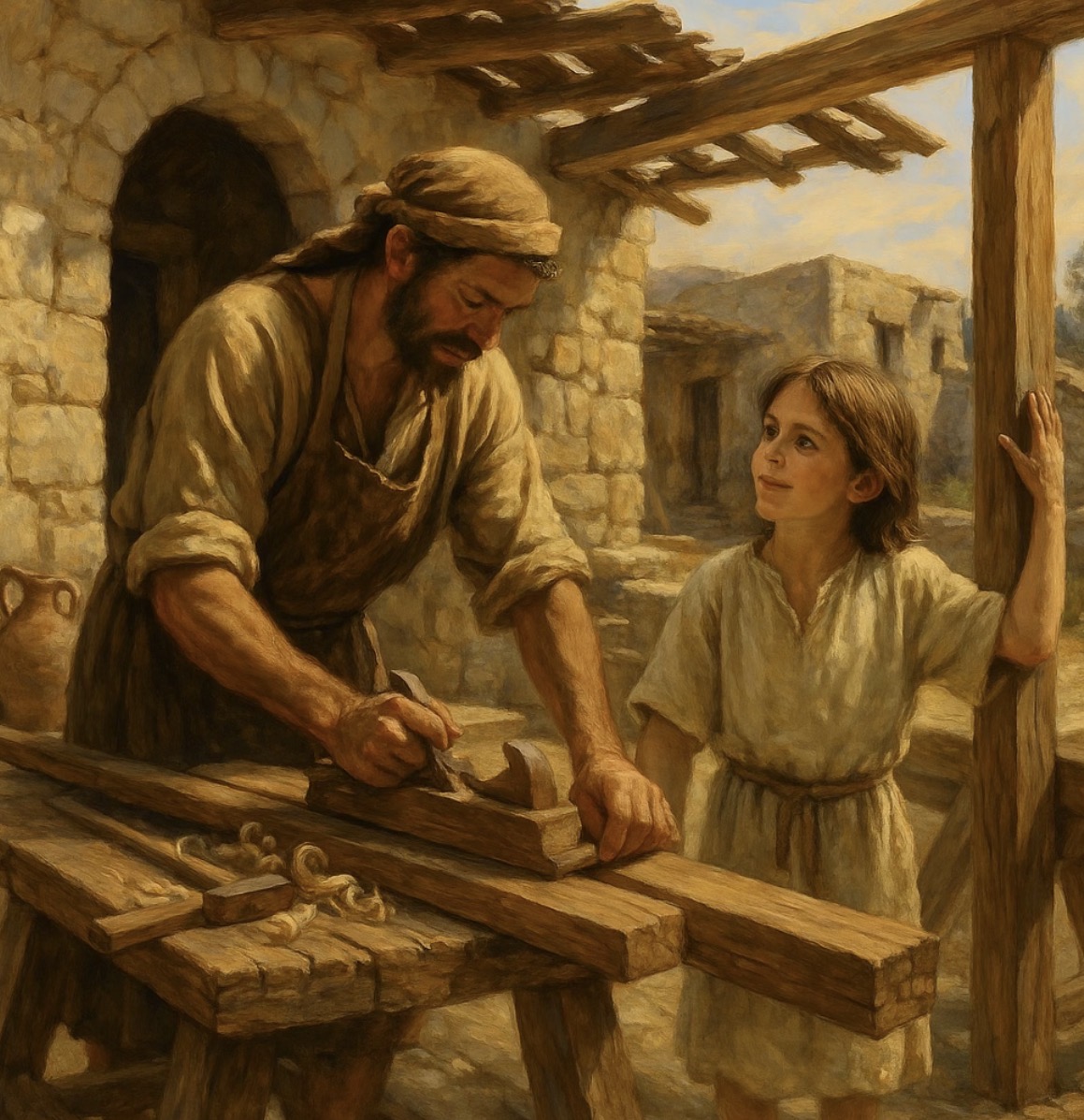
They saw kings parade, but they did not notice the young man in Nazareth. The One who shaped wood would later carry the cross; the One who built houses would later raise the temple of His own body.
Luke says: “And Jesus increased in wisdom and stature, and in favour with God and men.” (Luke 2:52)
He lived the human life fully — not above it, but within it — to restore it from the inside out. He was the perfect man, without sin, yet still subject to flesh. And every breath, every day, every act was part of God’s master plan slowly moving towards fulfilment.
By the time He became a young man, Jesus already had a depth of understanding no teacher could explain. He worked, laughed, learned, and waited — patiently, humbly, always aware of His calling. He was not in a hurry to reveal Himself, because He knew: everything has its hour.
The world around Him carried on as always. Roman soldiers walked the streets of Galilee; priests brought their offerings; scribes studied their scrolls. No one knew that the One who would be their Redeemer walked past them every day — in ordinary clothes, with calloused hands, and the eternal Light in His eyes.
Heaven was silent, but it was not the silence of absence — it was the silence before revelation. For everything was ready: the words of the prophets, the roads of Rome, the language of Greece, and the people of Israel.
The world did not know it, but the King of all ages was taking His place among ordinary people.
In the next part, Part 23, we will see how that silence breaks — at the Jordan, where John baptises and heaven opens again. We will see how the Son of Man takes His first step onto the battlefield, how the Spirit descends upon Him, and how the princes of the air tremble when He enters the wilderness.
For from this point the second movement of the story begins — the revelation of the Light in a world that does not know He is already standing among them.
And so the silence ends not with thunder, but with a breath — God Himself living in flesh among men. The King of eternity walks unrecognised through the streets of Nazareth, and heaven holds its breath. For the next step, the day of the Jordan, is already appointed — the day when the voice from heaven will again say:
“This is my beloved Son, in whom I am well pleased.”