
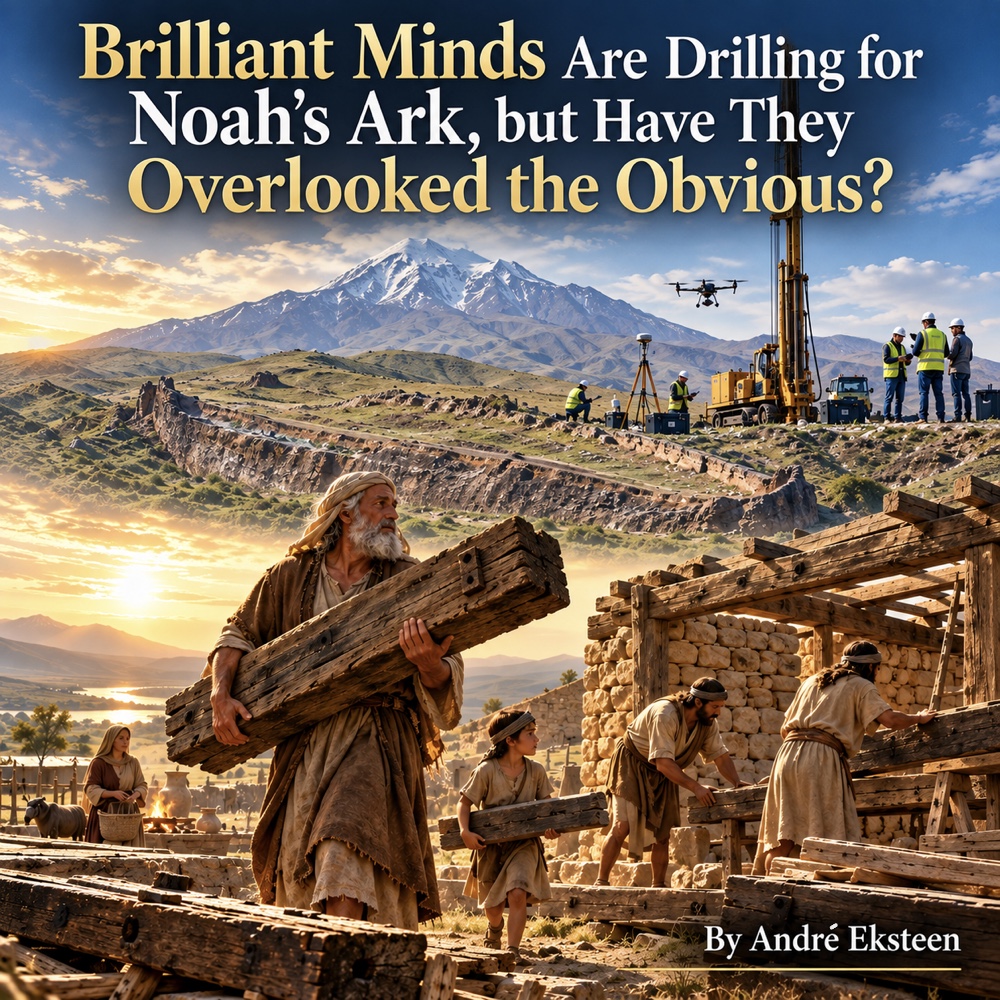
Brilliant Minds Are Drilling for Noah’s Ark, but Have They Overlooked the Obvious?
By Andre Eksteen
For thousands of years people have gone looking for Noah’s Ark. This September word came out of eastern Turkey that a drill had started cutting into a boat-shaped hill in the mountains of Ararat. Behind that drill stands a team of archaeologists, geophysicists, engineers, donors and believers, and behind them stands one of the oldest searches in the history of mankind.
The search has taken explorers up frozen slopes, into monasteries, through old manuscripts and, more recently, beneath the ground with radar, electrical imaging and core-drilling equipment. It is not hard to see why. If the remains of the vessel described in Genesis could be identified beyond reasonable doubt, the discovery would rank among the most important archaeological finds ever made. It would also put a physical reminder in front of the modern world that the Flood was not a myth, that Noah was not a fictional character, and that God’s judgment was not something dreamed up by ancient storytellers around a fire.
The present excitement centres on the Durupınar formation, roughly seventeen miles south of the summit of Greater Ararat. It does not sit on the modern volcanic peak itself, but it does lie within the broader mountainous region that has been associated with Ararat since ancient times. That distinction matters more than most people realise, because Genesis never says that the Ark came to rest on the summit of Mount Ararat. The text reads, “And the ark rested in the seventh month, on the seventeenth day of the month, upon the mountains of Ararat” (Genesis 8:4). In plain words, the Ark settled somewhere in the mountain country of Ararat. The Bible names a region of mountains, not necessarily the one peak that carries the name on today’s maps, and anybody who wants to search honestly has to start there.
The formation first came to public attention in 1959, when Captain İlhan Durupınar of the Turkish Army noticed a remarkable boat-shaped outline in aerial photographs taken during mapping work in eastern Turkey. The feature was later named after him. Its shape caught attention immediately, and in 1960 the photographs reached an international audience through Life magazine. There, in the mountains of Ararat, lay a long, symmetrical outline that looked from the air like the remains, or at least the impression, of an enormous ship. For a world that had largely written Genesis off as folklore, it was an uncomfortable picture.
An investigative party visited the site in September 1960. It included Durupınar himself and Arthur Brandenberger, a specialist in photogrammetry, which is the science of taking accurate measurements from photographs. The group dug into the formation and even used explosives to try and find out what lay beneath the surface. After two days they reported that they had found soil and rock but no visible archaeological remains, and they concluded that the feature was natural rather than man-made. Interest faded. The formation, however, did not go anywhere, and neither did the questions raised by that extraordinary outline lying in the grass.
In 1977 Ron Wyatt travelled to the site with his sons and brought the claim back to life. Wyatt was not a professional archaeologist. He worked in the medical field and investigated biblical sites on his own initiative, and he made no secret of his motivation. He believed the Bible recorded real history, and he wanted physical evidence that could confront unbelief head-on. He measured the formation, took samples and argued that its dimensions, its shape and its unusual concentrations of carbon and metal pointed to the remains of a decayed vessel rather than an ordinary geological structure.
The case gained momentum during the 1980s. David Fasold, a man with experience in marine salvage, visited the site with Wyatt and geophysicist John Baumgardner, and Fasold became convinced that he was looking at a ship. Ground-penetrating radar investigations were carried out, and large pierced stones in the surrounding area were put forward as possible drogue or anchor stones, the kind of heavy weights hung from a vessel to steady it in rough water. The measured length of the formation was said to be close to the three hundred cubits specified in Genesis. In 1988 an attempted core-drilling programme targeted four locations, but the holes did not produce the conclusive evidence the researchers had hoped for.
At the same time a serious opposing case was developing, and part of it came from inside the camp. Fasold himself later reconsidered his earlier conclusion. In 1996 he co-authored a paper with geologist Lorence Collins arguing that Durupınar was a natural structure after all. Collins and Fasold interpreted the formation as rock and sediment folded into what geologists call a doubly plunging syncline, a trough-shaped fold that dips down at both ends, and then shaped further by regional earth movement. They argued that the supposed metal fittings were natural concentrations of limonite and magnetite, that the material described as fossilised wood was metamorphosed rock, and that the so-called anchor stones were made from local volcanic stone. Other geological work linked the formation to the Telçeker landslide or earthflow. The unusual shape was still there, but from then on the argument was no longer about what the thing looked like. It was about what it was made of.
Modern investigation has since replaced much of the early speculation with better instruments. A ground-penetrating radar survey in 2019 was reported to have picked up linear and angular anomalies as deep as about seven metres. The Noah’s Ark Scans project has since pushed for a combination of drone mapping, LiDAR, ground-penetrating radar, electrical resistivity tomography, thermal imaging, magnetometry and soil analysis. Andrew Jones, the founder of the project, first visited the site in 1997 and has chased the question for nearly three decades. He describes himself as a software developer and independent researcher rather than an archaeologist, and his public statements make it clear that his interest grew out of a conviction that the Flood was global and that Genesis records real history.
The current project is directed by Professor Cenker Atila of the Department of Archaeology at Sivas Cumhuriyet University and includes archaeologists, geophysical specialists and international collaborators. According to the project, Turkish government agencies have authorised a multi-phase scientific plan. The work moves from aerial mapping and deep geophysical scanning to dry sonic core drilling, laboratory analysis and, if any accessible voids are found, exploration with robotic cameras. The team says the cores may go down seventy-five to a hundred metres, while deeper electrical surveys are meant to map the geological roots of the formation. All of it is then to be combined into a three-dimensional model for analysis.
With the drilling now under way, the project also plans to send in an underground robot called Gopher, adapted by Australian engineer Dr Robert Ross from machines originally built to explore animal burrows. Its job is to crawl into spaces too small or too dangerous for people, record high-resolution images and bring back samples. There is a certain irony in the name, since Genesis tells us that Noah built the Ark of gopher wood, and now a machine called Gopher is being sent down a hole to look for it. Irony aside, the team hopes that direct cores and camera images will settle whether the radar anomalies are chambers, structural remains or simply natural features in the ground. As an engineer I can respect that. It is a far more disciplined question than pointing at a boat-shaped hill and announcing that the Ark has been found.
Not everybody involved is there for the same reason. The archaeologists and geophysicists have a perfectly legitimate interest in understanding a disputed formation. Andrew Jones wants to test a site he believes may preserve the imprint or decayed remains of the biblical vessel. Those raising the funds see the investigation as an opportunity to challenge unbelief and put the Genesis account in front of a worldwide audience. Marketing director Lauren Witzke has spoken of “some of the most brilliant minds in the world” taking part and has predicted that university curricula may have to be rewritten. Behind that kind of confidence lies a hope, sometimes spoken and sometimes not, that one borehole, one sample or one camera image could finally force the modern world to admit that the Bible has been telling the truth all along.
Let me say clearly that there is nothing wrong with examining the site. Truth has never been afraid of an honest investigation. If Durupınar contains the remains or physical impression of an ancient man-made structure, that evidence should be properly documented. If it turns out to be a natural formation, that should be properly established as well. The problem is not the use of science. The problem starts when Christians begin to behave as though the integrity of God’s Word is sitting at the bottom of a drill hole, waiting for a laboratory to sign it off.
But while brilliant minds are drilling for Noah’s Ark, have they overlooked the obvious?
Put yourself in Noah’s boots for a moment. He and his family had just come through a cataclysmic, worldwide Flood that wiped out everything they had ever known. Every familiar settlement was gone. Roads, fields, workshops, houses, fences and storehouses had simply ceased to exist. The Ark had carried eight people, the animals and enough food through the judgment, and when it finally came to rest Noah could not step out into a working countryside and send someone down the road for building materials. There was no road, and there was nobody at the other end of it. He stood at the very beginning of a ruined world that had to recover before anything resembling ordinary human life could start again.
We need to be careful here, because Scripture does not say that no vegetation at all existed when Noah came out. The dove came back with “an olive leaf pluckt off” in her mouth, and from that Noah knew the waters were going down (Genesis 8:11). In everyday words, the bird brought back a fresh leaf torn from a living tree, and Noah read it the way any farmer reads the veld after rain. Plants had started to come back. But a green leaf is not a forest. Grass, shrubs and young shoots recover far faster than the big trees you need for beams, rafters, doors, furniture and tools. Even under good conditions, proper construction timber takes years, and more often decades, to grow. Noah’s immediate problem was never whether anything green existed. It was whether usable materials existed in enough quantity to carry a family that was about to become the whole human race.
The biblical timeline shows that Noah did not rush out the moment the Ark touched ground. The vessel came to rest in the seventh month. The tops of the mountains became visible in the tenth month. Noah then sent out the raven and the dove. On the first day of the first month of his six hundred and first year he removed the covering and saw that the ground was drying, and even then he waited until the twenty-seventh day of the second month, when God told him to go out. By the time the family finally set foot on the ground, they had been inside that vessel for about a year. For all that time it had been their ship, their house, their storeroom, their animal enclosure and the only secure place they had in the entire world.
There is no reason to think the Ark stopped being useful the day the door opened. The ground outside might have been firm enough to walk on, but that did not magically produce houses, barns or workshops. The seasons and climate of this changed world were still unknown to them. The stored food remained valuable while crops were planted and the livestock began to multiply. Tools, seed, equipment and every vulnerable supply they had still needed protection from the weather and from animals that were no longer penned in. For at least the first season, and very probably a good deal longer, living out of the Ark and drawing materials from it would have been the obvious practical thing to do.
Genesis tells us that “Noah began to be an husbandman, and he planted a vineyard” (Genesis 9:20). Put simply, Noah went farming and planted vines. Anyone who has ever planted a vineyard knows it does not appear in a week. It needs land preparation, planting, tending and patience, and it takes years before it gives a proper crop. That one short verse shows a family moving from survival into settled agriculture, and during that change they needed shelter and storage. We are also told that “Noah lived after the flood three hundred and fifty years” (Genesis 9:28), which means he farmed, built and watched his descendants multiply for three and a half centuries on the far side of the Flood. As sons, wives, grandchildren and great-grandchildren increased, one huge communal structure would have become less and less suitable, while the need for smaller houses, pens and working buildings would have kept on growing.
Now look at the Ark the way an engineer would. Genesis gives its dimensions as three hundred cubits long, fifty cubits wide and thirty cubits high. Using the common eighteen-inch cubit, that works out to about 137 metres long, 22.9 metres wide and 13.7 metres high, close to one and a half rugby fields in length and as tall as a four-storey building. We do not know the exact hull form or construction method, so no honest calculation can tell us the precise amount of timber that went into it. We can, however, establish the order of magnitude, and in engineering that is very often enough to answer the question.
A simple envelope calculation for the bottom, sides, ends and roof, together with the two internal decks needed to give three levels, gives roughly seventeen thousand square metres of major planked area. God’s instruction was clear on the three levels: “with lower, second, and third stories shalt thou make it” (Genesis 6:16). If the average effective timber thickness across decks, sides and roof was only fifty to seventy-five millimetres, those surfaces alone would hold roughly 850 to 1,275 cubic metres of wood. Heavy frames, longitudinal beams, braces, partitions, stalls, ramps and fittings would add a great deal to that figure. A reasonable conceptual range for the original timber content is therefore somewhere around 1,500 to 3,000 cubic metres. I am not claiming that this is how the Ark was built. It is an engineering estimate that shows the size of the resource sitting on that mountainside.
Even if age, damage, contamination and awkward shapes reduced the recoverable portion to forty or sixty per cent, Noah’s descendants could still have salvaged roughly 600 to 1,800 cubic metres of cut, shaped and treated structural timber. Remember that God had told Noah to “pitch it within and without with pitch” (Genesis 6:14), so this was not raw bush timber but material that had been prepared to keep out water and resist rot. A modest early dwelling built mainly from stone or earth needs timber only for its roof members, lintels, doors and internal fittings. Ten to twenty cubic metres would make an enormous difference to a building like that. On those numbers, the recoverable timber from the Ark could have supported somewhere between thirty and a hundred and eighty practical shelters and working buildings, besides animal pens, carts, handles, ladders, storage racks, furniture and, eventually, firewood.
Anyone who has spent any real time on a farm in South Africa will understand this without needing a calculation. Drive through the Karoo and look at what old railway sleepers have become. They are kraal posts, garden steps, gate frames, workbenches, shelves, fireplace mantels and half a dozen other things on farms between here and Beaufort West. Old corrugated iron becomes a chicken run. An old windmill tower becomes a stand for a water tank. A broken implement gets stripped for steel, bearings, shafts and bolts. On a farm, if something still has strength left in it, you do not simply throw it away.
I see this in my own home. My lovely wife, Lizel, can appreciate an old railway sleeper more than an expensive piece of jewellery, and anyone who has visited our farm will know that Schoongezicht stands as a testament to that way of thinking. My 215 m² office, for example, was built largely from stone and old I-beams—materials that many people might have regarded as scrap, but which still had years of useful life left in them. Old material has character, but more importantly, it has value. If it can become a step, a beam, a bench, a gatepost or part of another structure, it gets another life.
That is simply how practical people think. Farmers do not waste good material, and people who have just lost virtually everything would waste it even less. Ships, for that matter, have been broken up for their timber, iron and fittings for as long as ships have existed.
Now picture Noah and his family stepping out into a devastated world. They have homes to build, shelters to erect, fires to make, tools to fashion, animals to contain and an entire human existence to rebuild from almost nothing. And standing right beside them is probably the largest single stockpile of already cut, shaped and worked timber anywhere on earth.
Do we honestly believe they simply walked away from it, leaving thousands upon thousands of pieces of usable timber sitting on a mountainside to rot, merely so that people thousands of years later might one day find the remains?
Could Noah have kept the Ark as a monument? Certainly it is possible, but Scripture never says that he did. God did not command Noah to build a shrine around it, maintain it for future pilgrims or carry pieces of it around as relics. Noah’s first recorded act after leaving the Ark was to build an altar unto the Lord and offer burnt offerings on it (Genesis 8:20). His attention moved straight away from the instrument of deliverance to the God who had delivered him. God then set His covenant sign in the cloud: “I do set my bow in the cloud, and it shall be for a token of a covenant between me and the earth” (Genesis 9:13). In other words, God Himself chose the reminder, and He hung it in the sky where every generation after Noah would see it. The lasting memorial of the Flood covenant was the rainbow, not the boat.
There is also a pattern in Scripture that we should not ignore. When God uses a physical object to save His people, He shows very little interest in preserving that object for later admiration, and when people do preserve it, it has a way of turning into a snare. In the wilderness God told Moses to make a serpent of brass and set it on a pole, and everyone bitten by the fiery serpents who looked at it lived (Numbers 21:8-9). It was a genuine instrument of God’s mercy. Yet centuries later we read that King Hezekiah “brake in pieces the brasen serpent that Moses had made: for unto those days the children of Israel did burn incense to it” (2 Kings 18:4). Put plainly, the very thing God had once used to heal His people had become an idol, and a godly king had to smash it. When Moses died, the Lord buried him Himself, “but no man knoweth of his sepulchre unto this day” (Deuteronomy 34:6), and Jude tells us that Michael the archangel contended with the devil over that body (Jude 9). God kept the grave hidden. Even the Ark of the Covenant, the most sacred object Israel ever possessed, has disappeared from history, and Jeremiah speaks of a coming day when “they shall say no more, The ark of the covenant of the LORD: neither shall it come to mind: neither shall they remember it” (Jeremiah 3:16).
None of this proves what happened to Noah’s Ark. It does tell us a great deal about the way God works. He does not build faith on relics. He builds it on His Word, and He is quite willing to let objects fall away once they have served their purpose.
So where does that leave us? A genuine probability cannot be calculated, because we do not have observations from repeated post-Flood settlements to work from, and anyone who quotes an exact percentage is making it up. We can, however, make a conditional engineering judgment by weighing the forces acting on the decision, the same way I would weigh the options on any project. Reuse offered immediate shelter, saved an immense amount of labour, supplied scarce worked timber and supported a growing population. Abandonment cost no labour at all, but it surrendered a valuable asset to wind, frost and rot. Deliberate preservation required continuous maintenance, produced almost no practical return and had no recorded command from God behind it.
If I have to put transparent working figures on those three outcomes, I would allocate about seventy per cent to substantial reuse, twenty per cent to abandonment followed by natural decay, and ten per cent to deliberate long-term preservation as a monument. These figures are not archaeological data. They are a disciplined way of expressing how plausible each outcome is under the assumptions I have set out, and they place the odds of substantial reuse at roughly seven to one against deliberate preservation. Shift the assumptions moderately and the figures will move, but preservation still struggles to become the most sensible choice. My conclusion is therefore straightforward. The most likely fate of Noah’s Ark is that Noah’s own family took it apart and built it into the first homes of the new world.
That also exposes a false choice that runs right through the modern debate. We are told, directly or by implication, that either an intact Ark is waiting to be found or there never was an Ark. Those are not the only options. The Ark could have been real and later dismantled. It could have been stripped of every useful beam and then left to decay. It could have left an impression in the ground while the timber itself disappeared. A settlement could have reused its beams until later buildings, fires, migrations and ordinary deterioration erased every trace of where they came from. Not one of these outcomes contradicts a single word of Genesis.
And what if the drill comes up empty?
Suppose the cores bring up nothing but natural rock and sediment. That result would answer a question about Durupınar. It would not answer the question of whether Noah lived or whether the Flood happened. Genesis says the Ark rested upon the mountains of Ararat. It never says the vessel would still be lying there intact in the twenty-first century. To reject the biblical account because one proposed site turned out to be natural would be as illogical as rejecting the crucifixion because someone dug up the wrong hill outside Jerusalem.
This is exactly where the hunger for physical proof becomes spiritually dangerous. Some people say they will believe if the drill brings up wood, which means their faith is waiting on a laboratory report. Others already believe, but they have tied their confidence so tightly to one disputed hillside that a negative result could shake them badly. In both cases an uncertain archaeological claim is being allowed to sit in judgment over the certain Word of God, and that is the wrong way around.
We should also be honest about what physical proof actually achieves. If a camera filmed a wooden chamber a hundred metres down tomorrow, would the world fall on its knees? I doubt it very much. The sceptics would call it a medieval shrine, a later structure, a hoax or a contaminated sample, and the argument would simply move to new ground. Jesus told us this would happen. In the account of the rich man and Lazarus, Abraham says, “If they hear not Moses and the prophets, neither will they be persuaded, though one rose from the dead” (Luke 16:31). In plain English, if people will not believe what God has already said, even a man coming back from the grave will not change their minds. And a Man did come back from the grave, and most of the world still does not believe it.
Peter goes even further. Writing about the scoffers of the last days, he says, “For this they willingly are ignorant of, that by the word of God the heavens were of old, and the earth standing out of the water and in the water: Whereby the world that then was, being overflowed with water, perished” (2 Peter 3:5-6). Notice the words “willingly are ignorant”. Peter does not say these people lack evidence. He says they choose not to know. They deliberately push the Flood out of their minds, because a God who judged the world once can judge it again. That is not a problem any drill rig can solve.
The Bible does not ask us to believe blindly, in the sense of believing without any testimony at all. God has given us His Word, the witness of creation, fulfilled prophecy, the testimony of Christ and the witness of the Holy Ghost. Biblical faith is not a wild leap into the dark. It is confidence in the character and testimony of God. Archaeology can shed light on that testimony, but it cannot make God truthful. The Lord was true before the first radar scan ever crossed Durupınar, and He will remain true whatever the drill cores contain.
Thomas gives us the clearest warning in all of Scripture. After the resurrection the other disciples told him, “We have seen the Lord.” Thomas answered, “Except I shall see in his hands the print of the nails, and put my finger into the print of the nails, and thrust my hand into his side, I will not believe” (John 20:25). In other words, unless he could see the nail wounds and touch them with his own hands, he was not going to believe a word of it. His demand was not simply for evidence. He was setting the terms on which he would allow himself to believe.
Eight days later Jesus came and stood among them. He did not owe Thomas a demonstration, yet in His mercy He met the demand head-on: “Reach hither thy finger, and behold my hands; and reach hither thy hand, and thrust it into my side: and be not faithless, but believing” (John 20:27). Thomas answered, “My Lord and my God.” Then Jesus spoke the words that reach straight into the present search for Noah’s Ark: “Thomas, because thou hast seen me, thou hast believed: blessed are they that have not seen, and yet have believed” (John 20:29). Put simply, Thomas believed because he saw, but the ones who are truly blessed are those who believe without seeing.
Those words do not condemn honest research. They condemn the proud attitude that says God must first satisfy our demand for sight. Faith does not summon God into the witness box. “Now faith is the substance of things hoped for, the evidence of things not seen” (Hebrews 11:1). Faith is the solid ground under our feet for the things we have not yet seen, and it rests on the One who promised them.
And here is the part the searchers so easily miss. Noah himself is the Bible’s great example of exactly that kind of faith. “By faith Noah, being warned of God of things not seen as yet, moved with fear, prepared an ark to the saving of his house; by the which he condemned the world, and became heir of the righteousness which is by faith” (Hebrews 11:7). In plain words, God warned Noah about something that had never happened before, and Noah took Him seriously enough to start building. He built before a single drop of rain proved the warning true. He cut and fitted and pitched, year after year, while the people around him carried on as usual and no doubt laughed at the old man and his boat on dry land. He obeyed before judgment became visible. Had Noah demanded physical proof first, there would be no Ark to search for today, and nobody left alive to search for it.
Think about that for a moment. The very object that modern believers hope will prove the Bible was built by a man who needed no proof. The Ark stands as a monument to faith without sight, and we are trying to turn it into a substitute for faith. That is the obvious thing the brilliant minds have overlooked. The real lesson of the Ark was never buried in the ground at Durupınar. It was written down for us in Genesis, and it has been lying in plain sight all along.
Christ Himself used Noah’s generation as a warning about His return. “But as the days of Noe were, so shall also the coming of the Son of man be. For as in the days that were before the flood they were eating and drinking, marrying and giving in marriage, until the day that Noe entered into the ark, And knew not until the flood came, and took them all away; so shall also the coming of the Son of man be” (Matthew 24:37-39). In plain language, people carried on with ordinary life, eating, drinking and getting married, and paid no attention until the water came and swept them all away, and Jesus says it will be exactly the same when He returns. Those people did not lack evidence. They had Noah, whom Peter calls “a preacher of righteousness” (2 Peter 2:5), standing in front of them, and they had an enormous ship going up in plain sight. Their problem was never a shortage of proof after the judgment. It was unbelief before it. The purpose of the account is not to hand a future generation a lost-object mystery to solve. It is to warn us that God judges sin, that He provides one way of salvation, and that He expects His warning to be believed before the door closes.
And the door did close. Genesis says simply, “and the LORD shut him in” (Genesis 7:16). God closed that door Himself. Up to that day anyone could have walked through it. Once God shut it, no amount of banging, pleading or evidence was going to open it again. That is the part of Noah’s story that matters to every person alive today, and it is the one part we will never need a drill to find.
So let the researchers drill. If genuine evidence comes out of the ground, Christians should welcome it without exaggeration. If the formation proves natural, Christians should accept that without panic, because our faith was never fastened to a Turkish hillside in the first place. For my part, I believe the most likely truth is that Noah and his sons took the Ark apart and put it to work, and that whatever was left has long since gone back to the dust. God never promised that the Ark would be preserved for modern scientists, and He never made our faith depend on finding it. He gave us a rainbow in the sky and a record in His Book, and He considered that enough.
Brilliant minds can drill through soil and stone. They can map anomalies, pull up cores and send a robot called Gopher into the dark. But no machine has ever manufactured faith, and none ever will. The real question has been in plain sight since Genesis was written, and it is not whether we will find the Ark. It is whether we will believe the warning of God before we see the judgment of God. The blessing still belongs to those of whom Jesus said, “Blessed are they that have not seen, and yet have believed.”


