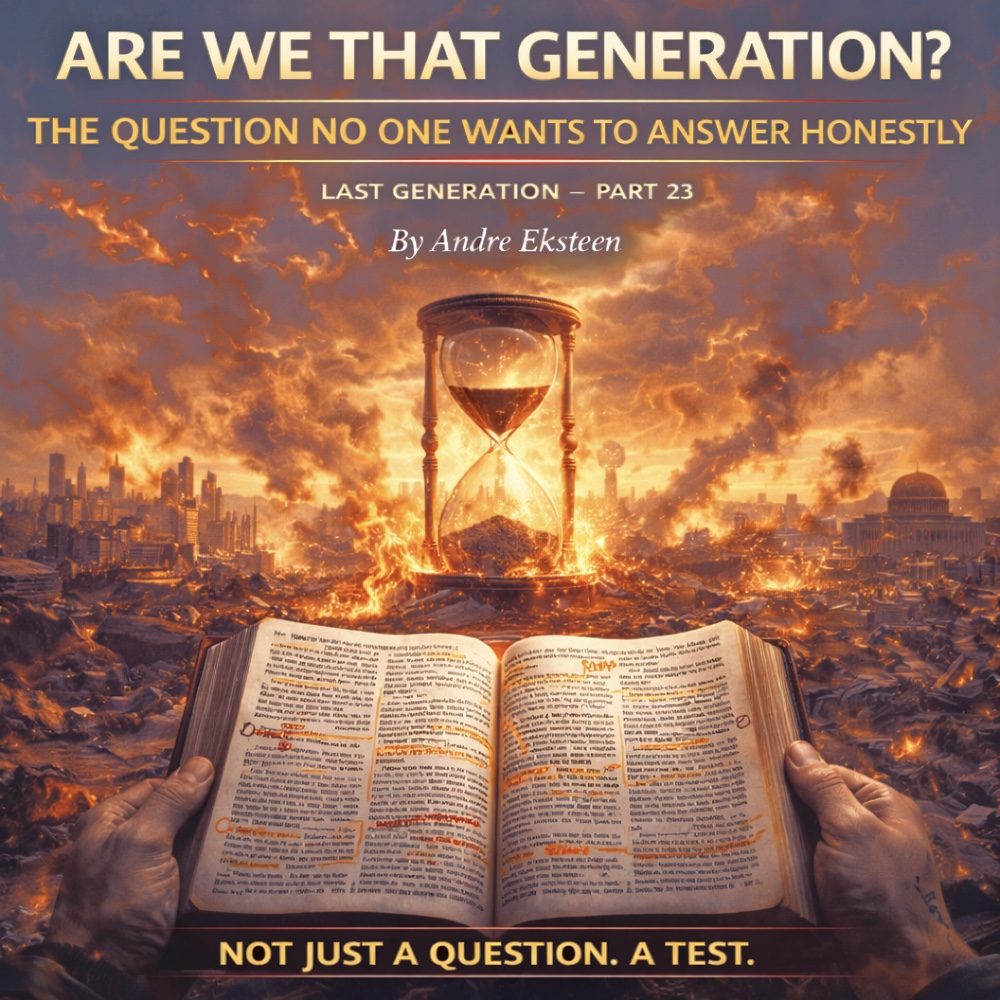
Are We That Generation? The Question No One Wants to Answer Honestly – Last Generation Part 23
By Andre Eksteen
Now we come to the question everyone wants answered but almost no one wants to answer honestly. Not because it is complicated. Because it is uncomfortable in both directions. If the answer is yes, it carries implications that most people are not prepared to live with. If the answer is no, it requires sitting with genuine uncertainty in a culture that rewards confident declarations and punishes hedged ones. And if the answer is “not yet, but close” — which is the most honest position the evidence supports — it satisfies almost nobody, because it provides neither the urgency of certainty nor the comfort of dismissal.
But this series has been built for exactly this moment. Twenty-two parts of patient groundwork — removing wrong assumptions, following the text in sequence, establishing the right framework, dismantling the deceptive systems that have consistently led people to wrong answers — were not preparation for a different question. They were preparation for this one. And now, standing at this point with the full structure in place, we can ask it properly. Not “do I feel like this is the last generation?” Not “does my timeline produce a date that is close?” But the question the text actually asks: are all these things aligning? Is the full sequence Jesus described visible in the world around us? And if it is, what does the honest, grounded, text-anchored reader conclude?
What Every Previous Generation Had and Lacked
Let me make the comparison between the present moment and previous generations more specific, because the claim that the present is unprecedented requires precision if it is to carry weight. Every previous generation that declared itself the last had reasons for doing so. The reasons were real. The question is whether the reasons were the same kind as those available to the present generation, or whether there is a qualitative difference.
The generation that lived through the Black Death in the fourteenth century had genuinely catastrophic circumstances. A third of Europe’s population dead. Social structures collapsing. The church unable to provide either medical or theological answers to what people were experiencing. The scale of the suffering matched the language Jesus used about “tribulation such as was not since the beginning of the world.” But that generation did not have Israel in the land. Did not have Jerusalem under Jewish sovereignty. Did not have the structural preconditions for the abomination of desolation. Did not have the technical infrastructure for comprehensive global economic control. Their reasons for believing the end was near were real and understandable. But the specific textually-required conditions were not present. The general conditions were intense. The specific conditions were absent.
The generation that lived through the First World War had unprecedented industrial-scale slaughter, the collapse of four empires, a pandemic that killed more people than the war itself, and the beginning of Zionism as a political movement. The general conditions were catastrophic. They had no Israel in the land, no Jerusalem, no Temple Mount context, no global communication infrastructure, no digital financial systems. Some of the general conditions were present at horrifying scale. None of the specific conditions were present.
The generation that lived through the Second World War had the Holocaust — the industrialised murder of six million Jewish people — and the atomic bomb, and the beginning of the post-war order that would eventually produce the United Nations and the IMF and the WHO. And at the end of that war, in 1948, something happened that no previous generation had experienced: Israel returned to the land. From that point forward, the specific conditions begin to come into alignment in ways they had not before. Not all at once. Progressively. 1948 — Israel in the land. 1967 — Jerusalem under Jewish sovereignty, Temple Mount accessible. The following decades — the development of the global governance structures, the digital infrastructure, the integration of economic systems, the spread of the gospel to previously unreached nations, the developing Iranian nuclear programme, the intensification of Middle Eastern geopolitics around the specific geography the text describes.
This is not the same thing as what the Black Death generation experienced. It is not the same thing as what the World War generations experienced. It is a specific, progressive assembly of textually-required conditions that was not possible in any previous generation because some of the conditions — Israel in the land, Jewish Jerusalem, global communication infrastructure, digital economic systems — are themselves historically recent developments. That specificity is what distinguishes the present from the previous. Not that things feel worse. Not that the scale of suffering is greater. That the specific textually-required preconditions are simultaneously present for the first time since AD 70. That is a qualitative difference, not a quantitative one. And it is the qualitative difference that makes the present moment genuinely unprecedented in the prophetic sense.
The Cost of Honest Uncertainty
Now let me address something that the answer this series gives — “unprecedented convergence, but not yet complete” — costs in the current landscape. Because it costs something real, and the reader deserves to know what they are receiving when they receive this framework.
The cost is the loss of certainty. Popular end-times culture runs on certainty. The books that sell, the teachers that fill conferences, the videos that go viral are the ones that say “this is the generation, here is why, here is the timeline, here is what you need to do.” That certainty is currency. It attracts attention. It builds followings. It gives people a sense of inside knowledge — the feeling of being among the ones who understand what is really happening while others are unaware. And it requires, in the people who receive it, a willingness to accept confident declarations in place of the honest, careful, structurally grounded analysis that the text actually supports.
This series offers no certainty about timing. It offers a framework. It offers precision about what the text says and what it does not say. It offers the distinction between specific and general conditions, between complete and incomplete convergence, between the preparatory period and the beginning of the unprecedented climax. It offers the watching posture rather than the calculating timeline. And it does not offer the emotional satisfaction of a confident declaration that the end is in a specific year.
That is a real cost. The reader who has followed this series to Part 23 has worked harder than the reader who picked up the latest popular prophecy book and got a clear timeline. They have been challenged to let go of assumptions. They have been asked to hold inherited frameworks loosely enough to have them corrected by the text. They have been given a framework that does not produce the emotionally satisfying certainty that the alternative provides.
But what they have been given is more valuable than certainty for two reasons. First, because the certainty the alternative offers has failed — repeatedly, documentably, across decades — and the failure of confident certainty in prophecy does more damage to faith than honest uncertainty does. The person who built their faith on a 1988 end date or a 2007 end date was given certainty, and the certainty failed, and the failure damaged their ability to trust both the teaching and the teacher and sometimes the Scripture itself. The person who builds their framework on careful, honest, structurally grounded engagement with what the text actually says is protected against that specific form of damage, because they were never told more than the text gives.
Second, because genuine watching — the posture Jesus described, the posture this series has been building — requires an honest framework. The person who watches with a confident but wrong timeline is not really watching. They are waiting for their calculation to be confirmed. When the calculation fails, their watching framework collapses. The person with an honest framework continues watching regardless, because their watching is not dependent on a specific date but on a structural understanding that remains valid even when specific predictions fail. They are watching for the shape of the thing, not for the confirmation of an arithmetic.
That is the framework this series has provided. Imprecise about timing, because the text is imprecise about timing. Precise about structure, because the text is precise about structure. Honest about what is unprecedented in the present moment, because the evidence supports that honesty. Honest about what is not yet complete, because the evidence supports that honesty too. And calling the reader to the only posture that is both honest and adequate for the moment — watching, faithful, grounded in what is written, ready to recognise the season when it fully announces itself.
The question stands: are we that generation? The framework stands. The answer stands. And the reader who has followed this series all the way to this point is better positioned to live faithfully in the answer — whatever it ultimately proves to be — than they were at the beginning. That is what the work was for.
What the Question Actually Asks
Let us be precise about what we are asking, because precision matters here more than anywhere else in this series. The question “are we that generation?” is not asking whether this is a significant or turbulent historical moment. Every generation has lived through what felt like a significant or turbulent moment. The question is not asking whether there are signs of the times visible. Signs have been visible in every century. The question is whether the specific, unprecedented, textually-identified conditions that Jesus described as defining the last generation are present in a way that sets the present moment apart from every previous moment in history.
Now we have established across this series what those conditions are. Israel in the land, in Jerusalem specifically, with the Temple Mount accessible — historically unprecedented from 1967 onward. The global proclamation of the gospel to every nation — further advanced than at any previous point in history. The structural preconditions for the Revelation 13 economic control system — technically feasible and actively developing in the present period for the first time in history. The convergence of nuclear-armed powers in the most contested religious geography on the planet. The specific structural pressures on the Temple Mount that make the abomination of desolation scenario geopolitically possible in a way it has not been for nineteen centuries.
Now combine those specific conditions with the general conditions Jesus named as the beginning of sorrows — wars, rumours of wars, famines, pestilences, earthquakes in diverse places — and ask whether the combination is different in the present from what any previous generation faced. Previous generations faced the general conditions. They could not face the specific ones because the specific preconditions were not in place. No generation between AD 70 and 1948 faced the general conditions alongside Israel in the land. No generation before 1967 faced them alongside Jewish sovereignty over Jerusalem. No generation before the mid-twentieth century faced them alongside the technical possibility of comprehensive global economic control. The specific conditions are new. The combination is historically unprecedented. And that combination — not the general conditions alone — is what makes the present moment different in kind from what every previous generation experienced.
The Honest Assessment
Now let me state clearly and honestly what the evidence assembled across this series supports, because after twenty-two parts of careful groundwork the reader deserves a direct answer rather than another carefully hedged deferral.
The structural preconditions for the end-time sequence Jesus described are present in the world today in a way they have not been at any point since AD 70. Israel is in the land. Jerusalem is under Israeli sovereignty. The Temple Mount context exists. The gospel has been proclaimed globally. The infrastructure for comprehensive economic control is developing. The geopolitical alignment in the Middle East matches the kind of configuration the prophetic scenario requires. The spiritual pressures Daniel described are operating through the visible systems of power in ways that are consistent with the pattern Daniel 10 established.
The beginning of sorrows — wars, rumours of wars, famines, pestilences, earthquakes — are present and intensifying, as Jesus said they would be in the run-up to the specific unprecedented events that constitute the climax.
The deception Jesus warned about is operating at a level of sophistication and reach that has no historical parallel, enabled by the same information infrastructure that makes the gospel’s global reach possible.
Now what does the honest reader conclude from all of that?
Not that the tribulation has begun. It has not. The abomination of desolation has not stood in the holy place. The tribulation of unprecedented severity has not started. The cosmic signs have not appeared. The return of Christ has not occurred. The full sequence is not yet complete, and therefore the generation that will witness its completion cannot be fully identified yet.
But the structural convergence is real. The preconditions are assembled. The direction of movement is consistent. And the distance between the present conditions and the beginning of the sequence’s unprecedented climax is shorter — by any honest structural analysis — than it has been at any point in history. We are in the preparatory period. The branch is tender. The leaves are forming. The season is approaching in a way that is observable to anyone who is watching with the right posture and the right framework.
That is the honest answer. Not “yes, this is definitely the last generation.” Not “no, there is nothing special about the present moment.” The present moment is genuinely, historically unprecedented in the specific convergence of conditions it displays. Whether the generation that will see “all these things” in their fullness is alive right now cannot be determined with certainty. But the generation alive right now is living in the closest structural proximity to the beginning of that fullness that any generation has experienced since before the destruction of Jerusalem in AD 70.
Why This Answer Is Resisted
Now let me address why this kind of careful, honest, structurally grounded answer — “unprecedented convergence, but not yet complete” — is so consistently resisted, because the resistance itself is instructive.
On the side of those who want to declare “yes, this is definitively the generation”: the resistance to honest uncertainty comes from the same place it has always come from — the desire for certainty in a world that is genuinely threatening and uncertain. If you can say “this is the last generation and the end will come before such and such a year,” you have provided something that feels like solid ground in the middle of what feels like quicksand. The calculation gives you a framework for the future. It tells you how long you have to endure. It tells you the timeline is under control. And even if the calculation has failed before — as it has, repeatedly — the psychological appeal of having a calculation is powerful enough that people keep reaching for it.
On the side of those who want to dismiss “no, there is nothing special about now”: the resistance to honest structural engagement often comes from a reaction against the repeated overreaching of the yes side. Having watched generations of confident declarations about imminent returns fail to materialise, having seen the damage those failed predictions do to ordinary believers, the dismissive position has a kind of protective rationale. If you never say “this could be the moment,” you can never be embarrassed by a moment passing without the predicted events. The problem is that this protection comes at the cost of genuine watchfulness — the posture Jesus described is abandoned in favour of a blanket scepticism that is as unresponsive to genuine convergence as the overreaching certainty is unresponsive to evidence of failure.
The honest position has no tribe. It is not welcome in the confident end-times community because it refuses to make the declaration they want. It is not welcome in the dismissive sceptic community because it insists that something real is happening and deserves serious attention. But it is the position the text supports, and the position this series has been building toward, and the position from which genuine watching is possible.
The Personal Dimension
Now let me come to what the original ChatGPT article was reaching for at its close — the personal dimension. The question “are we that generation?” is not ultimately an abstract historical inquiry. It is a question that, if taken seriously, has direct implications for how you live. And those implications are not primarily about what you know but about who you are.
If the structural convergence is real — if the preconditions are assembled, the direction is consistent, and the distance to the beginning of the unprecedented climax is shorter than it has ever been — then the appropriate response is not to calculate how much time you have left or to prepare a bunker. It is to be the kind of person who will be able to watch clearly through what is coming, and who will maintain the faithfulness Jesus described as the characteristic of the one who is ready.
Matthew 24:44-46 — “Therefore be ye also ready: for in such an hour as ye think not the Son of man cometh. Who then is a faithful and wise servant, whom his lord hath made ruler over his household, to give them meat in due season? Blessed is that servant, whom his lord when he cometh shall find so doing.” The faithful and wise servant is found doing the work — feeding the household, maintaining the routine of faithfulness, serving the people in front of them — at the moment the lord returns. Not standing on a rooftop watching the sky. Not paralysed by the imminence of the end. Doing the work. Faithfully. In due season.
That is the personal implication of the convergence we have been describing. Not panic. Not withdrawal from ordinary life. The deep, grounded faithfulness that comes from knowing the framework well enough to watch clearly, combined with the everyday practice of the servant who is found doing the work when the lord returns. The person who has read this series and built the framework it has been constructing is not being handed a reason to stop living. They are being handed a reason to live more faithfully — more deliberately, more generously, more attentive to the people and the work in front of them, because the season is closer than it has ever been and the quality of the faithfulness in the time remaining matters.
The Question Stands
Let me close this part by returning to where it began. The question “are we that generation?” has been asked across twenty-three parts, approached from every angle, grounded in text and history and structural analysis. And the answer this series gives is not a declaration but a framework:
The specific unprecedented conditions are present. The structural convergence is real. The direction is consistent with the prophetic sequence. The preceding conditions required for “all these things” are assembling in a way that sets the present moment apart from every moment since AD 70. Whether the generation alive today is the one that will see the complete sequence — the abomination, the tribulation, the cosmic signs, the return — depends on how quickly the remaining elements of the sequence unfold, and that timing is not given in the text and cannot be calculated from the conditions.
What can be said is this: if you are alive now, and you are watching with the right posture, and you know what to look for — you are in the most propitious position for genuine recognition of the season that any generation has occupied in nearly two thousand years. Not guaranteed to be the last generation. Not certainly not the last generation. Closer to the conditions for it than any generation before you. And therefore called to a quality of watchfulness, faithfulness, and clarity that every previous generation was called to, but that the present structural proximity makes more urgent and more practically necessary than it has ever been.
That is not the dramatic declaration that popular prophecy culture wants. But it is what the text supports. And it is enough. Because the person who holds that position — genuinely, honestly, without forcing it beyond what the evidence allows — is exactly the person who will not be caught off guard when the abomination stands. They will not be confused. They will not be deceived. They will see the leaves, know the season, and stand firm in exactly the faithfulness the lord will find them in when He comes.
That is enough. That has always been enough. And the series now turns to its final task — not a declaration, but a call. A call to the watching posture. A call to the faithfulness of the servant found doing the work. And a call to trust the One who described the end from the beginning and who will be faithful to complete what He promised.