The Idolatry of Deliverance: When Jesus Is No Longer Enough
By Andre Eksteen
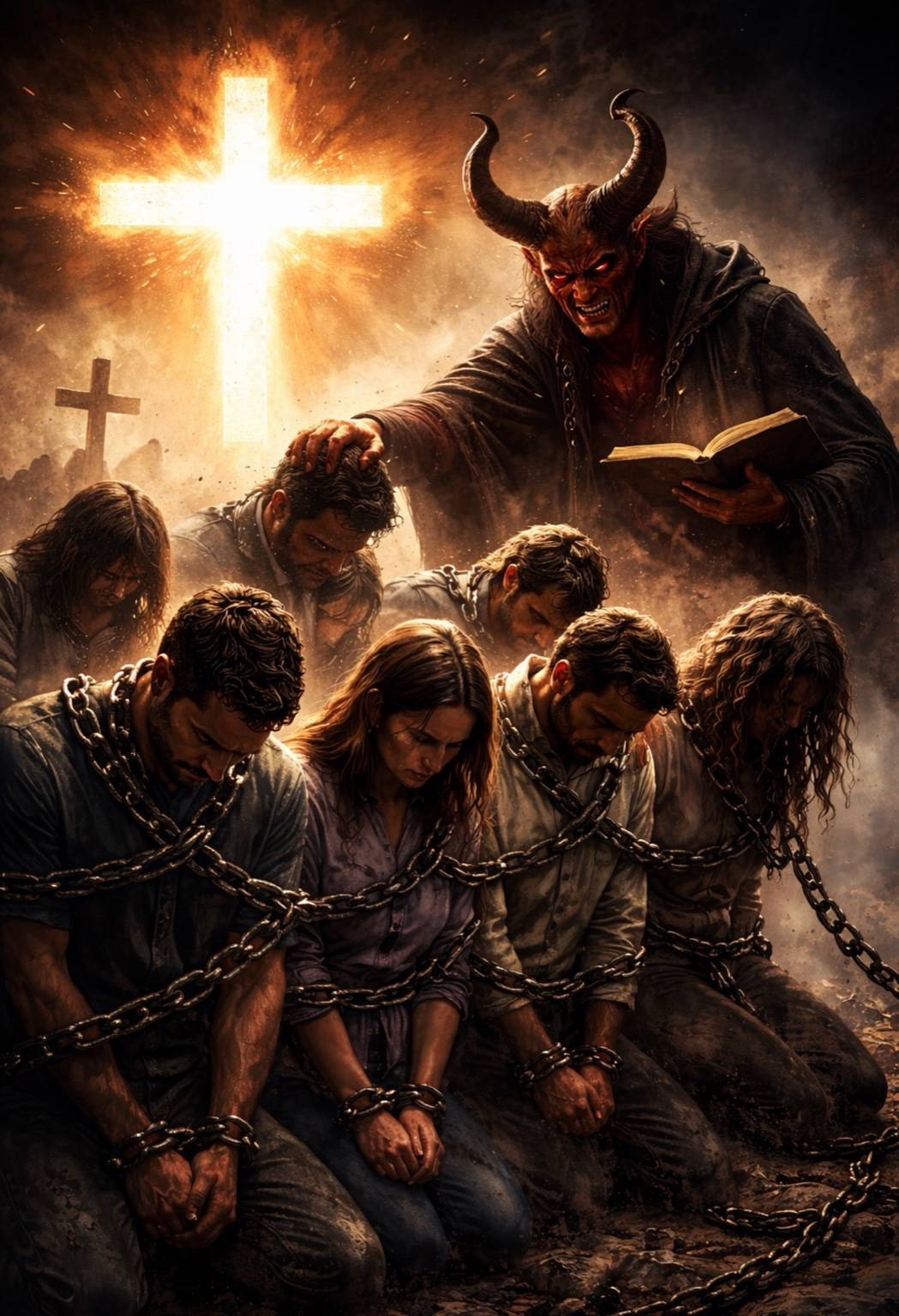
I am regularly confronted with the question about bondage and deliverance, because it is taught from pulpits not only by individuals, but by entire denominations who, whether intentionally or not, place their own authority above that of Jesus Himself, assuming a role that Scripture reserves for Christ alone. Although this does not originate in rebellion but in confusion and misinformation, the outcome is always the same—believers are led away from the true Christ and into the idolatry of man, where a false christ is presented who cannot fully save, cannot fully free, and therefore requires human mediators to complete what the cross supposedly did not.
While preachers and whole denominations teach this idolatry as Scripture, people are misled into believing the lie and begin asking these questions, convinced—often subconsciously—that their salvation, freedom, or wholeness depends on man rather than on Christ. The shift is subtle but deadly: authority quietly moves from the finished work of Jesus to human intermediaries, and faith in the cross is replaced with dependence on a system, a process, or a person.
The questions usually sound sincere and even humble. Are deliverance sessions necessary? Can a person’s spirit or soul be bound to another person? Can things that are not yours trouble you because of a spiritual cord? These questions are not being asked because people are chasing novelty or strange doctrines. They are being asked because these ideas are taught as truth, often with confidence, institutional authority, and heavy emotional emphasis. And when something is repeated often enough from a pulpit—especially under the banner of “spiritual maturity” or “deeper teaching”—many assume it must be biblical, even when it quietly contradicts the very gospel it claims to uphold.
But repetition does not make something true. Scripture does.
Here is the problem that must be stated plainly and without apology: the Bible does not teach these things. Not in the Old Testament. Not in the New Testament. Not in the worldview of Second Temple Judaism. Not in the early church. And most importantly, these teachings directly contradict the finished work of Jesus Christ on the cross.
When Jesus said, “It is finished” (John 19:30, KJV), He was not expressing relief or physical exhaustion. He was issuing a legal and eternal declaration. Redemption was completed in full. Nothing remained unresolved. Nothing was postponed. Nothing was deferred to any man, ministry, denomination, or human organisation. No authority was delegated to future “specialists” to complete, apply, unlock, or finish what the Son of God had already accomplished. The debt was paid in full. The verdict was final. The victory was absolute.
Any teaching that suggests otherwise—any doctrine that claims freedom must still be mediated through human hands—does not originate with Christ. It does not come from the apostles. It does not come from Scripture. It comes from the same voice that has always sought to undermine the sufficiency of God’s word. The only one who continues to preach a gospel that says “Jesus was not enough” is Satan himself, now speaking through pulpits, systems, and disciples who, whether knowingly or not, repeat his oldest lie: Did God really finish what He said He finished?
The apostles understood this without ambiguity. Paul writes that God “blotted out the handwriting of ordinances that was against us… nailing it to his cross” (Colossians 2:14). He then states that Christ “spoiled principalities and powers” and made a public spectacle of them, triumphing over them openly (Colossians 2:15). This is not the language of limitation, delay, or ongoing negotiation. It is the language of complete and irreversible defeat. Any teaching that reintroduces bondage, mediation, or unfinished liberation does not merely misunderstand the cross—it directly contradicts it, placing authority and power back into the hands of Satan and the very principalities Scripture declares were disarmed. In doing so, this heresy attempts to resurrect enemies Christ has already conquered, granting them relevance and leverage the apostles explicitly say they no longer possess.
What makes this even more serious is that Scripture is clear about how authority on the earth operates. God lawfully appointed man as the ruler and steward of the earth. “Let them have dominion” (Genesis 1:26) was not poetic language; it was a legal delegation of authority. The earth was given to man, not to angels, fallen or otherwise. “The heaven, even the heavens, are the LORD’S: but the earth hath he given to the children of men” (Psalm 115:16). This means that Satan and his principalities do not possess inherent legal authority on the earth. They cannot simply take it. They can only operate where man, through deception or rebellion, hands that authority back to them. This is why Scripture consistently places responsibility on man, not on demons, for the presence of bondage.
This legal framework explains why Satan has always operated through deception rather than force. He cannot rule unless man agrees with him. He has no lawful dominion of his own. This is precisely why Genesis 6 is so critical to understanding how authority is stolen rather than seized. Satan could not directly violate God’s established order, so he acted through the Watchers, who sought access to authority by exploiting what God Himself had instituted as lawful: marriage. Scripture tells us that “the sons of God saw the daughters of men that they were fair; and they took them wives of all which they chose” (Genesis 6:2). This was not a moment of random lust; it was a calculated legal transgression. Marriage is a God-ordained covenant, a recognised union that carries authority, inheritance, and legitimacy. By asking for the daughters of men in marriage—and by the fathers consenting—authority was unlawfully transferred through a structure God had designed for human stewardship.
The Book of Enoch makes clear that this was no secret seduction. The Watchers bound themselves by oath, descended with intent, and entered into covenantal unions that were forbidden, not because marriage was evil, but because they were not lawful participants in it. Through these unions they gained influence, taught forbidden knowledge, corrupted human behaviour, and produced offspring that were neither fully human nor lawful heirs. This was not merely moral corruption; it was jurisdictional theft. Satan sought to reclaim authority over the earth by corrupting the very vessel through which God had vested dominion—man. By gaining access through marriage, the Watchers exploited a divine institution to steal what could not otherwise be taken.
The same principle operates today, though no longer through physical unions, but through doctrine. Satan no longer needs to corrupt the human bloodline in an attempt to prevent the Messiah from being born—that objective failed at the cross and the resurrection. Christ has come, the Seed has prevailed, and redemption has been accomplished. What remains is not the prevention of salvation, but the distortion of its meaning and power. Satan no longer requires overt rebellion if he can achieve the same transfer of authority through belief.
When believers are taught that Christ’s victory was incomplete, that principalities still retain authority over the redeemed, and that freedom must be mediated through human systems, rituals, or spiritual specialists, authority is once again surrendered—this time willingly and under the guise of obedience. What the Watchers attempted through unlawful marriage in Genesis 6, Satan now accomplishes through theological corruption: persuading man to relinquish, through false doctrine, what Christ lawfully reclaimed. The method has changed, but the objective remains unchanged—to undermine God’s order by convincing man to hand back authority that was restored through the finished work of the cross.
This is why false teaching is never neutral. Doctrine is not academic—it is legal. When men submit themselves to a gospel that requires ongoing bondage, ritualised liberation, or human mediation, they are not merely mistaken; they are yielding authority to Satan himself. And since Satan cannot take dominion by force, he gladly accepts it when it is handed back under the guise of spirituality. This is not harmless error. It is the same ancient strategy, repackaged for the pulpit.
So we must ask a hard but necessary question. If the powers were disarmed, if the debt was cancelled, if the victory was complete, why are believers being told today that they remain bound unless a man performs a ritual over them?
This is where the modern doctrine of “bondage” collapses under biblical scrutiny.
Scripture does speak about bondage, but not in the mystical, externalised way it is presented today. In the Bible, bondage is always tied to sin, obedience, and personal responsibility. Jesus states it without qualification: “Whosoever committeth sin is the servant of sin” (John 8:34). Paul reinforces the same truth: “To whom ye yield yourselves servants to obey, his servants ye are” (Romans 6:16). Bondage, in biblical terms, is not something imposed on you by another person’s spirit, nor the result of invisible cords or external forces acting against your will. It is the direct consequence of what you choose to yield yourself to.
I consistently preach that the relationship between man and God is personal. Your decisions matter. Your choices carry weight. You are not condemned by objects, influences, or abstractions—you are judged by obedience or disobedience. Modern thinking tries to escape this responsibility by shifting blame onto external causes. Today we are told that alcohol causes alcoholism, or that guns cause violence. No—this is the same lie, repackaged. Alcohol does not force itself down your throat. A bottle does not grow legs and chase you. A firearm does not load itself and pull its own trigger. A human being makes those decisions.
Scripture operates on the same moral framework. Sin does not ambush you against your will; it is chosen. Bondage is not inflicted by mystical forces; it is entered into through yielding. This is why the Bible never instructs believers to hunt for hidden bindings or external causes, but instead calls them to repentance, discipline, and obedience. To remove personal responsibility is not compassion—it is deception. And every doctrine that teaches people they are bound by forces outside their own will quietly absolves them of responsibility while stripping them of the very freedom Christ secured.
The modern concept of “soul ties” or spiritual cords between people is entirely absent from Scripture. There is no Hebrew term for it. There is no Greek term for it. There is no teaching, example, or warning about it anywhere in the Bible. The idea that one person’s soul or spirit can remain spiritually attached to another person after salvation is foreign to the biblical text.
Ezekiel is explicit: “The soul that sinneth, it shall die” (Ezekiel 18:20). Each soul stands before God individually. Each soul bears its own guilt or righteousness. Even the most intimate human relationship recognised in Scripture—the marriage covenant—is never described as a fusion of souls or spirits. It is a covenant of responsibility and faithfulness, not a mystical merging that transfers spiritual control.
What people today often describe as “soul ties” are very real experiences, but they are not spiritual chains imposed by another person. They are the consequences of sin, trauma, emotional dependency, fear, and unrenewed thinking. The Bible does not deny the reality of these struggles, but it explains them very differently from modern teaching. Paul does not instruct believers to identify cords or submit to deliverance sessions; he tells them to renew their minds (Romans 12:2). He does not tell them to seek specialised intervention; he tells them to put off the old man and put on the new (Ephesians 4:22–24).
Once again, this brings us back to the unavoidable truth Scripture insists upon: this is a personal choice. You, and you alone, stand before God. You, and you alone, decide whether you will turn to Him, repent of your sins, and submit to the complete authority of Jesus Christ. No other person can do this for you, and no other person can prevent it. Redemption is not accessed through human mediators, rituals, or processes; it is entered into through repentance, faith, and obedience. When a person truly turns to God and accepts Christ’s finished work in full—His authority, His victory, His lordship—rebirth follows, and with it the ongoing transformation Scripture promises. Anything that shifts this responsibility away from the individual and onto external forces does not liberate; it deceives and draws a person deeper into Satan’s grasp.
Another serious error follows closely behind this teaching: the claim that a born-again believer can still be spiritually inhabited or controlled by demonic forces. This idea is often softened by the language of compartments—that the “spirit” belongs to God while the “soul” remains occupied or influenced by darkness—but Scripture knows nothing of such a division. Paul asks plainly, “What agreement hath the temple of God with idols?” (2 Corinthians 6:16). God does not share His dwelling. Light and darkness do not co-exist. Where light is present, darkness is driven out; it cannot remain alongside it. Any doctrine that suggests part of a believer belongs to God while another part remains under Satan’s control is not biblical discernment—it is the repetition of Satan’s oldest lie, repackaged in religious language.
“If any man be in Christ, he is a new creature” (2 Corinthians 5:17). Not a partially restored one. Not one waiting for further liberation. New. Entirely new. Jesus Himself affirms this security when He says that no one can pluck His sheep out of His hand (John 10:28). If that is true—and it is—then no other person’s spirit, no past relationship, no trauma, and no unseen “cord” has authority over someone who belongs to Christ. To claim otherwise is to deny the power of light over darkness and to diminish the totality of Christ’s victory.
So where did these ideas come from?
These doctrines did not come from the apostles. They are absent from the writings of the early church fathers. They cannot be found in the Reformation, nor in any historic confession of faith. They emerge very late in church history, most clearly in the twentieth century, alongside the rise of psychology, trauma theory, and experience-based theology. Concepts drawn from Freud, Jung, and later therapeutic models were gradually spiritualised, baptised with Christian language, and presented as biblical insight, despite having no foundation in Scripture.
By the mid to late 1900s, so-called “inner healing” and “deliverance ministries” began to flourish, particularly within charismatic movements. Experience was elevated above Scripture. Feelings were treated as revelation. What people sensed or relived emotionally was used to reinterpret what the Bible plainly said. Over time, this produced a new class of spiritual mediators—men and systems that positioned themselves as necessary for freedom, healing, and completion, roles Scripture reserves for Christ alone.
This is where the danger becomes eternal, not merely theological. When a person is taught that Jesus saves but cannot fully free, that His work must be supplemented by human intervention, authority has already shifted. The cross is no longer sufficient. Dependence moves from Christ to a ministry, a process, or a man. And Scripture is unambiguous about where this path leads. Jesus said, “I am the door” and “I am the way, the truth, and the life: no man cometh unto the Father, but by me” (John 10:9; John 14:6). He did not say He was one door among many, nor the beginning of a process completed by others.
Any doctrine that replaces Christ with human mediators does not lead to heaven. It closes the door to it. By substituting Jesus with men—no matter how sincere or religious—they effectively reject the only entrance God has provided. One cannot claim Christ while trusting in another authority. To do so is to shut the door of heaven by one’s own hand. This is precisely what Paul warned against when he asked, “Having begun in the Spirit, are ye now made perfect by the flesh?” (Galatians 3:3). The question remains as devastating today as it was then.
Biblical freedom does not come through rituals. It comes through truth. “Ye shall know the truth, and the truth shall make you free” (John 8:32). It comes through repentance, not performance. Through obedience, not emotional release. Through the ongoing crucifixion of the flesh, not the casting out of imaginary cords.
The ancient Jewish writings confirm this understanding. Texts such as Sirach, Wisdom of Solomon, and Jubilees consistently emphasise personal responsibility. Sin binds a person. Righteousness frees them. No ancient text speaks of spiritual bondage caused by another person’s soul. That concept is entirely foreign to the biblical world.
The fruit of this modern teaching is unmistakable. It produces people who see themselves as victims rather than disciples, perpetual patients rather than obedient followers of Christ. Yet Scripture leaves no room for such a category. Every truly reborn Christian is called to be a disciple—this is not an optional second step, nor a specialised calling for a few. It is the calling. Jesus did not say, “Go and make converts,” but “Go and make disciples.” A life that does not actively follow, obey, and grow in Christ is not being restrained by hidden bondage; it is avoiding discipleship. And worst of all, this teaching subtly but decisively undermines the sufficiency of Jesus by replacing the call to follow Him with a system that keeps people dependent, passive, and spiritually immobilised.
The gospel does not say you are almost free. It says you are free. “If the Son therefore shall make you free, ye shall be free indeed” (John 8:36).
Any teaching that adds conditions, intermediaries, or ongoing rituals to that declaration does not exalt Christ. It replaces Him. And no matter how sincere or well-intentioned it may appear, that is not Christianity.
That is idolatry dressed in religious language.
Jesus is enough.
He always was.
And He still is.