Norman Oklahoma Watchmen Conference: 29–30 December 2025
By Andre Eksteen
As we step into a new year, I find myself hesitating to offer the usual greetings. I do not know if, or how, to wish anyone a “prosperous” new year anymore. Not because I lack hope, but because I take Scripture seriously—and that is not what Scripture foretells for these final days. What lies ahead is not a season the Bible describes as safe, comfortable, or prosperous in any way, shape, or form as the world understands it. What lies ahead demands clarity, courage, and obedience.
What I can say with conviction is this: we are entering what the Word of God describes as the final years of the final generation Jesus spoke of. Israel became a nation again in 1948. Scripture defines a generation as seventy to eighty years. That window is closing rapidly. The time for vague well-wishes and religious platitudes is long past.
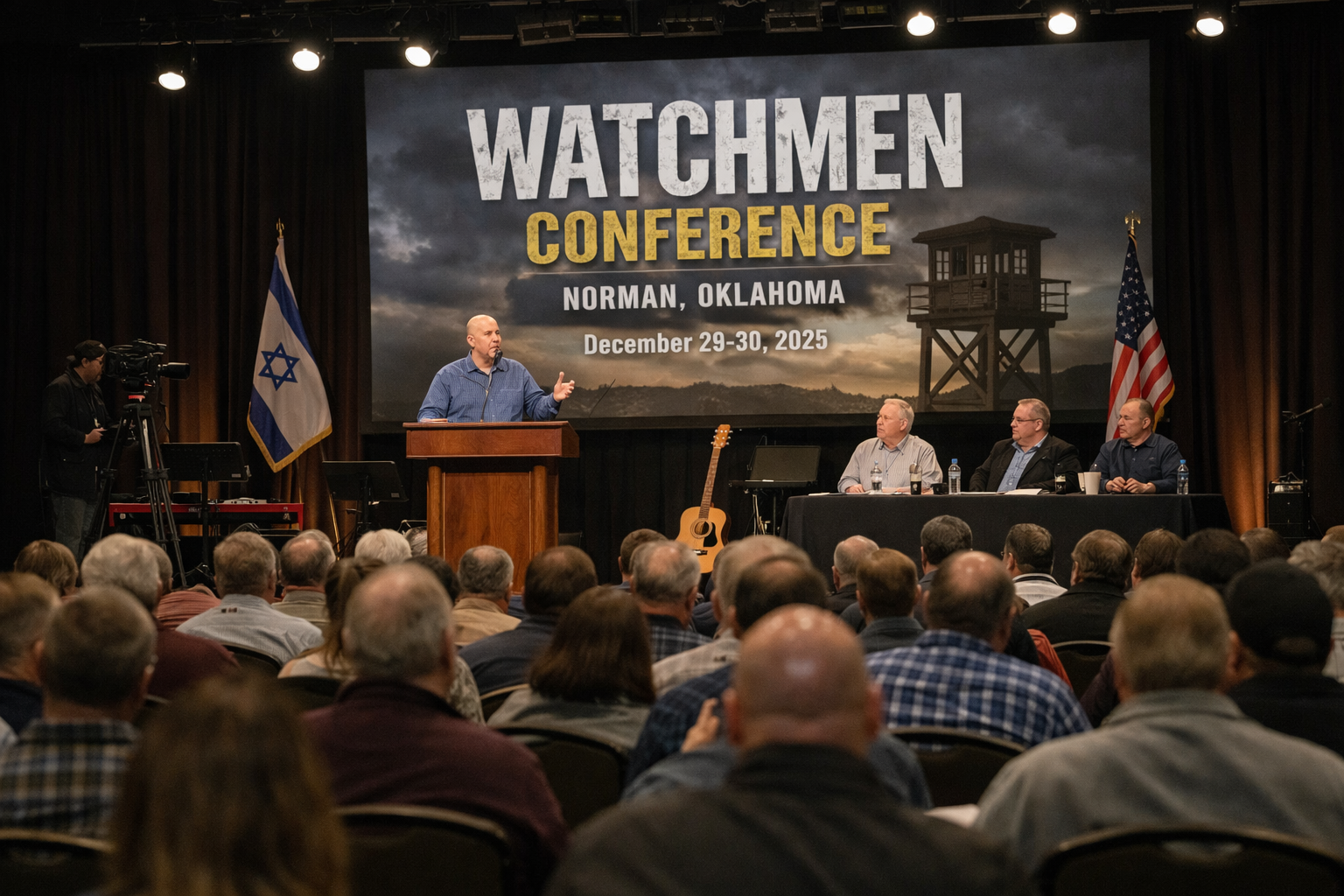
For that reason, instead of wishing anyone something I do not believe in myself, I want to share insight. I have just attended the Watchmen Conference in Norman, Oklahoma, and I believe what was addressed there is far more important than any seasonal greeting. What was discussed was not speculation or fear-mongering, but sober truth about where we are, what is happening to the church, and what faithful obedience looks like in the days ahead.
For everyone who did not attend this year-end conference in person, I want to share what I experienced. Like all of these conferences, it was made available to members via Zoom, and many of us joined live from around the world. Whether present in Norman, Oklahoma, or connected remotely, this was not a conference you merely listened to. It was a gathering of believers already engaged in the fight.
It is important to understand who comes together at a conference like this. These are not passive Christians. These are not people waiting to see what happens next. These are discerning believers who have already recognised the rot within the modern church and have refused to make peace with it. Every person involved has, in one way or another, taken up the cross of Jesus Christ and chosen obedience over comfort.
These are believers who take Scripture seriously, who read it literally, and who believe Jesus meant what He said. Many have been pushed out of churches that chose silence over truth. Others remained until compromise became unavoidable and obedience to God demanded separation. Some are pastors and ministry leaders who lost pulpits, income, or congregations because they refused to dilute the message. Others are older believers who have watched doctrine erode over decades and finally reached a point where silence itself became sin. All share one thing in common: they are actively living out Christ’s command to go and make disciples, not merely to attend services.
The theme of this year-end conference confronted us with a question that could no longer be avoided: Is God exposing the false church in these last days? As 2025 draws to a close, while many turn their attention to celebrations and new beginnings, it became clear that we are standing at a biblical crossroads. The corruption within the church is no longer hidden or subtle. It has been normalised, defended, and even celebrated. Because of this, God Himself is pulling back the curtain. What once hid behind polished language, professional platforms, and staged worship is now exposed in plain sight. Not gradually. Not accidentally. But deliberately.
These conferences are part of a rhythm. We meet four to five times a year, not to be stirred emotionally, but to assess, discern, and act. This was not a feel-good gathering, and it was never meant to reassure anyone that everything will somehow work out. It was a time of sober obedience, deliberate planning, and clear-eyed strategy. From the very first session, it was evident that this was not about criticising the church from the outside. It was about recognising that judgment begins inside the house of God and asking how faithful believers are to respond—not with words, but with action.
There were around a thousand people gathered in Norman, Oklahoma, with another 186 joining live via Zoom, myself included. What stood out immediately was not the size of the gathering, but the posture of those involved. These were not spectators. This was not a passive audience. These were believers already carrying the cost of obedience in their own contexts, coming together to compare notes, sharpen discernment, and align strategy. You could hear it in the conversations and see it in the way people connected. This was not networking. It was recognition. These were fellow labourers who understood that the work ahead cannot be done in isolation, and that standing alone is neither biblical nor sustainable.
A constant thread throughout the conference was the restoration of the fear of God—not as a concept, but as a foundation. Over and over, it became clear that the modern church has preached a gospel stripped of reverence, judgment, and accountability. Yet Scripture is explicit: the fear of God is the beginning of wisdom. True repentance often begins when the reality of judgment becomes unavoidable. This stands in direct opposition to the modern church narrative that teaches there is no fear of God. Scripture says otherwise. Jesus Himself said otherwise.
It was also made clear that prophecy has not simply faded from the pulpit; it has been deliberately removed. This did not happen overnight. It happened as churches reshaped themselves around growth models, metrics, and branding. Prophecy disrupts comfort. It reminds believers that this world is temporary, that accountability is coming, and that obedience matters. Because it does not grow crowds or protect income, it was quietly sidelined.
What was spoken plainly is something many already know: many churches are no longer built around truth, but around safety—safety for the institution, safety for leadership, safety for financial stability. The unspoken rule becomes obvious: do not offend, do not confront, do not speak about judgment, sin, repentance, or prophecy. Yet prophecy forms a substantial portion of Scripture. Removing it is not preference. It is disobedience.
Throughout the conference, one phrase kept returning: the whole counsel of God. Not selective verses. Not curated themes. The whole counsel. That includes warnings, rebukes, judgment, and the cost of discipleship.
A major focus was how God is actively separating the true church from the false one through pressure. These events are not random. They function as dividing lines that force believers to choose obedience or compromise.
The legalisation of same-sex marriage was one such line. It was not merely political; it was theological. Churches were forced to decide whether Scripture still defined morality or whether culture did. Most chose culture.
The transgender movement followed, pressing even further. Again, churches were tested. Again, most chose silence or affirmation over truth.
Then came the lockdowns. Churches were told to close their doors, and many complied without resistance. Some accepted government money in exchange for silence. Others shut down completely, even while secular businesses remained open. When those churches reopened, many returned changed—not purified, but compromised and woke. Language shifted. Doctrine softened. Ideologies foreign to Scripture entered pulpits. These were not accidents. They were filters.
Then came Israel. Long before October 2023, it was already understood that Israel would become another dividing line. When that moment arrived, much of the church—particularly in the West—chose neutrality or silence. Churches that claimed to believe the Bible refused to stand with the nation God Himself calls His timepiece. During the conference discussions, it was also acknowledged that this compromise was not confined to major powers alone. Even smaller nations were examined, including South Africa. This was especially sobering because the Afrikaner people were once a proud, God-fearing nation who openly aligned themselves with Israel as God’s covenant people for decades. That alignment was not political posturing, but flowed from a shared biblical worldview. To now see a major Afrikaans denomination abandon that legacy and financially support Israel’s enemies illustrated just how far institutional Christianity can drift when it cuts itself loose from Scripture, history, and the fear of God.
What followed soon after was one of the most confronting moments of all: the public killing of Charlie Kirk, a Christian voice in the public square. He spoke calmly, defended biblical truth, and was murdered for it in full view of the world. The response from much of the church was not prayer or courage. It was silence. Distance. Avoidance. That silence spoke volumes.
This gave language to something many believers have already experienced: the sin of silence. Silence in the face of evil is not wisdom. It is complicity.
The familiar excuse surfaced repeatedly: “We just want to preach the gospel.” But the gospel does not exist in isolation. The same Bible that proclaims salvation also commands repentance, confronts sin, warns of judgment, and calls believers to obedience. Refusing to address what Scripture addresses is not faithfulness. It is selective obedience.
Verse-by-verse teaching was repeatedly emphasised as one of the last remaining safeguards against deception. When Scripture is taught systematically and in context, nothing can be avoided or explained away. Sexual immorality, idolatry, false teaching, judgment, Israel, prophecy—every subject must be faced exactly as the text presents it. This approach demands honesty and accountability, drawing on the original context and meaning of Scripture rather than the watered-down, politically influenced interpretations that entered the church after the fourth century.
By contrast, modern topical preaching allows endless evasion. It creates space for false agendas to be selectively pushed, justified, and baptised from the pulpit under the appearance of biblical authority. Difficult passages are ignored, uncomfortable doctrines are softened, and cultural narratives are presented as Christian virtue. The pulpit becomes a tool for persuasion rather than discipleship, and Scripture is used to support conclusions already decided rather than to reveal God’s truth.
Again and again, the same conclusion emerged: worship has been turned into entertainment, teaching into a product, and the pulpit into a stage. Believers are being pacified—kept comfortable enough to fill church benches and church coffers, but never equipped for true discipleship. Instead, they are taught a soft, compromising version of Christ who promises safety, peace, and personal prosperity, as if following Him guarantees an easy life. That portrayal stands in sharp contrast to the real Jesus of Scripture, who called His followers to deny themselves, take up their cross, endure hardship, and count the cost. True discipleship would expose the fragility of the entire system and bring down the carefully constructed house of cards.
The conference also addressed the rise of Islam as a geopolitical and prophetic force. What is happening in Europe is visible: cities transformed, laws enforced selectively, Christians punished for prayer while violence goes unchecked. This is not about immigration in general, but about importing a system incompatible with biblical faith and constitutional freedom.
Islam functions not only as a religion, but as a political system with global ambition. Global elites have weaponised this reality. Money flows into universities, political movements, and institutions. Follow the money, and the strategy becomes clear.
This is not about loyalty to nations. Those driving this are loyal to global power structures. The erosion of national identity, economic stability, and religious freedom is deliberate.
Europe has already paid the price. Low birth rates, economic strain, and cultural collapse created a vacuum that is now being filled intentionally. The same patterns are emerging in the United States and elsewhere.
It was stated plainly that America stands in the way of global governance—and therefore must be weakened. Destroy the middle class. Overload systems. Create chaos. Then offer control as the solution: digital currency, centralised authority, surveillance, compliance. This is no longer speculation. It is openly discussed.
As this topic was discussed, I could not help but think of our own situation in South Africa under the so-called Government of National Unity. While Europe was the visible example, the same warning signs are present at home. Ministers and public figures now openly call for jihad, while Christian expression is increasingly marginalised. Even more troubling is the spiritual confusion at the highest levels of leadership, where our president openly participates in ancestral worship while being presented as a neutral or unifying figure. These are not harmless cultural gestures. They reflect the same pattern: the normalisation of systems and beliefs that stand in direct opposition to biblical faith, while the church is pressured into silence for the sake of peace, unity, and political correctness.
Prophetically, this aligns with the beast system described in Daniel—a progression toward global control. What was once mocked is now embraced.
Throughout the conference, the message was consistent: God is exposing the false church because the time is short. Compromise can no longer hide behind language. Silence is no longer neutral. God is dividing—wheat from chaff, truth from imitation.
What struck me personally was not fear, but resolve. This conference did not produce panic. It produced clarity, courage, and commitment. A reminder that following Christ was never meant to be safe or convenient. We were called to deny ourselves, take up our cross, and make disciples.
This conference was not about predicting dates or retreating into isolation. It was about how we can still make a difference in these final days, even as the visible church sinks deeper into deception and decay. Again and again, it became clear that much of modern Christianity is no longer anchored to truth, but to appeasement—avoiding offence, seeking approval, replacing repentance with tolerance. This gathering was about resisting that drift and asking, honestly and practically, how believers can still stand, speak, and act while there is time.
What was also confronted—quietly but unmistakably—is that obedience to God’s Word often hurts people. None of us enjoys that. None of us seeks conflict. Some of us are called to speak hard truths to people we love deeply—family members, friends, even our own children—when they choose paths that Scripture warns will rob them of eternity with God. That kind of obedience cuts deep. It brings tension, rejection, and heartbreak.
But one truth was made painfully clear: the hurt of speaking truth is nothing compared to the weight of silence. Silence for the sake of earthly peace may preserve relationships for a moment, but it can cost someone their soul. To say nothing, to affirm lies, or to remain quiet while deception destroys those we love carries a far heavier consequence.
Scripture does not leave this vague. It states it plainly:
“But if the watchman see the sword come, and blow not the trumpet, and the people be not warned; if the sword come, and take any person from among them, he is taken away in his iniquity; but his blood will I require at the watchman’s hand.”
— Ezekiel 33:6 (KJV)
This conference was a reminder that love is not silence, and peace is not the absence of conflict. Love warns. Love confronts. Love speaks truth even when it hurts, because eternity matters more than comfort.
And that, more than anything else, is what stayed with me as this gathering came to a close.