Live the Golden Line – Artificial Worship: Part 21
By Andre Eksteen
In Part 20 we saw how the church has sold the holiness of faith — how grace became a product and the altar became a counter. But there is yet a deeper layer to this trade — something that looks softer, sounds more beautiful, and is therefore even more treacherous: the buying and selling of worship itself.
Lizel and I have seen many places, but few things have made my soul realise so deeply how far the church has moved from the simple truth as the cathedrals of Italy. You cannot help but be impressed — they take your breath away. But they are also heartbreaking. Because they show exactly how mankind tries to imitate heaven, but without the breath of God.
We first walked through the giant doors of the Basilica di Santa Maria del Fiore in Florence — that great dome that stands over the city like a stone heaven. Inside it is cold and still. Not the kind of stillness where the Spirit moves you — it is a cold stillness. The air smells of damp stone, old incense, and the breath of centuries. Above you hang artworks by Michelangelo and his contemporaries — angels, martyrs, Mary with her crown of gold. Every wall tells a story, every ceiling preaches a message — but it does not preach life. These are people glorifying people.
From there we travelled to Venice. In St Mark’s Basilica the ceilings shine like a heaven of gold. The mosaics are incredible — images of Christ, apostles, scenes from Scripture. You are overwhelmed by the beauty, but not by His presence. It feels like a museum for God, not a house of God. You look, you admire, but you do not worship — because your spirit knows that He does not dwell there.
Then at last we arrived in Rome. St Peter’s Basilica — the heart of the Vatican, the “centre of world religion.” That place makes even unbelievers fall silent with its splendour and architecture. You step inside and become small — literally and figuratively. Pillars so high you strain your neck to see the top. Walls covered in marble and gold. The floor shines like glass. Statues of popes to prophets, martyrs to virgins. Everywhere people — “holy” people in stone, people in paint, people in stories. Mary sits on her throne, larger than most representations of Jesus Himself. She is exalted, gilded, gentle of face — and yet, she is the one who is worshipped.
If you look closely, you will see Jesus too. He hangs there — carved in wood, fastened to the cross, perfectly depicted… but dead. His eyes closed, His body cold, His presence absent. He is there as a symbol, not as Lord. The life that once radiated from Him is fixed against stone. His Spirit is not there. You feel the goosebumps rise on your skin — not from reverence, but from the cold emptiness running through the place. It is as if the silence itself whispers: He is not here. And for a moment you hear again those words from the cross in your spirit: “My God, My God, why hast thou forsaken Me?”
And outside, high up on the walls, the gargoyles look down on the square — those grotesque stone faces with open mouths through which water runs. Some look like people, others like monsters, all trapped in eternal grimaces. Originally they were simply gutters to lead rainwater away, but later people began saying they ward off evil spirits or remind people of the reality of sin. Ironic, isn’t it? The architecture itself preaches of demons meant to keep other demons away — yet nowhere do you see anything that testifies of Jesus. Even the water runs through the mouths of monsters, as if even the “holy ones” are afraid of what they worship.
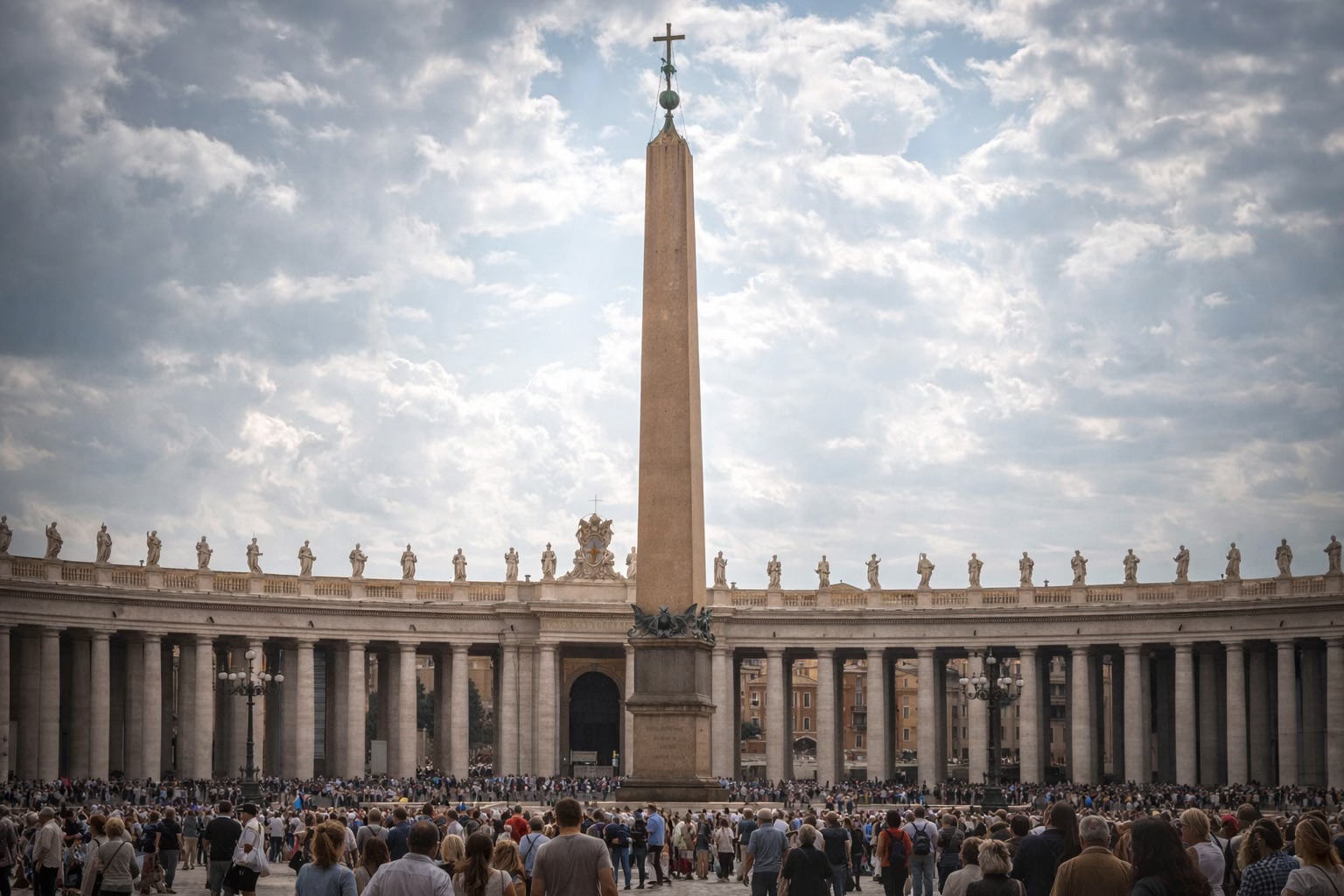
But it was the next day that truly struck us. We stood in St Peter’s Square — the great open area before St Peter’s. It is not merely a square; it is a stage. A semicircle of massive columns wraps around you like stone arms. On top of each pillar stands a saint — statues of men with books, swords, staffs — upright, unwavering, as though they still stand guard over a kingdom long fallen.
In the centre of the square stands the obelisk — a pagan sun pillar from Egypt, brought to Rome as a symbol of conquest. Now a cross stands on top of it, as if paganism has simply been painted over with holiness. The irony stabs you in the chest like a blade.
Then the bells rang. The crowd — thousands of people from every nation and tongue — turned together towards the balcony of St Peter’s. And there he appeared, white and exalted — the pope. The world’s “holiest man.” The loudspeakers carried his voice over the entire square. The sound was deep, solemn, well rehearsed. He spoke of peace, of unity, of love for the world. He said the church must embrace everyone, that all religions serve one god, that people must be good to each other. And in between the phrases Jesus’ name was mentioned — just enough to keep it religious, but never enough to acknowledge Him or His authority.
All around us people fell to their knees. Some held statues, some clutched crosses around their necks, others lifted their children, others whispered: “Papa Francesco.” I saw a woman with her hands against the cold stone, tears running down her face. People cried, sang, prayed. The emotion was overwhelming. And yet — it was not holiness. It was mass emotion. It was spectacle. It was an organised religious experience, perfectly managed, perfectly planned. The feeling was right, but the Spirit was gone.
Lizel and I stood among them — upright, silent. Not out of pride or rebellion, but because something deep within us knew: God is not here. He does not dwell in stone and gold, and He shares His glory with no one. Our knees do not bow before a false god. I looked at her, and she looked back — she did not need to say a word. That one quiet glance carried more weight than any sermon.
As we turned and walked out of the square, the display of wealth hit you like a blow to the chest. The streets outside were lined with shiny Ferraris, Lamborghinis, Maseratis, Rolls-Royces — a parade of power and money parked right outside the so-called holiest place on earth. People stood in queues with their phones up, smiling widely, taking selfies with the pope’s balcony behind them. Children wore miniature robes, tourists bought “blessed” keychains for five euros. The priests walked past in their white robes, and everyone looked with admiration — but no one looked up to God.
Lizel and I walked in silence through the streets. The walls of the Vatican were behind us, but the weight of that world lingered. You feel how the stone and gold follow you — like a city worshipping its own god. By the time we reached the bus stop, people were still standing with bags full of souvenirs: mini crosses, statues of Mary, bottles of “holy water”. No one talked about faith; they talked about photos, prices, food.
We boarded the bus. No one looked at you. The tourists sat with their earphones in, looking at their screens, laughing at memes. Outside the city drifted by slowly — beautiful, ancient and tired. I looked at Lizel. She looked out the window and said softly: “It’s beautiful, but it’s empty and cold.” I did not answer. Because she was right. Everything was there — the walls, the art, the light, the music, the people — but He was not. That night in the hotel we prayed quietly on our own, and God was there in the hotel room with us.
After that day I understood how worship has changed. From sacrifice to show. From humility to spectacle. From Spirit to art. From truth to tradition. From God to “holy” people.
Man has used art to try to create holiness — paint, stone, music, ritual. And when even that was no longer enough, they appointed a man in white robes as mediator in the place of Jesus Himself. They tried to replace the Holy Spirit with ceremony, and Christ with a seat of power. But you cannot paint breath. You cannot carve Spirit out of marble. You cannot reproduce God’s presence with architecture, gold, or a man in white.
Jesus said: “The Father seeketh such to worship Him as worship in spirit and in truth.” (John 4:23) He did not say “in feeling and atmosphere.” And yet the church did exactly that. What began centuries ago in Rome now lives in modern churches — just with different sounds, different colours, different smoke. The modern church was born out of that same circus of spectacle; she has simply replaced incense with smoke machines, bells with sound systems, and marble with LED lights. The spirit of display has merely taken on a new form — and many of its old customs, language and even theology live on today in what we call “worship.” Today you don’t need to go to a basilica to see artificial worship — you can experience it every Sunday in a “worship experience.”
Smoke machines, drum kits, lights flashing with every beat. A band so loud you cannot hear your own thoughts. The words on giant screens. The “worship leader” with tears in his voice, the cameras sweeping over the crowd. People cry, they sway their hands, they feel “the presence.” But it is not the Spirit moving — it is sound waves and emotion.
The enemy knows exactly how humans work — he plays with emotion. He knows if he can make you feel, you don’t need to believe. He knows if your body trembles, you will think your spirit is moving. It is the same spirit that lived in the Catholic cathedrals — just now with electric guitars instead of organs.
The modern church calls it a “worship experience.” I call it emotional manipulation with good sound engineering. Look closely: when the music stops, the “presence” stops. When the lights come on, the holiness disappears. This is not worship — it is production. And people call it the Holy Spirit, but it is just endorphins, adrenaline, a soundtrack of soul-level emotion.
The Shepherd of Hermas warns: “The Spirit of God rests not in the noise of men, but in the silence of the humble.” (Hermas, Vision 5) That is where worship begins — in silence, not in noise.
Today worship is driven by brand names. “Worship brands.” Album promotions. “Tours.” Worship has become an industry. People sell CDs, “anointing oil,” and even online “worship subscriptions.” You no longer need to be a disciple; you can simply be a follower — on YouTube.
And this is where it becomes so ironic. The world thinks religion has become more modern. No, it has just been marketed better. The altar is now a stage. The priest is now a worship leader with a headset. And the offerings? They are credit card transactions.
The Book of Baruch says: “They turned the praise of God into sound for men, and their songs reached not the heavens, for their hearts were empty.” (Baruch 4:28)
I have heard people say: “But the music helps me feel God.” And I say: God is not a feeling. He is a person. You do not need to feel Him — you must know Him. And if you know Him, you will worship Him in silence just as easily as in song.
True worship begins where music ends. It is when you softly say: “Lord, You are enough.” Not when you cry, but when you become still. Not when you see lights, but when you feel peace.
I know, it’s not popular. It’s not exciting. It’s not “viral.” But it is true.
The world has packaged God into sound and colour because it sells. A still heart does not sell. A soft tear does not bring “engagement.” But that is exactly where He is — in the everyday, in the silence, in the place where your spirit bows and your soul becomes still.
When worship becomes a sacrifice again — not a performance — the Spirit will move again.
We cannot touch God through rhythm; we touch Him through surrender.
In the book I expand further on this — on how music was used in the Old Testament to invite the Spirit, and how in the New Testament it found its place as a form of obedience, not emotion. I also show how the early church sang without instruments, without stage, without spectacle — and yet their houses shook with the power of God.
Worship is not a song; it is a life. It is not on the stage; it is in your hands, in your work, in your silence. It is not in how you feel; it is in how you obey.
That is what I saw in Rome: worship without God. And that is what I see everywhere now — the same spirit, just in different clothes.
God never asked for spectacle; He asks for truth.
The Odes of Solomon say: “I sang when He touched my silence; my words came from peace, not from sound.” (Ode 11:2)
That is what true worship is — words from peace. A song from silence.
The world has made noise, but God remains silent — waiting for the one who worships Him without music, without microphone, without crowd. Because that one has understood: worship is not something you do — it is someone you are.
When the Spirit of God breathes again through His children, there will be true worship once more — not the artificial sound of spectacle, but the living sound of surrender.
Deep calls unto deep. Answer Him.