John Was Told Not to Seal: Why That Changes Everything – Daniel Part 14
By Andre Eksteen
If you have followed this far without rushing ahead, then you should already feel it.
Something is shifting. Not because we are adding more information. But because we are removing what was never meant to be there in the first place.
And now we come to a point that most people read — and completely miss. Not because it is hidden. Because it is too clear.
Revelation 22:10:
“And he saith unto me, Seal not the sayings of the prophecy of this book: for the time is at hand.”
Read that again slowly. Seal not. That is not a suggestion. That is a command. And it stands in direct contrast to what Daniel was told.
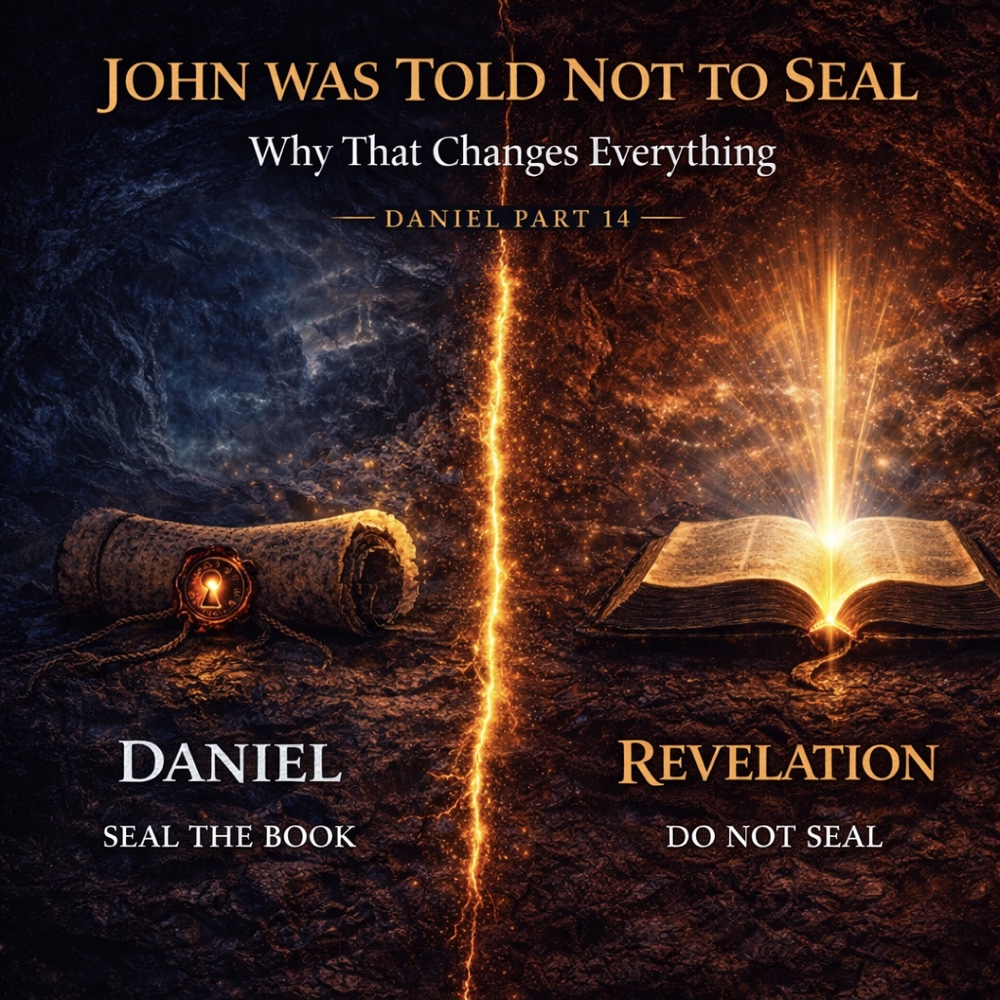
Daniel: seal the book. John: do not seal the book.
That is not a small detail. That is not something you explain away. That is a dividing line. And if you ignore it, you will read both books incorrectly from the start.
Now let me say something plainly. This is where most systems collapse. Because most systems are built on the assumption that Daniel and Revelation are simply one continuous message told in different ways. But if that were true, then this instruction makes no sense. You cannot tell one prophet to seal — and another to not seal — if they are operating under the same condition. That tells you something has changed. Not the truth. The position.
Daniel is shown things that are not yet open. John is shown things that are no longer sealed in the same way. That is a shift in timing. And if you miss that, you will force both into the same frame and end up with confusion.
Now let us slow this down. Because this is where people tend to rush again.
They see the contrast and immediately jump to conclusions. We are not doing that. We are observing what is actually said. Daniel is given revelation. He does not fully understand it. He is told to seal it. That means limitation. That means boundary. That means something is not yet open. Now move forward. John is given revelation. And instead of being told to seal it — he is told not to. Why? Because “the time is at hand.” That phrase matters. Because it tells you why the instruction is different. The time is near. That is the reason given. Not interpretation. Not explanation. Timing.
Now hold that. Because this is where everything begins to sharpen.
Daniel is positioned before the time. John is positioned much closer to it. That is why the instruction changes. Not because the message is the same. But because the moment is different. Now let me say this clearly. You cannot read Daniel and Revelation as if they are standing in the same place. They are not. They are separated by time. By position. By instruction. And that means they must be read with that in mind. Not blended. Not merged. Not forced together. Understood separately first.
Now here is where the problem begins.
People do not like separation. They want connection. They want everything to fit together immediately. So what do they do? They take Daniel’s sealed structure and try to unlock it using Revelation. Or they take Revelation’s imagery and push it back into Daniel. And in doing that, they create something that feels complete. But it is built on something that was never stated.
Now let me bring this into something simple.
If you are given two maps of the same territory, drawn from different points in time with different levels of detail, and you lay them on top of each other without understanding either one first — you will not get clarity. You will get distortion. Lines will not align. Details will conflict. And you will start adjusting one to fit the other. That is exactly what people do with Daniel and Revelation. They adjust. They reinterpret. They force alignment. And then they call it understanding. It is not. It is construction.
Now let me say something that will challenge you. If you need to change what one text clearly says in order to make it fit another — you have already stepped outside of what was given. That is not interpretation. That is modification. And once you start modifying meaning, you are no longer anchored.
Now bring this back to the instruction. Seal not. Why? Because the time is at hand. That means something has shifted. Not the existence of truth. The accessibility of it. Something that was once restricted is now presented differently. Not because everything is now fully understood — but because the position has changed.
Now ask yourself this. If John is told not to seal — does that mean everything is now fully clear? No. Because even in Revelation, there are things that are not explained directly. There are layers that are not immediately obvious. So what does “not sealed” actually mean? It means the restriction is different. Not removed completely. But no longer the same as Daniel. That is the key.
Now let me bring this into where we are in the series.
We have been following a pattern carefully. We have not rushed. We have not forced connections. We have observed. Step by step. And now we arrive at a point where the difference between Daniel and Revelation is no longer subtle. It is direct. Opposite instructions. Different positions. Different timing. That should force you to rethink how you approach both. Because if you continue to read them as one continuous system — you will continue to build on a foundation that does not hold.
Now let me say something very directly. Most confusion in prophecy today does not come from the text. It comes from mixing the text. And this is the clearest example of that. Daniel and Revelation being treated as one — without first respecting the difference between them.
Now here is where we stop again. Because this is where people usually rush into rebuilding everything. We are not doing that yet. We are still removing. Still separating. Still clearing the ground. Because until that is done — anything you build will carry the same problem.
So hold this. Daniel was told to seal. John was told not to. Two different instructions. Two different positions. And that difference is not something you explain away. It is something you respect. Because if you do not — you will continue reading both through a lens that was never given in the first place.
And that is where we go next. Because once you accept that difference — you begin to see where the mixing actually started. And why it has been so effective.