The Middle East: Why This Region Never Sleeps – Last Generation Part 16
By Andre Eksteen
If you look at the world honestly, there is one place that never truly settles. Not for long. Not completely. Not in any lasting way. The Middle East. Conflicts rise, tensions ease, and then something flares again — different players, different headlines, the same region. And people get used to it. They start saying things like, “It’s always been like this,” or “That’s just how that part of the world is.” And in one sense, that is true. The region has been contested territory since before recorded history. But in another sense, that kind of normalising is dangerous, because it numbs you to something that deserves serious attention. When something repeats with the consistency and centrality that conflict in the Middle East repeats, you should not dismiss it. You should understand it. Because repetition at that scale and in that specific location is not random. It points to something structural.
So let us step back from the politics and the headlines and ask a more foundational question. Why does so much of global tension consistently centre on this region? Not occasionally. Not when particularly dramatic events occur. Consistently, persistently, across centuries and millennia, in ways that pull the attention and the resources of every major world power. The answer is not simple, and anyone who reduces it to one factor — oil, religion, ethnicity, colonialism — is not looking carefully enough. This region is a convergence point, and understanding why that is the case is essential to understanding why it will remain central to everything this series has been building toward.
The Layers That Make This Region Different
Start with the most obvious layer and work inward. The Middle East sits at the geographical intersection of three continents — Europe, Asia, and Africa. Before the age of modern transport, whoever controlled this region controlled the trade routes connecting the known world. The Silk Road, the spice routes, the maritime passages through the Red Sea and the Persian Gulf — all of them passed through or near this territory. Empires did not fight over the Middle East for millennia because they were irrational. They fought over it because controlling it meant controlling the economic arteries of civilisation.
That geographic centrality is now expressed in a different form, but it is no less real. The Middle East holds approximately 48 percent of the world’s proven oil reserves and a significant portion of its natural gas reserves. The Strait of Hormuz, through which approximately 20 percent of the world’s oil supply passes, is bordered by Iran on one side and the Arabian Peninsula on the other. The Suez Canal, through which a significant portion of global maritime trade moves, connects the Mediterranean to the Red Sea through Egypt. The disruption of either of those chokepoints — through military action, political instability, or deliberate closure — would send immediate shockwaves through every economy in the world.
This is not peripheral. It is structural. When a military conflict, a political crisis, or a terrorist attack occurs in the Middle East, its effects are not contained in the region. They ripple outward through energy markets, shipping routes, and global supply chains with an immediacy that no other region on earth can match. The conflict in Ukraine disrupted European energy supplies significantly, but Europe had alternatives it could pursue. A disruption of Middle Eastern oil and gas flows would affect Asia, Europe, North America, Africa, and the entire developing world simultaneously, with no comparable alternative supply base available in the short term.
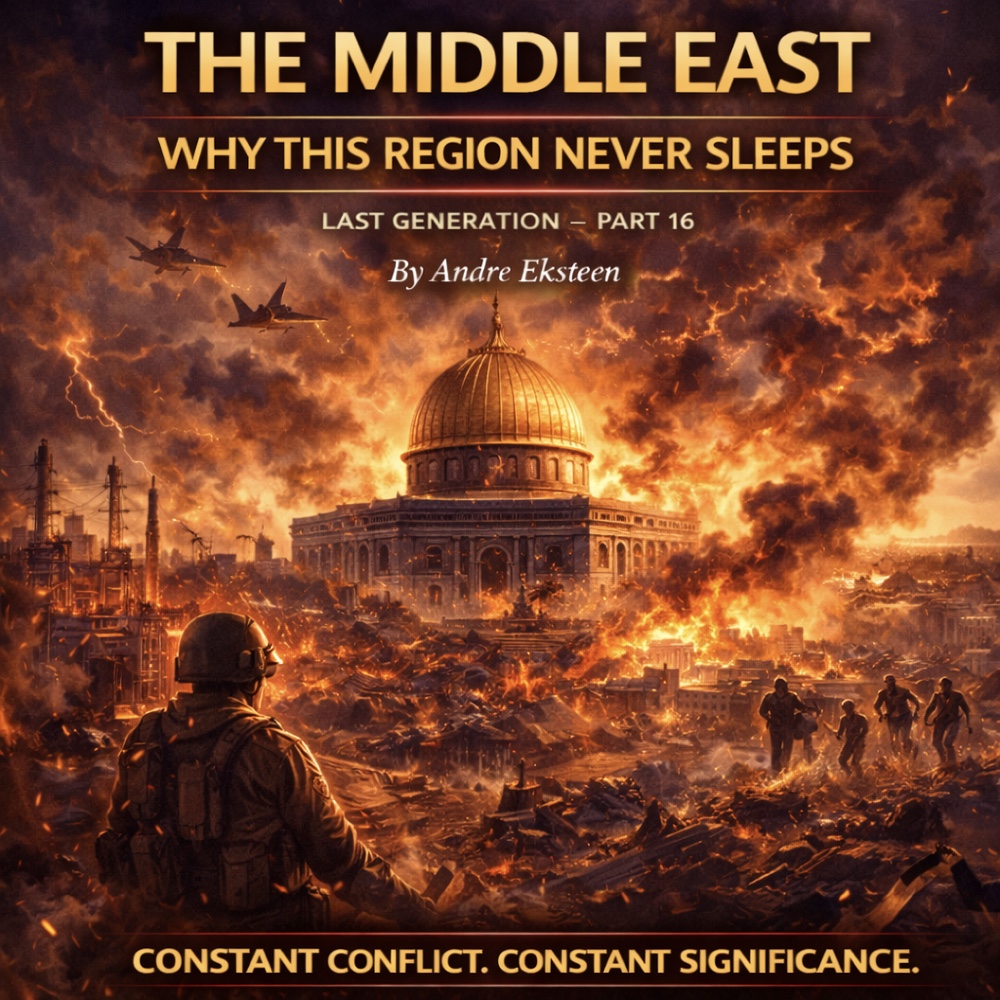
Now add the second layer. The Middle East is the birthplace of the three major Abrahamic religions — Judaism, Christianity, and Islam. Jerusalem is the most contested religious city on the planet. The Temple Mount — a thirty-five-acre plateau in the heart of Jerusalem — is simultaneously the holiest site in Judaism, the third holiest site in Islam, and the site where, according to the biblical prophetic tradition, some of the most significant end-time events will occur. The Dome of the Rock sits where the Jewish temple stood. The Western Wall is the remnant of the temple’s outer structure. Al-Aqsa Mosque occupies the same compound. These three religious traditions, each with hundreds of millions or billions of adherents worldwide, all have claims on the same small piece of geography.
The religious significance of Jerusalem is not a background detail that occasionally becomes relevant when tensions flare. It is a permanent accelerant. Every political development in Jerusalem is simultaneously a religious event for billions of people. Every decision about the status of the Temple Mount, the boundaries of the Old City, the rights of Jews to pray on the mount, the sovereignty over East Jerusalem — all of these are simultaneously political negotiations and religious confrontations, and the emotional weight attached to them is essentially limitless. This is not a problem that can be resolved through normal diplomatic tools, because normal diplomatic tools operate on the assumption that interests are finite and compromisable. Religious conviction of the kind attached to Jerusalem is neither finite nor easily compromisable.
Now add the third layer, which is the one this series has been building toward. Israel’s existence in the land — as we established in Parts 5, 6, 7, and 12 — places the covenantal geography back into active play. The land of Israel, and specifically Jerusalem and the Temple Mount, is the location of the specific prophetic events Jesus described in Matthew 24. The abomination of desolation must stand “in the holy place.” The temple context — however that is eventually constituted — must be present for that event to occur. The return of Christ, in the Zechariah 14 picture, involves His feet standing on the Mount of Olives, which is directly adjacent to Jerusalem. The great tribulation is centred on Jerusalem and its fate. Every specific end-time event Jesus described in Matthew 24 and the prophets described across the Old Testament has its focal point in this same small territory.
Now sit with all three layers together. Strategic geographic and economic centrality. Irreducible religious significance for billions. Covenantal prophetic significance as the focal point of the biblical end-time sequence. No other piece of territory on the planet carries all three of those simultaneously. No other region combines global economic leverage, multi-civilisational religious significance, and specific biblical prophetic centrality in the same concentrated space. That is why this region never truly sleeps. Not because the people there are uniquely prone to conflict. Because the forces intersecting in that region are uniquely and permanently charged, and any disturbance in that intersection sends shockwaves in every direction.
The Pattern in Modern History
Now let us look at the modern history of the Middle East through this structural lens, because the pattern is clarifying rather than random.
The modern period of sustained involvement of the great powers in the Middle East begins in the late nineteenth century with the decline of the Ottoman Empire. Britain and France competed for influence in the region as the Ottoman hold weakened. The Sykes-Picot Agreement of 1916 secretly divided the Arab territories of the Ottoman Empire between the two powers — drawing borders that cut across ethnic, religious, and tribal realities in ways that have produced conflict ever since. The Balfour Declaration of 1917, in which the British government expressed support for “the establishment in Palestine of a national home for the Jewish people,” set in motion the series of events that culminated in 1948.
The discovery of oil in Persia in 1908 and subsequently across the Arabian Peninsula transformed the strategic importance of the region from significant to indispensable. By the mid-twentieth century, every major global power had vital interests in the stability and accessibility of Middle Eastern oil. The United States, Britain, France, the Soviet Union — and later China and India as their energy demands grew — all organised significant portions of their foreign policy around securing access to Middle Eastern energy.
The 1948 Arab-Israeli War, the 1956 Suez Crisis, the 1967 Six Day War, the 1973 Yom Kippur War, the Iranian Revolution of 1979, the Iran-Iraq War of 1980-1988, the first Gulf War of 1990-1991, the second Gulf War beginning in 2003, the Arab Spring and its consequences, the Syrian civil war, the rise and fall of ISIS, the continuing conflict between Israel and Palestinian militant groups, the Iranian nuclear programme, the normalisation agreements between Israel and Arab states, the October 7 Hamas attack in 2023 and its aftermath — these are not isolated events. They are episodes in a continuous pattern of pressure, conflict, and restructuring in a region that the entire world watches and into which the entire world’s interests are embedded.
Each of these events has been interpreted by someone, somewhere, as the prophetic sign that the end is near. Each has generated a wave of prophetic excitement and prediction. And each has been followed by some degree of resolution or stalemate without the end arriving. That pattern should make anyone cautious about declaring any specific Middle Eastern event as the definitive prophetic trigger. At the same time, the pattern as a whole — the continuous escalation and restructuring, the drawing in of more players, the increasing sophistication and lethality of the weapons involved, the growing entanglement of nuclear-armed powers — represents something that is not simply the same as what has always been.
The Iran Dimension and What It Represents
Of all the current players in the Middle Eastern picture, Iran deserves specific attention — not primarily because of the geopolitical headlines it generates, but because of what its particular character and stated objectives represent in the structural analysis we are building.
Iran since the 1979 Islamic Revolution has been explicitly and avowedly organised around a religious ideology that incorporates specific end-times theology. The Shia Islamic tradition within which the Iranian theocracy operates has its own version of messianic expectation — the return of the Mahdi, the twelfth imam who is believed to be in occultation and whose return will be preceded by a period of cosmic conflict and will establish a global Islamic order. More specifically, a significant strand of Iranian religious and political thinking has argued that actions taken to bring about conflict — particularly conflict involving Israel — can accelerate the conditions for the Mahdi’s return. This is not a fringe interpretation. It has been articulated by Iranian leaders at the highest levels.
Now this is not the place to adjudicate Islamic theology or prophetic claims. The point is structural and observable: Iran is a state actor with nuclear ambitions, significant conventional military capacity, and an extensive regional proxy network — Hamas in Gaza, Hezbollah in Lebanon, the Houthis in Yemen, various Shia militias in Iraq and Syria — that is explicitly motivated by a religious ideology that sees the destruction of Israel as both a political objective and a theological imperative. That combination — nuclear capability or near-nuclear capability, regional proxy reach, and religious conviction that frames conflict with Israel as eschatologically significant — makes Iran a qualitatively different kind of actor from most of the other players in the region’s history.
The implication for the prophetic picture is this: whatever the coming climactic events in the Middle East look like — whatever brings multiple nations against Jerusalem in the scenario that Zechariah 12 and 14 describe, whatever produces the pressure on Israel that leads to the specific events Jesus referenced from Daniel — Iran is structurally positioned to be a significant actor in that scenario. Not because Iran is specifically named in prophecy (the arguments about Persia in Ezekiel 38 are real but require more careful treatment than a paragraph allows). But because Iran represents exactly the kind of power — religiously motivated, apocalyptically framed, militarily capable, regionally connected — that the prophetic scenario would require.
Again: this is structural observation, not specific prediction. The point is not that Iran will do any specific thing at any specific time. The point is that the elements are in place in a way they were not before. The actors are positioned. The motivations are aligned with the type of conflict the prophetic picture describes. Whether the play will run in the next decade or the next generation or further ahead is not something honest observation can determine. What it can say is that the stage configuration now matches the requirements of the script in ways it did not before 1948, before the Iranian Revolution, before the development of Iranian nuclear capability.
The Temple Mount Question
Of all the specific pressures in the region, the Temple Mount is the one that most directly connects the current geopolitical situation to the specific prophetic event Jesus flagged as the pivotal trigger in the Matthew 24 sequence — the abomination of desolation, “spoken of by Daniel the prophet, stand in the holy place.”
The Temple Mount has been under Israeli sovereignty — in the sense that Israel controls access to the compound — since the Six Day War of 1967. But in one of the most unusual decisions in modern military history, Moshe Dayan, the Israeli general who led the recapture of Jerusalem, immediately handed administrative control of the Temple Mount to the Jordanian Islamic Waqf authority. The Israeli flag that had been briefly raised on the Dome of the Rock was taken down. Jewish prayer on the mount was and remains prohibited. Israeli sovereignty is nominal in the sense that Israel controls who enters the compound, but the religious and administrative authority belongs to the Waqf.
This arrangement — Israeli military sovereignty without religious or administrative control — has produced a permanently contested, permanently explosive situation. The question of Jewish prayer rights on the Temple Mount, the question of whether any Jewish presence or structure is permitted on the mount, the question of excavations and archaeological work near the mount — all of these are perpetual flashpoints that can trigger violence with remarkable speed and regularity. The Intifada of 2000 — the second Palestinian uprising, which lasted years and killed thousands — was triggered in part by Ariel Sharon’s visit to the Temple Mount. The sensitivity is essentially unlimited.
Now several strands within Jewish religious thought — particularly within nationalist and religious Zionist circles — have focused increasing attention on the eventual rebuilding of the temple. There are organisations in Israel that have been preparing temple vessels, training priests according to the Levitical requirements, breeding red heifers for the purification ceremony, and producing architectural plans for a third temple. These efforts are minority movements within Israeli society. But they are real, they are serious, and they have been gaining visibility and political connections in recent years.
The relevance to the prophetic picture is direct. Jesus said the abomination of desolation would stand in the holy place. Daniel describes it as being set up in connection with the removal of the daily sacrifice — implying a context in which sacrifice has been reinstated. A third temple, or some reconstitution of temple worship on the mount, is the context within which those events become possible. That context does not currently exist. But the pressures moving toward it — the Israeli presence in Jerusalem, the religious nationalist movements, the international attention, the permanent contest over the mount itself — are visibly intensifying in ways they were not a generation ago.
None of this means a third temple is imminent, or that the abomination of desolation is about to occur. But it means the conditions within which those events could occur are closer to being met than they have been at any point since AD 70. And that observation, combined with everything else in this series, continues to build a picture that is worth watching carefully — not with the urgency of someone who has found their proof, but with the alertness of someone who sees the branch becoming tender and is watching to see whether the leaves will follow.
The Middle East is not just another region. It is the convergence point. And convergence, when multiple systems begin to align at the same point simultaneously, is exactly what the beginning of sorrows building toward its climax would look like from inside the sequence. We are not at the climax. But we are closer to the conditions for it than any previous generation in the past nineteen centuries. And that is a fact worth taking seriously, without either panicking about it or explaining it away.
Why Israel Is the Centre of the Centre
Within the Middle East, Israel occupies a unique position that goes beyond its size — a country of approximately nine million people in a territory smaller than many single provinces of larger nations. Yet no other country in the region generates comparable international attention, comparable diplomatic investment, or comparable polarisation of global opinion. The United Nations has passed more resolutions criticising Israel than any other country in the world. The question of Jerusalem’s status has generated decades of intense international negotiation. The Palestinian issue has been the subject of more sustained international attention than virtually any other territorial dispute anywhere on the planet.
Why? The geographic and economic answers are insufficient. Israel does not control significant oil reserves. It does not occupy a uniquely strategic chokepoint. Its economy is significant but not disproportionate to the attention it receives. The explanation has to include the religious and covenantal dimensions — the fact that Israel’s existence and its specific location in that specific territory touches the nerve of the three major Abrahamic traditions and the specific geography of the biblical prophetic tradition in a way that no purely political analysis can account for.
Now bring that back to Matthew 24. Jesus is sitting on the Mount of Olives, which overlooks Jerusalem and the Temple Mount, and He is describing the end-time sequence in response to questions about the fate of the temple. The entire discourse is grounded in that specific geography. The abomination of desolation stands in the holy place — a specific location in that specific city. The great tribulation is centred on events in and around Jerusalem. The return of Christ is connected to the Mount of Olives. The apostle John, writing Revelation from exile on Patmos, uses the same Jerusalem-centred geography.
The fact that Jerusalem and the Temple Mount remain the most contested and the most watched piece of real estate on the planet — that every development there is immediately global news, that multiple world powers have competing claims and interests in its governance, that billions of people attach ultimate religious significance to its status — is not coincidental from the biblical prophetic perspective. It is structural. It is the convergence of the geographic, the economic, the religious, and the covenantal in the one location that the text identifies as the focal point of the end-time sequence.
What This Does and Does Not Tell You
Now let me state clearly what all of this observation does and does not tell you, because precision matters here as much as it has anywhere in this series.
What it tells you is that the Middle East is structurally positioned — by geography, energy resources, religious significance, and covenantal importance — to remain the focal point of global tension for as long as the present age continues. It tells you that Israel’s presence in the land, and specifically Jerusalem’s contested status, keeps the specific prophetic geography Jesus described in active play in a way it was not for nineteen centuries. It tells you that the intersection of these forces in one region creates a permanent condition of instability and potential escalation that is genuinely different in kind from conflict elsewhere in the world. And it tells you that the pattern of continuous, escalating, globally connected Middle Eastern conflict is consistent with what the beginning of sorrows, building toward a climax, looks like from inside the sequence.
What it does not tell you is that the last generation has arrived, that the tribulation has begun, or that any specific current conflict is the fulfilment of any specific prophecy. The observation is structural and pattern-based, not event-specific. The region is the stage. The actors are in position. The props are in place. But the specific, unprecedented, unmistakable events that Jesus identified as the climax of the sequence — the abomination of desolation, the tribulation of unsurpassed severity, the cosmic signs — have not yet occurred.
What honest watching looks like, at this stage, is recognising that the conditions for those events to occur are present in a way they have not been since before AD 70. Not that the events themselves are happening. That the context in which they would happen — an Israel in the land, Jerusalem as contested holy city, the Temple Mount under perpetual global attention, nuclear-armed regional powers surrounding a small nation whose fate is tied to global religious conviction — is assembled and active. The stage is set. The play has not yet begun. But the audience is in their seats and the lights are going down.
That is where we are. Not at the end. Not at a comfortable distance from it either. Somewhere in a period that is, by any honest structural analysis, closer to the conditions the prophetic sequence requires than any previous period in history. And that is worth sitting with, watching carefully, and understanding structurally — not as a reason for panic, but as a reason for the kind of alert, informed, grounded watchfulness that this series has been building toward from its first word.