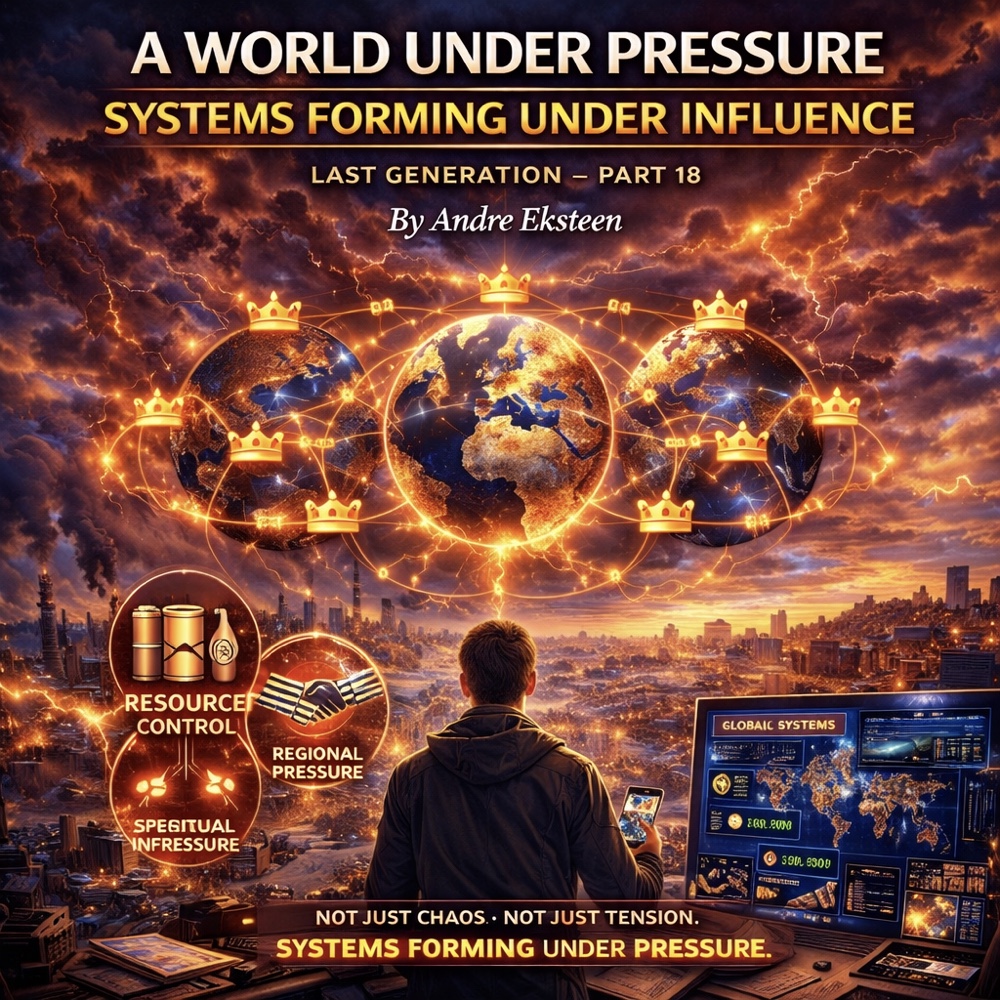
A World Under Pressure: Systems Forming Under Influence – Last Generation Part 18
By Andre Eksteen
Up to now we have been peeling back layers. Not adding assumptions — removing them. Because the consistent error throughout the history of end-times teaching has been the one Jesus warned about at the very beginning of Matthew 24: taking real pieces and assembling them into something that feels right but is not grounded in what is actually written. Each part of this series has tried to do the opposite — to strip away what has been imported into the text, follow what is actually there, and build a picture from the bottom up rather than from a pre-formed conclusion downward.
Now we go one layer deeper. Because what we have established so far — the visible instability, the pressure in key regions, the control of resources, the spiritual influence over nations that Daniel 10 describes — is not yet the full picture. There is a dimension to what Daniel saw that goes beyond individual nations under spiritual influence and begins to describe something structural. A form of alignment that forms under pressure. A coming together of powers into a configuration that is not random but directional — moving toward something specific. And understanding that structure, without forcing it into modern parallels before the text has established the right to make those connections, is the task of this part.
The Ten Kings Question
Now let me deal more carefully with the ten kings of Daniel 7:24, because it is one of the most specifically debated prophetic details and one where precision matters. Rather than confidently identifying the ten kings with a specific modern institution or alliance — which would repeat the error of imported certainty we have been dismantling — let me ask the more basic question that the text itself raises.
What would a configuration of ten regional powers operating within a larger system look like? What are the structural prerequisites for that arrangement? And are those prerequisites present in the world today?
The configuration requires first a dominant empire — the fourth beast — from which the ten kings arise. They are not independent. They emerge from within and are part of a single larger structure. That means the ten represent a form of regional authority within a larger integrated system, not ten fully sovereign nations operating independently. Second, the ten have power simultaneously — “the ten horns which thou sawest are ten kings, which have received no kingdom as yet; but receive power as kings one hour with the beast” (Revelation 17:12). They receive power together, at the same time, in connection with the beast. This is coordinated, simultaneous empowerment, not sequential conquest. Third, they have a shared agenda — “these have one mind, and shall give their power and strength unto the beast” (Revelation 17:13). One mind. They are not competing with each other. They have unified purpose in relation to the dominant figure.
Now ask what kind of world produces that configuration. Not a world of fully sovereign, independent nation-states as that concept was understood in the nineteenth and twentieth centuries. A world where regional blocs and multilateral institutions have progressively absorbed significant elements of national sovereignty, where economic and security dependencies have created real constraints on independent national decision-making, and where a sufficiently powerful centralising figure or system could command coordinated commitment from regional authorities without requiring full military conquest. That is a different world from what existed a century ago. It is closer to what exists today than at any previous point in history.
The European Union — whatever its prophetic significance or lack thereof — is the most developed example of the kind of regional integration that produces exactly this structure: member states that retain nominal sovereignty but have ceded significant authority over currency, trade, movement, and increasingly security to supranational institutions. The model of integration the EU represents — pooled sovereignty, shared rules, common institutions — is one that multiple other regions are in various stages of developing. The African Union, ASEAN, the Gulf Cooperation Council, the Shanghai Cooperation Organisation — all represent varying degrees of regional integration that reduce full national sovereignty in favour of coordinated regional governance.
Now I am not identifying any of these with the ten kings. The text does not establish that connection and I am not going to manufacture it. The point is structural: the kind of world in which ten regional authorities could simultaneously receive power and give it to a dominant central figure is a world with the kind of multi-layered integrated governance that the present world is in the process of building. The structural preconditions are forming. Whether the specific configuration is near or far is not something this series can determine. What it can say honestly is that the world of 2024 is structurally closer to the Daniel 7 configuration than the world of 1924, which was in turn closer than the world of 1824. The direction is consistent. The pace appears to be accelerating.
The Patience Required
Now let me say something about the posture that this kind of structural watching requires, because it is different from what most end-times culture produces, and the difference matters for how you actually live in response to what this series is describing.
The posture that structural watching requires is patience. Not passive resignation. Active, informed, grounded patience. The kind that knows the shape of what is coming without being constantly destabilised by the pace at which it arrives. The kind that can hold the big picture with clarity and continue living faithfully in the present moment without either collapsing into urgency that produces poor decisions or drifting into complacency that produces inattentiveness.
This is genuinely difficult. Human beings are not naturally patient about things they care deeply about. When you have a clear picture of a dangerous trajectory, the natural response is urgency — to warn everyone, to prepare intensively, to act as if the deadline is tomorrow. And sometimes that urgency is appropriate. But the prophetic record suggests that the timeline of God’s purposes is not calibrated to human urgency. Jesus told His disciples He was returning soon, and nearly two thousand years have passed. Paul expected the return in his own lifetime. The church has been living in expectation since the first century, and the faithfulness required is not the sprint of someone who believes the end is in a specific year. It is the marathon of someone who knows the destination without knowing the distance remaining.
Now what does that patience look like practically? It looks like continued engagement with the world — working, building, raising families, serving communities — without the kind of short-term thinking that comes from believing the end is imminent in a specific way at a specific time. It looks like genuine watchfulness — knowing the sequence, tracking the structural developments, staying alert to the convergence — without the obsessive, anxiety-driven focus on every headline that most prophecy culture produces. It looks like the kind of faithful, grounded, long-view living that can recognise the season when it arrives without having spent the years before it in a state of false urgency.
The Sermon on the Mount’s instruction to not be anxious for tomorrow — to trust God for daily provision and to keep the kingdom of God and His righteousness as the primary orientation — is not in tension with the watching Jesus described in Matthew 24. It is the foundation on which genuine watching can be built. Anxious watching is not watching. It is reacting. Genuine watching is possible only for the person who is grounded enough that the developments they observe can be processed calmly rather than reacted to with either panic or denial.
The generation that sees all these things will need that patience and that groundedness more than any previous generation, because the pressure they will be under — the deception Jesus described at the start of the discourse, the scale of the events He described in the middle, the false peace He pointed to through Daniel — will be unlike anything in human history. The preparation for that moment is not primarily tactical. It is spiritual and attitudinal. The person who arrives at that moment knowing the sequence, holding the framework, maintaining the posture of calm watchfulness rather than anxious prediction, is the person who will be able to recognise what is happening and respond with the faithfulness Jesus described.
That preparation is what this series has been building. Not a prediction. Not a date. Not a timeline. A framework for watching. A picture of the shape of things. And the patience to hold that picture without forcing it to resolve faster than the sequence actually moves.
We are watching. The alignment is visible. The structure is forming. And the season, when it announces itself fully, will not need a calculation to be recognised. It will be seen by the ones who have been watching all along.
From Chaos to Structure: The Pattern Daniel Describes
The most important thing to recognise about Daniel’s visions is that they do not describe endless chaos. They describe pressure producing structure. The four beasts of Daniel 7 — the lion, the bear, the leopard, and the terrible fourth beast — do not represent random disorder. They represent a succession of empires, each rising out of the sea of human turmoil, each more powerful and more terrible than the last, each building on and incorporating what came before. The movement is not toward fragmentation. It is toward consolidation. Each empire absorbs its predecessors. The final beast is the most terrible of all, and it produces a specific structural configuration — ten horns, and then an eleventh that rises among them.
Daniel 7:24 — “And the ten horns out of this kingdom are ten kings that shall arise: and another shall rise after them; and he shall be diverse from the first, and he shall subdue three kings.” Ten kings arising out of the final kingdom, and then a distinctive eleventh who rises among them and subdues three of the first. This is not a picture of chaos. It is a picture of organised power — a structure in which multiple authorities operate together and within which a dominant figure eventually emerges and takes control.
Now before we go any further, let me revisit something we established in Part 17 and apply it here. Daniel 10 showed us that nations have spiritual princes — powerful beings operating at a level above human leadership, shaping the direction of nations in ways that go beyond purely human political calculation. When Daniel 7 describes ten kings arising out of a final kingdom, we need to ask whether those kings are primarily human political leaders, primarily spiritual authorities over regions, or some combination of both. The text does not resolve that question definitively, and that interpretive openness should be acknowledged honestly rather than papered over with confident specificity.
What can be said with confidence is that the structure Daniel describes — multiple regional powers operating together under and within a larger system, with a single dominant figure eventually emerging — is a specific kind of political configuration that requires specific conditions. It requires levels of global integration that enable multiple regional powers to operate as a coordinated system rather than as purely independent actors. It requires the kind of economic and political interdependence that makes regional actors both powerful within their sphere and constrained by their dependence on the larger system. And it requires the kind of centralised authority structure that can produce a single figure capable of subduing other kings and establishing dominance within the system.
Now look at the present world and ask whether those conditions exist or are forming. A hundred years ago, the level of global economic and political integration required for the Daniel 7 picture to operate did not exist. Nations were interdependent in trade, but the mechanisms of global financial governance — the IMF, the World Bank, the Bank for International Settlements, the G7 and G20 structures, the UN system — did not exist. Today they do. The degree to which national economies are integrated into a global financial system with shared rules, shared infrastructure, and shared vulnerabilities is historically unprecedented. The level to which a financial crisis in one country or region immediately affects every other country is something that could not have been said with the same force in any previous period of history.
This does not mean the ten kings of Daniel 7 are the G10 nations, or that the eleventh horn is a specific political figure operating today. The text does not establish those specific connections, and we will not establish them here. What it does mean is that the structural preconditions for the Daniel 7 configuration — global integration, coordinated regional authority, the possibility of a single dominant figure emerging from within a larger system — are being assembled in the present period in ways they were not before. The conditions are forming. Whether the specific configuration is close or further ahead than it appears is not something honest analysis can determine from the present vantage point.
The Pressure That Produces Alignment
Now let us examine the mechanism — the how of the structural formation — because it is directly relevant to understanding both what is happening now and what will eventually produce the configuration Daniel described.
Systems do not integrate voluntarily, as a rule. Integration is forced. It is driven by shared threats that cannot be addressed individually, by crises that overwhelm national capacity, by interdependencies that have already been built up through decades of trade and financial integration. The mechanism of the formation is pressure. Nations and the powers behind them are pushed into closer coordination and eventually into new structural configurations by crises that they cannot manage alone.
Look at how the existing global integration has happened historically. The post-World War II order — the United Nations, the IMF, the World Bank, NATO, the GATT and later the WTO — was built in direct response to the catastrophic experience of two World Wars and the Great Depression. The integration was driven by shared trauma. The lesson drawn from the chaos was that more coordination, more shared rules, more integrated structures were necessary to prevent the chaos from recurring. The institutions were created, the integration deepened, and over seventy years the level of global economic and political integration built to something that would have been unrecognisable to people living in 1913.
Now look at the pressures currently operating that could drive the next wave of integration. The COVID-19 pandemic produced the most extensive coordinated global governmental response to a single event in history — synchronized lockdowns, coordinated vaccine procurement, expanded WHO authority, G20 coordination of economic response. The climate agenda is producing pressure for coordinated global economic governance — carbon trading systems, shared emissions targets, the potential for cross-border carbon taxes that would require new levels of economic integration to implement. The Ukraine war produced a dramatic restructuring of European energy dependence and military alliance structures. The rise of China as a peer competitor to the United States is driving a realignment of global supply chains and alliance structures on a scale not seen since the Cold War.
Each of these pressures is producing structural responses — new institutions, new agreements, new levels of integration and coordination. The overall direction of that movement is toward a more integrated, more centralised, more coordinated global system. Not smoothly. Not without resistance and conflict. But the direction is consistent. And the biblical picture of a final world system emerging from the pressure of history is not abstract prophecy. It is the logical endpoint of a trajectory that has been building for over a century.
Organised Control, Not Disorganised Collapse
Now let me address directly something that shapes most popular end-times thinking and that this series needs to push back on clearly. Most people who engage seriously with end-times prophecy expect the end to look like chaos. They expect societal breakdown, random violence, the collapse of all systems, a Mad Max scenario in which the normal structures of civilisation have disintegrated and people are simply surviving from day to day. This expectation shapes how they read the prophetic passages and what they look for as evidence that the end is approaching.
But that is not what the prophetic picture describes. The prophetic picture describes organised control. The mark of the beast in Revelation 13 is not operating in a world without systems. It is the central control mechanism of a system sophisticated enough to track every economic transaction globally and enforce participation or exclusion in real time. That requires infrastructure. It requires databases. It requires the kind of integrated financial, identification, and communication systems that only highly organised and technologically sophisticated civilisation can produce. The Antichrist figure who establishes himself in the holy place and demands worship is not operating in the ruins of civilisation. He is at the peak of a system that has integrated enough power to make the demand globally enforceable.
The tribulation is not the collapse of order. It is the perversion of order. The difference is significant. A collapsing civilisation cannot produce the kind of comprehensive control Revelation 13 describes. Only a highly integrated, highly functional, highly sophisticated civilisation can. The tribulation is what happens when the systems of human civilisation — financial, military, political, informational — are captured by a single authority that uses them to demand comprehensive allegiance. The chaos is not the end. The organised control is.
Now apply that to the present. The world is not moving toward the kind of disintegrated chaos that most popular end-times imagery depicts. It is moving toward greater integration, greater technological sophistication, and greater centralisation of the systems that govern economic and social life. That movement will not be smooth — it will be driven by crises and punctuated by conflict. But the direction is toward more structure, not less. And the structure that is forming under the pressure of the present period is moving toward the conditions that the final organised global system would require. Not there yet. But moving.
What Comes After the Structure Forms
Now let me deal with what the original ChatGPT article was pointing toward at its close — the idea that after structure forms under pressure, what comes next does not look like danger. It looks like relief. Peace. Resolution. And that is where deception reaches its highest expression.
Daniel 8:25 describes the figure associated with the final kingdom this way: “And through his policy also he shall cause craft to prosper; and he shall magnify himself in his heart, and by peace shall destroy many.” By peace shall destroy many. Not through open aggression. Through a false peace — a covenant of security, a resolution of the chaos, an apparent order that conceals its own destruction.
Paul echoes this in 1 Thessalonians 5:3 — “For when they shall say, Peace and safety; then sudden destruction cometh upon them, as travail upon a woman with child; and they shall not escape.” The cry of peace and safety is the moment of maximum danger. Not the moment when things look dark and threatening — the moment when things look resolved. The moment when the pressure has eased, the structure has formed, and the promise of stability has been fulfilled. That is when sudden destruction comes.
Now think about what that means for how you watch. Most people are watching for the dangerous-looking event that announces the end. They are watching for something that looks threatening. But the prophetic picture says the most dangerous moment comes dressed as relief. After the pressure. After the chaos. After the long period of instability — a figure or a system that offers resolution, stability, peace. And the world, exhausted by the pressure of the preceding period, receives it gratefully. Not recognising that the peace is the trap.
This is why the deception at the end is so profound. It does not look like deception. It looks like the answer. And the person who has been watching for something that looks threatening will potentially miss the thing that looks like a solution. Jesus’ warning — “take heed that no man deceive you” — applies with maximum force at exactly that moment. When the world says peace and safety, when the pressure resolves into apparent order, when the structure that has been forming under influence presents itself as the solution to the chaos that preceded it — that is the moment to watch most carefully. Not to relax.
The generation that sees all these things — including this final movement from pressure to false peace, from apparent chaos to organised control — is the generation Jesus described. And the watching posture this series has been building is precisely the posture that will be able to recognise what is happening when peace looks like the answer and is actually the deepest point of the deception.
We are not there yet. But we are watching the pressure build that will eventually produce it. And watching it build is exactly what Jesus said to do.