The Convergence: When Everything Begins to Align – Last Generation Part 22
By Andre Eksteen
Up to this point in this series we have resisted something consistently. We have not rushed. We have not forced conclusions. We have not taken one piece and tried to make it carry everything. Each part has added one element to a picture that has been building slowly, carefully, from the bottom up — from the words of the text, through the pattern of Scripture, through the structure of history, through the observable condition of the present world. And now, twenty-one parts in, we arrive at a place where the question itself changes.
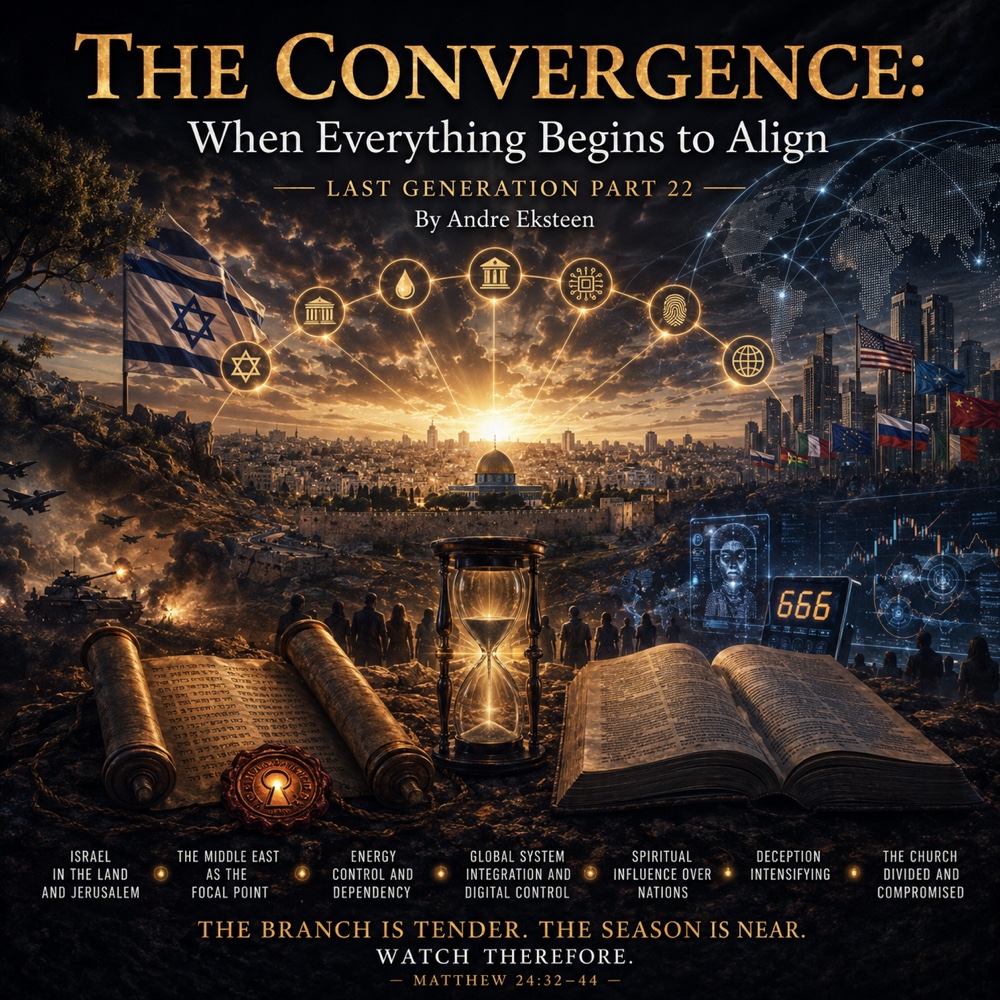
Not “Is something happening?” We have established that something is happening across multiple dimensions. Not “Which sign proves the generation?” We have established that the last generation is not defined by one sign but by a complete sequence. The question that this part addresses is more specific and more structural than either of those. What happens when the elements we have been describing — Israel in the land, the Middle East as focal point, energy control, global system integration, spiritual influence over nations, deception intensifying, the Church divided — stop being isolated observations and start operating together? What does it look like when the pieces that have been assembling separately begin to function as a system? That is what convergence means. Not one event. Multiple elements aligning into a configuration that is qualitatively different from any of its parts in isolation.
The Difference Between Convergence and Noise
Now let me address a practical challenge that the convergence argument faces, because it is a legitimate one and deserves honest engagement. If genuine convergence is hard to recognise from inside — if it looks gradual until it suddenly does not — then how do you distinguish between genuine structural convergence and the pattern-matching that every anxious generation has performed on its own moment? How do you know that what looks like tightening connections and aligning systems is not simply the same selective reading of current events that has been done in every period?
The answer lies in specificity. Genuine convergence produces specific correspondences between what the text describes and what is observable — correspondences that are specific enough that they cannot be explained away as general patterns of human conflict and uncertainty. General patterns — wars, famines, political instability, social fragmentation — are present in every generation. They are the beginning of sorrows, and Jesus said explicitly that they do not mark the end. The convergence that marks the approach of the end is not the general pattern. It is the specific configuration.
The specific configuration requires: Israel in the land and in Jerusalem specifically. That is new from 1948 and 1967. It requires the Temple Mount context — a holy place in a functioning Jewish Jerusalem — without which the abomination of desolation cannot stand where the text says it stands. That context is new from 1967 and has no parallel since AD 70. It requires the global reach of the gospel to every nation — a condition that was not met in any previous century and is being met progressively in the present. It requires the technical infrastructure for the Revelation 13 economic control system — which is genuinely new, genuinely unprecedented, and genuinely developing in the present period in ways that have no historical parallel.
Now combine those specific correspondences. In any previous century, none of them were met simultaneously. In the nineteenth century, Israel was not in the land, Jerusalem was not under Jewish sovereignty, the gospel had not reached every nation, and the infrastructure for comprehensive economic control was a physical impossibility. In the early twentieth century, Israel was still not in the land. In the mid-twentieth century, Israel returned to the land but Jerusalem was still divided. In the late twentieth and early twenty-first century, all of the specific geographical and political conditions are present and the systemic infrastructure is developing. That is a specific, historically unprecedented configuration. It is not the general pattern of conflict and anxiety. It is a specific set of conditions that the text requires and that had not been simultaneously met before.
That specificity is what distinguishes the present structural convergence from every previous generation’s pattern-matching. Previous generations could point to wars and see Matthew 24:6. They could point to famines and see Matthew 24:7. They could point to false prophets and see Matthew 24:11. But they could not point to Israel in Jerusalem with Temple Mount access, combined with global gospel proclamation, combined with developing comprehensive economic control infrastructure, combined with nuclear-armed powers engaged in Middle Eastern dynamics centred on the same territory the text describes. That combination is new. And the newness of it is not simply “things feel worse than before.” It is a specific set of textually required conditions being met simultaneously for the first time in history.
The Abomination as the Decisive Marker
Now let me address something that this series has been circling and needs to land on directly. Of all the elements in the convergence, the one that Jesus specifically flagged as requiring careful attention — “whoso readeth, let him understand” — is the abomination of desolation. And of all the elements that constitute “all these things,” it is the one whose appearance will most clearly and unmistakably mark the arrival of the generation’s defining moment.
Matthew 24:15-16 — “When ye therefore shall see the abomination of desolation, spoken of by Daniel the prophet, stand in the holy place, (whoso readeth, let him understand:) Then let them which be in Judaea flee into the mountains.” The abomination standing in the holy place is the trigger event for the great tribulation. Jesus does not say “when you see wars” and then tell people to flee. He does not say “when you see famines” or “when you see false prophets.” He says when you see this specific thing — the abomination in the holy place — then you act. Then you flee. The urgency attached to that specific event is qualitatively different from the urgency attached to anything in the sequence before it.
Now what does this mean for the convergence question? It means that the decisive marker — the event that most clearly identifies the last generation as the one that has arrived at the climax rather than the preparation — is specific, identifiable, and unprecedented. It is not a general condition. It is a specific act, in a specific location, with specific consequences. The holy place — the Temple Mount in Jerusalem — must be the site of something that constitutes the abomination Daniel described. And as we established in Part 16, that site currently exists, is contested, is under active attention from multiple religious traditions and political powers, and is surrounded by the exact structural tensions that would need to shift dramatically for the abomination of desolation to occur there.
Now two things follow from this. First, the last generation cannot be fully identified — the convergence cannot be declared complete — until the abomination stands. Everything before that event is precondition and preparation. The generation’s defining experience begins with the abomination and runs through the great tribulation, the cosmic signs, and the return of Christ. Before the abomination, we are in the preparatory period. The preconditions are assembling. The structural pressures are building. But the generation has not yet been formally defined by its experience of “all these things,” because all these things have not yet begun in their fullness.
Second, when the abomination does stand, it will be unmistakable. Not subtle. Not something requiring specialist interpretation. It will be the most publicly visible, most religiously charged, most internationally significant event in modern Jerusalem’s history — an event that will trigger immediate recognition from every tradition that holds the Temple Mount sacred and every power that has interests in Middle Eastern stability. It will be the fig tree’s leaves, fully out, announcing the season to everyone who has eyes to see. And the generation that sees it will not need a calculation to know what time it is. They will know, because Jesus told them what to look for and they will be looking at it.
That is where the convergence ultimately leads. Not to a date. To an event. An identifiable, specific, text-described event that serves as the decisive marker for the generation that Jesus described. And the preparatory convergence — everything this series has been mapping across the last several parts — is the tightening that precedes it. The branch becoming tender. The first signs of leaves. Summer not yet here, but approaching in a way that is no longer deniable to the person who has been watching for it.
Why Convergence Is Hard to Recognise From Inside
The first thing to establish about convergence is why it is so consistently missed by the people living inside it. And the answer is one we have touched on throughout this series but have not stated this directly: convergence is gradual until it is not. The assembly of a complex system happens piece by piece, and at every stage the individual pieces are familiar. The Israel-in-the-land piece has been present since 1948. The Middle Eastern tension piece has been present for decades. The globalisation of economic systems has been building since the post-World War II order. The digital infrastructure that makes comprehensive economic control possible has been developing for thirty years. Each piece, viewed in isolation in its own moment, looks like one development among many — significant, perhaps, but not the defining thing that changes everything.
The convergence becomes visible when you pull back far enough to see the pieces in relation to each other, and when you notice that the relationships between them are tightening rather than loosening. Not just that Israel exists and the Middle East is contested and global systems are integrating — but that these things are increasingly connected in ways that create interdependencies and pressures that none of them created individually. Israel’s presence in the land directly affects the Middle Eastern dynamics. The Middle Eastern dynamics directly affect the energy markets. The energy market pressures directly drive the political alignments of global powers. The political alignments of global powers directly affect the formation of the global governance structures that are integrating economic and informational systems. And the spiritual influence over nations — which Daniel 10 showed us is real and operative — is working through all of these visible systems simultaneously.
When you see those connections tightening — when you see the pressure in one system driving responses in other systems that then create more pressure, in a feedback pattern that is building rather than dissipating — you are seeing convergence. Not one dramatic event. A tightening web of interconnected pressures that is, in aggregate, producing the structural conditions for the specific unprecedented events Jesus described as the climax of the sequence.
Now this is why the watching posture is different from the calculating posture. The calculator is looking for the event that confirms the calculation — the starting gun, the date trigger, the specific sign that proves the timeline is right. The watcher is looking for the shape of the whole picture — for the moment when the tightening becomes visible as a pattern rather than as isolated pressures. That moment cannot be identified by arithmetic. It can only be recognised by someone who knows what the assembled picture is supposed to look like. Which is exactly why this series has spent twenty-one parts establishing what the assembled picture looks like before asking whether we can see it in the present world.
What the Present Picture Actually Shows
Now let me state clearly and honestly what the picture assembled across twenty-one parts of this series actually shows, because it is time to say plainly what has been implied progressively.
The physical preconditions for the end-time sequence Jesus described are present in ways they have not been since before AD 70. Israel is in the land. Jerusalem is under Israeli sovereignty. The Temple Mount is accessible. The Jewish people have returned from many nations. The structural context within which the abomination of desolation could occur — a holy place, a functioning Israel, a contested Jerusalem, the religious and political pressures surrounding the Temple Mount — is assembled. That does not mean it is imminent. It means the geography and the political context are in place for the specific prophetic events to be possible in a way they were not possible for nineteen centuries.
The geopolitical preconditions are building. The Middle East is structurally volatile in a way that involves every major world power simultaneously. Nuclear-armed powers are engaged in the regional dynamics. Iran’s combination of nuclear ambition, apocalyptic religious motivation, and regional proxy reach creates exactly the kind of actor that the prophetic scenario would require. The contest for the Temple Mount is ongoing and structurally irresolvable through normal diplomatic means. The surrounding nations’ rejection of Israel’s right to exist — at least in significant political formations — creates the kind of permanent existential pressure that the prophetic picture of Israel surrounded by enemies reflects.
The systemic preconditions are developing. Global economic integration has reached a level where the concept of comprehensive economic control — the Revelation 13 mark-of-the-beast scenario — is technically and structurally feasible in a way it was not in any previous century. Central bank digital currencies are being developed by most major central banks. Digital identity systems are being integrated with financial access in multiple countries. The infrastructure for linking identity, health, financial, and movement data into a comprehensive surveillance and control system is being assembled, primarily with the stated motive of efficiency and security, regardless of what the aggregate effect of that assembly will be.
The spiritual conditions described in Matthew 24 are clearly present. Deception has not decreased with increased information access — it has intensified alongside it. False prophets are not fewer in an age of digital communication but more numerous. The love of many has not grown warmer with prosperity and peace but colder, in exactly the pattern Jesus described. The global proclamation of the gospel is further advanced than at any previous point in history. The persecution of believers is increasing globally, particularly in the regions that will be most central to end-time events.
Now state all of those things together and ask the question honestly: is this the convergence? Is the present moment the moment when the pieces that have been assembling separately are beginning to function as a system?
The honest answer is: the structural preconditions are present. The assembly is visible. The tightening is real. Whether we are at the beginning of the generation’s experience of “all these things,” in the middle of it, or still in the preparatory period before the specific unprecedented events that constitute the climax — that cannot be determined from the present position with certainty. What can be said honestly is that the present world is structurally closer to the conditions the full prophetic sequence requires than any world in the past nineteen centuries. The pieces are in place. The connections are tightening. The direction of movement is consistent with the sequence. And the specific unprecedented events — the abomination of desolation, the great tribulation, the cosmic signs — have not yet occurred.
The Tension Between Recognising and Declaring
Now let me address something that has been implicit throughout this series but needs to be stated explicitly here, because this is the point where the series’ consistent restraint requires the most explanation.
We have, across twenty-one parts, built an increasingly detailed picture of structural convergence. We have established that the preconditions are present, the connections are tightening, the direction is consistent with the prophetic sequence. And we have consistently declined to make the declaration that would follow naturally from that if you were applying the popular end-times framework: “This is the last generation. The clock is running. The end is near.”
Why? Not because the evidence is insufficient to take seriously. It is sufficient. Not because the convergence is not real. It is real. But because the series has been arguing throughout — from Part 1 — that the last generation is defined by witnessing “all these things,” and not all these things have occurred. The abomination of desolation has not stood in the holy place. The tribulation of unprecedented severity has not begun. The cosmic signs have not appeared. The return of Christ in visible, unmistakable glory has not happened.
The fig tree has not yet fully leafed. The branch is tender. There are signs of what is coming. But the full leaf cover that unmistakably announces the season — the complete convergence of everything Jesus described — is not yet present. And declaring the generation on the basis of partial convergence is the specific error we have been dismantling throughout this series. Every previous generation that looked at a partial convergence and declared “this is the generation” was wrong. Not because their observation of the partial convergence was entirely false but because they treated partial as complete.
So what is the right response to genuine structural convergence that falls short of complete convergence? Heightened watching. Increased alertness. The kind of engaged, careful, structurally informed attention that positions you to recognise the remaining elements of the sequence when they appear, rather than being caught off guard by them or misreading them through a damaged framework. Not panic. Not premature certainty. The alert, watchful, grounded readiness that Jesus described when He told His disciples to watch.
What Convergence Requires of the Reader
Now let me come to the most personal dimension of this part, because this is where the abstract finally touches the individual. The convergence we have been describing is not just something to observe and analyse. It is something to respond to. And the response it requires is specific.
It requires a decision about posture. The person who has followed this series to this point has been exposed to a significant amount of structural analysis and prophetic argument. They can do one of several things with it. They can add it to their collection of end-times material and continue as before. They can resist it because it disrupts a framework they value. They can dismiss it because the conclusion is not definitive enough to satisfy the desire for certainty. Or they can receive it as what it is — a call to the specific posture Jesus described, which is watching.
Watching, in the sense Jesus meant, is not a passive state. It is an active orientation of the whole person — toward God, toward the Word, toward the world around you with the Word as your frame of reference. The watcher knows the sequence. The watcher knows the character of false peace. The watcher knows the mechanisms of deception. The watcher knows what the preconditions look like and can recognise them. And the watcher, precisely because they know all of that, is also the person least likely to be destabilised by what they observe. Not because the events are not serious. But because they are not surprising. The watching person has been prepared.
Now this preparation is not primarily intellectual. It does not come from reading twenty-two parts of a prophecy series. It comes from the same place Daniel’s understanding came from — from prayer, from seeking, from the posture of humility before God that keeps the heart open to correction and the mind clear enough to see through deception. The intellectual framework this series has been building is a support for that posture, not a substitute for it. The person who has the framework without the posture has knowledge without clarity. The person who has the posture without the framework will be watching but not sure what they are looking for. Both are needed. The framework tells you what to look for. The posture keeps you able to see it.
The convergence is real. The structural preconditions are assembled. The remaining elements of the sequence will arrive — not because this series says so, but because Jesus said so, and because everything this series has established confirms the direction of movement. The generation that sees all these things will not pass before everything is fulfilled. The task of the person reading these words is not to calculate when that will be. It is to be the kind of person who will recognise it when it comes — because they have done the work, built the framework, and maintained the posture that the watching requires.
That is what this series has been for. Every part has been building toward this: not a date, not a declaration, but a reader who is genuinely watching. Eyes open. Framework clear. Posture right. Ready for the season when it finally announces itself fully. And trusting the One who told them it would come.