False Peace and False Confidence: The Calm Before Collapse – Last Generation Part 21
By Andre Eksteen
If there is one thing people long for when pressure builds, it is peace. Not truth. Not alignment. Not even understanding. Relief. The cessation of pressure. The end of anxiety. The sense that things are finally, at last, going to be all right. Now think about that carefully, because it tells you something fundamental about human nature — and about why the most effective deception is not the one that offers something obviously false but the one that offers something people genuinely, desperately want. When systems tighten, when conflict increases, when uncertainty grows, people do not first ask whether what is being offered is true. They ask whether it will stop the pain. And that posture — exhausted, desperate for relief, less discerning than it would be in calmer times — is precisely the posture into which false peace is introduced.
This is not cynicism. It is the plain logic of what 1 Thessalonians 5:3 describes, and it is worth sitting with for the entirety of this part rather than rushing past it to the next element of the sequence.
The Thessalonians Warning and Its Specificity
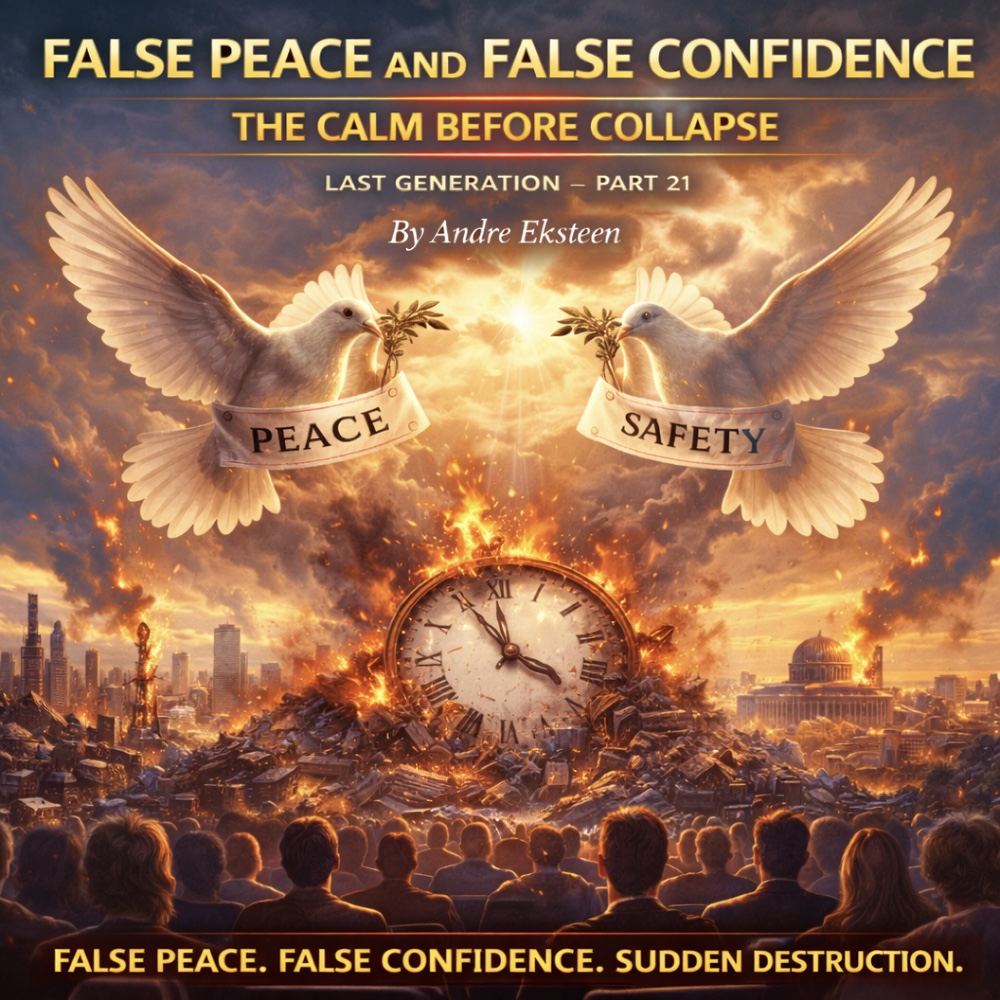
1 Thessalonians 5:3 — “For when they shall say, Peace and safety; then sudden destruction cometh upon them, as travail upon a woman with child; and they shall not escape.”
Read that verse carefully. It is not describing a general condition of human fragility. It is describing a specific moment — a moment characterised by a particular declaration. “Peace and safety.” The cry is specific. And what makes it dangerous is not that it is false on its face — it may represent a genuine resolution of tension, a real agreement between powers, an actual period of reduced conflict. What makes it dangerous is that it creates a confidence that is not warranted by the underlying structural realities. The destruction that follows is sudden. Not gradual. Sudden. Which means the people who said “peace and safety” were not simply wrong about a minor detail. They were catastrophically wrong about the fundamental condition of the world they were living in.
Now Paul gives you the image of labour pains — the woman with child. The destruction comes as labour comes on a pregnant woman. Now that image is doing specific work. Labour is not random. It follows a period of building pressure. The pregnancy has been progressing. The body has been preparing. And then, when the time comes, the contractions arrive — sudden, powerful, inescapable. The suddenness is not surprising to the person who understands the process. It is only surprising to the person who was not watching for it, who believed the relative calm of late pregnancy meant the delivery was still far away.
Now connect that to what we have been building across this series. The pressure has been building. The systems have been forming. The structural alignment we have been describing — Israel in the land, the Middle East as focal point, the energy control contests, the integration of global governance structures, the spiritual influence over nations — all of that represents the pregnancy progressing. The declaration of “peace and safety” is not the beginning of the process. It is the moment just before the delivery. And the person who has been watching — who knows the process, who has followed the progression — will not be caught off guard when the contractions begin. The person who only noticed the relative calm of late pregnancy and concluded everything was fine will be.
Historical Examples of False Peace
Before we look at the specific character of the false peace in the prophetic picture, let me establish the pattern from history — because false peace is not an abstract concept and understanding how it has operated in the past makes it easier to recognise in the future.
The clearest modern example is the period between the two World Wars, specifically the years from 1919 to 1938. The First World War ended with the Treaty of Versailles in 1919. The war had been catastrophic — seventeen million dead, four empires dissolved, the map of Europe redrawn. The relief was enormous. The desire to believe that the war had, as the phrase went, ended all wars, was so powerful that it shaped diplomatic decisions for twenty years. The League of Nations was established. Disarmament conferences were held. International agreements were signed. The sense that civilisation had passed through its worst moment and was now, finally, building toward a stable peace was widespread and deeply felt.
And it was false. The structural problems — the punitive terms of Versailles, the humiliation of Germany, the unresolved ethnic and territorial tensions across Central Europe, the economic catastrophe of the Great Depression, the rise of authoritarian nationalism — were not resolved by the agreements. They were covered. And when Hitler came to power and began systematically dismantling the post-Versailles order, the response of Britain and France was not resistance. It was accommodation. The Munich Agreement of 1938 — in which Britain and France allowed Germany to annex the Sudetenland in exchange for Hitler’s promise to seek no further territorial changes — was greeted with relief across Europe. Chamberlain returned to London declaring “peace for our time.” Within a year, Germany had invaded Poland and the Second World War had begun.
The “peace for our time” declaration is one of the most historically instructive examples of Paul’s “peace and safety” pattern. The structural problems were real and building. The desire for peace was genuine and understandable. The agreement covered the surface tension temporarily. The confidence it produced lowered the discernment of those who should have been watching most carefully. And the sudden destruction — the outbreak of the most destructive war in human history — came at the moment of maximum perceived stability, not at the moment of maximum perceived danger.
Now apply that pattern forward. The specific prophetic false peace is bigger than Munich. It involves a covenant confirmed with many — a broad agreement across multiple parties in the most contested region on earth. The relief it produces will be proportional to the pressure it resolves. The confidence it generates will be enormous. And the watching person needs to know the pattern well enough that the relief does not override the structural analysis. The agreement is real. The peace is real as experience. The structural problems are still there. And the midpoint break — the abomination of desolation — will come as suddenly as the German panzer divisions rolled into Poland.
The parallel is not exact. The prophetic fulfillment will be on a different scale and with specific features the Munich analogy does not capture. But the mechanism is the same. Pressure produces a crisis of confidence. The crisis produces desperation for resolution. A resolution is offered and accepted. The resolution feels like peace. And then it breaks in a way that reveals it was never what it appeared to be.
The Church’s Specific Vulnerability to False Peace
Now let me address something that connects the false peace question directly back to the condition of the Church we discussed in Part 20 — specifically, the Church’s particular vulnerability to accepting false peace at the prophetic moment when it matters most.
The dominant end-times framework within evangelical Christianity — particularly the pre-tribulation rapture position — teaches that the Church will be removed from the earth before the tribulation begins. On this view, the false peace of Daniel 9:27 and the abomination of desolation that breaks it are events the Church will not be present to witness. The seven-year tribulation is Israel’s time. The Church watches from heaven. The watching posture Jesus described — “watch therefore” — is reinterpreted as watching for the rapture rather than watching through the tribulation.
Now I am not going to resolve the pre-tribulation rapture debate in this part, because it requires more careful treatment than is possible here and will be addressed in a later part of this series. But I want to make a specific point about how the pre-tribulation framework affects the Church’s posture toward the false peace question.
If you believe the Church will be removed before the tribulation, then the false peace, the abomination of desolation, and the great tribulation are not things you personally need to watch for. They are things you read about in prophecy books as events that will happen after you are gone. The watching posture is directed toward a different event — the rapture — rather than toward the unfolding sequence of events Jesus described in Matthew 24. And the specific alertness to false peace — to agreements that look like resolution but carry the character Daniel describes — is not part of your active watchfulness because you believe you will not be present when it matters.
The practical consequence of this is that the community most equipped with prophetic teaching — the evangelical and fundamentalist church — is largely trained to not watch for the specific signs that Jesus said the last generation would need to watch for. If the pre-tribulation position is correct, that is not a problem. But if it is not — if the Church is present through the tribulation, as the post-tribulation and mid-tribulation positions argue, and as a plain reading of Matthew 24 (which does not describe a pre-tribulation removal of the Church) seems to suggest — then the pre-tribulation framework has produced exactly the wrong posture for the moment that will matter most.
A community that has been taught it will be removed before the hard things begin is not positioned to watch carefully for the hard things. A community that has been told “peace and safety” is something the post-rapture world will be deceived by — not something it needs to be alert to — will not maintain the structural alertness that 1 Thessalonians 5 and Daniel 8 and 9 require. The framework has created, in practice, a community that is watching for the exit rather than watching through the sequence. And if the exit does not come when the framework predicts it — if the Church finds itself present in a world declaring peace and safety — the disorientation will be profound.
This is not a minor concern. It is one of the most practically significant implications of the framework critique this series has been making. The question of the rapture’s timing is not merely theological. It directly determines the posture of millions of people toward the specific sequence of events that defines the last generation. A community positioned to watch through the sequence will recognise the false peace for what it is. A community positioned to exit before the sequence will not be watching for it at all — and when it arrives, the disorientation of a failed expectation may be compounding at exactly the moment when clear-eyed watchfulness is most required.
That is why the framework matters. That is why the twenty parts of groundwork this series has built are not optional preparation before getting to the real content. The framework determines the posture. The posture determines what you see. And what you see — or fail to see — at the moment of the false peace will determine whether you are caught in the sudden destruction or whether you are watching, knowing the pattern, recognising the season, and holding fast to the faithfulness that the last generation will need above all other things.
What False Peace Actually Looks Like
Now let me be specific about the character of false peace, because “false peace” as a concept can be vague in ways that make it difficult to recognise in practice. What does it look like? What are its specific features? How do you distinguish it from real peace?
The first feature is that it is built on unresolved structural problems. Real peace — the kind that genuinely lasts — requires the resolution of the underlying tensions that generated the conflict. It requires that the parties involved have addressed not just the surface disagreement but the deeper incompatibilities of interest, ideology, or claim that produced it. False peace covers rather than resolves. It produces an agreement or a truce that manages the symptoms while the structural problems remain. And because the structural problems remain, the stability it produces is inherently temporary — the underlying pressure continues to build until the cover fails.
Applied to the current global situation: the pressures we have been describing — the contest for energy control, the regional competition in the Middle East, the rising China-US rivalry, the Israeli-Palestinian territorial and religious dispute, the Iran nuclear programme, the fracturing international order — none of these have structural resolutions available that are acceptable to all parties. Any “peace” that is achieved in that environment is achieved by managing the surface tension while the structural tensions remain. The agreement papers over the fault lines. It does not remove them.
The second feature of false peace is that it requires ongoing maintenance by the authority that brokered it. A genuine resolution between parties does not require continuous enforcement because the parties have genuinely reconciled their interests. A false peace requires a power structure capable of keeping the parties from returning to open conflict — a power that can impose the agreement, that has leverage over all the parties involved, and that can intervene when the surface tension threatens to break through the cover. The maintenance of false peace therefore concentrates power in the hands of the party or system that brokers and enforces it.
Now think about what that means in the end-time context. The peace that Daniel 8:25 describes — by which the final figure “shall destroy many” — is peace as a mechanism of control. The agreement is real enough to feel like peace. But the authority required to maintain it, and the price paid to secure it, involves a degree of submission to the broker’s power that goes beyond what genuine resolution would require. The peace is real as experience. It is false as structure. And the power that enforces it is accumulating leverage over the parties who depend on it for stability.
The third feature is that it creates a specific kind of confidence that lowers discernment. When people believe that peace has been achieved — when the immediate threat has receded, when the tension of the conflict period has been replaced by the relief of apparent resolution — they relax in ways that reduce their critical awareness. This is not a character failing. It is a human response to the removal of threat. When you are under pressure, your awareness is heightened. When the pressure eases, your awareness relaxes. False peace exploits that relaxation. It creates a window in which the structural changes that the false peace requires — the transfer of authority, the acceptance of new terms, the embedding of the enforcement mechanism — can be normalised before the people who would have resisted them in a high-pressure environment have time to recognise what is happening.
Daniel’s Picture of the Peace That Destroys
Now let us look at what Daniel actually says about the specific figure who uses peace as a weapon, because the passages are more specific than most treatments of false peace acknowledge.
Daniel 8:23-25 — “And in the latter time of their kingdom, when the transgressors are come to the full, a king of fierce countenance, and understanding dark sentences, shall stand up. And his power shall be mighty, but not by his own power: and he shall destroy wonderfully, and shall prosper, and practise, and shall destroy the mighty and the holy people. And through his policy also he shall cause craft to prosper; and he shall magnify himself in his heart, and by peace shall destroy many: he shall also stand up against the Prince of princes; but he shall be broken without hand.”
“By peace shall destroy many.” Not by obvious aggression. Not by open conquest. By peace — by a policy that presents itself as resolution, as stability, as the answer to the world’s problems. The craft that prospers — the deception, the cunning — is the mechanism through which the peace functions. The destruction is real but it is achieved through what looks like its opposite. And the victims are not only the mighty — the powerful who might be expected to resist. They include the holy people — those who should be the most aware, who have the Scripture, who know the pattern. Even they are destroyed by the peace.
Now Daniel 9:27 adds another dimension: “And he shall confirm the covenant with many for one week: and in the midst of the week he shall cause the sacrifice and the oblation to cease, and for the overspreading of abominations he shall make it desolate.” The covenant is confirmed with many — a broad agreement, involving multiple parties, that establishes a framework of peace. And it holds for a time. The stability is real enough that sacrifice has been reinstated in the holy place and is ongoing. Then, at the midpoint, the agreement is broken. The abomination of desolation is set up. The false peace revealed as what it always was.
Now this is the specific prophetic picture that Paul is referencing in 1 Thessalonians 5:3. The “peace and safety” cry corresponds to the period of the confirmed covenant — the period in which the agreement appears to be holding, in which the stability feels genuine, in which the most alert observers might be tempted to believe that things are, perhaps, settling. And it is precisely at that moment that the sudden destruction arrives. Not after an obvious period of declining stability. After the confident declaration that peace has been secured.
What the Watching Posture Looks Like Here
Now let me connect this back to the posture this series has been building, because the practical question is: how do you watch for false peace without being either paranoid about every diplomatic development or so conditioned to suspicion that you cannot recognise genuine positive developments when they occur?
The answer is structural. You are not watching for peace as an event. You are watching for the specific character of the peace — whether it resolves structural problems or covers them, whether it concentrates power in an enforcement mechanism or distributes it, whether it requires ongoing submission to a central authority as the price of stability, and whether the terms of it are accepted with the kind of desperation that bypasses discernment.
Genuine peace between genuine parties who have genuinely reconciled their differences does not require vigilance to resist. It is not a trap. But peace that is brokered under conditions of exhaustion and desperation, that requires ongoing enforcement by a power that has accumulated leverage through the crisis that made peace necessary, that comes with terms that would have been rejected if offered in calmer times — that peace deserves the kind of careful, structural examination that the watching posture makes possible.
Now the last generation — the generation that sees all these things — will live through a period in which the distinction between genuine resolution and false peace becomes the most practically urgent question in the world. Because the false peace that precedes the abomination of desolation is the last point at which the watching person can be caught off guard. After it breaks — after the covenant is violated, after the abomination is set up, after the great tribulation begins — there is no more ambiguity. The watching person will know exactly what is happening. The difficulty is the period before that breaking, when the peace is in place and the pressure to believe in it is enormous.
That is why Jesus warned about deception first. That is why Daniel said “by peace shall destroy many.” That is why Paul said “when they shall say, Peace and safety.” The warning is for the moment that looks safe. For the moment when the pressure has apparently resolved and the watching posture is hardest to maintain. For the moment when being the person who still sees the structural problems looks like unnecessarily dark thinking in a world that has apparently found its way to stability.
The last generation will need to hold the watching posture through exactly that moment. And the preparation for it is what this series has been building — a framework clear enough and grounded enough to survive the pressure of apparent peace, and a posture patient enough to keep watching even when the world says the danger has passed.
Because when the world says peace and safety, that is not the signal to stand down. It is the signal to watch most carefully. The labour pain is coming. The contractions are building. And the person who knows the process — who has followed the sequence, who understands the mechanism of false peace, who has not allowed the appearance of stability to override the structural analysis — will not be caught unaware by what comes next.
That person will know. Not because they calculated it. Because they were watching. And watching, when the peace is announced, is the hardest and most necessary thing a person can do. It is what this series has been building toward. Not panic. Not calculations. Watching. With eyes open and framework clear, through the peace that precedes the destruction, all the way to the morning that follows it.