From Genesis to Revelation: The One Story – The Golden Thread that Explains Everything – Part 21
By Andre Eksteen
As we saw in Part 20, the world began to believe that God had forgotten them.
Israel prayed and heard nothing.
Rome believed it was the crown of civilisation.
Greece deified its wisdom.
And in that silence, the old powers moved again — not with noise, but through thinking, culture, and people.
When God is silent, the enemy keeps talking.
The world made new gods, but they were the same old faces.
Greece raised them to legends — half-gods, half-men, mortals who ascended to heaven.
The world calls it “mythology”, but it was the revival of the spirits of the Nephilim — the fallen beings from before the Flood who now ruled under new names.
Enoch says: “They descended upon the earth and gave their names to men.” (Enoch 6:7)
Those names did not disappear; they only changed.
The Greek gods were not fantasy; they were memories.
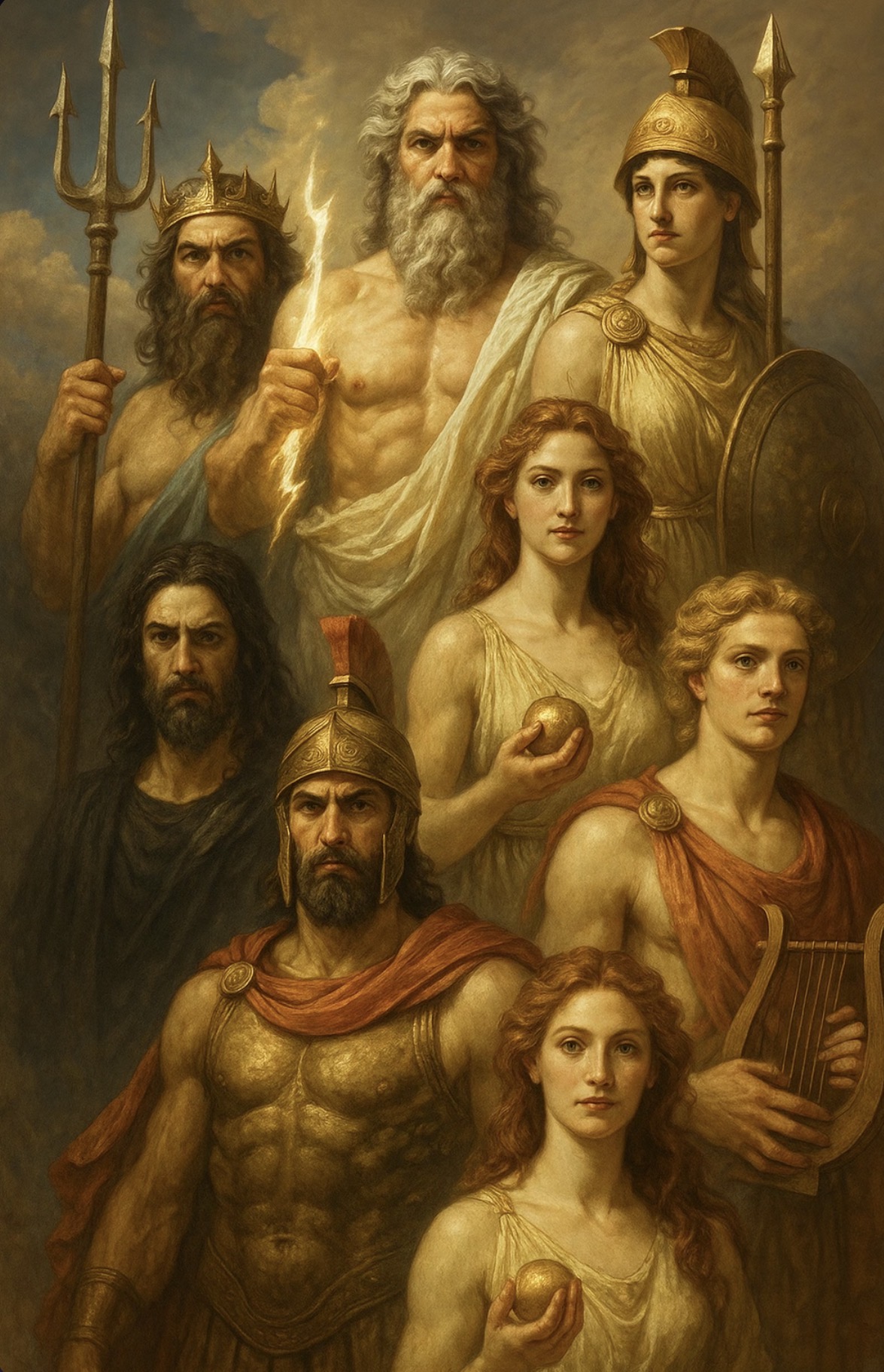
Zeus, Poseidon, Hades, Apollo, Athena — each a different face of the same powers.
Jealous, proud, lustful — human, yet with supernatural power.
Because that is exactly what they were: the spirits of the giant race whose flesh God destroyed, but who continued to be worshipped in spirit.
Those spirits did not only reappear in Greece. They received names among every people and nation.
In Egypt they were Osiris, Isis, and Ra. In Mesopotamia, Enlil, Inanna, and Marduk. In Canaan, Baal and Asherah.
In Africa they appeared as ancestral spirits; among the American Indians as beings from the stars.
Always the same message: “Worship us, and we will give you wisdom.”
It is always the same story — just different names. From the Shinto gods of Japan to the Zulu water spirits, from Quetzalcoatl to Odin — all carry the same pattern of rebellion against the Creator.
It is the legacy of Hermon: one rebellion, many names.
The world forgot that God destroyed their bodies, and now they built altars again — not of stone, but of screens.
Not in temples, but in homes.
Not with incense, but with light and sound.
The spirits of the Nephilim are not dead.
They wander between worlds — half heavenly, half human — and they thirst for worship.
And humanity gives it to them.
Look at today: the gods of old have new platforms.
They no longer appear on mountains — they appear on screens.
They no longer preach through priests — they preach through actors, singers, and “influencers”.
This is not mythology; it is marketing.
The same spirits, new masks.
People say it is just entertainment.
But look closely: every story where man becomes his own god, every hero who creates his own destiny, every power used without God, is the same old voice that spoke in Eden: “You shall be as gods.”
Superheroes, comic figures, “iconic” characters — modern faces of ancient beings still seeking worship.
They are always half human, half something else. It is Enoch, just with better graphics.
The world calls it games.
God calls it idolatry.
Every time someone gives their time, attention, or passion to something that is not holy, they bring an offering — not on stone, but on the altar of their attention.
And there these spirits find life again.
Look at the younger generations.
They know the world, but not God.
They quote films, not Scripture.
They wear crosses, but do not understand the blood.
They play games where demons are heroes and fallen angels are celebrated.
This is not fantasy; it is preparation.
These are the same spirits shaping human thinking — just as in Babel — turning sin into style and rebellion into art.
Zeus and Apollo live on in superheroes and galaxies.
Ishtar lives on in the world’s obsession with beauty and self.
Hermes lives on in the spirit of speed and profit.
Molech lives on in every society that justifies child sacrifice under new names — “freedom”, “choice”, “progress”.
The world calls it modern.
Heaven calls it repetition.
The same spirits who swore their oath at Hermon walk the streets today — just better dressed and better paid.
They sit in music, ideology, politics, and in churches that no longer believe in the supernatural.
The greatest deception of our time is to think these things are harmless.
The world laughs at the idea of demons, yet buys their products, sings their songs, and lives their ideas.
Technology has advanced, but the soul has grown dull.
The light of knowledge burns, but the world is blind.
And the danger is within.
In hearts, families, and churches.
They give people dreams and desires and make them believe these are their own choices.
Paul warns: “Satan himself transforms himself into an angel of light.” (2 Corinthians 11:14)
This is today’s reality — darkness calling itself light, and people cheering.
God foretold it long ago.
“For three unclean spirits go out to the kings of the earth to gather them for the war of the great day of God.” (Revelation 16:14)
They are not on their way; they are here.
The earth is being prepared for the final war, and humanity is helping to build it — with time, money, and attention.
As in the days of Noah.
People think they are playing, but they are being possessed.
They think they are watching, but they are being shaped.
They think they are choosing, but they are being chosen.
And through these “innocent” things, the spirits gain bodies again — through people who open themselves out of curiosity.
They were in Eden, Hermon, Babel, Egypt, Rome — and they are here again.
They know their time is short, and so they work quickly.
When the Light of the Second Coming breaks, their voices will fall silent.
The myths of the ancient world fit perfectly with the Bible’s description of the pre-Flood world.
The Titan wars of the Greeks, the heroes of Homer — that is Genesis 6 in different words.
The world forgot; the spirits remembered.
They wanted to be worshipped again, and people gave it to them — in art, song, and thought.
Then came Rome.
They inherited Greece’s gods, but worshipped power.
Zeus became Jupiter, Ares became Mars, Aphrodite became Venus.
“What the Gentiles sacrifice, they sacrifice to devils, and not to God.” (1 Corinthians 10:20)
Rome united the world, but it was not God’s unity; it was Babel again.
One language, one law, one emperor.
The emperor called himself “son of the gods”, and people bowed.
The old spirit of self-deification took flesh again — not in giants, but in kings.
That world looks like ours.
Peace through power, wisdom without God, religion without Spirit.
The names changed, not the pattern.
But God was still working.
His silence was strategy.
While the princes built their thrones, He completed His plan.
Rome’s roads would become the routes of the Gospel.
Greece’s language would become the language of the New Testament.
Even the enemy’s work served God’s purpose.
The world thought heaven was closed.
Heaven was only waiting.
Everything fell into alignment — the promises from Abraham to David to a simple house in Nazareth.
Not in Jerusalem, but in the shadow of Galilee.
“Can anything good come out of Nazareth?” (John 1:46)
That is what they believed.
But it was precisely there that God placed His final link — the womb through which His Word would become flesh.
Galilee was a mixture of peoples — Romans, Greeks, Jews, Arameans.
The priests in Jerusalem saw it as unclean.
God chose what people despised.
In a world of marble, He chose clay.
In a time of emperors, He chose a girl.
Mary was probably sixteen.
A quiet girl who went to fetch water and knew the Scriptures.
Betrothed to Joseph, a carpenter from the line of David.
No one would have looked at them — and that is why God did.
She knew the prophecy of Isaiah: “The virgin shall conceive and bear a son, and shall call his name Immanuel.” (Isaiah 7:14)
She never thought it applied to her.
But that is how God works — He chooses what is quiet and small.
While Rome paraded and philosophers spoke, God held His hand over Galilee.
The time was fulfilled.
The Light began to take shape in a girl’s womb.
“But when the fullness of the time had come, God sent forth His Son, born of a woman.” (Galatians 4:4)
Not earlier. Not later.
The world was ready.
Even the enemy’s system would carry His plan.
In Nazareth, a girl prayed.
She did not know heaven was listening.
She simply believed.
And that is always where God begins — with obedience.
The One who left heaven was on His way to enter the world through flesh.
The war that began in Eden would continue in a womb.
Mary.
Not divine. Not perfect.
Just available.
God did not seek a queen. He chose a servant.
And through her would come the King of kings.
The silence is almost over.
Heaven is ready to speak again.
Not through fire or thunder, but through a voice that says:
“Fear not, Mary, for you have found favour with God.”
In Part 22, that voice will be heard.
Heaven will speak, and the Golden Thread will become flesh.
But for now, the truth is simple:
when God is silent, He is still working.
When people believe He is gone, He comes nearer.
And in the darkness of Nazareth, the Light had already begun to shine.