
Jesus Is Not the Crimson Worm — and Why I Can No Longer Stay Quiet About It
I have heard the story of the crimson worm more times than I can count. I have read it in devotionals, heard it preached from pulpits, seen it shared online as “deep hidden revelation,” and spoken face to face with sincere, well-meaning believers who accept it as unquestionable biblical fact. For many of them, it has become so woven into their understanding of Scripture that questioning it feels, emotionally, like questioning Christ Himself. And that, more than anything else, is why I feel compelled to write this.
Not because I enjoy correcting people. Not because I think I stand above others. And certainly not because I believe the Church is beyond hope. I am writing because when something that is not written as fact in Scripture is repeatedly taught as fact, and worse, defended as ancient tradition, the damage does not remain local. It spreads. It reshapes how people read the Bible, how they understand prophecy, and ultimately how they see Christ.
I have reached the point where I can no longer treat this as a harmless sermon illustration.
Because it isn’t.
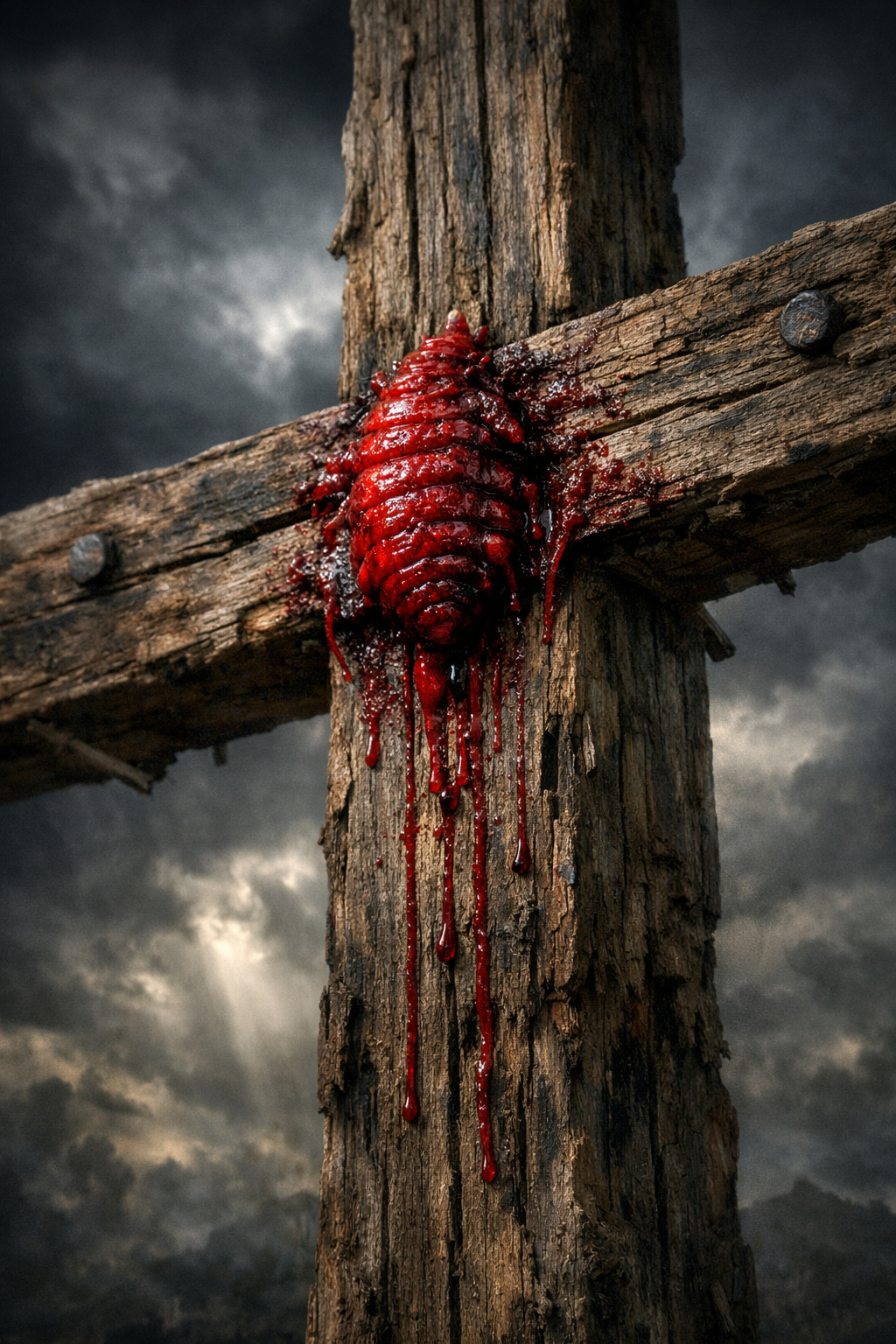
The image of the crimson worm is now regularly presented not merely as a metaphor for humility or suffering, but as a direct prophetic picture of Jesus Himself, complete with detailed claims about the worm’s biology, its attachment to wood, its blood staining the surface beneath it, and a supposed transformation after three days. These claims are often delivered with confidence, emotion, and spiritual authority, as though they are part of the biblical record.
They are not.
And the problem is not simply that the claims are exaggerated or poorly sourced. The real problem is what happens once the Church becomes comfortable turning metaphor into prophecy, poetry into biology, and illustration into revelation.
Because once that line is crossed, nothing in Scripture remains anchored.
Let us start where Scripture actually starts.
When David writes in Psalm 22, “I am a worm, and no man,” he is not inserting hidden zoology into the text, nor is he encoding a future sermon illustration waiting to be uncovered. He is doing what Hebrew poetry has always done: pushing language to its absolute limit in order to express humiliation so complete that it strips him of human dignity.
A worm is beneath notice. Beneath honour. Beneath value. It is something stepped on without thought. David is saying, in the strongest possible language available to him, that he has been reduced to nothing in the eyes of men.
Psalm 22 is not gentle. It is not comforting. It is not abstract. It is violent, exposed, and humiliating. It speaks of mockery, public scorn, physical agony, enemies encircling, bones pulled apart, hands and feet pierced, and garments divided by casting lots. This is execution language, not reflection language.
And this psalm does not need help.
When Jesus quotes the opening line of Psalm 22 from the cross — “My God, My God, why hast Thou forsaken Me?” — He is not expressing confusion or despair, nor is He searching for words in weakness. He is deliberately invoking the entire psalm, declaring that what was written there is now being fulfilled in Him.
The cross is not symbolic theatre.
It is not poetic suffering.
It is not metaphor.
It is judgment.
It is abandonment.
It is humiliation carried to its absolute limit.
The worm language exists to show how low Jesus went, not what He became.
For most of Church history, this was understood without controversy. The early Church did not feel the need to decorate the crucifixion or soften its edges. They preached Christ crucified, publicly executed, stripped naked, mocked by religious leaders, abandoned by His followers, and crushed under divine judgment.
That message was enough to turn the world upside down.
Because it did not appeal to comfort.
It did not appeal to self-esteem.
It did not appeal to emotional reassurance.
It demanded surrender.
But the Church did not remain in that posture forever.
As Christianity became culturally accepted and later culturally dominant, especially in the Western world, something subtle but deadly began to shift. The scandal of the cross faded into familiarity. What once horrified people into repentance became something expected, recognised, and eventually controlled.
By the middle of the twentieth century, particularly after the Second World War, the Church found itself no longer standing against culture, but comfortably inside it. Attendance grew. Buildings grew. Influence grew. And with that growth came a quiet but devastating question that reshaped preaching more than most people are willing to admit:
How do we keep people engaged when the message no longer unsettles them?
That question changed everything.
From roughly the 1950s onward, accelerating sharply through the 1960s and 1970s, preaching increasingly shifted from proclamation to presentation. Truth was no longer declared and left to confront; it was framed, shaped, softened, and packaged to ensure engagement. The unspoken question behind sermons quietly changed from “Is this true?” to “Will people stay?”
And this is where we have to be brutally honest about what really changed in the West during that period, because the crimson worm teaching did not arise in a vacuum. It arose in a world where God was quietly displaced and something else was given His seat.
When the earth was turned into a “mother”, and nature was elevated from creation to “revealer”, theology could no longer remain intact.
This shift did not happen overnight, and it was not announced from pulpits. It crept in through culture, education, and philosophy, and then filtered into the Church disguised as sensitivity, depth, and maturity. Creation was no longer seen primarily as fallen and cursed, groaning under judgment as Scripture describes it, but as inherently spiritual, wise, healing, and instructive. Nature became a teacher. Nature became a healer. Nature became a revealer of truth.
Meaning was no longer tested against revelation — it was drawn out of observation. “Mother Nature” became God in the minds of the populus.
Once that happens, Scripture is no longer the starting point; it becomes one voice among many. Redemption is no longer something God declares; it is something we “discover” reflected in natural cycles, life processes, and emotional parallels. And when that mindset takes hold, it becomes perfectly reasonable to search an insect’s life cycle for salvation meaning instead of bowing before the horror of the cross.
At the same time, suffering itself had to be re-framed.
After the trauma of world wars, genocide, and political upheaval, Western culture became deeply uncomfortable with violence, judgment, authority, and any form of imposed consequence. Pain could no longer be presented as confrontation; it had to be beautified. It had to be meaningful, gentle, redemptive in a way that did not accuse or demand repentance.
The biblical picture of suffering — judgment falling, blood being shed, sin being punished — became morally embarrassing. So suffering was softened. It was wrapped in symbolism. It was re-imagined as a tender, almost therapeutic process rather than a terrifying reckoning.
The cross stopped being an execution and became a story.
And once that happened, experience began to outweigh authority.
Truth was no longer something revealed by God and submitted to. It became something validated by how it made people feel. If a message felt moving, inspiring, or meaningful, it was treated as true — even if it could not be supported by the text itself. Objective claims were quietly pushed aside in favour of emotional resonance.
This is why people defend the crimson worm teaching so fiercely. Not because it is written, but because it feels right to them. It moves them. It makes the cross feel safe, understandable, and beautiful. And once feeling becomes the test of truth, Scripture has already lost its authority.
Finally, stories began to matter more than facts.
Narratives that “carry a message” became more important than declarations that demand submission. A good story was allowed to stand even if it was not true, as long as it conveyed a “spiritual lesson.” Facts became negotiable. Precision became optional. Accuracy became secondary to impact.
This is a fatal shift.
Because the Bible is not a collection of inspiring stories waiting to be re-imagined. It is a record of what God has done, is doing, and will do — whether we find it beautiful or not. It does not ask to be reshaped into something gentle. It demands to be believed as it is written.
The moment nature replaces God as revealer, the moment suffering is beautified instead of confronted, the moment experience outranks authority, and the moment stories are allowed to replace facts, the Bible is no longer read — it is reinterpreted.
And in that environment, the crimson worm does not look like error.
It looks inevitable.
That is why this issue cannot be brushed off as “just an illustration.” It is the fruit of a much deeper theological corruption, one where creation is allowed to speak louder than the Creator, and where symbolism is trusted more than revelation.
Once that door is open, everything follows — prophecy becomes metaphor, judgment becomes allegory, Revelation becomes political commentary, and Christ Himself becomes one image among many instead of the final, sufficient truth.
That is the world in which the crimson worm was born.
And that is why confronting it matters.
And that shift has consequences.
This is where Christ began to be replaced — not officially, not doctrinally on paper, but practically, in focus and function.
The raw weight of the cross became too heavy, too final, too demanding for audiences growing increasingly uncomfortable with sin, judgment, and surrender. So the message was adjusted — not rejected outright, but re-interpreted.
Blood became symbolic.
Judgment became metaphor.
Repentance became a journey.
Obedience became optional.
And once Scripture is treated that way in one place, it will be treated that way everywhere.
This is the environment in which the crimson worm was elevated.
Originally, the word in Psalm 22 was simply a word of humiliation. Nothing more. It was never presented as a prophetic stand-in for the Messiah. It was never treated as a biological revelation. It was never described as a secret code hidden in nature.
But modern preaching was no longer comfortable leaving Scripture raw and unresolved. It wanted beauty. It wanted sentiment. It wanted something emotionally compelling that could carry weight without demanding repentance.
So the worm was transformed.
It was no longer allowed to remain a word of disgrace. It became a centrepiece. A symbol. A replacement. The focus quietly shifted from the cross itself to an illustration that made the cross feel poetic instead of horrifying.
Jesus was no longer simply the suffering Messiah.
He became the worm in the telling.
And this is where the damage deepens.
Because many preachers do not stop at illustration. They go further. They confidently state that this interpretation is rooted in ancient Jewish tradition, that it appears in early Jewish literature, that rabbis taught it, that it was “well known” in biblical times.
That claim is a complete and utter lie.
There is no ancient Jewish source — none — that teaches the crimson worm as a Messianic prophecy. There is no rabbinical commentary, no Midrash, no Talmudic reference, no early Jewish tradition that connects the life cycle of a worm to the Messiah, the cross, or redemption. It does not exist. It never existed.
And this matters, because these claims are not presented as speculation. They are presented as authority.
People are told, explicitly, that “Jewish tradition teaches this,” that “ancient sources confirm this,” that this was part of the original understanding of Psalm 22. None of that is true. These statements are used to shut down questions and give emotional preaching a false historical weight.
Once you actually look, there is nothing there.
The Hebrew word in Psalm 22 was always understood as a metaphor for humiliation, insignificance, and disgrace. That is it. No secret biology. No three-day transformation. No redemption narrative hidden in nature.
Those additions appear nowhere in ancient literature because they are not ancient.
They are modern.
And once a preacher invents ancient authority where none exists, the issue is no longer style. It is integrity. Because at that point, people are not being taught Scripture; they are being manipulated into trust through false claims of historical backing.
This is precisely how confidence in the Bible is destroyed.
Because eventually someone checks. Eventually someone reads. Eventually someone realises that what they were told was “ancient tradition” is nowhere to be found. And when that happens, the damage rarely stays limited to one teaching.
People do not say, “That preacher was wrong.”
They say, “What else was I told that isn’t true?”
And that is where faith begins to fracture.
This is also why the damage spreads so easily into prophecy.
If a preacher can confidently invent ancient support for the crimson worm, then Daniel’s timelines can just as confidently be dismissed as symbolic. Revelation’s beasts can be reduced to political metaphors. Judgment can be reframed as poetic imagery. Blood can be turned into allegory.
And before you realise it, the Bible is no longer read as a record of what God has done and will do, but as a flexible spiritual narrative that means whatever the speaker needs it to mean.
Daniel stops being a precise prophetic roadmap and becomes a vague reflection on empire.
Revelation stops being a violent, terrifying, supernatural unveiling of real future events — war, blood, fire, beasts, destruction, judgment — and becomes a religiously dressed political science book.
And the same voices that insist the crimson worm teaching is “ancient” will tell you that taking Scripture literally is immature.
This is not maturity.
It is retreat.
The crimson worm teaching is not dangerous because it is poetic. It is dangerous because it trains people to accept extra-biblical claims as biblical fact. It teaches believers that emotional impact is equal to revelation, and that sincerity is equal to truth.
It trains people to stop asking, “Is this written?” and start asking, “Does this move me?”
And once that shift happens, Scripture no longer governs belief. The audience does.
This is why I confront the modern Church so often.
Not because I hate it.
Not because I despise pastors.
But because I care deeply about truth.
I have watched too many sincere believers lose confidence in Scripture when they discover that things they were taught as fact are not actually written. I have watched faith collapse not because Christ failed, but because people were sold stories that could not stand up to scrutiny.
And when that trust breaks, it rarely stops at one doctrine.
Jesus never needed a worm to explain His sacrifice.
The Son of God was stripped naked, nailed to wood, mocked, abandoned, and crushed under judgment. He bore sin. He bore wrath. He bore separation. He bore death.
That is enough.
It has always been enough.
The worm was never meant to be admired. It was meant to communicate degradation, not redemption. Scripture never tells us to fix our eyes on a creature. It tells us to fix our eyes on Christ.
And that is why I will continue to speak, confront, and refuse silence.
Because once Christ is no longer enough, something else will always take His place.
And that is how truth dies — not through open rebellion, but through decoration.
Christ is enough.
He always was.




Dankie André. Dit is so waar. Leraars of sogenaamde Herders vandag sal altyd n metafoor kies. Nie om Christus se doel te verduidelik nie maar om impak en naam vir hulleself te maak by mense.
So word Hy en die waarheid omvorm in n gemaklike teologie sodat almal gemaklik kan wees en steeds sal terugkom om wurmbrood te eet.
It is such a beautiful thing to read comments like yours. Your comment proves that there are still people out there who read, and understand what they read. While this article was placed to teach those who truly belief in God, it was also placed to teach those who pretend to believe in God a lesson. Let’s see what happens on Thursday. I deliberately published this article, and the one about Darwin, as a live test — especially the introduction I placed on Facebook.
The test was simple: would people actually read what was written before reacting?
Most didn’t.
They did not read through the introduction. They saw the image. They saw the heading. And then they attacked. Not because the facts were wrong. Not because the argument was flawed. But because they did not like how it made them feel.
Instead of engaging with the content, they responded to an impression. They reacted emotionally to a headline. They argued against points that were already clearly explained — things they would have understood if they had taken a moment to read.
This is the deeper issue. People are so far removed from God, and so wrapped up in their own self-importance, that they cannot remain silent long enough to consider whether there might be something to learn — especially about Him. The moment discomfort arises, the reaction is noise, not reflection.
And when God goes out the window, logic follows. You cannot remove the Author of truth and expect clear thinking to remain intact.
Society is not collapsing because it lacks information. It is collapsing because it refuses to think. We are drowning in data, yet starving for wisdom.
The comments since yesterday have already confirmed that point. On Thursday, I will explain why this happens and what it reveals about the state of modern thinking.