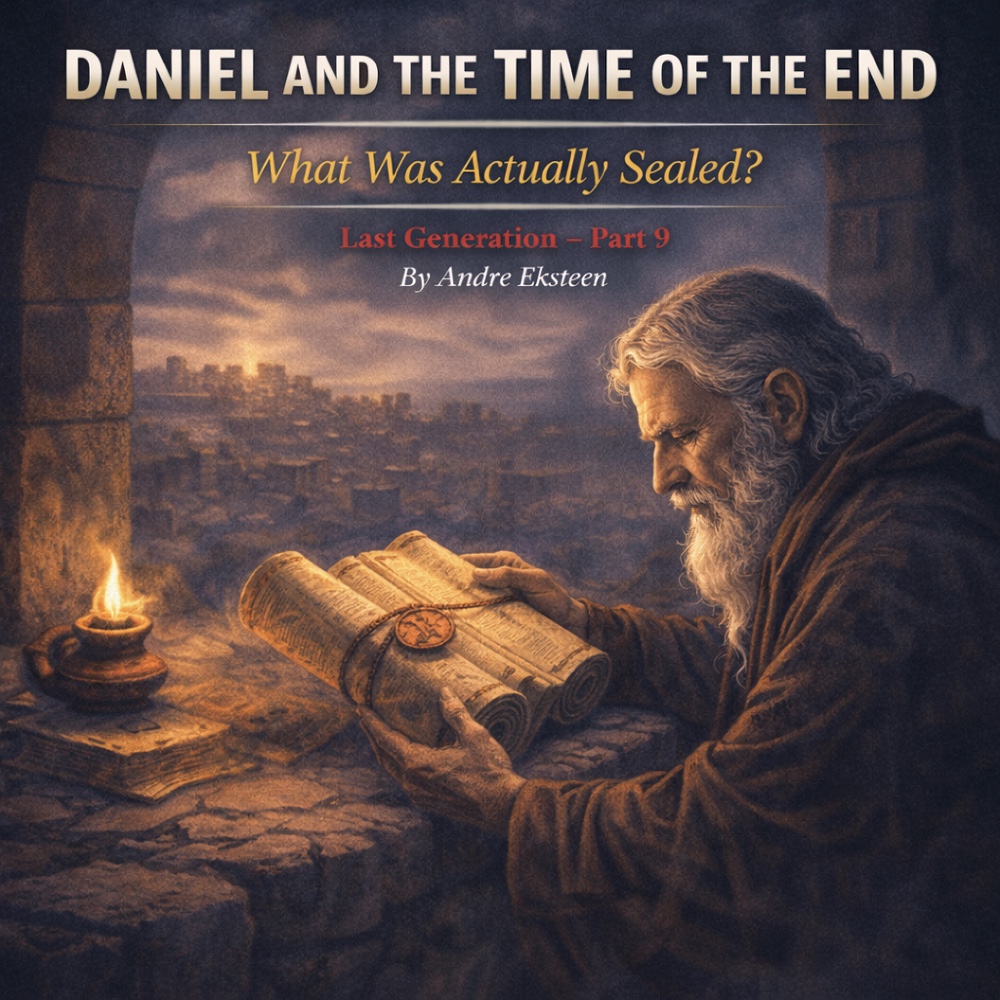
Daniel and the Time of the End: What Was Actually Sealed? – Last Generation Part 9
By Andre Eksteen
Before you can talk about the last generation with any real precision, you have to deal with something most people step over far too quickly. Daniel. Not the version people quote in support of their existing timelines. Not the system people have built around a handful of selected passages. The actual text, read in context, from the beginning, with the same careful attention we have given to everything else in this series. Because if you misunderstand what was sealed in Daniel, you will misunderstand what it means for anything to open. And if you get that wrong, the last generation question cannot be answered correctly — because the last generation is defined by witnessing “all these things,” and those things are inseparably connected to what Daniel was shown and told to close.
The standard approach to Daniel in popular end-times teaching is to treat it as a codebook. You extract the relevant numbers — the seventy weeks, the time, times, and half a time, the 1,290 days and the 1,335 days — and you run them through a calculation engine that produces a timeline. The numbers are real. They are in the text. But the way they get used — plugged into a predetermined system and made to produce specific dates — is not coming from the text. It is coming from the method applied to the text. And as we have established repeatedly in this series, a method applied to a text is not the same as a reading of the text.
So let us go back to what Daniel actually says about the nature of the book itself, what was sealed, what sealing means, and what the unsealing implies. Because until those questions are answered from the text, everything else built around Daniel is built on an assumption.
What the Sealing Actually Was
Daniel 12:4 — “But thou, O Daniel, shut up the words, and seal the book, even to the time of the end: many shall run to and fro, and knowledge shall be increased.” That is the instruction God gives Daniel. Shut up the words. Seal the book. Until a specific time — the time of the end. And in that time, something characterises the world: many running to and fro, knowledge increasing.
Now the first and most critical thing to establish is what the sealing actually refers to. Because most people, when they hear “seal the book,” imagine something physically hidden — a document locked in a vault, a text removed from circulation, something that was simply unavailable until the right moment. But that is not what happened. Daniel wrote. His visions were recorded. The book of Daniel was included in the Hebrew canon, copied and preserved by the same scribal tradition that preserved every other book of Scripture. It was read and studied and debated by Jewish scholars and later by Christian theologians across the centuries. The physical text was not hidden.
So what was sealed? Understanding. The sealing is not about physical access to words. It is about the comprehension of what those words mean. And the text itself supports this reading immediately. Look at what Daniel says about his own experience with the visions he received. Daniel 8:27 — “And I Daniel fainted, and was sick certain days; afterward I rose up, and did the king’s business; and I was astonished at the vision, but none understood it.” None understood it. Including Daniel himself. He received the vision. He recorded it faithfully. And he did not understand it. Daniel 12:8 — “And I heard, but I understood not: then said I, O my Lord, what shall be the end of these things?” Daniel asks directly for understanding, and the answer he receives is not a full explanation. It is a deferral: “Go thy way, Daniel: for the words are closed up and sealed till the time of the end” — Daniel 12:9.
Now sit with that. The prophet who received the visions, who wrote them down under divine instruction, who was described elsewhere as a man of exceptional understanding and wisdom — he did not understand what he had been shown. He asked for clarity and was told that the words were sealed until a future time. If Daniel could not fully understand his own visions, the assumption that later generations working from the same text have fully understood them is not warranted. What Daniel was told is clear: full understanding awaits a specific future moment. Until then, understanding is partial.
This is not an unusual pattern in Scripture. It is actually a consistent one. Peter says in 1 Peter 1:10-12 that the prophets who wrote about the grace that would come “searched diligently” to understand “what, or what manner of time the Spirit of Christ which was in them did signify” when it testified beforehand about Christ’s sufferings and the glory that would follow. They were writing things they did not fully understand. They were told that what they wrote was not for their own time but for a future generation. The visions were given, the words were recorded, and the full meaning was held in reserve.
What Sealing Does to Interpretation
Now here is where this becomes directly relevant to the state of end-times theology today. If the book of Daniel was sealed until the time of the end — meaning that full understanding was withheld until a specific future moment — then every interpretation of Daniel built before that moment was operating with incomplete information. Not necessarily false. Partial. Like someone working with a technical drawing where a portion of the detail is obscured. The visible parts can be read correctly. The obscured parts will be guessed at, filled in from surrounding context, or simply worked around. And different people looking at the same partially obscured drawing will fill in the gaps differently — which is exactly what we see in the history of Daniel interpretation.
The early church fathers read Daniel and applied it to the Roman empire. Medieval scholars applied it to the papacy. The Reformers applied it to various contemporary figures and powers. Dispensationalists in the nineteenth century developed the gap theory and the doctrine of a future seven-year tribulation based on a particular reading of the seventy weeks. Historicists read the same passages as spanning the entire church age. Preterists read most of it as having been fulfilled in the events of AD 70. These are not marginal disagreements about minor details. They are fundamental disagreements about the entire framework — disagreements produced by intelligent, serious, Scripture-engaged people reading the same text and arriving at radically different conclusions.
Now you could explain that diversity of interpretation by saying that some people are right and others are wrong, and the task is to identify which is which. That is a legitimate position. But it sits awkwardly against the text’s own statement that the book was sealed until the time of the end. If the sealing limited understanding until a specific moment, then the diversity of interpretation throughout history is at least partly explained by the fact that interpreters were working with a partially sealed text. They were reading accurately what was visible, and filling in the obscured parts with what seemed most consistent to them — but without the full picture that the unsealing would eventually provide.
This does not make all the historic interpretations equally wrong. Some of them captured real elements of the prophetic picture, even if they did not have the complete frame. But it does mean that no pre-unsealing interpretation should be treated as final. And it means that the test of whether any given interpretation is right is not whether it is internally consistent or whether it has a long tradition behind it. The test is whether it aligns with what the full picture, when the sealing is lifted, actually shows.
What the Time of the End Implies
Now let us look at the conditions Daniel 12 associates with the time of the end, because they have direct bearing on how you identify that moment. Verse 4 gives two characteristics: many running to and fro, and knowledge increasing. Verse 10 adds more: “Many shall be purified, and made white, and tried; but the wicked shall do wickedly: and none of the wicked shall understand; but the wise shall understand.”
Take the verse 4 characteristics first. “Many shall run to and fro, and knowledge shall be increased.” Now there is a debate among commentators about what “run to and fro” refers to. Some argue it is about travel — people physically moving around the world at speeds and in volumes unprecedented in history. Others argue it refers to searching through the text — running to and fro through Scripture looking for understanding, which was a common idiom in the ancient Near East for diligent study. Both readings are linguistically defensible. And it is worth noting that both are arguably true of the present age in ways that have no clear parallel in any previous period of history.
The knowledge increase is harder to restrict to a single meaning. At one level, the explosion of human knowledge in the modern era — scientific, technological, informational — is so dramatically beyond anything in previous history that it almost demands acknowledgment as at least partially relevant to this description. In two hundred years, humanity has moved from horse-drawn transport to space travel, from handwritten manuscripts to instant global communication, from limited literacy to near-universal access to more information than any individual can process in a lifetime. Whatever else that is, it is an increase in knowledge of a kind that has no historical precedent.
But the knowledge increase in context is almost certainly not primarily about scientific or technological knowledge. It is about understanding of the sealed book — the prophetic picture Daniel was shown. The implication is that at the time of the end, the visions Daniel received begin to become clear in a way they were not before. Not because the words change, but because the circumstances of the time provide the context within which what was previously obscure becomes intelligible. The events unfolding provide the frame within which the picture can finally be seen completely.
Now look at verse 10. “The wise shall understand.” Not everyone. Not all who read. The wise. Who are the wise? In the broader biblical context, wisdom is not primarily intellectual capacity. It is a quality of relationship with God — Proverbs 9:10, “The fear of the LORD is the beginning of wisdom.” The wise who understand are not necessarily the most educated or the most theologically sophisticated. They are the ones who approach the text with the right posture — fear of God, humility, genuine seeking, willingness to be corrected. They are the watchers. The ones Jesus described in Matthew 24 — those who know the sequence, who recognise the shape of what is coming, who will not be caught unaware when the season announces itself. And in contrast, “the wicked shall do wickedly: and none of the wicked shall understand.” Same text. Same world. Radically different comprehension. Not because the text is ambiguous but because understanding requires a posture that the wicked are unwilling or unable to assume.
The Seventy Weeks and the Common Misreading
Daniel 9 contains the prophecy of the seventy weeks, and it is one of the most debated passages in the entire Old Testament. It has been the foundation of more prophetic timelines than almost any other passage of Scripture, and it has been read in more different ways than almost any other passage of Scripture. Those two facts are related.
Daniel 9:24-27 — “Seventy weeks are determined upon thy people and upon thy holy city, to finish the transgression, and to make an end of sins, and to make reconciliation for iniquity, and to bring in everlasting righteousness, and to seal up the vision and prophecy, and to anoint the most Holy. Know therefore and understand, that from the going forth of the commandment to restore and to build Jerusalem unto the Messiah the Prince shall be seven weeks, and threescore and two weeks: the street shall be built again, and the wall, even in troublous times. And after threescore and two weeks shall Messiah be cut off, but not for himself: and the people of the prince that shall come shall destroy the city and the sanctuary; and the end thereof shall be with a flood, and unto the end of the war desolations are determined. And he shall confirm the covenant with many for one week: and in the midst of the week he shall cause the sacrifice and the oblation to cease, and for the overspreading of abominations he shall make it desolate, even until the consummation, and that determined shall be poured upon the desolate.”
Now I am not going to work through the full exegesis of this passage here, because it would require several articles of its own and it is not the primary focus of this part. What I want to establish is a specific methodological point. The most common popular reading of this passage — associated with dispensationalism — inserts a gap of unspecified length between the sixty-ninth and seventieth week, placing the seventieth week in the future as a seven-year tribulation period separated from the first sixty-nine weeks by the current church age. That gap is not stated in the text. It is inferred — based on the observation that the events described in verse 26 (the destruction of the city and sanctuary by “the people of the prince that shall come”) seem to describe events that happened in AD 70, after the Messiah was cut off, but before any fulfillment of what verse 27 describes.
The gap theory is not a reading of the text. It is an inference applied to the text to resolve an apparent chronological problem. Whether that inference is correct is a question I am not resolving in this part. What I am establishing is that it is an inference — and an inference made, largely, during the period when the book was still sealed. Which means it needs to be held loosely enough to be tested against what the unsealing eventually reveals, rather than defended as established doctrine simply because it has been taught consistently for a hundred and fifty years.
That same standard applies to every other framework built on Daniel — historicist, preterist, idealist, futurist. All of them captured something real. None of them should be treated as final while the question of the unsealing remains open.
Daniel’s Own Experience and What It Teaches
There is something in the personal dimension of Daniel’s experience that most systematic treatments of his prophecies skip over, and it is worth pausing on because it says something important about the nature of sealed understanding that no amount of textual analysis quite captures the same way.
Daniel was not a passive receiver of information. He was a man of prayer, of fasting, of prolonged seeking. Daniel 10 describes him mourning for three full weeks before the vision he receives in that chapter — no pleasant food, no meat, no wine, no anointing — and then a figure appears to him and tells him that from the first day Daniel set his heart to understand and to chasten himself before God, his words were heard. The understanding came in response to seeking. The angel who came to him in Daniel 9 — during Daniel’s great prayer of confession in which he identifies himself with Israel’s sin and pleads for mercy on behalf of the people — arrives “being caused to fly swiftly” and says, “I am now come forth to give thee skill and understanding… therefore understand the matter, and consider the vision” — Daniel 9:22-23.
Understanding, in Daniel’s case, is not a byproduct of intellectual study alone. It is a byproduct of seeking God with humility, with identification with his people’s condition, with honest confession, with fasting and mourning. He did not arrive at the visions by being the smartest person in the room. He arrived at them by being the most surrendered person in the room. And even then, the understanding was partial, given progressively, and explicitly held back at the end until the appointed time.
Now connect that to Daniel 12:10 — “the wise shall understand.” The wisdom that produces understanding of the sealed visions is not acquired by running more sophisticated calculations or building more elaborate charts. It is acquired by the same path Daniel modelled — humility before God, honest engagement with Scripture, willingness to receive correction, identification with the condition of God’s people, and persistent seeking. The person who brings that posture to the text in the time of the end will find the sealed things opening. The person who brings the confident certainty of a pre-formed system will find the words there but the understanding closed.
That is not a comfortable observation for anyone who has invested heavily in a particular framework. But it is the consistent pattern of how prophetic understanding works in Scripture. The disciples on the Emmaus road needed the full sweep of Moses and all the prophets opened to them before they could see what had happened. Daniel needed weeks of fasting and prayer before the understanding came. And in both cases, the understanding came not as a validation of existing frameworks but as a correction and completion of them.
The last generation — the one that sees all these things — will not see them clearly because they inherited the right system. They will see them clearly because they are watching with the right posture. Humble enough to follow the text where it leads. Persistent enough to keep seeking when the picture is not yet complete. And honest enough to hold their frameworks loosely enough for the text to correct them when correction is needed.
That is the foundation. And from it, we are now finally positioned to do what this series has been building toward from the beginning — to follow Daniel’s visions in detail, connect them to the sequence Jesus described, and ask honestly whether the pieces of “all these things” are now in view. Not as a calculation. As a recognition. The same kind of recognition the disciples had on the Emmaus road, when the burning in their hearts told them that something was opening that had been closed.
Where This Leaves Us
What Daniel 12 establishes, when read on its own terms, is this: there is a specific future time called “the time of the end” at which the understanding of Daniel’s visions becomes available in a way it has not been before. The conditions associated with that time include widespread movement and knowledge increase, a purification and testing of the faithful, and a clear division between those who understand and those who do not. The generation that lives in that time is the generation for which the sealed visions become readable.
Now connect that to Matthew 24. Jesus told His disciples that “this generation shall not pass, till all these things be fulfilled.” All these things includes the abomination of desolation — which Jesus specifically connects to Daniel, flagging it with “whoso readeth, let him understand.” The understanding of Daniel is therefore directly embedded in the sequence Jesus described. The generation that sees all these things is the generation for which the sealed book becomes open — because they cannot fully see all these things without the Daniel visions being clear.
That is a significant connection. It means the last generation is not just defined by being alive at a certain moment in history. It is defined by a moment when things sealed for centuries begin to become clear — when the prophetic picture assembles in a way it has not done before, when events provide the context that makes previously obscure visions intelligible, and when the wise, who are watching with the right posture, begin to understand in ways that previous generations could not.
Whether we are in that moment, approaching it, or still some distance from it is not something this series is forcing to a premature conclusion. What we are establishing is the principle: the last generation is the generation for which the sealed things open. And the opening is not announced by a headline. It is recognised by those who have followed the text carefully enough to see the shape of what has been described — and who have the humility to let the text correct their frameworks rather than defending frameworks against the text.
That is where the next part takes us. Directly into what was described in Daniel and how it connects to the sequence Jesus laid out. Step by step. No shortcuts.