Live the Golden Line – What Is Sin Really? Part 9
What Is Sin Really? By Andre Eksteen
In Part 8 we saw how forgiveness is not an option but a command — a spiritual law that either opens heaven to you or shuts it. But beneath the theme of forgiveness lies something deeper, something the modern church has long forgotten to teach: what sin truly is. Because you cannot know what forgiveness means if you do not first understand what you must be forgiven of.
The modern sermon – the softness that kills
The word “sin” has lost its weight. It has become a light joke — a trendy word without fear or reverence. People use it as a quip: “I’ve sinned, I’ve eaten too much,” or “we all make mistakes.” Even the church preaches it that way: sin is supposedly just being “naughty” — you say sorry, and it’s over.
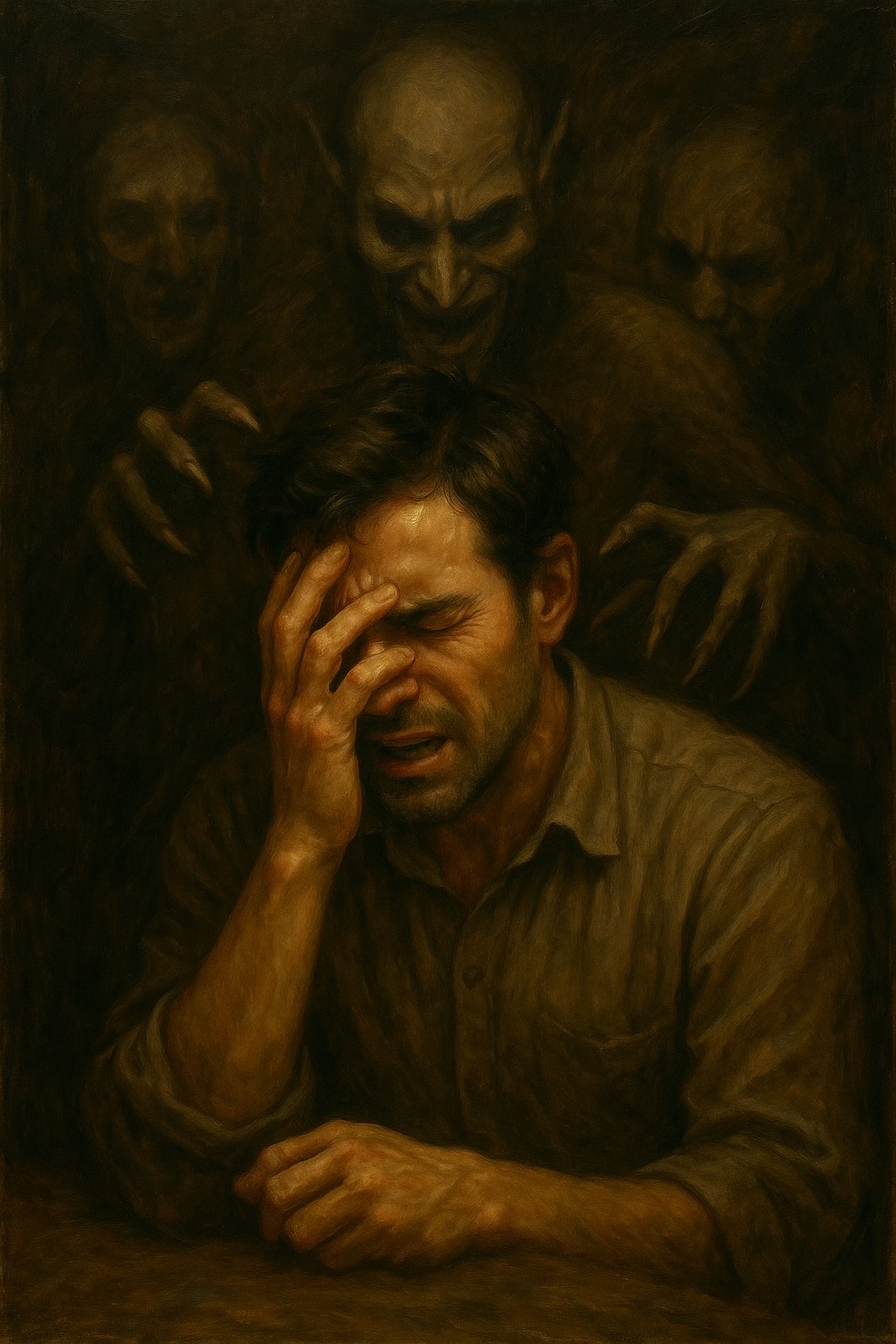
But that is not the Bible’s description. Sin is not behaviour — it is a spiritual disease. It is not merely what you do; it is what works through you. It is the visible result of invisible spirits that take control of people who bow to their influence.
Yet today we hear the softest message in the history of the church — a sermon that comforts millions but changes no one. And if you listen carefully, you hear the serpent himself speaking — the voice of deception that has always said:
“You shall surely not die.”
“Friends,” he whispers, “God understands. Don’t be so hard on yourself. He knows it’s not easy to do right. There’s no need for guilt — it only makes you sick. God wants you to be happy; He doesn’t look at your sins — He sees your beautiful heart.”
And people cry, they feel lighter, they believe they have found freedom.
But that is not the voice of Christ — it is the voice of sedation. It is the theology of comfort: a faith without repentance, a heaven without a cross, a Jesus without holiness.
This sermon has no power to break sin because it redefines sin as humanity. It comforts people in their rebellion. It is the most beautiful road to hell.
The origin of sin – pride in heaven
Sin did not begin on earth. It began in heaven — when one being, the most beautiful of them all, allowed something to grow in his heart that had never existed before. His name was Lucifer — the bearer of light.
He was created perfect: full of wisdom, full of music, full of glory. He was meant to reflect God’s light, but then he looked up at the throne he was meant to guard and said within himself:
“Why not me?”
Isaiah 14 says:
“I will ascend into heaven; I will exalt my throne above the stars of God… I will be like the Most High.”
Five times he says “I will.” Not “Thy will” — “I will.”
Not “Thy throne” — “my throne.”
And there, in that single thought, sin was born.
Not out of wickedness — out of pride.
Not out of violence — out of self-exaltation.
Lucifer did not want to destroy God; he wanted to share Him. He wanted God to share His glory with him.
And that is the essence of sin: to share in God’s glory without submitting to His holiness.
But God does not share His throne.
So when Lucifer said, “I will,” God said, “You will not.” And he was cast out of heaven.
This is why Jesus says:
“I beheld Satan as lightning fall from heaven.” (Luke 10:18)
Sin therefore did not begin with a murder or a lie — it began with self. Every sin afterwards is merely a repetition of that first “I.”
Man – God’s image, Satan’s target
When God created man, He gave him something no angel had ever possessed: His image. And along with that He said to man:
“Let them have dominion over the earth.” (Genesis 1:26)
God gave man what Lucifer tried to steal — authority.
He clothed clay with His breath, dust with His glory, and handed him the keys of the earth.
That is why Satan attacked Adam and Eve. Not out of revenge — out of jealousy. He could not reach God, so he targeted the image of God in man.
When he said to Eve:
“You shall be as gods,”
he transferred his own sin.
He did not sell a fruit — he sold pride. And she bought it.
But when Adam arrived, he knew what he was doing. Eve was deceived, but Adam chose.
And that is why Romans 5:12 says:
“Through one man sin entered into the world.”
When Adam obeyed his soul above God’s Spirit, the channel changed: the spirit of man fell silent, and the soul began to rule.
And from that moment, man became open to other influences — spirits that are not from God.
How sin works – through control, not behaviour
We wrestle not against flesh and blood, says Ephesians 6:12, but against principalities, powers, and evil spirits in the air.
Every sin has a spirit behind it.
That is why sin binds you — not because you are weak, but because you are under control.
When someone is full of hatred, the spirit of murder works through him. When someone lies, the “father of lies” speaks through him.
When someone is proud, the spirit of Lucifer himself works through him. When someone is addicted, he serves a spirit that controls him.
This is why Jesus did not only forgive people — He cast out demons. Because He knew: you cannot heal a spirit — you must cast it out.
The modern church no longer understands this. They give psychological names to spiritual diseases. They call rebellion “self-discovery.”
They call sin “human nature.”
They say “someone was born this way.”
But you cannot solve a demonic problem with medication.
Sin is a power, not a mistake.
It is a spirit that uses a person as an instrument. That is why Jesus said:
“Whosoever commits sin is the slave of sin.” (John 8:34)
How it works through man – body, soul and spirit
When God created man, He established an order:
the spirit should lead, the soul should follow, and the body should obey.
The spirit connects you to God.
The soul is your mind, will, and emotions.
The body is merely the container — the instrument.
But after the fall, the order reversed.
The soul became king, and the spirit fell silent.
Now man says: “I feel,” “I think,” “I want.”
It is the language of the soul — the same language as Lucifer: “I will.”
Every time you live from your soul instead of your spirit, you give permission for other spirits to work through you.
Because both God and Satan work through permission. God waits for surrender.
Satan waits for agreement.
He does not knock on your door with horns — he comes with a thought: “God understands.”
“You deserve better.”
“Do what makes you happy.” “You were born this way.”
And the moment you believe it, you open a door. You give him legal access to work through you.
Thus every sin begins — not with an action, but with a thought you choose to believe.
Sin is worship
Every time you give in to sin, you worship the spirit behind that sin. That is why Jesus says:
“No man can serve two masters.” (Matthew 6:24)
When you live in hatred, you worship the spirit of vengeance. When you live in pride, you worship the spirit of self-exaltation. When you live in lust, you worship the spirit of the flesh.
Sin is therefore worship — worship pointed in the wrong direction. It no longer points to God; it points to self.
God created man to bear His image.
Sin is the process by which that image is deformed until you begin to resemble the spirit working through you.
That is why Jesus said to the Pharisees:
“You are of your father the devil.” (John 8:44)
They were religious men — but the spirit that spoke through them betrayed God, just as the spirit that speaks through many so-called Christians today.
How forgiveness and sin are connected
Now we understand why forgiveness is so important.
When someone sins against you, it is not merely a person working against you — it is spirits working through that person.
When you forgive and hand the person over to God, you remove those spirits’ legal right to continue. You place the situation under God’s jurisdiction, and the Holy Spirit drives out the powers that caused the sin.
But forgiveness is not only for others — it is also for yourself.
For if you do not hand your own transgressions over to God and forgive yourself, He cannot forgive you either.
Jesus said:
“If you do not forgive, neither will your Father forgive you.” (Matthew 6:15)
That law applies not only to people against you, but also to the one within you — your own soul.
When you hate yourself for your failures, you hold that guilt like an anchor to your spirit.
God cannot remove it while you still cling to it.
Self-condemnation gives the same spirits a foothold as bitterness against others.
The spirit of guilt, shame, and self-hatred binds you with the same chains.
And that is why so many people pray for deliverance but never find peace — they forgave others, but not themselves.
Unforgiveness, whether against others or against yourself, is the chain sin uses to hold you.
Forgiveness breaks it, because it returns the matter — and yourself — to God.
When you say, “Lord, I give this person to You,” and then say, “Lord, I give my own guilt to You,” something supernatural happens: the Spirit of God fills the space where sin and self-reproach once lived.
Sin and unforgiveness always walk together — one keeps the door open for the other.
But when you choose to forgive, both others and yourself, you break the circle of control, and where sin once ruled, the Spirit establishes peace.
Sin – the system of this world
Sin is not only personal — it is a system.
There are princes over nations, says Daniel 10 — spiritual powers that influence whole peoples, steer ideologies, and drive people to do things against their own conscience. That is why certain sins dominate certain cultures — because every nation has a spirit that directs it.
We see this already at Babel, where mankind stood united against God, and also with the prince of Persia who resisted the angel of the Lord for twenty-one days. These spirits have always ruled over nations, each with its own domain and influence — from Babel to today.
These princes now control the media, politics, the economy — and even churches that no longer discern.
Sin is organised rebellion.
It is the kingdom of Satan working through people, in direct opposition to God’s Kingdom working through the Spirit.
And see how clever the enemy is — he has even convinced the church to admire the enemy.
They persuade the church never to warn against them, but to present them instead as “the ten kings” of Revelation — future men with influence, power, and charisma who will supposedly usher in the one-world system. Meanwhile, the princes carry on unhindered, and the world is too blind to see them.
Thus the church is prepared to receive the Beast — not through violence, but through expectation.
And who today is still bothered by a clown in a suit on a political throne? The church preaches about the ten kings that are to come, while the princes already ruling are laughing. They use the church’s own words to shield themselves. And the congregation, blinded by pretty sermons, does not see that the enemy is already inside the camp.
This is exactly how Satan wanted it: a world entertained by his servants, while the saints keep quiet in the name of peace.
The church, which was meant to be the prophetic voice, has become a singer in Pharaoh’s court.
And only the person who lives in the Spirit can see it.
Conclusion – The true definition of sin
So, what is sin really?
Sin is not merely doing wrong — it is being a channel through which the enemy works. Sin is the work of Satan through man.
Holiness is the work of God through man.
Every person carries something — either Light or Darkness.
Every thought, every word, every reaction shows who is working through you.
The world says: “Sin is humanity.” God says: “Sin is rebellion.”
But Christ came to break sin’s control over your life.
He cried: “It is finished!”
And with that He not only paid your debt — He gave you the right to be free again, to live again through the Spirit of God, as in the beginning.
Every day you make a choice: Light or Darkness. Choose to bear the Light, not the Darkness.
For when Light and Darkness are finally separated, it will not be about belief alone — it will reveal who lived by which spirit.
The time for compromise is over.
The Spirit is still calling, but the world is shouting louder. Choose now, while there is still Light.
Deep calls unto deep. Answer Him.