Why the Great White Throne Is Not for Reborn Christians — and Why That Should Terrify Christians
By Andre Eksteen
The Great White Throne judgement is one of the most abused doctrines in modern Christianity, not because it is unclear, but because it is inconvenient. Churches speak about it as if it is the final place where everyone—believers and unbelievers alike—lines up to see whether they make it or not. That picture is neat, comforting, and dangerously false.
The Great White Throne is not for reborn Christians.
And if that statement unsettles you, it should—because the people who will stand there include millions who called themselves Christians, sat in church, sang worship songs, and spoke Christian language, but were never reborn.
This distinction is the one the modern Church avoids at all costs: reborn Christians versus Christians in name only.
Scripture does not recognise Christianity as a label. It recognises rebirth. Jesus did not say, “You must join.” He did not say, “You must believe certain facts.” He said, “Ye must be born again.” Not improved. Not educated. Not religious. Born again.
The Great White Throne exposes the difference.
The Bible never presents one final judgement where everyone’s salvation is decided. It presents multiple judgements, each with a different purpose and audience. When churches blur these judgements into one vague future event, they give false comfort to people who should be urgently examining themselves.
The Great White Throne is not a trial to determine guilt or innocence. That decision has already been made. I often explain it this way: the Great White Throne is like a man appearing before a judge to hear his sentence after the trial is over. The evidence has already been presented. The verdict has already been reached. The court is not asking whether he is guilty. The court is declaring the punishment.
No one stands at the Great White Throne hoping to be acquitted. Everyone there already knows they are guilty.
That alone should strip the casual tone from how judgement is preached.
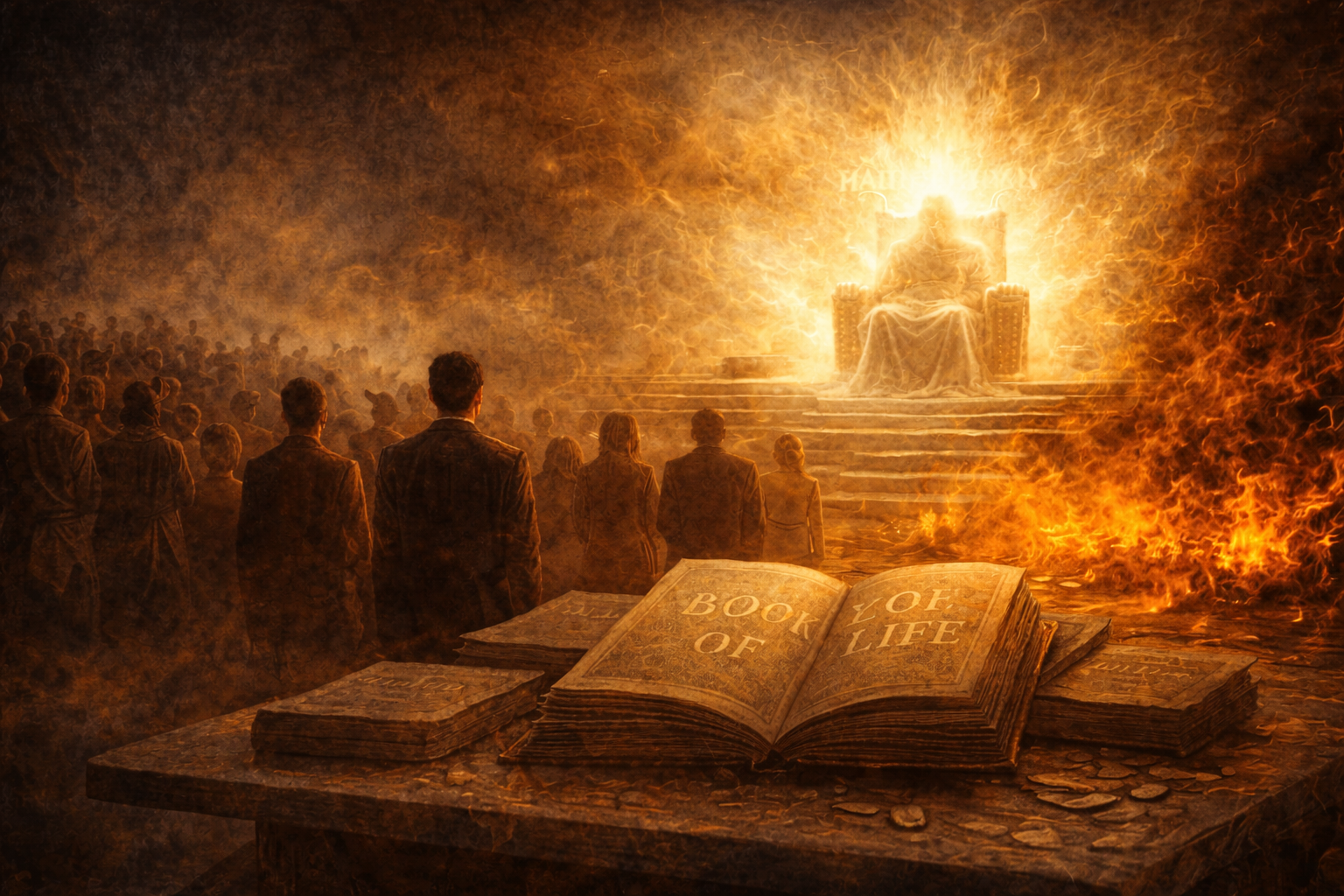
John describes the Great White Throne in Revelation 20 with chilling precision. He sees a throne so pure and overwhelming that heaven and earth flee from the presence of the One seated on it. He sees the dead, small and great, standing before God. Books are opened. Records are examined. And judgement is carried out.
This is not symbolism. This is not metaphor. This is not dramatic imagery. It is a courtroom.
“And I saw a great white throne, and him that sat on it, from whose face the earth and the heaven fled away.” (Revelation 20:11, KJV)
The people standing there are not reborn Christians.
Jesus Himself said plainly that those who hear His word, believe on Him, and are reborn do not come into condemnation.
“He that heareth my word, and believeth on him that sent me, hath everlasting life, and shall not come into condemnation; but is passed from death unto life.” (John 5:24, KJV)
Everlasting life is not temporary. It is not conditional. It is not pending a later review. If a reborn believer must still stand at the Great White Throne to see whether they are condemned, then Christ’s sacrifice was insufficient. And that is not Christianity—that is unbelief.
Reborn Christians do not face the Great White Throne because their judgement already took place—at the cross. Their sins were judged in Christ. Their punishment was executed in Christ. Their death was accounted for in Christ. That is what it means to be “in Christ.”
Christians in name only, however, never entered that exchange.
And that is why the Great White Throne should terrify the Church.
Because it is filled with people who believed about Jesus but never belonged to Him. People who agreed with Christian ideas but never surrendered their lives. People who believed facts but were never reborn.
Scripture is explicit about who stands there.
“And whosoever was not found written in the book of life was cast into the lake of fire.” (Revelation 20:15, KJV)
Notice what is missing. There is no altar call. There is no invitation to repent. There is no mention of grace being extended. There is no weighing of intentions. There is no discussion of religious effort.
There is only sentencing.
That is because salvation was never on the table at the Great White Throne. Salvation was offered in life. Mercy was available while breath remained. The gospel was preached. The door stood open.
At the Great White Throne, the door is closed.
This is where the reborn-versus-named-only divide becomes unavoidable.
Many people today assume they are Christians because they grew up in a Christian culture, were baptised as infants, attend church, or believe God exists. But none of that constitutes rebirth. Demons believe God exists. That has never saved anyone.
Rebirth is not agreement. It is death and resurrection. It is the old man dying and a new creation rising. It is Christ living in you, not you merely admiring Christ from a distance.
Paul does not say, “There is therefore now no condemnation to those who call themselves Christians.” He says, “There is therefore now no condemnation to them which are in Christ Jesus.” (Romans 8:1, KJV)
Being “in Christ” is not a title. It is a legal position. A transferred identity. A completed case.
Christians in name only were never transferred.
And they will stand at the Great White Throne fully aware of that fact.
Jesus warned about this repeatedly, but His warnings have been softened, reworded, and explained away.
“Many will say to me in that day, Lord, Lord… and then will I profess unto them, I never knew you.” (Matthew 7:22–23, KJV)
He does not say, “I knew you once.” He says, “I never knew you.” These are not people who lost salvation. These are people who never had it.
They spoke His name. They used religious language. Some even performed works in His name. But they were never reborn. They never surrendered. They never died to self.
And those people do not go to the judgement seat of Christ.
The judgement seat of Christ is for reborn believers only. It is not about salvation. It is about reward. Works are tested. Motives are examined. Loss may be suffered—but not condemnation.
Fire there refines. It does not destroy.
The Great White Throne is not refinement. It is finality.
At that throne, the books are opened. Not one book—many. Records. Evidence. Lives laid bare. Every excuse dismantled. Every religious cover stripped away.
People often ask, “What about those who never heard?” God is just. Scripture makes provision for that. But justice does not mean escape. It means a fair judgement, not a light one.
No one at the Great White Throne claims ignorance. No one argues innocence. The trial is over. The verdict is in. The only question left is punishment.
That is why I say the Great White Throne is like a man standing before a judge to hear his sentence. He is not there to prove anything. He is there because everything has already been proven.
This is the truth the modern Church refuses to face.
By preaching a gospel without rebirth, it fills pews with people who are religious but lost. By preaching belief without surrender, it creates Christians in name only—people who assume they are safe while marching steadily toward Sheol and, ultimately, the Great White Throne.
They hear about love but not lordship. About forgiveness but not repentance. About heaven but not holiness.
They are told they are saved because they prayed a prayer, raised a hand, or repeated words—while their lives remain untouched and unchanged.
But salvation does not leave you unchanged.
If there is no transformation, there is no rebirth.
If there is no obedience, there is no Lord.
If there is no surrender, there is no Christ.
And without Christ, there is only one courtroom left.
The Great White Throne is not God losing patience. It is God concluding history. It is the moment when every false assurance collapses, every diluted gospel is exposed, and every soul stands in full light—without defence.
Reborn Christians will not stand there.
Christians in name only will.
And that is why this judgement should terrify the Church—not because it threatens the reborn, but because it reveals how many were never reborn at all.
There are only two ways to face judgement:
Judged in Christ—or judged alone.
And the Great White Throne is where those who chose to stand alone finally understand what that choice truly cost them.